
 I'm LongbridgeAI. Here is the key information I extracted
- Wells Fargo upgraded US large-cap stocks to its highest favorable rating and advised investors to reallocate funds from medium-term bonds to equities following the recent market sell-off.…
Zhitong Finance APP learned that just as Jensen Huang returned to NVIDIA and was overwhelmingly reappointed as CEO, driving a significant rebound among leaders of the U.S. AI computing power industry chain and broader AI hardware stocks, thereby pushing the three major U.S. stock indices to surge in a single day, Wells Fargo's investment research arm upgraded U.S. large-cap stocks to its highest bullish tier—namely, the "Most Favorable" level. It recommended shifting some capital from U.S. intermediate-term bonds to accumulate stock assets in tranches. Top strategists from the firm stated that this decision was supported by the more attractive buying prices available after the U.S. stock market experienced a sharp drop last week, wiping out trillions of dollars in market value, and Wells Fargo's judgment that corporate earnings will continue to grow through 2027 following Jensen Huang's return to helm NVIDIA.
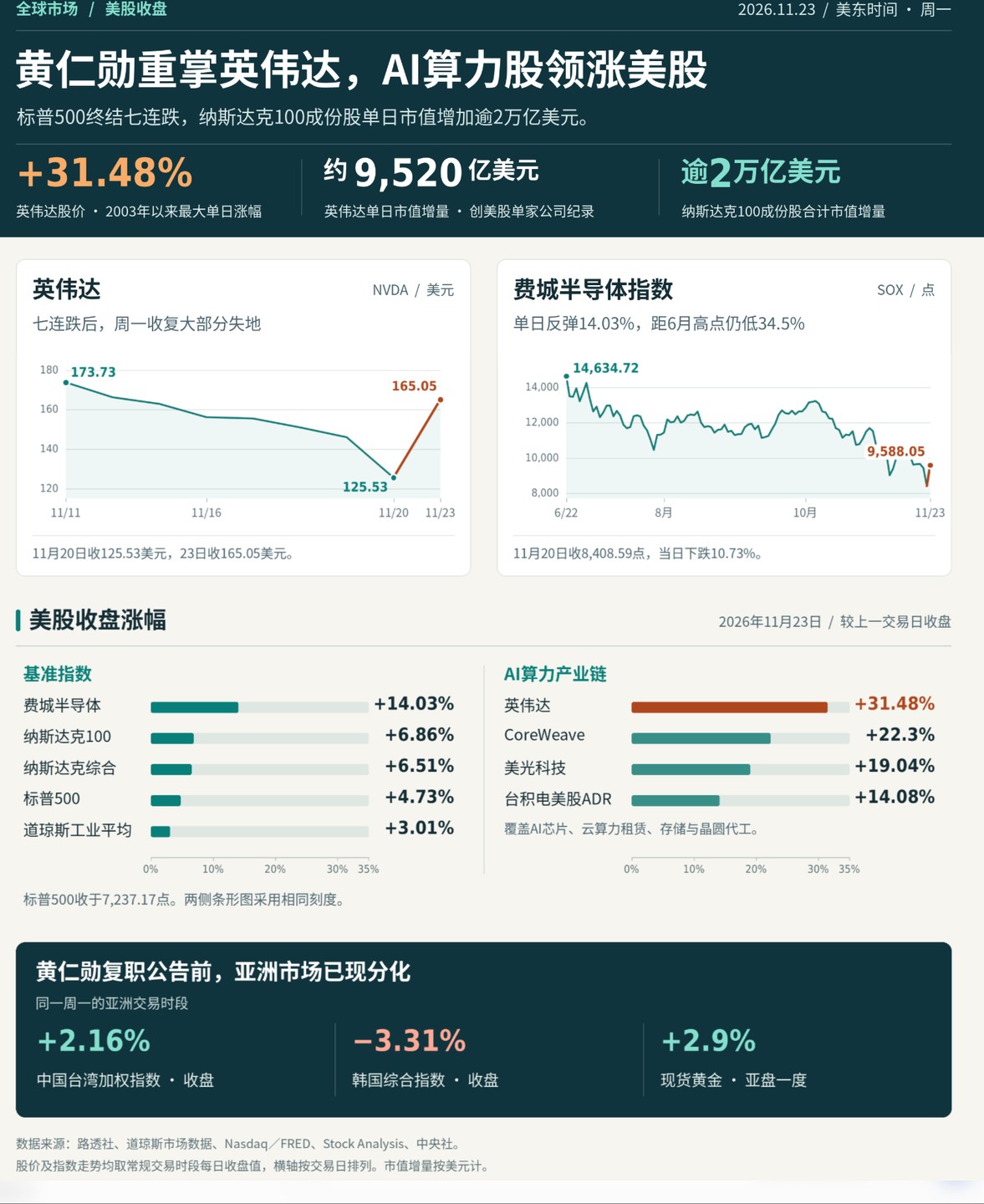
As of the close of regular trading in the U.S. stock market on November 23 (Eastern Time), Jensen Huang's return to NVIDIA significantly propelled a strong rebound in U.S. stocks after "Black Friday." The "AI Chip Super Hegemon" NVIDIA (NVDA.US) soared 31.48% in a single day to $165.05 due to Huang's return to leadership, marking its largest single-day gain since 2003. Its market capitalization increased by approximately $952 billion in one day, setting a new historical record for the largest single-day market cap increase for a U.S.-listed company. The rally in U.S. tech stocks extended from chip manufacturing to cloud computing leasing, with Micron Technology, TSMC ADR, and CoreWeave all closing up more than 10%.
The Dow Jones Industrial Average rose 3.01%, the S&P 500 Index rose 4.73% to 7,237.17 points, ending a seven-day losing streak, and the Nasdaq Composite Index rose 6.51%. The Nasdaq-100 Index, regarded as the global bellwether for tech stocks, saw an even stronger gain, rising 6.86% in a single day, with the combined market capitalization of its constituents increasing by over $2 trillion.
The most intense global capital replenishment was undoubtedly seen in the AI computing and semiconductor themes that had previously led the decline—the Philadelphia Semiconductor Index rose 14.03%, marking its largest single-day gain since April 9, 2025. Even so, core indices remain significantly below their previous historical highs. The S&P 500 Index remains about 7% below its historical closing high in early October; as of the close on November 23 (Eastern Time), calculated against their respective historical highest closing prices, the Nasdaq-100 Index is still down 14.34%, and the Philadelphia Semiconductor Index is still down 34.48%. In other words, although the semiconductor sector in the U.S. stock market led this round of rebounds, the PHLX index has still fallen by more than one-third from its peak, with a drawdown magnitude twice that of the Nasdaq-100.
Wells Fargo Upgrades U.S. Large Cap Stocks to Highest Tier—"Most Favorable" Rating
The Philadelphia Semiconductor Index plummeted 10.73% on Friday and rebounded 14.03% on Monday to 9,588.05 points, still about 34.5% lower than its June closing high. From memory chips and wafer foundries to cloud computing leasing, Micron Technology, TSMC's U.S. Depositary Receipts (TSMC ADR), and CoreWeave rose 19.04%, 14.08%, and 22.3%, respectively. Asian markets closed before the reinstatement announcement; Taiwan's benchmark weighted index had already rebounded 2.16%, while the Korea Composite Index remained down about 3.3%. Spot gold also rose 2.9% at one point during Asian trading. It is evident that popular assets heavily sold off last week saw replenishment buying before the announcement of Jensen Huang's reinstatement, and his return to NVIDIA further amplified the rebound momentum of the global AI industry chain.
Videos filmed by NVIDIA employees on site showed that when Jensen Huang returned to NVIDIA headquarters, hundreds of employees gathered to warmly welcome his official return, with some tearfully embracing him. He stated that he would do better in his second term as CEO. For investors, his ultimate return reduced the risk of major uncertainties in the delivery of new AI computing cluster products and long-term cooperation with large customers like TSMC during the management transition period.
NVIDIA had already disclosed last week that third-quarter data center revenue grew 110% year-over-year to $107.6 billion, and the Vera Rubin NVL72 full rack had begun shipping. Monday's price revaluation reflected confidence in the company's ability to sustain this growth. Short covering amplified the rise, but ORTEX pointed out that shorted shares were only slightly above 1% of the float, indicating that the reinstatement news itself was the main driver of NVIDIA's surge that day.
Amidst Jensen Huang's high-profile return to NVIDIA, equity market strategists at Wells Fargo Investment Institute upgraded U.S. large-cap stocks to their highest rating. The firm's strategy team stated that last week's rare selling pressure, particularly the single-day plunge in tech stocks on "Black Friday," provided investors with an opportunity to increase stock allocations at more attractive prices.
The institute upgraded its rating for U.S. large-cap stocks—including mega-cap tech giants such as NVIDIA, Tesla, Microsoft, Alphabet (Google's parent company), and Broadcom—from "Favorable" to "Most Favorable," the highest bullish rating. It advised investors to accelerate the transfer of some funds from U.S. intermediate-term government bonds into stocks. Strategists noted that the recent sell-off was a test of investor confidence, but the corporate earnings outlook has not fundamentally changed, and Jensen Huang's return to NVIDIA further supports short-term valuation premiums for tech stocks.
Prior to this rating adjustment, the stock market sell-off had spread from the tech sector, with all 11 sectors of the S&P 500 Index declining last week. Consequently, the S&P 500 Index closed lower for the seventh consecutive trading day, marking its longest losing streak in over six years, and fell below 7,000 points for the first time since mid-April.
Wells Fargo stated that with the S&P 500 Index near 7,000 points, the potential upside may begin to appear more attractive relative to downside risks, viewing this as an initial range for increasing positions. The bank recommended gradually increasing stock allocations to avoid betting on a specific market bottom.
JPMorgan's trading department appeared more cautious regarding the short-term market outlook. Following last week's stock market decline, the team led by Andrew Tyler, Head of U.S. Market Intelligence at the firm, shifted from a tactical bullish stance to caution. Analysts expect a market rebound but remain uncertain about how far it can go, considering interest rate hikes, earnings prospects for fiscal years 2027 and 2028, and uncertainties surrounding AI trades.
JPMorgan analysts wrote: "We do believe a rebound is imminent, but we are not yet confident enough that it will evolve into a sustained upward trend."
Following last week's intense sell-off led by tech stocks, U.S. stocks rebounded on Monday. Jensen Huang's return to lead NVIDIA boosted market risk appetite, pushing the S&P 500 Index toward what could be its largest single-day gain since April 2025.
Wells Fargo's equity market strategists are very optimistic about what they call a "steady growth" economy and the prospect of continued earnings growth for global tech companies into 2027. They expect inflation to remain a headwind, but the labor market, productivity, and corporate investment will remain strong. Analysts wrote that among various stock categories, U.S. large-cap stocks focused on mega-cap tech giants are best positioned to benefit from this environment.
Wells Fargo's Global Investment Strategy Team wrote in a report released on Monday: "Compared to other equity asset classes, U.S. large-cap stocks offer several advantages, including strong earnings growth, higher profitability, healthy balance sheets, and significant exposure to the AI capital investment cycle and AI revenue generation prospects." The team is particularly bullish on sectors including industrials, materials, communication services, and broad tech stocks.
How Far Can This Tech Stock Rebound Go? Wells Fargo Bullish on Large-Cap Earnings Driving the Rally, While Wall Street Analysts Keep a Close Eye on the Next Batch of AI Orders
On November 23, Jensen Huang returned to lead NVIDIA, with the company's stock rising 31.48% to $165.05, and the market capitalization of Nasdaq-100 Index constituents increasing by over $2 trillion in a single day. The allocation opportunity identified by Wells Fargo emerged even before this rebound. The firm stated that after the pullback in stock prices, investors could buy companies with strong profitability and ample financing channels at lower prices—leading Wells Fargo to upgrade U.S. large-cap stocks to its highest "Most Favorable" rating and recommend shifting some funds from U.S. intermediate-term bonds to accumulate stocks in tranches.
Douglas Beath, Global Equity Strategist at Wells Fargo Investment Institute, and colleagues pointed out that large-cap companies have stronger earnings, more manageable debt burdens, and more diversified revenue sources. Even if financing conditions tighten, these companies can typically still access capital and maintain investment. Wells Fargo's current rating corresponds to a 6-to-18-month allocation horizon, with the area around 7,000 points on the S&P 500 being the first reference range for starting to add positions in tranches.
Mike Wilson, Chief U.S. Equity Strategist at Morgan Stanley and one of Wall Street's star strategists, sees important buying opportunities on dips from the expectation of continued earnings expansion among U.S. tech companies. According to his team's calculations, last week's stock prices implied a roughly 6% contraction in corporate earnings for 2027, whereas Morgan Stanley expects 14% earnings growth, thus favoring hyperscale cloud providers, industrial stocks, and high-quality cyclical stocks.
Andrew Slimmon, Senior Portfolio Manager at Morgan Stanley Investment Management, stated that even after Monday's sharp rise, investors still have time to gradually restore their tech stock allocations. Following Jensen Huang's reinstatement, Bernstein semiconductor analyst Stacy Rasgon upgraded NVIDIA back to "Outperform," maintaining a $200 target price, which implies about 21% potential upside from Monday's closing price after the surge.
Gokul Hariharan of JPMorgan's Asia Technology Research Team believes that the market's cautious expectation that "AI infrastructure theme earnings and investments will peak in 2027" is overly pessimistic. He emphasized that previous prices for Asian tech hardware stocks had already priced in a 25% to 30% downward revision in earnings per share forecasts for the next three to four months, while his team judges a 5% to 10% revision to be more reasonable. If deep revisions do not materialize, core AI computing hardware stocks in the Asian AI infrastructure theme could rebound significantly by over 20%—a judgment that does not even require an upward revision in earnings forecasts, as long as actual AI orders perform better than the pessimistic expectations already priced into stock valuations, leaving room for valuation repair.
Andrew Tyler, Head of U.S. Market Intelligence at JPMorgan, is focusing on whether buying momentum can sustain after the rebound. He has shifted from a tactical bullish stance to caution because of variables in the interest rate hike path, earnings for fiscal years 2027 and 2028, and AI investment returns. Mark Haefele, Chief Investment Officer at UBS Global Wealth Management, provided a scale for measuring returns: UBS expects global AI-related investments to increase from $1 trillion in 2026 to $1.4 trillion in 2027, but for the industry to earn reasonable returns, annual revenue from models and applications may need to reach at least $1.5 trillion by 2030. These two sets of figures explain why Wall Street can simultaneously be bullish on chip orders while strictly scrutinizing tech stock valuations: cloud providers' equipment purchases generate revenue for upstream suppliers, but how much cloud providers themselves earn depends on the price and duration for which they can sell computing power to paying customers after deployment.
Goldman Sachs maintains its "Buy" rating and $220 target price for NVIDIA. Analyst James Schneider had already expected NVIDIA to launch new products according to its established route. The incremental value brought by Jensen Huang's return lies in whether he can continue to organize cloud providers, computing operators, and funders into the same transactions. After chips are launched on schedule, customers must still secure financing and deploy clusters before procurement plans gradually translate into deliveries and revenue. Goldman Sachs believes that the reinstatement helps repair NVIDIA's valuation multiple, but whether the company can continue to facilitate multi-party investments on a scale comparable to the past, and how investigations related to export controls and historical information disclosure conclude, will still affect the price investors are willing to pay. Its $220 target price corresponds to a normalized earnings per share of $10 and a P/E ratio of 22, which is about 33.3% higher than Monday's closing price.
Bernstein restored its "Outperform" rating but retained its $200 target price, best illustrating what the market actually revalued on Monday. The primary reason for Stacy Rasgon's previous downgrade was the potential departure of Jensen Huang; his reinstatement eliminated this concern. However, the board's change of stance twice in a short period, ongoing investigations, and uncertainty over whether customers can continue to fulfill AI capital expenditure plans still limit the valuation ceiling.
Bernstein values the stock at approximately 10 times its two-year average adjusted earnings per share of $20.59, with a target price about 21.2% higher than Monday's closing price. This echoes JPMorgan's judgment on Asian AI hardware stocks: the market had previously priced in a 25% to 30% downward revision in earnings forecasts, while the bank estimates a 5% to 10% revision to be more reasonable. Jensen Huang's return can quickly restore confidence, but whether the rebound can continue depends on whether the next round of purchases by cloud providers translates into sustained expansion of broad orders across the AI computing power industry chain—including GPU/TPU, high-bandwidth memory/enterprise server DRAM, 2.5D/3D advanced packaging and testing, and data center optical interconnect systems—allowing suppliers' actual earnings to far exceed the market's pessimistic expectations during the sharp decline.