
 I'm LongbridgeAI. Here is the key information I extracted
- Wall Street institutions remain cautious as ongoing investigations, corporate governance concerns, export controls, and questions about AI capital expenditure sustainability continue to weigh on the company.…
Zhitong Finance APP learned that the reinstatement of NVIDIA (NVDA.US) CEO Jensen Huang drove the stock to record the largest single-day market capitalization gain in U.S. stock market history on Monday, as investors regained optimism. However, multiple Wall Street investment banks and analysts warned in their latest reports that Huang's return has not dispelled all the uncertainties hanging over NVIDIA—investigations into his personal conduct are ongoing, while questions about corporate governance flaws, the outlook for its China business, and the sustainability of AI capital expenditures continue to constrain the chip giant's valuation.
On Monday, NVIDIA's stock staged a historic surge of over 31%, with its market capitalization skyrocketing by more than $952 billion, setting a record for the largest single-day market cap increase for any stock ever. Yet even after this explosive rally, the stock remains more than 30% below its early October highs. This contrast has become the core context for commentary from many Wall Street institutions: opinions are divided on whether a "surge shock" can truly reverse market sentiment.
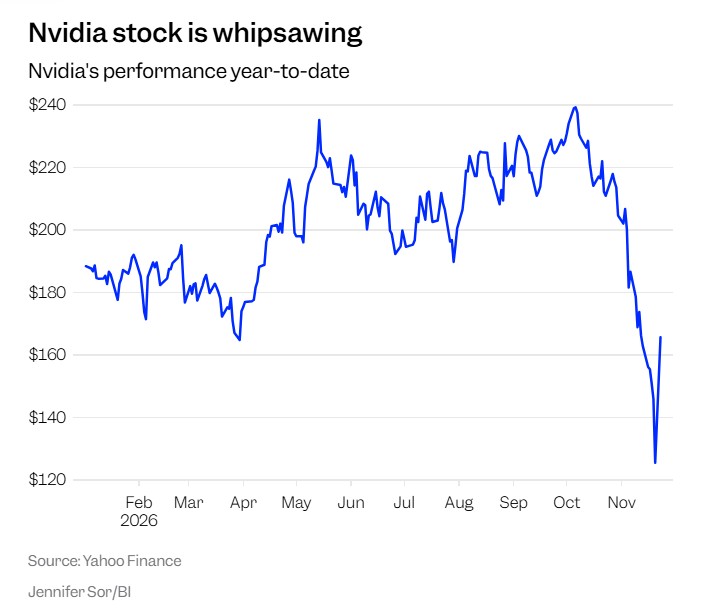
Bernstein: Upgrades Rating, but Criticizes Governance and Judgment Bluntly
In a report, Bernstein analysts led by Stacy A. Rasgon confirmed that NVIDIA's board unanimously voted to immediately reinstate Jensen Huang as President, CEO, and Director, with Harvey Jones continuing as Chairman. While an internal board investigation into Huang's recent conduct is still underway, the board believes his reinstatement is "in the best interests of shareholders, employees, partners, and customers."
However, Rasgon was quite sharp in his criticism of NVIDIA's corporate governance. The firm stated directly that despite Huang's return, there are still "some headwinds" that could limit the stock's upside potential—given his personal turmoil, the CEO's credibility remains in question, and weaknesses in NVIDIA's board and corporate governance have been "clearly exposed."
"Questions remain about Jensen Huang's judgment. We don't really care what he does in private, but he clearly associates with problematic companions from time to time, and his willingness to lie to the board and other key stakeholders concerns us," the firm wrote, adding that the relevant investigations are still ongoing.
Rasgon further criticized the board's flip-flopping: "While we are pleased to see Huang return, the board's vacillating attitude is, frankly, a 'farce'—just last week they firmly stated he was definitely out—which raises reasonable doubts about their judgment and decision-making process, and makes one wonder how their other important decisions are made." The firm also pointed out that investors remain concerned about the "achievability" of AI spending.
Bernstein upgraded NVIDIA's rating from "Market Perform" to "Outperform," but kept the target price unchanged at $200—a figure that was halved from the previous $400 last week following revelations of rumors regarding Huang's second extramarital affair.
Dan Ives: Target Price Lowered from $300 to $225
Even after Huang's return, prominent tech bull Dan Ives remains reserved about NVIDIA. The Senior Managing Director at Yorkville Ives reiterated his $225 target price for NVIDIA in a client note, down from the previous $300, while maintaining an "Outperform" rating.
"We maintain our 'Outperform' rating and $225 target price, rather than raising it directly to a 'Huang stays smoothly' scenario, because there are still several matters to be resolved: the independent committee's investigation is ongoing, government inquiries which the company says it is cooperating with are still proceeding, and export control issues remain unresolved," Ives wrote, referring to NVIDIA's business in China.
He further explained: "Our analytical framework has not changed. The gap between $225 and $300 represents the value of 'Huang with clarified governance issues,' not the value of Huang alone."
Luke Lango: Merely an "Emotional Rebound"
Independent tech analyst Luke Lango was even more cautious, describing the stock price surge following Huang's return as "merely an emotional rebound, nothing more," arguing that the CEO's reinstatement does not alleviate market concerns about slowing AI capital expenditures.
"The bullish logic—that the 'NVIDIA Central Bank' is reopening taps and AI construction is proceeding as planned—is flawed," he wrote, suggesting that Huang is more likely to scale back trading activities after his return. "Emerging from a highly publicized scandal, he is unlikely to restart that machine."
In contrast, RBC analysts were more optimistic. The bank believes Huang's reinstatement strengthens the bullish case for NVIDIA, as it alleviates market concerns that his departure could trigger a talent exodus. "NVIDIA's business fundamentals remain strong," the bank stated, though analysts also expect investigations into export controls "and other issues" to continue.
Goldman Sachs: Maintains Buy, Target Price $220
Goldman Sachs maintained its "Buy" rating following the reinstatement news, setting a 12-month target price of $220, corresponding to 22 times its normalized earnings per share forecast of $10.00.
Goldman Sachs believes that Huang's vision, influence, and ability to integrate external resources have always been crucial to NVIDIA and the entire AI industry chain. His return will largely reinforce the company's existing culture, and the company is expected to continue advancing according to its established product roadmap.
However, on the regulatory front, Goldman Sachs noted that the U.S. Department of Justice is investigating whether NVIDIA violated export controls by shipping to regions including Singapore through certain customers, and that the SEC's investigation into the company's past disclosures is reportedly ongoing. These investigations may continue to weigh on the stock price until conclusions are reached or the company discloses more information.
Goldman Sachs expects a re-rating of valuation multiples, but the impact of the pending investigations will persist in the interim.
Nomura: Quantitative Buying Triggers "Too Big to Fail" Trade
Nomura Securities analyzed the event from a broader macro perspective. In a client report, strategist Charlie McElligott pointed out that U.S. President Trump's intervention in the decision to reinstate Huang effectively established the "too big to fail" nature of AI and U.S. stocks in the market, triggering a rare, program-driven rally.
McElligott described the surprise of "Huang's reinstatement" as a "shock," causing the near-term VIX volatility index to collapse and igniting what he called "massive programmatic buying." The sharp drop in volatility caused deep out-of-the-money put options to rapidly lose value, forcing market makers to cover their short futures positions held for hedging as the delta protecting their exposure decayed, triggering stop-losses for short sellers and strongly lifting the S&P index, with upside space being continuously chased. He summarized this process as "hedging failures, shorts stopped out, S&P futures pulled up sharply, and funds chasing the upward move."
In McElligott's view, the scale of secondary-level programmatic buying was even more significant. After the S&P 500 index rebounded above 7,043 points, Nomura's 12-month CTA trend signal flipped from short to long, triggering approximately $16.1 billion in S&P futures "cover buying" flows and about $2.4 billion in Nasdaq futures buying. Although volatility control models generated $11 billion to $16 billion in selling due to the excessive single-day gain, this scale was "dwarfed" by the rebalancing of leveraged ETFs at the close—the latter tracked buying scales exceeding $41 billion, marking the second-largest single-day "buy rebalancing" in Nomura's data history, second only to the $46.5 billion record set in April this year.
McElligott further analyzed that the stock market has become the primary mechanism for transmitting financial conditions in the U.S. economy. When the wealth effect turns sharply negative, regulators are "forced to make an asymmetric 'dovish' response." The White House's intervention in the NVIDIA reinstatement decision reflects this consideration—after weeks of elevated worst-case scenario premiums, this move significantly lowered the market's pricing of left-tail risks.
However, he also warned that it is "too naive" to think that a single-day "surge shock" can completely resolve the market's fundamental concerns; structural headwinds such as tight financial conditions, rising real interest rates, and widening credit spreads have not been eliminated.