
 I'm LongbridgeAI. Here is the key information I extracted
- Major tech giants like Meta and Alibaba, alongside financial and internet firms, are actively entering the personal agent market to enhance user stickiness and capture the primary AI entry point.…
Competition in the Personal Agent sector is heating up.
On November 24, "Xiao Dou," the AI personal assistant product under Doubao, officially launched its public beta test in the form of a standalone app. Currently, Xiao Dou is accessible via an invitation-only system, allowing users to start experiencing the service with an invitation code.
Unlike the Doubao app, Xiao Dou places greater emphasis on long-term memory, proactive services, and task execution capabilities, covering application scenarios such as office work, consumption, and travel for personal affairs.
Doubao stated that the capabilities and experience of Xiao Dou will gradually be integrated into the Doubao app in the future.
Wallstreetcn·All-Weather Technology obtained an invitation code for Xiao Dou at the earliest opportunity and conducted a hands-on review.
For users who have previously used Doubao and Doubao Work, they can directly import the accumulated memory data into Xiao Dou, eliminating the need to reintroduce their professional background, work habits, and personal preferences.
Xiao Dou also provides connection entry points to multiple third-party applications, including Amap (Gaode Map), Wind, Ziroom, and Baidu Netdisk, covering scenarios in finance, travel, housing, and office work.
After connecting to Wind, All-Weather Technology attempted to have Xiao Dou organize NVIDIA's market data from the last two trading days into an Excel file. Xiao Dou promptly completed the data query and file generation.
From the actual user experience, Xiao Dou's entire task execution process is more automated. Users do not need to understand specific tool invocation methods and can complete operations simply through natural language.
This change is even more evident in life service scenarios. For instance, All-Weather Technology posed a rather vague request to Xiao Dou: "Can you check if the coupon I bought on Douyin has decreased in price?"
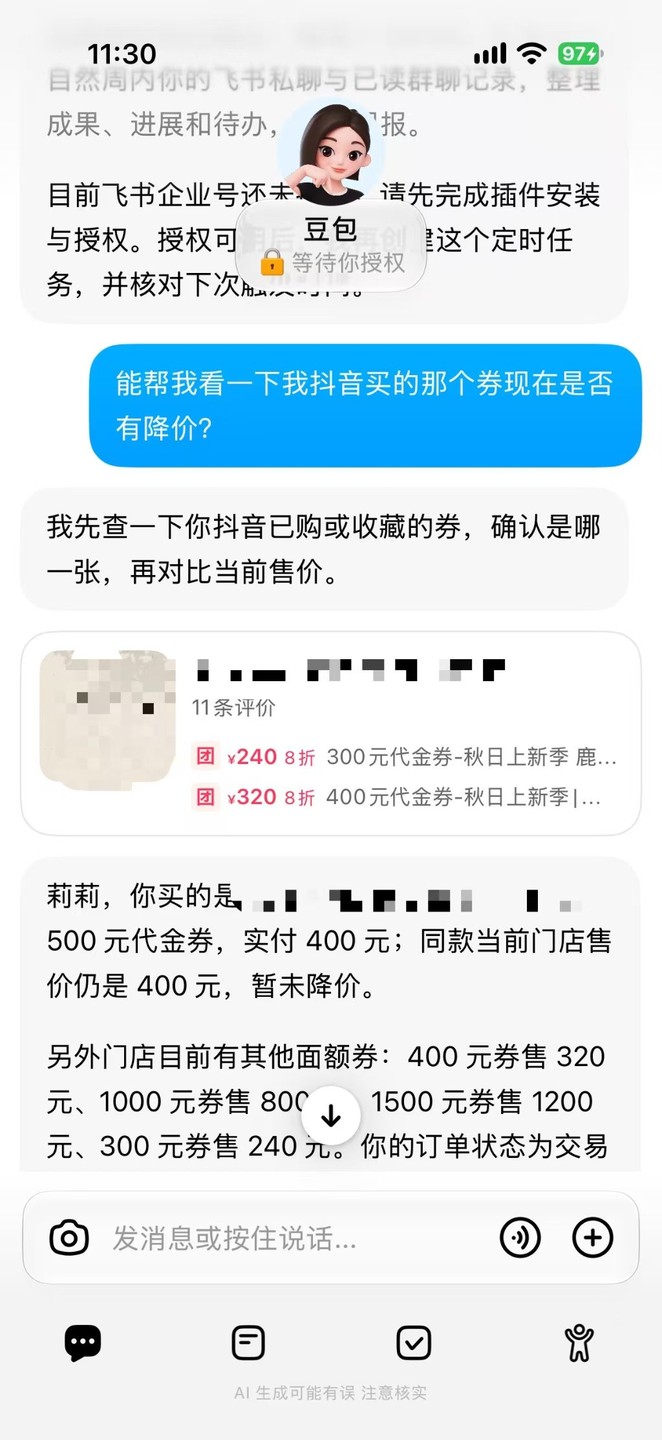
Without further providing merchant names or product information, Xiao Dou queried the author's historical orders on Douyin, located a 500-yuan voucher previously purchased for 400 yuan, compared it with the merchant's current selling price, and concluded that the price had not yet dropped.
Similar requests can be handed over to Xiao Dou for continuous follow-up by setting scheduled tasks.
This has become a direction that many major technology companies are striving to break through.
In September this year, Meta launched its Personal Agent product, Muse. At the Q3 earnings conference held on October 21, Meta founder and CEO Mark Zuckerberg revealed that over 10 million users in the United States and Canada had completed the setup of the Muse Personal Agent.
Domestic internet giants are also accelerating their layout.
On October 13, Alibaba launched the Personal Agent "Qianwen Go!," leveraging Alibaba's commercial ecosystem and open platform to extend services further into scenarios such as shopping price protection and insurance claims.
On October 27, Ant Group released Lingguang 2.0, positioning it as an AI assistant capable of handling personal affairs.
Doubao's entry has also attracted attention from peers. A source close to Ant Group revealed to All-Weather Technology that Lingguang internally regards Xiao Dou as a potential competitor.
Compared to general-purpose AI assistants, Personal Agents are expected to bring higher user stickiness to internet giants.
In the past, users could flexibly switch between multiple AI applications based on the capabilities of different large models. However, as personal memory, application authorization, and automated tasks continue to accumulate, the cost of switching AI products may also increase.
Even if the model capabilities of different AI products gradually converge, the experiences provided based on personal data and service ecosystems may still form significant differences.
However, competition for Personal Agents is not limited to within apps.
For Personal Agents that need to perceive user status and provide proactive services, mobile phones, as one of the smart terminals with the highest daily usage frequency, are also an important battleground.
On November 23, Honor released the Honor 700 series, equipped with the YOYO·Doubao mobile assistant. Leveraging the newly launched AI Dynamic Back Screen, users can customize personalized back screens through voice interaction and experience functions such as English tutoring.
At the same time, Honor itself is continuing to increase its investment in Personal Agents.
In September this year, Honor released MagicOS 11, further sinking the agent execution framework to the operating system level. The system-level agent YOYO remains Honor's important entry point for connecting various AI capabilities.
This makes the relationship between internet giants and mobile phone manufacturers in the Personal Agent field more subtle.
Mobile phone manufacturers possess operating systems, hardware sensors, and system service capabilities, giving them natural advantages in perceiving user needs, executing cross-application tasks, and coordinating across devices. Internet giants, on the other hand, hold long-accumulated user data, model capabilities, and a rich internet service ecosystem.
While there is significant room for complementarity between the two sides, both hope to become the primary entry point for users to access various services.
For Doubao, launching a standalone personal assistant product can further accumulate user memory and broaden the service ecosystem; cooperating with mobile phone manufacturers holds the promise of expanding the scenarios where AI capabilities reach users.
As more players enter the fray, competition for Personal Agents is evolving from a single contest of model capabilities into a comprehensive contest involving personal memory, service ecosystems, and terminal entry points.
In the past, internet giants competed for the time users spent after opening their apps. Now, they are beginning to compete for the needs users have before opening their apps.