


FaithAnchor

FaithAnchor

AssetsTop 6%ReturnsTop 6%
54Following59Followers748Likes & Bookmarks
F
FaithAnchor

$Coreweave(CRWV.US)

CRWV plunged 15.5% as hotter inflation revived rate fears and its 2032 bonds sank below 80 cents, yielding nearly 15%. Bondholders face mark-to-market losses and credit risk; shareholders face pricier refinancing, potential dilution and greater downside if AI returns fail to justify its cause.

C
Captain's Watch
Featured☕️ [Task Coins Giveaway] Daily Market Talk — Hot CPI Doubles October Hike Odds

September CPI came in hotter than anyone wanted, and the market's odds of an October hike doubled within the hour. At home, the STI is down about a percent. Let's dig in 👇💬 With an October hike now cl...

F
FaithAnchor

$Food Empire(F03.SG)

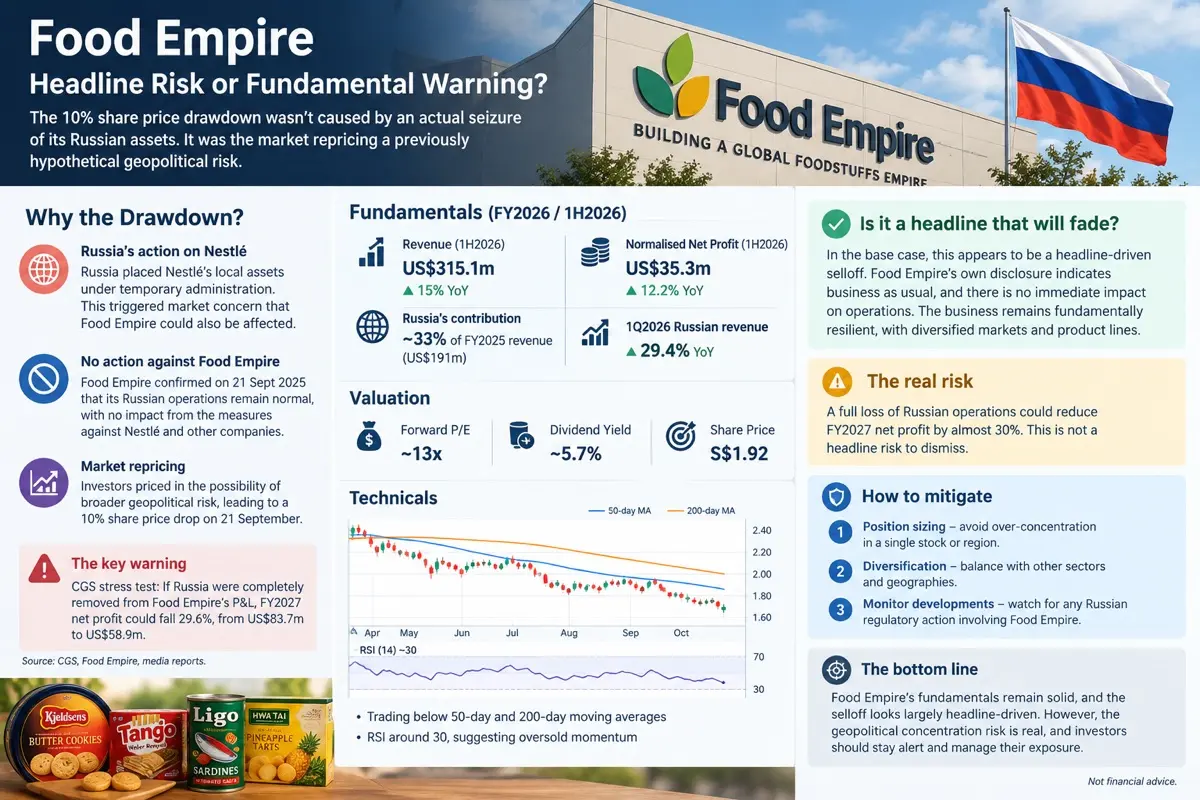
Food Empire: Headline Risk or Fundamental Warning?

Food Empire (SGX: F03) fell about 10% after Russia placed Nestlé’s local assets under temporary administration. The selloff was not caused by any action against Food Empire. Instead, investors repriced the possibility that Russian authorities could eventually target other foreign businesses.

The concern is legitimate. Russia contributed about US$191 million, or 33% of FY2025 revenue, while Russian revenue continued growing in FY2026. That creates meaningful geopolitical concentration.

Yet the fundamentals remain resilient. 1H2026 revenue rose 15% to US$315.1 million, while normalised net profit increased 12.2% to US$35.3 million. Growth is also supported by markets outside Russia.

At around S$1.92, Food Empire trades at roughly 13x forward earnings with a dividend yield near 5.7%. Technically, however, momentum remains weak: the stock is below its 50-day and 200-day moving averages, while RSI is around 30, indicating heavily oversold conditions.

The key warning investors should not dismiss is the Russia stress test. If Russian operations were completely removed, FY2027 net profit could fall almost 30%, from about US$83.7 million to US$58.9 million. That would be a genuine earnings shock, not merely headline noise.

For now, Food Empire has indicated that its Russian operations remain normal. The current drawdown therefore looks more headline-driven than fundamentally driven. But investors should not assume the risk disappears.

Mitigation is straightforward: avoid excessive portfolio concentration, diversify geographically, and monitor any Russian regulatory action involving Food Empire’s assets or operations.

The investment thesis changes materially if temporary administration, asset seizure or restrictions are imposed directly on Food Empire.

The takeaway: the selloff may fade, but Russia remains a risk that deserves a valuation discount and disciplined position sizing.

图片 1,共 1 张
Trade Showcase: Trade, Show & Earn Rewards!
F
FaithAnchor

1B 2B 3B — Inflation should stay close to forecasts. Core prices remain sticky, but there’s little sign of a major upside or downside surprise.

C
Captain's Compass
【Market Predict & Win】September CPI Tonight: Wall Street Can't Agree. Can You? 🔥

7 Banks Say 2.4%. 6 Say 2.5%. That's How Close This One Is.At 8:30pm SGT tonight, the US releases September CPI. It's the last inflation print before the Fed's next decision on 28 Oct.Last month, the ...

September CPI Forecasts Wall Street institutions' forecasts for U.S. September C
U.S.CPI Scenarios Stock Market View vl 1 Based on the median headline CPI YoY fo
F
FaithAnchor

MAS holds steady despite inflation risks. For Singaporeans, that means some relief from imported costs as the S$ stays firm, but don’t expect prices to fall. My take: 2027 inflation eases, while growth cools as the AI boom matures.

C
Captain's Watch
Featured☕️ [Task Coins Giveaway] Daily Market Talk — Tonight’s CPI Decides the Fed’s Next Move

Three Fed officials backed another rate hike on the same day, hours before tonight's CPI. At home, MAS surprised every analyst by holding. Let's dig in 👇💬 If tonight's CPI runs hot, do you add to rate...

F
FaithAnchor
Featured

$CityDev(C09.SG)

CDL: Cheap on Assets, But Can Management Unlock the Value?

FY2026 fundamentals have improved. 1H2026 revenue jumped 61.1% to S$2.72 billion, while PATMI more than tripled to S$301.6 million, supported by stronger residential contributions and improved hotel operations. The balance sheet, however, remains the key concern, with net gearing around 75%.

The valuation is compelling. At about S$7.01, CDL trades at roughly 0.65x NAV of S$10.74, while estimated RNAV is considerably higher. This suggests the market is assigning a substantial discount to the group’s property portfolio and future development potential.

The problem is execution.

CDL’s three-year GET+ strategy targets S$5 billion of investments, S$6 billion of divestments, more than S$1 billion of divestment gains and net gearing of about 55% by FY2029. If delivered, this could unlock significant value and strengthen the balance sheet.

But investors should question how quickly assets can be monetised without sacrificing value. Capital allocation also deserves attention, particularly with around 30% of new investments directed towards China and Japan. CDL’s previous experience in China shows that international expansion can carry significant downside.

Technically, the picture remains weak. The sharp fall from S$8.26 to around S$7.01 on heavy volume signals a loss of confidence. Until the stock reclaims the S$7.40–S$7.60 area, momentum remains fragile.

The bullish case is simple: strong Singapore property fundamentals, a large asset base, deep NAV discount and potential debt reduction.

The bearish case is equally clear: high gearing, execution risk and uncertainty over overseas investments.

For new investors, valuation provides a margin of safety—but patience may be required. Existing shareholders should focus less on the headline strategy and more on whether management actually delivers the promised cash, deleveraging and recurring income.

Not financial advice.

图片 1,共 1 张
Trade Showcase: Trade, Show & Earn Rewards!
F
FaithAnchor

$SK Hynix(SKHY.US)

SK Hynix is pulling back. Is China’s CXMT a real threat, or just market noise? If China starts pumping out more memory chips, prices could take a hit. The big question is whether the AI memory boom still has legs.

C
Captain's Watch
Featured☕️ [Task Coins Giveaway] Daily Market Talk — Micron Leads a $108B Memory Rout

Memory was the best trade of the AI boom until Monday, when Micron, SanDisk and SK Hynix shed about $108B between them on news that a Chinese rival is closing the technology gap. At home, the early ba...

F
FaithAnchor

$Nike(NKE.US)

Nike: The Turnaround Is Losing Momentum

Nike’s decline is starting to look less like a normal cyclical slowdown and more like a brand problem.

FY2026 revenue was roughly flat at US$46.4 billion, while net income fell 3% to US$3.1 billion. More worrying, Nike Direct revenue dropped 7%. China remains a major drag, with Greater China sales declining for nine consecutive quarters.

The brand is also losing cultural relevance. Kylian Mbappé, one of football’s biggest names, has moved from Nike to On. Losing a global ambassador of that calibre matters because Nike’s competitive advantage has always been more than shoes — it is culture, athletes and brand heat.

Elliott Hill has been cutting costs, simplifying the business and pushing product innovation. But another US$2.5 billion restructuring programme and further job cuts raise the question: is Nike treating the symptoms rather than fixing the underlying problem?

At around US$35, the stock trades at roughly 17x earnings, but that multiple is difficult to call cheap when revenue is still falling. Technically, the shares remain below key moving averages and close to the 52-week low, with RSI around 37.

For shareholders already assigned shares, repeatedly selling covered calls may not be ideal when the stock is depressed. A collar strategy could be worth considering: sell an out-of-the-money call and use the premium to partially fund a protective put. This limits downside while leaving room for a recovery.

Nike doesn’t simply need to cut costs. It needs consumers to want Nike again.

JUSI Nike: The Turnaround DOiT. Is Losing Momentum 比 Cost cuts can't fix a brand
Trade Showcase: Trade, Show & Earn Rewards!
F
FaithAnchor

$American Tower(AMT.US)

American Tower is bouncing on hopes that SpaceX’s telecom ambitions could boost demand for wireless infrastructure. The irony? Even as satellite connectivity threatens traditional telcos, it could create new opportunities for tower owners. Is this the start of a recovery, or just a short-lived rally?

C
Captain's Watch
Featured☕️ [Task Coins Giveaway] Daily Market Talk — SpaceX's $8B Spectrum Deal Sinks Telcos

SpaceX is paying about $8B for nationwide spectrum, and US telcos got repriced in one session: AT&T -9.8%, T-Mobile -13%. At home, the banks are bouncing after last week's 5% STI slide. Let's dig in 👇...

F
FaithAnchor

$DBS(D05.SG)

Singapore Banks: Is the Pullback a Buying Opportunity?

DBS, OCBC and UOB have taken a hit, falling around 6%, 10% and 8% respectively between 6 and 8 October. After years of strong gains, the sell-off raises a familiar question: is it time to buy the dip, or is more pain ahead?

The biggest concern is rising global bond yields. If yields remain elevated, bank valuations could face further pressure, even if earnings hold up. With 3Q26 results around the corner, investors will be watching net interest margins, wealth management fees, funding costs and credit quality. Expectations are already high, particularly for DBS and OCBC, leaving less room for disappointment.

Which bank deserves a closer look? DBS remains attractive for investors seeking dividends and exposure to wealth management. OCBC offers a more diversified mix through banking, insurance and wealth management, while UOB could appeal to investors looking for value after its recent decline. However, none is automatically cheap simply because its share price has fallen.

For investors sitting on cash, there is no need to go all in. Consider deploying around 25–30% of the intended investment first, keeping the balance for further weakness or a more attractive entry after earnings. Those who missed the initial pullback should resist chasing a rebound.

Existing shareholders should focus on whether the investment case has changed, rather than reacting to short-term price movements.

The bottom line: Singapore banks may be entering a more attractive buying zone, but the correction may not be over. Staggering purchases, checking valuations and keeping some cash in reserve could be a more sensible approach than trying to call the bottom.

The opportunity is there, but patience and price discipline will matter. Not financial advice.

Singapore Banks: Is the Pullback a Buying O Opportunity? DBS, OCBC and UOB have
Trade Showcase: Trade, Show & Earn Rewards!
F
FaithAnchor

$Lion-phillip S-Reit(CLR.SG)

S-REITs slipped 1%, a smaller hit than the STI. Perhaps investors are still holding on for those dividends while the broader market takes a beating. The question is whether that resilience will last if sentiment worsens.

C
Captain's Watch
Featured☕️ [Task Coins Giveaway] Daily Market Talk — OpenAI's $20B Gap Hits AI Stocks

The FT reported OpenAI's annualized revenue is about $20B lower than thought, and the AI chain sold off: Oracle -5.5%, CoreWeave -7.8%, Nvidia -2.9%. At home, the STI closed -3.5% Thursday as all thre...

F
FaithAnchor

$Cent Accom REIT(8C8U.SG)

8C8U: Adelaide Expansion — Growth Opportunity or Gearing Risk?

Centurion’s proposed S$22.3 million Adelaide land acquisition could open another growth avenue through purpose-built student accommodation. But for 8C8U investors, the real question is whether expansion will translate into higher distributions or simply more debt.

CAREIT’s 1H2026 fundamentals look encouraging, with 98.8% PBSA occupancy, a 72% NPI margin and aggregate leverage of 29.9%. Yet the Adelaide project is not automatically dividend-accretive to 8C8U, as the acquisition sits with its parent, Centurion Corporation.

Technically, the unit price is trading below its 50-day and 200-day moving averages, suggesting near-term weakness despite resilient operating performance.

My take: the long-term opportunity is promising, but investors should watch funding costs, gearing and DPU growth before pricing in the Adelaide expansion. Growth is welcome — provided it delivers returns rather than just a bigger balance sheet.

Not financial advice.

Centurion Accommodation REIT (8C8U): Adelaide Expansion - CENTURION Growth Oppor
Trade Showcase: Trade, Show & Earn Rewards!
F
FaithAnchor

$DBS(D05.SG)

DBS got dragged lower after Citi’s cautious OCBC call. But is OCBC’s flattish outlook really a proxy for DBS? I don’t think so—different earnings mix and catalysts. This feels more like sector sentiment than DBS fundamentals.

C
Captain's Watch
☕️ [Task Coins Giveaway] Daily Market Talk — OCBC Sell-Off Deepens

OCBC is down about 10% in two days after Citi's sell call, and DBS and UOB are sliding with it. Rates aren't helping: the US 10-year just touched 5.35%. Let's dig in 👇💬 Buying the bank dip in 10-share...

F
FaithAnchor
Featured

$SBS Transit(S61.SG)

Oil above US$100 is exposing a big difference between Singapore’s transport plays: SIA, SATS and SBS Transit may all face higher energy costs, but the earnings impact is far from equal.

SIA is taking the hardest hit. FY2026 revenue rose 5% to S$20.5bn and operating profit jumped 39% to S$2.4bn, but the latest quarter shows how quickly oil can change the picture. Net fuel costs surged 78.5% to S$2.25bn, pushing operating profit down 73.8% and the group into a S$76m loss. Its passenger breakeven load factor has also climbed to 87.9%. At S$6.65, the stock trades at about 17x earnings, while RSI near 31 suggests it is approaching oversold territory.

SATS looks more resilient. FY2026 revenue reached a record S$6.35bn, PATMI rose 17% to S$285m and free cash flow turned positive at S$216m. Oil hurts indirectly through airline and cargo volumes rather than directly through jet fuel. At S$3.83, valuation is around 20x earnings, while RSI near 32 and the price below its 50- and 200-day averages point to near-term pressure.

SBS Transit has the strongest structural protection. Its Bus Contracting Model largely passes diesel costs through to LTA. 1H FY2026 revenue rose 5.3%, while operating profit slipped just 0.3%. At S$3.70, it trades around 19x earnings, with the share price above its 50- and 200-day averages.

For dividend investors, my view is to prioritise cash-flow resilience over headline yield. SIA’s dividend is more cyclical, while SATS offers improving cash generation. SBS Transit appears best positioned to weather sustained oil inflation.

The key defence is diversification: don’t let one fuel-sensitive business become the foundation of the income portfolio.

Oil Above US$100: IILIRES Which Dividend Stock Can Weather It? Higher oil prices
Trade Showcase: Trade, Show & Earn Rewards!
F
FaithAnchor

$OCBC Bank(O39.SG)

OCBC slipped ~5% at the open. Citi expects its upcoming earnings to lag DBS and UOB, weighing on sentiment. After the strong run-up, I’d stay patient and see if this retracement creates a better entry.

C
Captain's Watch
☕️ [Task Coins Giveaway] Daily Market Talk — SpaceX Eyes $40B Chip Loan

The S&P 500 and Nasdaq closed at records again, and SpaceX is reportedly lining up US$40B of debt to buy Nvidia chips. Under the surface it was messier: Seagate sank -9.2% while nuclear power names ri...

F
FaithAnchor
Featured

$NVIDIA(NVDA.US)

NVIDIA: Is China Slowly Opening the Door?

The NVIDIA-China story may be getting interesting again.

China has reportedly signalled that companies such as Alibaba and ByteDance could be allowed to buy NVIDIA’s new RTX Pro 5500 chips. It is still early days, but I see this as more than just another GPU sale.

For NVDA shareholders, the bigger question is whether this becomes the first crack in the wall that has largely shut NVIDIA out of China’s advanced AI market.

The numbers show what is at stake. NVIDIA generated $215.9 billion in FY2026 revenue, up 65%, with $120.1 billion in net income and $96.6 billion in free cash flow. Data Center revenue alone reached $193.7 billion, up 68%. Yet NVIDIA’s FY2027 outlook assumed no Data Center compute revenue from China.

That makes any reopening potentially meaningful.

But I would not call this a breakthrough yet. The RTX Pro 5500 is not NVIDIA’s flagship AI accelerator, and U.S. export restrictions remain firmly in place. There is still a huge gap between allowing selected products into China and Washington loosening its grip on advanced AI technology.

At around $228.86, NVDA trades at roughly 29x FY2026 earnings. Technically, the picture remains constructive, with the stock above its 50-day and 200-day moving averages and RSI around 59—positive momentum without looking stretched.

For shareholders, the real prize is not the RTX Pro 5500 itself. It is what comes next.

If China gradually regains access to more NVIDIA computing products, the market could be underestimating an additional growth avenue. For now, I see this as a potential opening of the door—not the door being fully opened.

Not financial advice.

NVIDIA: Is China Slowly Opening i the Door? A potential nVIDIA. opening China ha
Trade Showcase: Trade, Show & Earn Rewards!
F
FaithAnchor

$NVIDIA(NVDA.US)

NVDA just closed at another record, taking its market cap to $5.76T. The AI story still has plenty of fuel, but at this size, expectations are huge. Is there more upside—or are we getting closer to the top of the cycle?

C
Captain's Watch
☕️ [Task Coins Giveaway] Daily Market Talk — SpaceX Jumps 7.6%

SpaceX ripped +7.6% after Morgan Stanley called it one of the cheapest ways to own space and AI, putting Musk back above $1 trillion. Nvidia closed at a record and dragged the Nasdaq to one too. The c...