This week will rebound, then turn down in the next few weeks. Everyone should avoid heavy positions in the tech sector$Micron Tech(MU.US)$Hang Seng Index(00HSI.HK)$SpaceX(SPCX.US)


洛城徐先生
我只是发布我的看法,有些人别找骂
 洛城徐先生
洛城徐先生Suggestions for you to follow

洛
Is the overall market about to turn? Can we still play the AI game? Are there still opportunities in SpaceX-related concepts?
Let's talk about the market first.
At this point in the current rally, both the Nasdaq and the S&P 500 have accumulated a significant amount of profit-taking positions. The indices look strong as they climb, but it's precisely at times like these that we need to be wary of short-term volatility. The market never rises at a 45-degree angle forever; when it's time for a shakeout, there will be a shakeout, and when it's time for consolidation, there will be consolidation.
From a technical perspective, the 10-day, 20-day, and 50-day moving averages remain important levels to watch. As long as these key moving averages are not effectively broken, I prefer to interpret pullbacks as rest stops during an uptrend, not the end of the trend.
Many people like to try to predict the top, but real money is usually made by riding the trend, not by trying to guess peaks and troughs.
Now, let's talk about the US dollar.
The market has repeatedly proven one thing over the past few years: the US dollar and tech stocks often have a seesaw relationship.
A weak dollar means strong risk assets.
A strong dollar puts pressure on tech growth.
Therefore, for the foreseeable future, I believe that in addition to watching NVIDIA and the overall market, the US Dollar Index is also worth paying attention to, as it often determines the direction of market risk appetite.
Next, let's talk about AI.
Even today, I still believe that AI and semiconductors are the core themes of the entire market.
Every bull market has its protagonists. The internet era had Microsoft. The smartphone era had Apple. The cloud computing era had Amazon. And today, the market's protagonist is still artificial intelligence. As long as this story isn't disproven, capital will eventually flow back to the strongest direction. So, whether it's NVIDIA, Broadcom, AMD, or other companies in the AI supply chain, I believe there may be short-term volatility, but the long-term logic hasn't changed.
Finally, let's talk about the recently popular SpaceX concept. I admit, SpaceX is one of the rare companies in recent years that sparks boundless imagination. Rocket launches, the Starlink project, the space economy, defense contracts—each story alone is enough to attract capital. But one of the biggest fears in investing is equating imagination directly with profitability. Many people see Mars in ten years. Mature investors care more about the cash flow and growth realization in the coming years. SpaceX is certainly worth long-term attention, but the more grandiose the story, the more patience is needed to wait for the right price. The market is never short of opportunities. What's often lacking is patience. So my strategy remains unchanged. For the overall market, respect the trend, don't be quick to turn bearish. For AI, continue to focus on the core leaders. For the SpaceX concept, bullish long-term, but don't chase highs in the short term; wait for the market to offer a more comfortable entry point. Soros once said, "It's not whether you're right or wrong that's important, but how much money you make when you're right and how much you lose when you're wrong." Investing is never about who predicts more accurately. It's about who survives longer. The future belongs to artificial intelligence, and the future also belongs to the space economy. But before the future truly arrives, we must first learn to survive the market's fluctuations. This might be the most important lesson in investing.$Hang Seng Index(00HSI.HK)$Micron Tech(MU.US)$SpaceX(SPCX.US)

洛
Next week, the market is highly likely to speculate on the Fed's interest rate hike expectations, so everyone should be mindful of the risk and safety of their positions. $Hang Seng Index(00HSI.HK)$SpaceX(SPCX.US)$Micron Tech(MU.US)
洛
In every bull market, the market falls in love with a story.
In 2000, it was the internet changing the world; in 2021, it was the metaverse reshaping the future; and today, it's the space economy's turn.
I don't deny that SpaceX is a great company. On the contrary, it might be one of the most imaginative enterprises of the past two decades. But the greater the story, the more investors need to stay sober. The market's enthusiasm for SpaceX has recently approached frenzy. The stock price has been soaring, and forums are filled with voices saying you can't miss SpaceX after missing Nvidia. But there's a market rule: when everyone believes the future has only one direction, volatility is often already on the way. Don't forget, in just over ten days, a large number of chips held by early investors and institutions may enter the circulating market. History tells us that whether it's CRCL, Uber, Meta, or Amazon, they all experienced capital chasing and emotional euphoria in their early listing stages, but eventually, their stock prices went through a process of returning from dreams to reality, from stories to performance, and from sentiment to valuation. Many people aren't buying stocks; they're buying a future. They believe that in ten years, humans will migrate to Mars; that Starlink will cover the entire Earth and even the solar system; that robots will take on most of the work; that future lifestyles will be completely rewritten. These visions do sound thrilling. But I often think of one question. Robot technology has been developing for decades, and AI has been developing for so many years, yet until today, I still haven't seen a robot nanny that can help me buy groceries, cook, do laundry, clean, care for the elderly, and chat with me truly enter millions of households. We haven't even solved household chores on Earth, yet we're already discussing real estate prices on Mars.
This reminds me of a quote from Buffett: the most dangerous time for an investor is when they start substituting fantasy for cash flow. The market's favorite thing to do is to paint the future as incredibly beautiful at its peak. Because the most beautiful stories are often the easiest to make people overlook risks. Rockets can fly into space, but stock prices can't forever escape gravity. A great company and a great investment are often not the same concept.
A great company, if priced too high, can still be a terrible investment; while an ordinary company, if priced cheaply enough, can also bring excess returns. Truly mature investors can see the stars and the sea, yet also lower their heads to calculate valuations. They can believe in the future, yet also respect reality. So for SpaceX, I'm still bullish in the long term. But being bullish long-term doesn't mean chasing highs short-term. Being optimistic about the future doesn't mean ignoring risks. Dreams are worth looking up to, but investment needs to be down-to-earth. Because the biggest trap in the capital market has never been a bad story, but the good story everyone firmly believes in. When everyone is discussing how to get to Mars, perhaps the people really making money have already started considering when to return to Earth.$SpaceX(SPCX.US)$Hang Seng Index(00HSI.HK)$Micron Tech(MU.US)
洛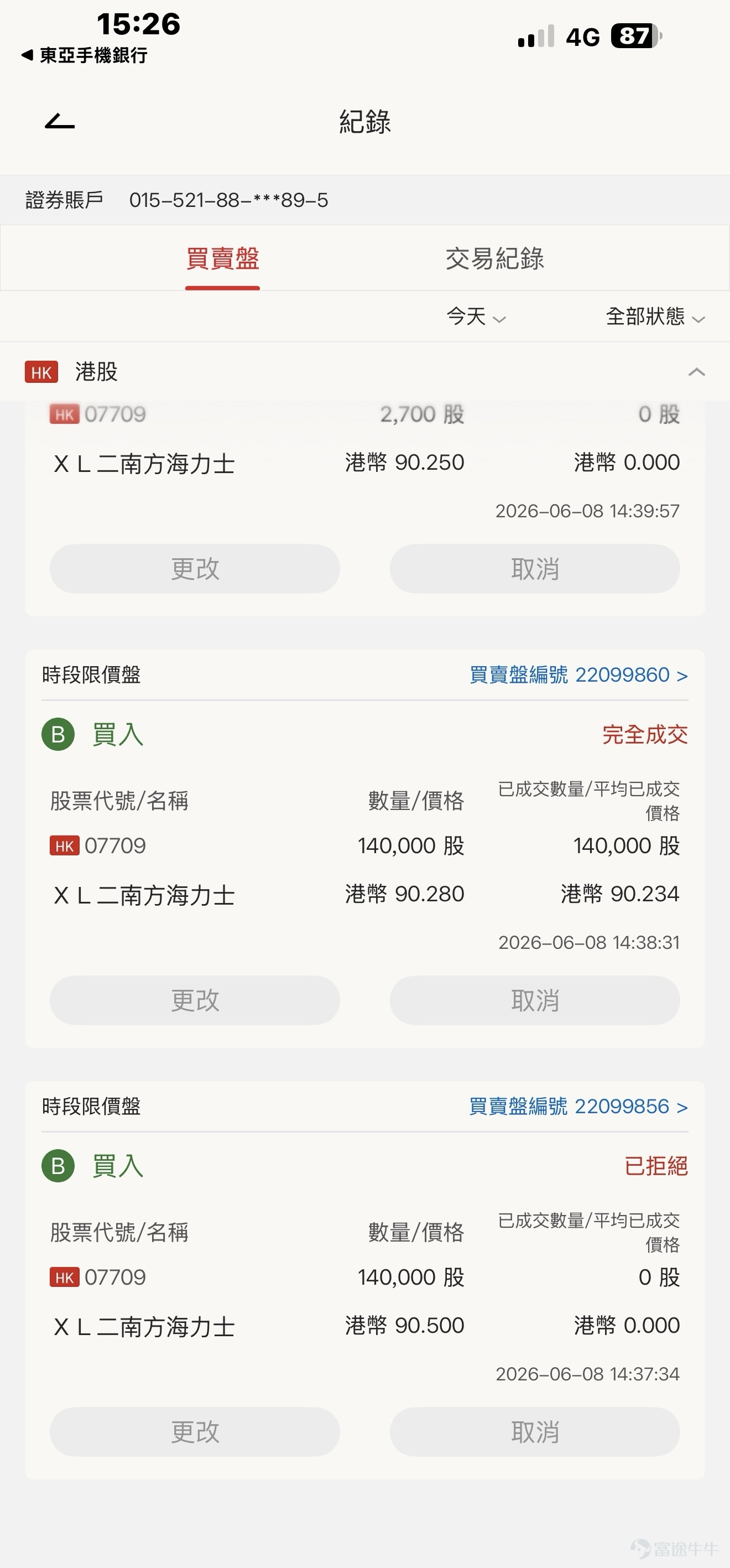
Today I made a trade. 07709 (CSOP Hang Seng Tech Index 2x Daily Leveraged Product) 140,000 shares were executed. The order was placed at 90.28, with the final average execution price at 90.234. A few minutes later, a buy order for the same quantity at 90.5 could no longer be filled. Many people only see a price difference of a few dimes. But the real difference lies in: whether you are trading on expectations, or chasing results. There has been a very obvious change in the market recently. From US stocks to Hong Kong stocks, capital is flowing back into growth sectors. AI, semiconductors, and internet technology are starting to regain capital attention. However, most investors are still waiting for confirmation: CPI confirmation, interest rate cut confirmation, market confirmation. The problem is: when all positive news is confirmed, the price is often no longer at its original level. My trading logic is actually quite simple: First layer: Determine the direction. I don't predict the index. I only observe capital flows. Recently, whether it's Nasdaq or Hang Seng Tech, capital has clearly started shifting from defensive sectors to growth sectors. This is the signal. Second layer: Determine the odds. When the market is still hesitating, the risk-reward ratio is often the highest. Because: the upside expectation is not yet fully priced in, while pessimistic sentiment still exists. Third layer: Execution discipline. Many people know where the opportunities are. But they can't execute. The reason is simple: they always want to buy at the absolute bottom. In fact, professional traders never pursue the lowest point. Instead, they aim to: establish a position in the early stages of a confirmed trend. Why did I choose 07709? Because it essentially amplifies my judgment on Hang Seng Tech. If the trend holds, the gains will be amplified. If the trend fails, the stop-loss must also be resolute. Trading is never about predicting the future. It's about acting decisively when a probabilistic edge appears. The market has taught me one thing over the years: the people who really make big money are often not the ones who see things most accurately. They are the ones who dare to bet and strictly execute when opportunities arise. The market always rewards discipline. Not emotion. What do you all think? Is this round of Hang Seng Tech rebound a short-term technical bounce,
or the beginning of a new market cycle?$Hang Seng Index(00HSI.HK)$XL2CSOPHYNIX(07709.HK)$Micron Tech(MU.US)
洛
There will be a 1-2 day rebound next week. If it goes as I expect, we need to cut losses or set up a protection mechanism for the tech stocks that weren't sold off earlier. The market will decline further before the World Cup opens on the 11th, especially after the Fed's interest rate decision results come out. There's a high chance the market will reach around the 7200 level by the end of the month. If the Fed meeting gives a rate hike expectation or statement, the market is highly likely to go near the important 7000 support level. If the result is ambiguous, there might be a rebound again. Pay close attention to the Fed's interest rate decision result on the 17th.$Hang Seng Index(00HSI.HK)$Micron Tech(MU.US)$NVIDIA(NVDA.US)
洛
U.S. May job growth exceeded all forecasts, with the unemployment rate remaining stable, indicating that the labor market may be emerging from a prolonged period of sluggish hiring. This prompted JPMorgan to fully price in a Fed rate hike by the end of this year. Traders have fully priced in a 25 basis point Fed hike by December, with the probability of a hike as early as October seen at around 60%, and public opinion endorsing short selling is starting to form. After the data release, U.S. Treasury yields surged, with the 20-year/30-year yields climbing back above 5%. Gold, silver, and TLT plummeted. If Warsh pushes for balance sheet reduction again, the liquidity drain from Musk's SpaceX IPO, combined with the significant profit-taking pressure after nine consecutive weeks of gains, leads me to believe a deeper correction is imminent!$Micron Tech(MU.US)$Marvell Tech(MRVL.US)$Hang Seng Index(00HSI.HK)

洛
Winning Streak Ends
Stocks fell on Wednesday, with the S&P 500 index ending its nine-session winning streak. Rising oil prices and U.S. Treasury yields, driven by escalating U.S.-Iran military tensions and inflation concerns, dragged down major tech and semiconductor stocks.
Brent crude oil prices are once again approaching $100 per barrel. Strong economic data combined with rising energy costs have heightened market concerns about persistent inflation, which is believed to hinder the Federal Reserve from cutting interest rates. The market is currently preparing for possible rate hikes this year.$Hang Seng Index(00HSI.HK)$Micron Tech(MU.US)$SPDR S&P 500(SPY.US)
洛
Can you still chase after MRVL's 24% surge? And are there still opportunities in the AI optical communication sector?
1. MRVL's surge is not accidental. I believe the core reason for Marvell's significant rise this time is not simply better-than-expected earnings. Instead, the market has re-evaluated its position in the fields of AI servers, data centers, Custom ASIC (custom AI chips), and optical communication. The market previously viewed MRVL as an ordinary chip company, but now it's starting to see it as an AI infrastructure company. Consequently, its valuation logic has changed.
2. The optical communication trend is not over yet. Many people think CPO, optical modules, and optical communication have already risen a lot. However, I believe AI training clusters are getting larger, and the data transmission demand between GPUs is also increasing. Therefore, the stronger the computing power, the higher the demand for networking and optical communication. So, optical communication isn't the end of speculation; it's entering the second phase.
3. Market capital is starting to spread from GPUs. In the past, everyone only focused on NVDA, AMD, and AVGO. Now, capital is beginning to spread to surrounding areas, including optical modules, network switches, data center connectivity, and AI ASIC. Essentially, the AI investment logic is expanding from computing power to connecting that computing power.
4. Why am I optimistic about Custom ASIC? Custom ASIC AI chips represent one of MRVL's biggest areas of potential. Because Amazon has Trainium, Google has TPU, Microsoft has Maia, and more cloud providers are developing their own AI chips. MRVL happens to be involved. I believe the future of AI chips won't be dominated by NVDA alone. The custom chip market is likely to grow larger.
5. My view on MRVL: After the short-term 24% surge, there's definitely a risk in chasing the high. But from a long-term logic perspective, MRVL's story has only just begun to gain market attention. Therefore, I think it's possible to wait for a pullback, build a position in batches, and not chase the emotional peak.
6. Optical communication sector focus: Marvell Technology, Corning, Arista Networks, Broadcom, Ciena. I believe these companies are all beneficiaries of AI data center expansion. To summarize in one sentence: The 24% surge in Marvell reflects the market beginning to reprice the logic of AI networking and Custom ASIC. The AI trend has gradually expanded from simply speculating on GPUs to optical communication, network equipment, and data center connectivity layers. I believe the main theme of optical communication is not over, but MRVL's short-term gains are excessive. Chasing highs requires caution. A better strategy might be to wait for a pullback before participating.$Marvell Tech(MRVL.US)$TENCENT(00700.HK)$Hang Seng Index(00HSI.HK)
洛
Is AI destroying the software industry or reshaping it? Let's take a look at some of my analysis below.
1. There are two extreme views on AI in the market right now. The first view holds that as AI becomes increasingly powerful, many jobs will be automated, companies won't need as many employees, and demand for software subscriptions will decline. This leads some to worry that AI will devalue traditional SaaS software.
2. AI will indeed eliminate some traditional software. In the past, many software programs handled information organization, process management, and simple automation. However, with the advent of AI, many tasks that previously required multiple software programs might be solved by a single AI Agent. Therefore, software companies without a moat will face difficulties in the future.
3. The real beneficiaries are AI-native software companies. The future isn't about software disappearing, but about software transitioning from the tool era to the Agent era. In the past, humans operated software; in the future, AI will help humans operate software. Therefore, companies that can deeply integrate AI first may usher in a new growth cycle.
4. The collective rise in software stocks is not accidental. I believe the recent broad-based strength in software stocks—with enterprise software, cloud services, and AI applications all rising—actually represents the market beginning to realize that the beneficiaries of AI are no longer just NVDA and chip companies. Capital is spreading from the computing power layer and chip layer to the application layer and software layer. This is different from last year when capital only chased semiconductors.
5. AI Agent might be the core logic of the next phase. We are gradually moving from the Prompt Engineering era into the Context Engineering and AI Agent intelligent proxy era. Simply put, in the past, AI only answered questions. In the future, AI will execute tasks, call tools, and automatically complete workflows. This will fundamentally change the business models of the software industry. I am personally more optimistic about these areas: enterprise-grade AI software, AI Agent platforms, cloud computing, data management, and enterprise automation, rather than software companies solely reliant on traditional subscription models.
AI won't kill the software industry; it is gradually phasing out old software and giving rise to new software. The recent collective strength in software stocks indicates that capital has already started shifting from chips to software. The next wave of explosive growth might not be Nvda, but rather the software companies that first implement AI Agents in enterprise scenarios. Therefore, everyone can position themselves in advance.$Microsoft(MSFT.US)$NVIDIA(NVDA.US)$Micron Tech(MU.US)

洛
Friends, tomorrow will either gap up or gap down at the open. Have a nice weekend.$Micron Tech(MU.US)$Tesla(TSLA.US)$Sandisk(SNDK.US)
洛
Will the US stock market experience a pullback in June??? 1. The broader market has entered a high-level game phase.
Personally, I believe the overall trend of the US stock market has not completely deteriorated, but it has gradually shifted from the previous unilateral rise into a phase of high-level volatility, capital divergence, and enhanced risk management. The market is starting to worry about: inflation data, the Fed's interest rate policy, overvaluation in the AI sector, and profit-taking. Therefore, I think a phased pullback in June is not impossible, but it's more like a healthy adjustment rather than a trend reversal.
2. DELL's surge indicates that the logic of AI capital expenditure is still intact; DELL's big jump is not an isolated event. However, it reflects that the demand for AI servers continues to grow, data centers are expanding, and corporate AI investment is increasing, which shows that AI infrastructure construction is not over yet. It can be said that the main AI theme is still alive, but capital is starting to spread from single leaders to the entire industry chain.
3. The semiconductor sector is beginning to diverge. Previously, everyone rose together—NVDA, MU, AMD, AVGO, SNDK. My personal systematic analysis suggests it has entered a phase where the strong remain strong, and the weak diverge. The market is now paying more attention to the ability to deliver on performance, the proportion of AI revenue, HBM and storage demand, rather than simply buying the entire semiconductor sector.
4. Software stocks are experiencing a short squeeze. Software stocks have already seen significant gains, but the logic is this: short positions are heavy, earnings exceed expectations, and the AI concept provides support, forcing capital to cover short positions. Essentially, it's a rise driven by a short squeeze.
5. The space sector's popularity is declining. Previously very hot stocks like Rocket Lab and ASTS and other space-related concept stocks have started to pull back. The reasons are
excessive gains in the earlier period, capital taking profits, and a decline in market risk appetite, leading to the phenomenon of a "space fall" and an "AI return."
6. Let me share my personal views on a few recent hot stocks. MU: HBM demand is growing, AI servers are driving storage demand, fundamentals still benefit from the AI cycle, but there may be short-term volatility. SNDK: Benefits from the storage industry recovery following the AI industry chain, but its elasticity and certainty are not as good as MU.
PLTRAI: One of the representative software companies, institutions continue to pay attention, but valuations are no longer low. It belongs to the type that is good for the long term but may see volatility in the short term.
ORCL: Cloud business growth, AI computing power leasing, and data center expansion have made it an important participant in AI infrastructure.
Finally, I conclude one point: the AI bull market is not over, but the market has moved from a comprehensive frenzy to an internal rotation and high-level game phase. Dell and Orcl represent that AI infrastructure remains strong. Mu and Sndk benefit from the storage cycle, while space stocks and some high-valuation directions are beginning to face a full-scale capital withdrawal. Whether AI will end in the future is not the most important thing; what matters is how to manage positions and risk in an environment of increasing volatility.$Sandisk(SNDK.US)$Micron Tech(MU.US)$Tesla(TSLA.US)
美股六月会不会回调?
会
57%不会
43%Voting ended196 votes

洛
It seems Sister Hua is determined to pull the S&P 500 to 7600 and won't stop until all short positions are wiped out. So, if you want to open a short position, wait patiently for this level. You can try opening a small short position at the end of the trading day. The chance of an adjustment next Monday is still quite high.
As I said, MU is almost at 1000 here, there will be many more short positions next week. ORCL can be exited a bit early. 200 is a support level, you can re-enter near this level. Also, as I said, spring has come for software stocks$Microsoft(MSFT.US)$Micron Tech(MU.US)$Oracle(ORCL.US)
洛
The market is using the US-Iran ceasefire news to play a game of greater fool theory, especially in chip concept stocks. I will wait and see for now, and only add to my position after the US and Iran sign a ceasefire agreement. The US April PCE price index grew 3.8% year-on-year, which is in line with expectations. Pay attention to changes in crude oil inventory data, as it could cause sharp market fluctuations. Crude oil prices have already shown signs of rebounding, which will affect the overall market trend.$Micron Tech(MU.US)$NVIDIA(NVDA.US)$Tesla(TSLA.US)
洛
Next spring should be the turn of software stocks. You can start positioning in stocks like Msft and pltr. I think 460 for Msft shouldn't be a problem. I feel stocks in the storage sector are already too high. Capital is gradually flowing out of semiconductors and slowly moving into software stocks. Also, Trump has been praising Micron non-stop, so Mu reaching 1,000 in the short term is no problem. A reminder here: a lot of capital is preparing to flee when Mu hits 1,000, so it might drop to around 750 after reaching 1,000. These are my views on the market going forward and some of my positioning. Welcome to discuss.$Micron Tech(MU.US)$Microsoft(MSFT.US)$Intel(INTC.US)$Tesla(TSLA.US)$NVIDIA(NVDA.US)$Sandisk(SNDK.US)
洛
The AI theme is not over yet, but the market has already entered a stage of risk gaming after high-level acceleration.
Currently, the broader market (especially the Nasdaq) still maintains a strong upward structure, with the overall trend not truly broken. Capital remains highly concentrated in the AI industry chain. The strongest sectors in the market are still: AI, semiconductors, HBM memory, computing power-related, and high-beta growth stocks, indicating that risk appetite is still quite high. In many sectors now, AI-related directions are significantly stronger than the overall performance of the S&P 500. This means the market is no longer in a broad-based rally, but increasingly focused on directions with certain growth. Space economy-related sectors have also become active recently. Essentially, this reflects that capital is starting to spread from pure AI to future tech narratives. Technically, the current index has entered a stage of high-level consolidation and trend continuation. In the short term, it can still continue to rise, but the higher it goes, the greater the volatility may be. This is because there are more and more profit-taking positions; market expectations are becoming increasingly aligned; institutions are starting to both go long and defend. The AI bull market is not over, but the market has slowly transitioned from a mindless rally to a stage of rising with fear, high-level gaming, and enhanced risk control. In short, the strongest directions in the market are still AI and high-growth tech, but the closer to the highs, the more attention should be paid to volatility and pullback risks after overheated sentiment. This is some analysis I did pre-market. You can all take a look. $Sandisk(SNDK.US)$Circle(CRCL.US)$AMD(AMD.US)$Intel(INTC.US)$Tesla(TSLA.US)$Micron Tech(MU.US)
洛
MU is showing close to 1000, and South Korea's SK Hynix has simultaneously broken through a market cap of ten thousand. When retail investors are frantically buying in, large orders have already started to slowly take profits using the cover of retail investors. If you're greedy, you can still do some intraday trading in the short term. A pullback should start in June, which is also an opportunity.$Micron Tech(MU.US)$Tesla(TSLA.US)$NVIDIA(NVDA.US)$Intel(INTC.US)$AMD(AMD.US)$Circle(CRCL.US)$Sandisk(SNDK.US)
洛
Many retail investors lose money not because they don't look at the direction, but because they use the wrong trading strategies. I've summarized the three worst trading methods. Are any of you among them? 1. Chasing rallies and selling on dips. Many people only rush in after seeing a big surge, then panic and cut losses as soon as it drops.
The result is: buying at the top and selling at the bottom, always being led by market sentiment.
The market loves to harvest those with the most emotional reactions. 2. Holding onto losing positions. The most common problem for many retail investors is: taking profits immediately when they make a little, but holding onto losses.
They always think: as long as you don't sell, it's not a loss. But in reality: small losses turn into big losses, the more you average down the deeper you sink, and in the end, both capital and mentality collapse.
The importance of stop-loss and position management. 3. No system, trading purely by feel. Many people: look at group messages, follow KOLs, watch intraday sentiment, and open positions on a whim. No trading logic, risk control, or plan.
The result is: as soon as the market fluctuates, they get flustered first.$Intel(INTC.US)$NVIDIA(NVDA.US)$Tesla(TSLA.US)$Micron Tech(MU.US)$Sandisk(SNDK.US)$Circle(CRCL.US)

洛
The market rose too fast previously, especially AI and tech stocks accumulated a large amount of profit-taking positions;
Fed rate cut expectations have become volatile, and capital is starting to worry that high interest rates will persist for longer;
CPI, Treasury yields, and the US dollar's movement are once again affecting market risk appetite;
Many institutions are starting to increase Put protection, indicating that large capital has entered a defensive state;
While the main trend for the semiconductor and AI sectors remains unchanged, they have entered a phase of high-level volatility in the short term;
The biggest characteristic of the market now is: it's not that no one is bullish, but that people are starting to get scared as prices rise.
In fact, the AI bull market is not over, but the market has shifted from the previous frenzy of optimism to a phase of high-level gaming and risk re-pricing. Simply put, the market used to focus only on growth and AI potential, but now it wants to make money while also fearing a high-level correction. Therefore, many of the recent declines are essentially more like a repositioning of high-level capital and a cooling of sentiment.$Tesla(TSLA.US)$NVIDIA(NVDA.US)$Intel(INTC.US)$Sandisk(SNDK.US)
洛
NVIDIA's earnings exceeded expectations, its Q2 guidance was higher than market consensus, and it announced an additional $80 billion in stock repurchase authorization. The growth story is quite perfect, but the stock still fell 1% in pre-market trading, while long-term Treasury yields rose again. The Fed meeting minutes released yesterday showed that most Fed officials did not rule out the possibility of raising interest rates. It can already be determined that the last straw for the market's recent continued rise has fallen. The S&P 500 will enter a 1-3 month volatile downward cycle, with the first target at 7270/7150 by the end of May. Starting today, short positions can be established for tech stocks that have risen significantly earlier. Any long positions in tech stocks can only be quick in and out, and one must not get entangled in a prolonged battle.$NVIDIA(NVDA.US)$Tesla(TSLA.US)$Circle(CRCL.US)$Micron Tech(MU.US)$Sandisk(SNDK.US)$AMD(AMD.US)$Intel(INTC.US)
洛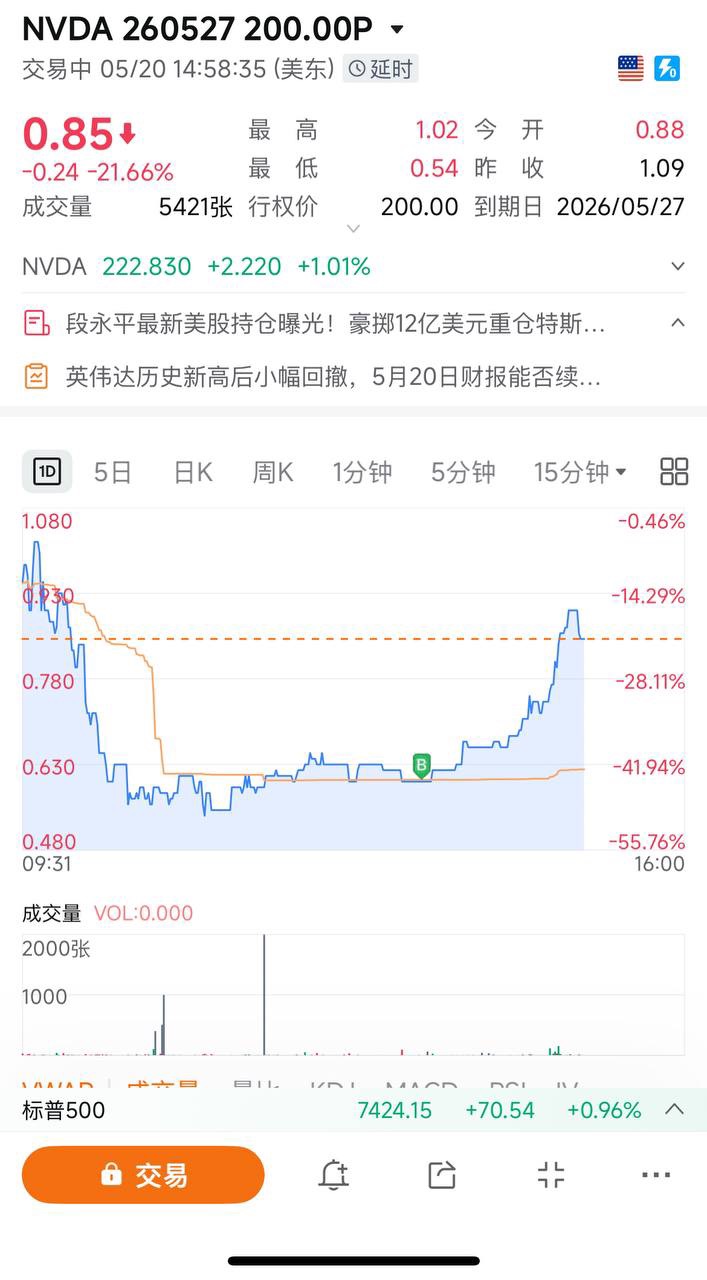
The total score is only 100 points, can Nvda score 200? The results will be announced tomorrow$NVIDIA(NVDA.US)