Combining Obsidian with AI tools like Codex or Cursor for knowledge management is really quite effective.
I specifically looked it up, and Obsidian's parent company isn't publicly listed, nor are there any investment channels. Sigh.


Combining Obsidian with AI tools like Codex or Cursor for knowledge management is really quite effective.
I specifically looked it up, and Obsidian's parent company isn't publicly listed, nor are there any investment channels. Sigh.
Yesterday, Goldman Sachs released a research report with the core view that PLTR's TAM is poised for leapfrog growth. Why this perspective? I attempt to break it down from three angles: PLTR is no longer just a 'government data platform + high-growth software' but is entering a second-layer TAM market: budgets paid by institutions for sovereign AI and industry-specific production applications are deeper and broader than traditional data analytics solutions. Three drivers...
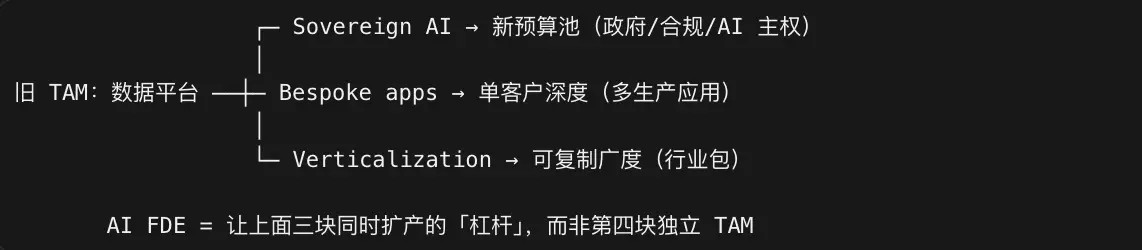
Goldman Sachs released a research report on PLTR with a 'Buy' rating, focusing on the analytical logic rather than the target price. Goldman posits that 'as enterprise users focus on AI sovereignty and customized applications, PLTR is poised for a transformative leap in its TAM.'
'The FDE model isn't just about hiring FDEs; it requires establishing tight feedback loops between the field and product development. Palantir has refined this mechanism to the point where AI can automate FDE operations.'
Nearing $200 pre-market $Palantir Tech(PLTR.US)
$BitMine Immersion Tech(BMNR.US) Tom Lee, in his speech at yesterday's Token2049 forum, stated that the 5% coin accumulation target is about to be met, after which they will pause and stop buying, meaning no further dilution from financing.
Next, cash and staking yields will primarily be used for three things:
1. Share repurchase
2. Expanding the scale of MAVAN
3. New ETH ecosystem investments, potentially data centers, such as transitioning mining equipment from the original mining business
I went back to my hometown for the holidays and wasn't in Beijing. It felt like AI suddenly vanished from daily life—no one was talking about it, nor caring.
Looking at it this way, there's still a huge room for AI penetration.
The 62k–63k range is the chip peak that gradually formed before the August rally, accumulating 1.4 million BTC. Since this peak didn't loosen during the pullback, it established 62k as a support floor.
The 83k–84k range is the next chip peak, where roughly 1 million BTC has gathered. BTC has now risen into this zone; if it holds steady and the chip distribution remains intact, 83k will become the new base.
With the bill and rate hikes behind us, there are no major macro events left, and the bearish pressure hasn't hit hard, indicating that support at 7.5w and 2.35k remains solid.
As oil prices face downward expectations, crypto is rallying; we're eagerly anticipating ETH breaking through the 2.8k resistance level.
Partisan competition takes top priority; not a single Democratic congressman voted in favor.
Even if the bill fails, BTC at 7.5w and ETH at 2.35k still have solid support after the wick. The vote is more of an interlude; the pessimistic outcome is already priced in. Moving forward, the main focus remains on the FOMC.
Many investors are tracking the odds shifts for the Clarity Act on Polymarket, which have swung from 15% to 30% and back down to 19% over the past two days, reflecting a tense tug-of-war between the two parties.
It's important to note that the 19% or 30% odds on Polymarket specifically refer to the likelihood of the bill being enacted by 2026. The Sept. 15 vote merely determines whether the bill enters the Senate review agenda. With midterm elections this year and the House adjourning early in late September, even if the Sept. 15 vote passes, the window for subsequent legislative action remains tight, keeping Polymarket odds low.
The current focus is on the Sept. 15 vote itself. I believe the probability of passage here is far higher than the 19% implied by Polymarket. A likely outcome is a bipartisan compromise: passing the vote to uphold procedural norms while continuing to haggle during later legislative stages. This means significant hurdles remain for 2026 enactment—so the 19% figure might still be accurate—but it doesn't change the fact that the Sept. 15 vote has a ~40–50% chance of passing.
$Strategy(MSTR.US)$Coinbase(COIN.US)$Circle(CRCL.US)
$BitMine Immersion Tech(BMNR.US)
Clarity played out until the last moment before the vote; Trump made concessions to ethic, slightly increasing the likelihood of approval.
ETH has been doing pretty well recently; it's resilient to negative news and surges on positive ones, slowly recovering. $IShares Ethereum Trust ETF(ETHA.US)
$BitMine Immersion Tech(BMNR.US)
Bessent is being so straightforward, giving a live demonstration of what a "market maker" really means.
- It's about possessing extremely asymmetric information.
"When we intervene in the yen market, I know exactly what the Japanese people, the Bank of Japan, and the Japanese decision-makers are going to do."
Crypto recently pulled back after a rally and is stabilizing; trading volumes for MSTR and BMNR have also declined to levels seen before this uptrend. Although ETFs are still seeing net inflows, the pace has slowed. These signs suggest the market has entered a consolidation phase.
The move on Aug 20 was driven by Trump's crypto meeting and Bessent's buybacks. The current consolidation reflects a wait for the next major macro signal, with two key dates to watch:
Sept 15: Clear Act vote - the most critical policy event for crypto, requiring 60 votes to advance to Senate consideration.
Sept 16: FOMC meeting - interest rate decision that will determine macro liquidity.
Until then, expect continued consolidation with shrinking volume.
This chart shows the power-law distribution of BMNR and ETH tracked since August '25.
As seen above, there is a clear gap for ETH between 2.4k and 2.8k. Below 2.4k, both upside and downside ranges contract significantly, corresponding to the compression of BMNR's premium when ETH fell into the 1.5k-2.4k range over the past six months; above 2.8k, these ranges expand, implying greater volatility for BMNR vs. ETH, thus opening up upside potential for mNAV.
The sharp drop in ETH in February '26 created a vacuum zone between 2.4k and 2.8k. Chips in this range haven't undergone sufficient turnover, meaning there's little resistance here. A breakout could lead to a rapid surge to 2.8k, at which point BMNR's mNAV also has the opportunity to expand significantly.
The key observation level for ETH is the breakout of 2.8k.
$BitMine Immersion Tech(BMNR.US)
BMNP has also hit a new high. Although liquidity remains mediocre and not on the same level as STRC, we look forward to unlocking more potential in the future to enrich BMNR's financing toolkit.
Last week, BMNR's average daily trading volume was 1.3 billion, nearly 4x its previous level, and mNAV also bounced back to 1 at certain highs. Liquidity is the foundation of DAT; management restored cash positions via ATM offerings, accumulating over 30k coins and 300 million in cash.
Over the past two months, they repurchased shares when mNAV was at 0.8 and raised capital via ATM when mNAV returned to 1, corresponding to stock prices of roughly 16 for repurchases and 24 for equity financing.
I strongly agree with management's operational strategy over the past two months, and it seems the market is buying in as well.
$BitMine Immersion Tech(BMNR.US)
The net capital inflow into the 'Big Pie' and 'Second Pie' ETFs is still accelerating. After the massive single-day surge that triggered a short squeeze the day before yesterday, sustained upward momentum requires real capital to continue absorbing positions, which appears to be the current trend.
$Strategy(MSTR.US)
$BitMine Immersion Tech(BMNR.US)
$iShares Bitcoin Trust ETF(IBIT.US)
$IShares Ethereum Trust ETF(ETHA.US)
Compared to the gains in BMNR and ETH yesterday, the breakout of the large bullish candle on ETH/BTC is even more exciting, indicating that ETH is not simply following BTC's rise but is showing a stronger upward momentum.
Rising from a June low of 0.025 to 0.033, if the driver behind yesterday's crypto surge was liquidity from Treasury repurchases plus positive sentiment from the White House crypto meeting, the strength of ETH/BTC confirms the narrative: clear regulation → tailwinds for tokenization → tailwinds for ETH.
PS: Heard yesterday's liquidation event was second only in scale to Oct 11, but this time it was short sellers who got liquidated.
$BitMine Immersion Tech(BMNR.US)
$IShares Ethereum Trust ETF(ETHA.US)
In the previous cycle, MSTR's mNAV bottomed out before BTC;
In this cycle, MSTR has additional STRC, and BMNR has added BMNP. After experiencing the decoupling of STRC approaching 70 in July, MSTR restored its cash reserves by selling BTC and using ATM offerings, prioritizing STRC interest payments. Currently, STRC has also rebounded to around 95, as shown in Figure 1;
The same applies to BMNR's mNAV. Figure 2 shows the mNAV trend I've been tracking. BMNR's mNAV briefly returned to 1 in June but then fell to 0.8 along with the decline in ETH. However, with continuous buybacks by management for four consecutive weeks starting in July, market confidence was bolstered. With buybacks as a safety net, 0.82 became the bottom for mNAV. Currently, mNAV has rebounded to 0.95; this repair process took nearly two months;
If ETH rebounds further to $2k, I believe mNAV is expected to recover to 1. Based on these two observations, my view leans towards the idea that as STRC and BMNR's mNAV bottom out and rebound, both BTC and ETH are also nearing their bottom regions.
$BitMine Immersion Tech(BMNR.US)
$Strategy(MSTR.US)
$Microstrategy Inc Pref Shares STRC 9.0 Perp(STRC.US)
An analysis by JP Morgan on the winners of open-source vs. closed-source in different scenarios
The conclusion is that regardless of whether open-source weights, closed-source weights win or lose, or if it's a dead heat, large cloud providers and NVIDIA will all win
The logic behind open-source models benefiting cloud providers: The rise of open-source models is dismantling the monopoly of closed-source models, transforming CSPs from mere resellers of tokens into AI operating systems: Cloud providers control routing rights, customer relationships, and pricing power, allowing them to directly host open-source models and sell tokens, thereby reducing external profit-sharing. Meanwhile, open-source competition drives up training investment and call volumes.
This ultimately forms a positive cycle: Model layer rents decrease → Cloud provider monetization efficiency improves → Inference price drops stimulate new demand → High data center utilization drives continuous compute investment
$NVIDIA(NVDA.US)$Alphabet(GOOGL.US)$Amazon(AMZN.US)$Microsoft(MSFT.US)$Palantir Tech(PLTR.US)
PLTR differs significantly from other tech companies in its clear-cut stance on ideology or corporate spirit, and it never hides this. I previously discussed similar views with @Luyouyou; as a result, PLTR has an additional layer of value-driven appeal to top talent in Silicon Valley, which extends the company's narrative.
Perhaps it was Karp's background as a PhD in philosophy that shaped the company's culture. From publishing the book *The Technological Republic* last year to emphasize that tech companies should be closely aligned with national core interests, to the narrative on AI sovereignty since June this year, all these arguments for PLTR are presented from a perspective of value-based deliberation.
The shareholder letter following this earnings report continues to emphasize AI sovereignty. Karp stated very clearly in the letter:
"We will not be compensated based on clicks, tokens, or chat volume."
"Others, including many companies building large language models, whether intentionally or unintentionally, intend to control the means of production of their so-called partners."
"We have always refused, and will continue to refuse, to establish a parasitic relationship with our partners."
$Palantir Tech(PLTR.US)
Last week, two leading DAT companies both conducted share repurchases. BMNR repurchased 4.5 million shares, marking the third consecutive week of repurchases, with a cumulative total of 16 million shares.
MSTR also engaged in repurchases, but they were buying back STRC. The funds were raised by selling BTC (1638) and utilizing MSTR's ATM (3 million shares). It appears the company prioritizes protecting STRC, which is somewhat misaligned with the interests of MSTR shareholders.
$BitMine Immersion Tech(BMNR.US)
$Strategy(MSTR.US)
After the initial repurchase of 5.5 million shares, BMNR continued to repurchase another 6.1 million shares last week. mNAV is around 0.85, and ETH/BTC has rebounded to 0.03, a high point in nearly 3 months, with decent momentum.
$BitMine Immersion Tech(BMNR.US)
$IShares Ethereum Trust ETF(ETHA.US)
The biggest news yesterday was Huang Xiaoming opening an X account and posting his first tweet. An open letter initiated by a16z, jointly signed by NVIDIA, Microsoft, PLTR, PerplexityAI, Ollama, and other tech companies, explicitly advocates that "cutting-edge open-source models and cutting-edge closed-source models should coexist and develop."
Among so many companies, who didn't sign? Obviously Company A.
There is a data point: the weekly token share of Chinese open-source models used by US enterprises is approaching 60%. With open-source models accounting for such a large proportion of token consumption in US enterprises, if they are banned or restricted, enterprise costs will surge dramatically.
We previously discussed two paths for AI competition: model expansion and platform expansion. Now, enterprise AI adoption has entered the engineering era, with AI adoption in the enterprise market increasingly shifting to scenario-specific application models:
1) High-value scenarios continue to use high-value tokens from cutting-edge closed-source large models;
2) In high-frequency, low-complexity task scenarios, enterprises are increasingly favoring high cost-performance tokens (mostly from open-source models).
This trend is inevitable:
- For chip manufacturers, whether using which model, training and inference are required;
- For cloud providers, the more model choices offered to enterprise customers, the higher the gross margin;
- For deployment layers (such as PLTR) or application-oriented companies, there is naturally a stronger incentive to choose high cost-performance tokens.
The co-signing enterprises on this open letter basically fall into these three categories, so behind the open letter lies extremely strong commercial demands and huge commercial value. In other words, the attitude of O and A making money while blaming customers is increasingly causing dissatisfaction among customers and the industry, and the competition is becoming increasingly fierce.
$NVIDIA(NVDA.US)$Microsoft(MSFT.US)$Palantir Tech(PLTR.US)
Last week, mNAV remained at 0.8~0.85, and BMNR finally repurchased shares, 5.5 million shares $BitMine Immersion Tech(BMNR.US)


