
The logic of AI trading in the US stock market has changed dramatically: Mag 7 has turned into "Lag 7," and storage chip…
 Complete. Here is the key summary
The trading logic of AI in the US stock market has undergone a dramatic change, shaking the market dominance of the Magnificent Seven (Mag 7). Despite the overall market rising, the Mag 7 index only slightly increased by 1.1%, while memory chip stocks such as Micron, SanDisk, and the Philadelphia Semiconductor Index surged significantly. Investors are focusing on the biggest beneficiaries of AI funding and are skeptical of the capital-intensive giants, leading to a sell-off of individual stocks like Microsoft and Meta, resulting in a massive evaporation of market value and a clear divergence in the market
According to the Zhitong Finance APP, for many years, the "Magnificent Seven" of the US stock market—NVIDIA (NVDA.US), Alphabet (GOOGL.US), Apple (AAPL.US), Microsoft (MSFT.US), Amazon (AMZN.US), Meta Platforms (META.US), and Tesla (TSLA.US)—have firmly attracted the attention of investors and dominated the trends of the S&P 500 index. However, those days seem to be gone.
Despite the Nasdaq 100 index rising nearly 18% year-to-date in 2026 and the S&P 500 index increasing about 10%, the Mag 7 index has only risen by 1.1%. The market power of these tech giants was created by AI trading, which continues, but the nature of the trading has fundamentally changed—investors are now focusing on the biggest beneficiaries of massive AI funding while becoming increasingly skeptical of the companies receiving the investments.
Memory chip manufacturers like Micron Technology (MU.US) and SanDisk (SNDK.US) have surged to the top of the gainers list, while Mag 7 stocks have been marginalized. The Philadelphia Semiconductor Index (SOX) has risen over 80% year-to-date in 2026, with an 88% increase in the second quarter, marking the strongest single-quarter performance in the index's history.
Divergent market: Who is falling, and who is rising against the trend
The market has not blindly abandoned all seven giant stocks but has conducted a "selective sell-off" based on investment intensity—companies with the most aggressive capital expenditures have borne the brunt of the sell-off pressure.
In the declining camp, Microsoft has fallen about 22% year-to-date, recently recording its worst monthly performance since 2000. In June, Microsoft dropped 18.1% in a single month, with a market value evaporating by approximately $570 billion. Meta has retreated about 14% over the past six months; Tesla has also experienced varying degrees of decline.
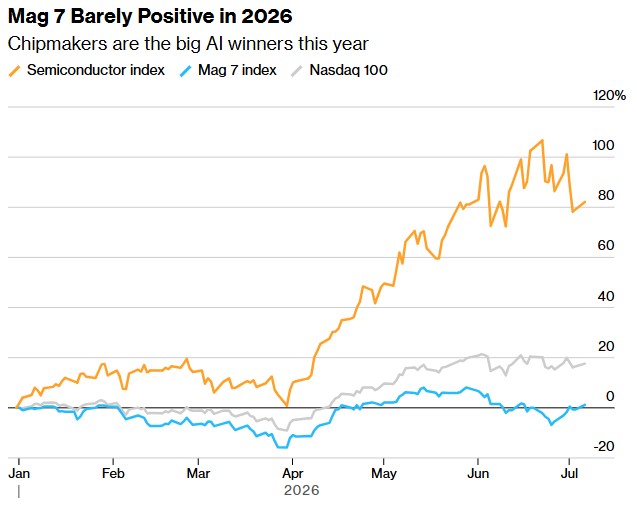
In just June alone, the combined market value of the seven giants evaporated by approximately $2.3 trillion, marking the worst single-month performance in a year. The price of the Roundhill Magnificent Seven ETF (MAGS), which tracks the seven giants, has fallen from this year's peak of $71.10 to about $65.10, a decline of 8.7%, with capital outflows reaching $248 million year-to-date. According to ETDFB data, MAGS has seen cumulative outflows exceeding $607 million over the past six months, with assets under management dropping to $3.6 billion.
On the contrary, Alphabet has risen about 12%; Apple and NVIDIA have also recorded gains. However, NVIDIA has also fallen 7.7% from its historical peak. The divergence within the Magnificent Seven reflects the market's refined pricing based on expected returns from AI investments.
In April of this year, the 40-day correlation between the Mag 7 index and the Nasdaq 100 index peaked above 0.95, indicating near-perfect synchronization. Recently, this correlation has dropped below 0.7, marking the lowest level since 2017 In a report sent to clients on June 30, Jessica Rabe, co-founder of DataTrek Research, wrote that the "synchronization of large tech stocks and the S&P 500 index is almost the same as in 2015, when these stocks accounted for only 10% to 11% of the index."
The decoupling of the Magnificent 7 from the broader market may best reflect the evolving trend of AI trading, focusing on emerging winners, particularly memory and storage chip manufacturers. These companies had previously performed strongly, but the difference now is that their growth has largely freed itself from the constraints of NVIDIA. NVIDIA was once a bellwether in the AI field, dominating the stock market for a long time. However, this year, NVIDIA ranked third from the bottom among semiconductor benchmark stocks, rising only 4.9%.
Capital Flow: The "Great Migration" from Magnificent 7 to Storage ETFs
The withdrawn funds have not left the market but have undergone deep sector rotation. Scott Rubner, a strategist at global leading quantitative market maker Citadel Securities, pointed out that the current weight of the semiconductor sector is approaching one-fifth of the S&P 500 index, about four times that of 2020.
Capital flow data clearly outlines the trajectory of this rotation. The three giants in storage chips—Micron, SanDisk, and Western Digital—have collectively contributed nearly a quarter of the S&P 500 index's gains this year. According to strategist Simon White's calculations, over the past six months, Micron alone contributed about 1.4 percentage points to the cumulative 8.3% gain of the S&P 500 index, accounting for nearly one-sixth.
The performance of storage stocks can be described as "explosive": SanDisk recorded an approximately 860% increase in the first half of 2026, Micron rose 304%, and Intel increased 278%, becoming the three best-performing stocks in the S&P 500 index during the same period. The world's first actively managed ETF in the memory sector—Roundhill Memory ETF (DRAM)—has risen 141% since its establishment in April. Nearly all of the approximately 20% gain in the Nasdaq 100 index in the first half of the year was contributed by 10 stocks, with Micron alone contributing 26% to that index's gain.
Retail investors have shown extremely high enthusiasm for this. In June, the average daily premium trading volume for retail investors in semiconductor options reached about $1.9 billion, nearly six times the historical average, with the vast majority being call options.
Data shows that in June, investors withdrew $786 million from the Roundhill Magnificent Seven ETF, a record high, while at the same time, $9.3 billion flowed into the Roundhill Memory ETF. Deutsche Bank strategists wrote in a report on June 30: "At the end of May, the positioning of large tech stocks was 'extreme,' but 'has now returned to a more neutral level.'"
The alternating profit expectations between tech giants and storage chip stocks: a fundamental reversal of growth momentum Behind this rotation is a fundamental reversal of profit expectations. The profit growth advantage of the seven giants is rapidly narrowing. According to forecasts, the earnings per share (EPS) growth rate of the Magnificent Seven is expected to slow to 20% in 2026 and further decline to 18.9% in 2027, down from an expectation of 21.4 three months ago; meanwhile, the EPS growth rate for the remaining 493 companies in the S&P 500 is expected to be 11% and 15% in 2026 and 2027, respectively—this gap is closing at an astonishing rate. In contrast, profit expectations for chip manufacturers have been significantly raised. Industry research data shows that profit expectations for chip manufacturers have been revised upward from 34.3% to 48.5% over the past three months.
UBS pointed out in its latest report that the technology sector is undergoing an "unusual" transformation, with the performance of artificial intelligence infrastructure stocks expected to far exceed that of most of the "Magnificent Seven." Data from UBS's research department, Holt Unit, indicates that the cash flow return on investment (CFROI) forecast for AI infrastructure companies is accelerating; however, over the past two years, as commitments to AI spending have soared, the CFROI forecasts for large tech companies have declined by 200 basis points.
More critically, there is a gap in economic profits. UBS estimates that economic profits in the AI infrastructure sector will soar from about $200 billion in 2023 to an estimated $1.4 trillion in 2027, an increase of 600%; during the same period, the economic profits of hyperscale data center operators are expected to rise only from $200 billion to about $400 billion. Storage stocks alone are expected to contribute half of the anticipated growth in the infrastructure sector.
UBS analysts wrote, "The magnitude of this transformation is unusual." Three years ago, the HOLT forecast framework listed Apple, Microsoft, Alphabet, Meta, and Amazon as the top five economic profit creators in the industry; by 2027, the top five are expected to be NVIDIA, Samsung, SK Hynix, Micron, and Alphabet. Storage chip companies, which reported losses in 2023, are expected to leap into the top five value creators in the global TMT industry by 2027, second only to NVIDIA.
Talbott stated, "The rarity of this situation cannot be overstated: an industry that has historically been cyclical and commoditized has, in just a few years, risen from a value destroyer to the top of the global rankings."
The "Double-Edged Sword" of AI Capital Expenditure: From Growth Engine to Trust Crisis
The core contradiction of the seven giants' slowdown lies in the "double-edged sword" effect of AI capital expenditure. So far this year, the seven giants have invested over $650 billion in data centers and chips behind AI. This has raised concerns in the market—when will these massive expenditures translate into substantial returns? Companies like Microsoft, Amazon, Alphabet, and Meta are significantly accelerating capital expenditures, putting pressure on cash flow, while the returns on investment remain unclear.
Apollo Global Management pointed out that these companies' expected free cash flow over the next 12 months will be far below 2024 levels. Brian Barbetta, co-head of the technology team at Wellington Management, stated, "The market is currently discussing whether cloud computing companies will face declining capital return rates and profit margins." Wedbush analyst Dan Ives described this market situation as a "divergent market." Jim Cramer stated that Wall Street is now more inclined to support companies providing AI tools rather than those funding AI projects. He characterized Amazon, Alphabet, Microsoft, and Meta as "becoming victims of their own AI ambitions."
According to reports, Meta CEO Mark Zuckerberg mentioned in a company-wide meeting that the development of its AI agents has not "accelerated in the way we expected." The company is reportedly also formulating plans for its cloud infrastructure business to sell excess computing capacity. These expenditures for AI have directly flowed to memory chip manufacturers such as Micron and SanDisk.
"Investors will flock to the areas with the strongest growth and returns," Barbetta said. "Currently, companies like Micron and SanDisk not only have faster profit growth but also have the strongest positive revisions in their earnings expectations."
Is the rotation in the second half of AI trading sustainable?
This massive capital migration from the Magnificent 7 to chip stocks essentially represents the evolution of the AI narrative from "concept hype" to "industry chain value reassessment." AI trading is shifting from "who is spending money" to "who is making money." Whether the hyperscale cloud service providers can prove during the upcoming earnings season that their massive capital expenditures are translating into revenue and profits will determine whether this rotation is a temporary episode or the starting point of a long-term trend.
Mark Lehmann, Vice Chairman of Citizens Bank Commercial Banking, may have the most representative judgment: "The Magnificent 7 still has value, but investors were very confident in their prospects in the past, and now they are more skeptical. Compared to Micron and SanDisk, their profitability seems to be second or third tier, while expectations for these two companies are continuously rising. It is hard to see how the Magnificent 7 can compete with them."
Whether hyperscale cloud vendors can narrow the gap will ultimately determine the trajectory of the entire AI trade by the end of 2026. The next quarterly earnings season will be a key point to test whether this trend continues.
However, when everyone rushes in the same direction, signals of market turning points also begin to flash. Mike Wilson, Chief U.S. Equity Strategist at Morgan Stanley, released a significant report on July 6, pointing out that the upward momentum of chip stocks is "clearly weakening." Wilson stated that as investors shift funds to previously underperforming sectors—including AI hyperscale cloud computing vendors—the upward momentum of semiconductor stocks is diminishing. He warned that the semiconductor industry is highly dependent on cloud computing giants, and the divergence in their performance is difficult to sustain in the long term.
Citadel Securities strategist Scott Rubner pointed out another risk: the current weight of the semiconductor sector is approaching one-fifth of the S&P 500 index, about four times that of 2020, making trading crowded and highly leveraged, which is prone to trigger a deleveraging sell-off.
Goldman Sachs Chief U.S. Equity Strategist Ben Snider, however, holds a different view, **noting that the valuations of the tech giants have fallen back to low ranges similar to those during the pandemic shock in 2020 and the interest rate hike cycle in 2022, significantly enhancing their attractiveness. Goldman Sachs has advised clients to increase their holdings in related stocks HSBC strategists' research shows that the Magnificent Seven are currently at the lower end of their respective ten-year forward P/E ratio ranges—Nvidia's dynamic P/E is close to 20 times (a ten-year historical low), Meta is close to 16 times, and Microsoft and Google are around 24 times.
HSBC strategists Duncan Toms and Max Kettner's research shows that the Magnificent Seven are currently at the lower end of their respective ten-year forward P/E ratio ranges: Nvidia's dynamic P/E is close to 20 times (a ten-year historical low), Meta is close to 16 times, and Microsoft and Google are around 24 times. This round of valuation adjustment is based on rising earnings rather than declining earnings—Meta, Amazon, Microsoft, Nvidia, and Broadcom have all seen their rolling P/E ratios decline over the past year, as earnings growth has outpaced stock price increases.
From 2016 to 2020, the Magnificent Seven also invested heavily in building data center cloud computing networks, during which investors were anxious about large-scale capital expenditures and profit margins—but these capital expenditures successfully transformed into absolute leading advantages in revenue and profit margins. Since 2016, the revenue of the Magnificent Seven has grown by nearly 375%, while the S&P 500 index's revenue has grown by about 95%.
JP Morgan strategist Nikolaos Panigirtzoglou wrote in a report that as hyperscale data centers, AI model providers, and users make progress in profitability, revenue, and profits, they are beginning to catch up, thereby capturing a larger share of the overall value added in AI, and this gap will ultimately narrow.
From Mag 7 to Lag 7, from "gold diggers" to "shovel sellers"—the narrative of AI continues to evolve. And when everyone rushes towards semiconductors, the real risk may not be choosing the wrong track, but rather that everyone is standing on the same side of the boat