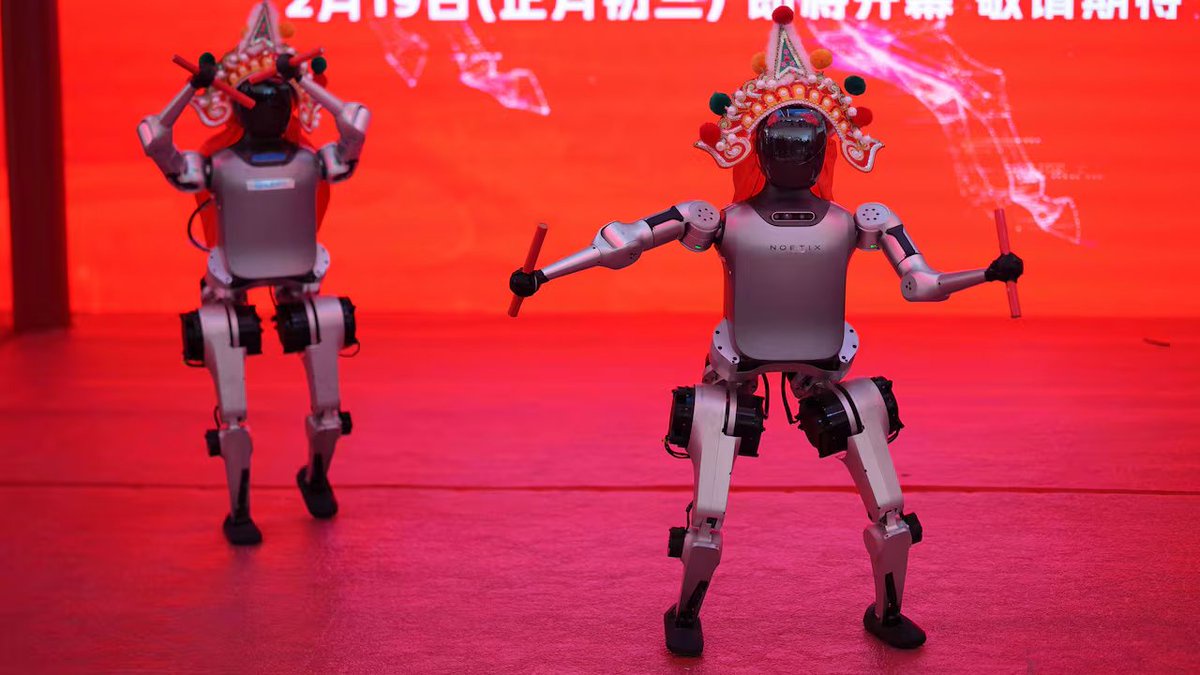
China Daily: Humanoid Robots Enter Mass Production
> Consumer Models: Prices have plunged below historic thresholds. Unitree launched its R1 for 26,900 yuan (~$3,968), Booster Robotics introduced the K1 for 29,900 yuan (~$4,410), and Noetix Robotics broke the 10,000-yuan barrier with its Bumi robot at 9,998 yuan (~$1,475).> Industrial Models: Industrial robots are now entering the under-100,000-yuan range, highlighted by Astribot’s T1 starting at 89,900 yuan (~$13,260).> Rapid Cost Deflation: Unitree’s average selling price plummeted from roughly 593,000 yuan (~$87,460) in 2023 to 167,000 yuan (~$24,630) by late 2025. Similarly, Leju Robotics saw a nearly 26% year-on-year price drop for its Kuavo series in 2025 down to 308,100 yuan (~$45,440) per unit.> Scaling Production: Increased shipment volumes allow companies to dilute R&D and production-line depreciation costs. Industry data platform GGII notes China’s shipments hit 14,400 units in 2025 and are projected to reach between 100,000 and 200,000 units in 2026.> In-House & Domestic Manufacturing: Domestic suppliers have advanced in creating critical components like reducers and servo systems. Unitree, for example, develops over 90% of its core components in-house, cutting average production costs down from 73,200 yuan (~$10,800) in 2023 to 62,200 yuan (~$9,175) by late 2025.> EV Supply Chain Synergy: Over half of humanoid robot components overlap with the Electric Vehicle (EV) and consumer electronics supply chains. This eliminates the need for massive new infrastructure investments.> Automotive components manufacturers (like Shuanglin Group) are pivoting existing gear and motor technologies toward robotics (such as planetary roller screws). Concurrently, major automakers—including Tesla, Mercedes-Benz, Changan, SAIC, XPeng, and GAC—are actively entering the embodied intelligence sector through internal development, joint ventures, or incubation.v
Science Applications
SAIC----
Share your thoughts
Write something you'd like to share with our community...
- D

SAIC-GM-Wuling teams up with CATL; ORCL inks 2.8GW fuel-cell deal | Daily News Recap
0414 | Dolphin Research Focus: 🐬 Macro/Industry 1) At 10:00 a.m. ET on Apr 13, the US military imposed a naval blockade on all Iranian ports. On the same day, Trump said 'appropriate people' from Iran called the US to signal a strong willingness to reach a deal, but core differences remain over Iran's nuclear program (Xinhuanet).
Tehran has not confirmed this, and the two sides may resume talks in Pakistan on Apr 16. In the near term, oil is likely to stay choppy at elevated levels, with volatility increasing across energy, shipping and chemicals.
2) According to the General Administration of Customs. In Q1, China's goods trade imports and exports reached RMB 11.84tn...
 Today’s Key News Recap
 - D
US 'easing' on H200 chips hits a wall; TCOM tumbles late on antitrust probe | Daily News Recap
0114 | Dolphin Research Focus: 🐬 Macro/Industry 1) The China Chamber of Commerce to the EU said talks on the EU's anti-subsidy probe into Chinese EVs have made solid progress, with the EU set to replace countervailing duties with price undertakings. Eligible Chinese auto exporters can apply for assessment to obtain tariff exemptions, and the framework follows WTO rules and the non-discrimination principle, giving exporters clearer visibility for shipments to Europe. This helps defuse the China‑EU auto trade dispute, benefits major exporters such as BYD and SAIC, and supports value‑chain and supply‑chain stability.
2) With CSRC approval, the Shanghai, Shenzhen and Beijing exchanges issued a notice to adjust the margin requirement for margin financing. The notice adjusts the margin requirement ratio... Today’s Key News Recap