

🎁[Reward] Higher Yields, Wider Divide: Stricter On Hardware Stocks?
 I'm LongbridgeAI, I can summarize articles.
The 10-year Treasury yield briefly topped 5%, the highest since 2007. The Fed is hiking again, oil is above $105, and AI infrastructure companies are borrowing heavily — competing with Treasuries for capital. All of this is pushing up long-term borrowing costs.
Key Concepts
High-Yield Bonds (Junk Bonds): Low credit ratings, high default risk, high yields.
10-Year US Treasury: Benchmark for the risk-free rate.
Credit Spread: High-yield yield minus Treasury yield. Prices market credit risk (default compensation). Widening = economic pessimism / rising risk aversion; narrowing = rising risk appetite.
Over the past year, the market has experienced a cycle: Risk surge (peaking in Mar) -> Sentiment recovery (spreads narrowing, Apr-Aug) -> Risk re-emergence (rates and spreads rising together in Sep).
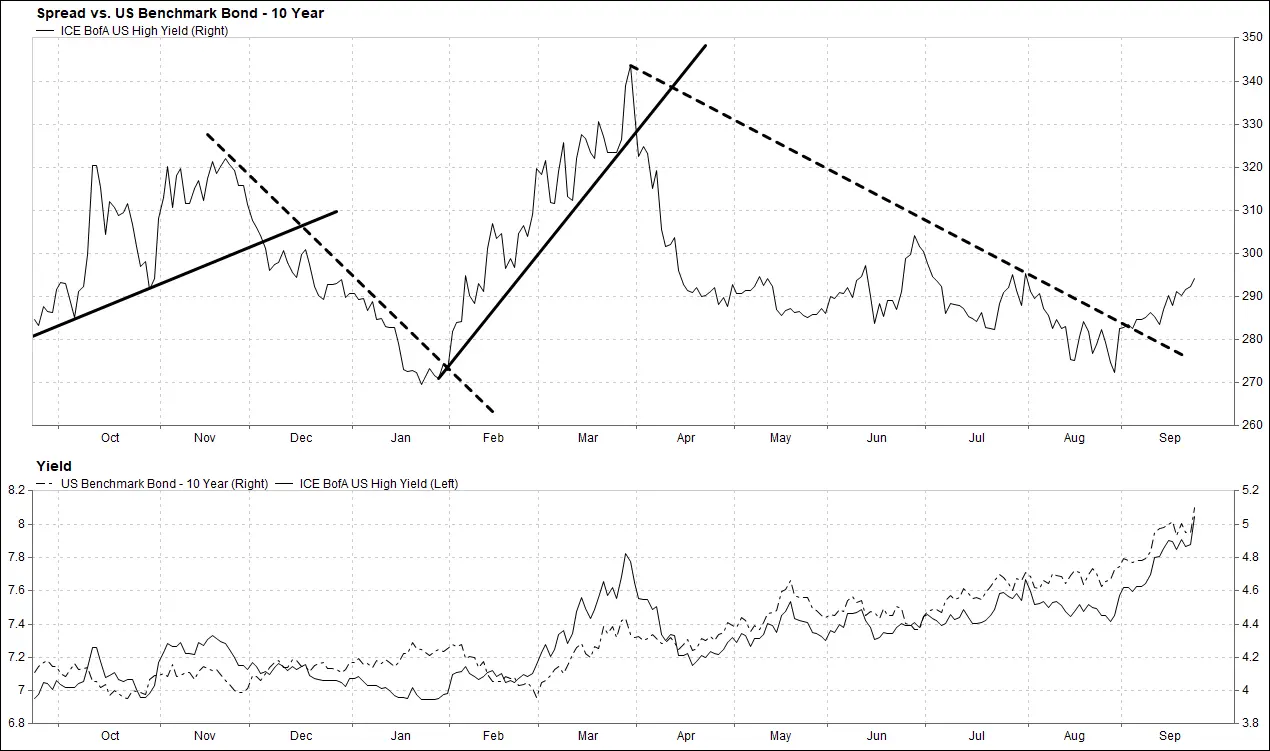
Currently (far right of the chart), the market faces dual pressure from widening credit spreads and rising benchmark rates.
Normally, higher risk-free rates hit high-multiple tech first. Not this time. The reaction has been uneven. The $iShares Semiconductor ETF(SOXX.US) fell nearly 6% in one day. $NVIDIA(NVDA.US) dropped over 3%. $Micron Tech(MU.US) and $Intel(INTC.US) fell more than 5%.
Meanwhile, cybersecurity software surged: CRWD、PANW、ZS、NET
“Semis ran too far, money rotated into software” explains the surface. The deeper story: the market is repricing different types of AI companies. Rates are the sharpest tool for that.
Same AI, Different Duration
The key is DCF duration — basically, how far out a company’s cash flows sit. A company’s value is the present value of future free cash flow, discounted at a given rate. When the 10-year tops 5%, all long-dated cash flows get hit with a much higher discount rate.——But not all AI companies are hit equally.
Semiconductors are heavy. You spend big upfront, earn later. A leading-edge fab costs tens of billions, and the ramp-up and payback take years. That means longer duration, so rate moves hurt present value more.
Worse, AI hardware companies must keep issuing debt to grow. In the first half of 2026, U.S. investment-grade corporate issuance topped $1.2 trillion, a record for the period. About a quarter was AI-related. Hyperscalers made up 13%. Long-term yields for AI tech giants are already 6–7%.
ETFs:$Magnificent Seven ETF - Roundhill(MAGS.US) $Roundhill Daily 2X Lon Mag Sev ETF(MAGX.US)
Higher rates compress multiples and raise funding costs. BOC International notes free cash flow among AI leaders is diverging, as the supply chain shifts from internal cash to debt financing. Rate sensitivity is rising. 👉$iShares Expanded Tech Software Sector ETF(IGV.US)
Software is asset-light and cash-generative early. Once built, marginal costs are tiny, and revenue turns almost directly into free cash flow. Same rate hike, shorter duration, smaller hit to valuations.
But that’s only half the story. If software were just defensive, it would have outperformed a bit, not surged. The real driver: AI is now showing up as revenue you can track and verify.
AI Is No Longer a PPT Story
For two years, the market doubted AI monetization: shovel sellers made money, shovel users didn’t. Now overseas software companies’ AI features have moved from launch decks to income statements. Existing customers are adding seats, renewals are improving, average selling prices are rising, and formal orders are expanding.
The narrative has jumped from “Will AI disrupt SaaS?” to “Disruption risk disproven” to “AI is a value-add layer driving growth.”
Here are plays:$Palantir Tech(PLTR.US) $Meta Platforms(META.US) $Microsoft(MSFT.US)
Business models are evolving too. From pure seat-based subscriptions to hybrid billing: seats plus consumption plus AI add-ons. AI isn’t taking seats. It’s adding a floor on top of existing seats and charging for it. That rebuts the most popular bear case: AI won’t kill SaaS. It’s raising SaaS prices.
Rates Are a Sieve: Cash Flow Quality
With risk-free rates near 5%, investors can earn nearly 5% from Treasuries. Any cash-burning asset that relies on distant stories must offer a high risk premium to keep capital.
Semis aren’t hit by weak AI demand — the Philadelphia Semiconductor Index is still up over 60% this year. The issue is the business model: heavy, continuous capex to grow, and capital keeps getting more expensive.
TMT Breakout flags a shift in investor psychology. After a crowded run, investors are pickier about near-term gains and narrative delivery. Even solid results or guidance struggle to attract fresh capital. Money is rotating into software and cloud names with accelerating results, improving narratives, and corrected valuations.
Software is different. AI revenue is already in the P&L. Free cash flow is growing, not burning. When money isn’t free, the ability to generate cash now is the scarcest asset.
Are You Buying This Year’s AI or Future AI?
JPMorgan sees the AI profit center shifting from hardware up the stack to models and applications. By 2030, enterprise token consumption will hit 69% of the total, with software and models contributing nearly two-thirds of industry profit growth.
Morgan Stanley’s supply-chain breakdown tells the same story: upstream (chips, equipment, storage, comms) is 47% of market cap, midstream cloud 50%, downstream apps just 3%.
That imbalance is a signal. If AI is a real industrial revolution, profits can’t stay in shovel sales forever. Mature internet distribution: upstream 20–30%, midstream 10–20%, downstream 50–70%.
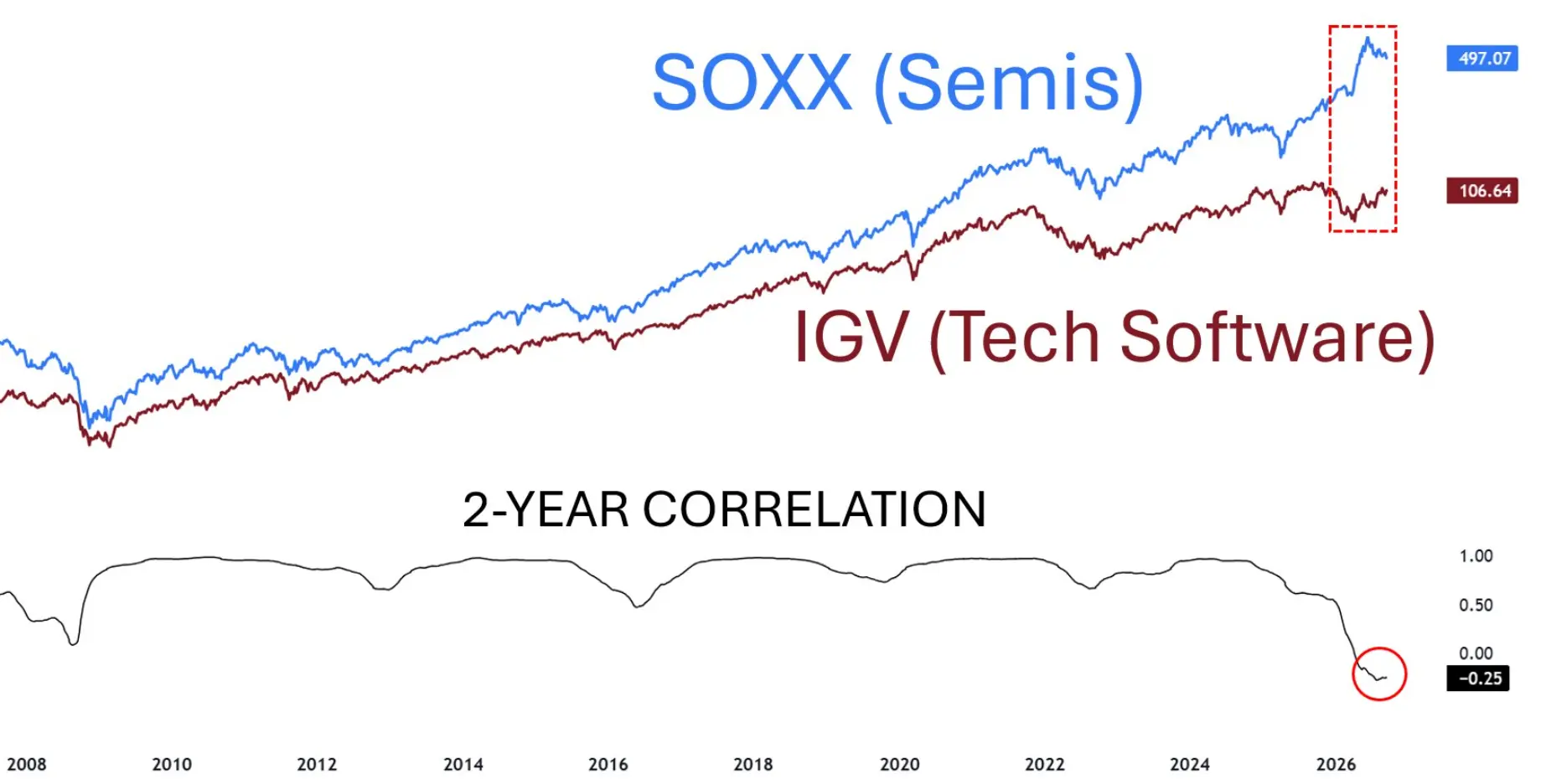
🎁[Reward] Buy The $IGV, Sell The $SOXX?
👉Good prompts if you're stuck: With the 10-year Treasury above 5%, isthis just short-term rotation, or the start of Al profits moving fromnardware to software? We're paying 288 points for a good answer.
Rules & Settlement
Event close: 27 September, 23:59 SGTRewards are credited within 7 working days after settlement.Content must be original and relevant. Copied, duplicate, spam ordirectly Al-generated submissions may be disqualified.
For community discussion only. Not investment advice.


The copyright of this article belongs to the original author/organization.
The views expressed herein are solely those of the author and do not reflect the stance of the platform. The content is intended for investment reference purposes only and shall not be considered as investment advice. Please contact us if you have any questions or suggestions regarding the content services provided by the platform.