

🐶🐾 OPTIONS PUPPY BEGINNER GUIDE to nvda options — PART 2
 I'm LongbridgeAI, I can summarize articles.

NVIDIA (NVDA): How I Choose the Right Options Strategy to Earn Premiums, Buy Shares and Manage Risk
$NVIDIA(NVDA.US) 🐶 Hello, pack! Welcome back to Options Puppy!
In Part 1, I explained why NVIDIA options can lose value after earnings even when the share price rises. We discussed Implied Volatility (IV), IV Crush, Delta, Theta and Vega.
Today, I want to take things one step further.
NVIDIA ($NVIDIA(NVDA.US)) is one of the most closely watched stocks in the AI industry. Its movements can create opportunities for stock investors and options traders. But I don’t want to buy or sell options blindly just because NVIDIA is moving.
My objective is simple: understand the different strategies, collect premiums when the risk makes sense, and build a position at prices I am comfortable with.
Let’s get started, pack!
1️⃣ 🐶 Why NVIDIA Is an Interesting Stock for Options Trading
NVIDIA is not just a semiconductor company anymore. It has become an important part of the global AI infrastructure ecosystem.
Its GPUs are used in:
- AI model training and inference.
- Cloud computing and data centres.
- Autonomous driving technology.
- Robotics and advanced computing.
- Enterprise AI applications.
The big technology companies are investing heavily in AI infrastructure, and NVIDIA is one of the major beneficiaries of this investment.
But there is one problem for investors.
Everyone knows NVIDIA is an important company. A lot of optimism may already be reflected in its share price.
This means I must consider valuation, expectations and market sentiment.
A good company does not automatically mean a good entry price.
For Options Puppy, I want to approach NVIDIA with a strategy rather than simply chasing the green candles.
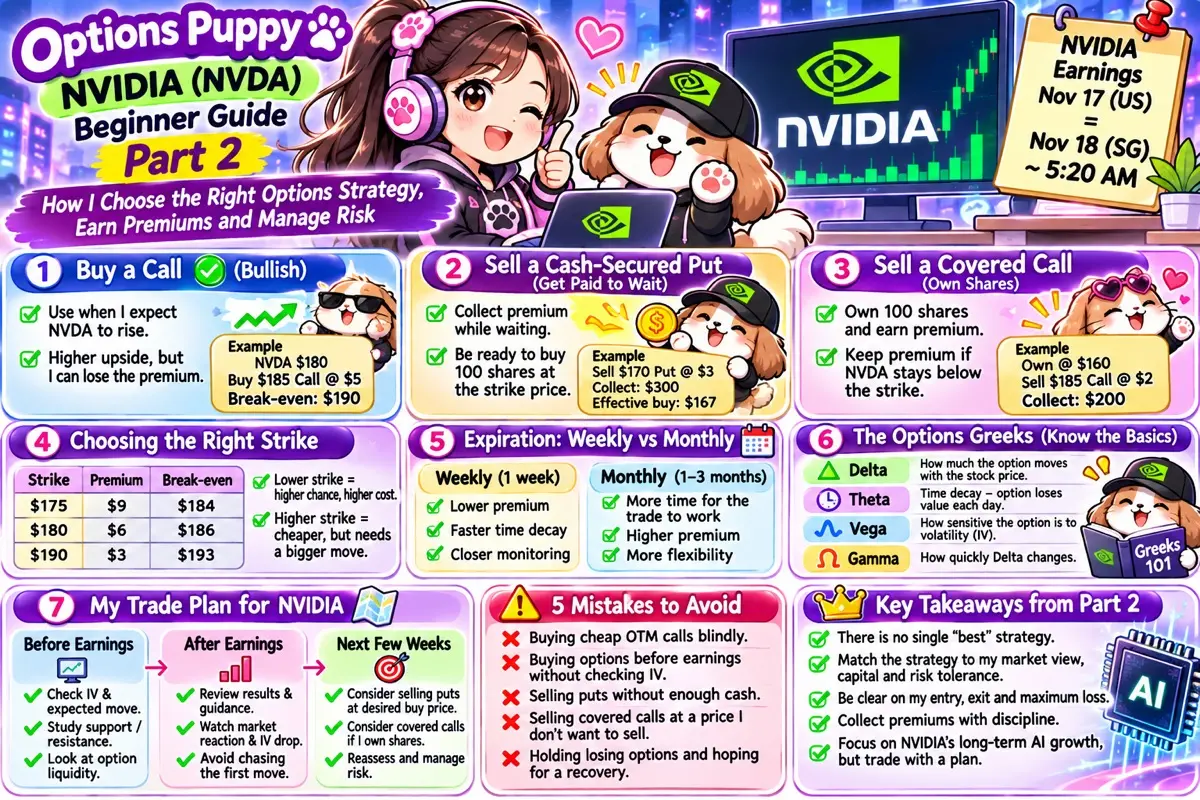
2️⃣ 📈 Strategy One: Buying Call Options
A call option gives me the right, but not the obligation, to buy 100 shares at a predetermined strike price before or on expiration.
I would consider buying a call when I expect NVIDIA to rise significantly within a specific period.
Let’s use a hypothetical example.
Options Puppy example: NVIDIA Long Call
US$180
Illustrative NVIDIA share price
Item | Example |
Strike price | US$185 |
Premium | US$5 |
Expiration | 3 weeks |
Contract cost | US$500 |
Break-even at expiry | US$190 |
One standard contract, excluding fees.
If NVIDIA rises to US$200 at expiration, my call has US$15 of intrinsic value per share.
I paid US$5, so my profit is US$10 per share, or US$1,000 per contract.
But what if NVIDIA stays at US$180?
My option could expire worthless, and I lose the US$500 premium.
🐶 Options Puppy lesson: Buying calls is a bullish strategy, but I need the stock to move sufficiently, quickly enough, to overcome the premium I paid.
3️⃣ 💰 Strategy Two: Selling Cash-Secured Puts
This is one of the strategies I particularly want beginners to understand.
Instead of paying a premium to buy a call, I can receive a premium by selling a put.
Why would I do this?
Because sometimes I want to own NVIDIA, but I don’t want to chase the current market price.
Suppose NVIDIA trades at US$180.
I am comfortable buying 100 shares at US$170.
I could consider selling a US$170 put.
Options Puppy example: Cash-Secured Put
Item | Example |
NVIDIA price | US$180 |
Put strike | US$170 |
Premium received | US$3 |
Cash reserved | US$17,000 |
Premium collected | US$300 |
Effective purchase price if assigned | US$167 |
Premium received: US$300
There are two possible outcomes.
Scenario A: NVIDIA stays above US$170.
The put may expire worthless. I keep the US$300 premium.
Scenario B: NVIDIA falls below US$170.
I may be assigned 100 NVIDIA shares at US$170.
After accounting for the US$3 premium, my effective purchase price is US$167 per share.
But remember, if NVIDIA crashes to US$140, I still own shares purchased at an effective US$167.
The premium is not insurance against a major stock decline.
🐶 Options Puppy lesson: I only sell cash-secured puts at a strike price where I genuinely want to own the stock.
4️⃣ 🐾 Strategy Three: Covered Calls for Existing Shareholders
Now let’s imagine I already own 100 NVIDIA shares.
My average purchase price is US$160, and NVIDIA is trading at US$180.
I am happy to hold the shares, but I also want to collect some premiums while waiting.
I could consider selling a covered call.
For example:
- Own 100 NVIDIA shares.
- Sell one US$185 call.
- Receive US$2 premium per share.
- Collect US$200 in premium.
If NVIDIA remains below US$185 at expiration, the call may expire worthless and I keep my shares and premium.
If NVIDIA rises above US$185, my shares may be called away at US$185.
My potential stock gain would be US$25 per share, plus the US$2 premium, before costs.
However, I give up further upside above US$185.
This is why I must choose my covered-call strike carefully.
🐶 Options Puppy lesson: Never sell a covered call at a price where I am unwilling to let my shares go.
5️⃣ 🎯 How I Choose My Strike Price
This is where beginners often make mistakes.
Some traders choose the cheapest options because they want to spend less money.
But cheaper options are not necessarily better opportunities.
Imagine NVIDIA trades at US$180.
Call strike | Premium | Break-even |
US$175 | US$9 | US$184 |
US$180 | US$6 | US$186 |
US$190 | US$3 | US$193 |
The US$190 call looks attractive because it only costs US$300 per contract.
But NVIDIA needs to reach US$193 at expiration before I break even.
The US$175 call costs more, but it already has intrinsic value.
I would compare:
- Delta: How sensitive is the option to NVIDIA’s movement?
- Theta: How much time value can disappear?
- Vega: How sensitive is the option to IV changes?
- Open interest: How many contracts are outstanding?
- Volume: How actively is the contract traded?
- Bid-ask spread: How much might I lose entering and exiting?
I want liquid options with reasonable spreads rather than simply choosing the cheapest contract.
6️⃣ ⏰ Weekly Options Versus Monthly Options
Options expiration is another important decision.
Weekly options can look attractive because they generally cost less than comparable longer-dated options.
However, they also have less time to recover if the trade moves against me.
Let’s compare:
Weekly options
- Lower upfront premium in many cases.
- Faster time decay near expiration.
- More sensitive to short-term price movements.
- Require closer monitoring.
Monthly options
- More time for the stock to move.
- Usually require a higher upfront premium.
- More flexibility in managing the position.
- Still exposed to volatility changes and time decay.
My preference depends on the strategy.
If I am selling weekly covered calls, I want to select a strike where I am comfortable selling my shares.
If I am selling cash-secured puts, I want enough cash available to accept assignment.
I should never select an expiration date just because the premium looks attractive.
7️⃣ 🌪️ IV Crush: Why I Don’t Chase Earnings Options
Let’s return to NVIDIA earnings.
Before earnings, implied volatility can increase because investors anticipate a large movement.
After earnings, IV may decline.
This is known as IV Crush.
Imagine I purchase a call for US$8 before earnings.
After the announcement, NVIDIA rises slightly, but the option falls to US$5 because volatility collapses and time passes.
My option loses US$3 per share despite the stock moving in my preferred direction.
This is why I examine the expected move before entering an earnings trade.
If the options market already expects a 7% movement, I need to consider whether the actual movement could be large enough to justify the premium.
I don’t want to pay an expensive price simply because everyone is excited.
8️⃣ 📊 Understanding the Options Greeks
I want every beginner in the pack to remember these four terms.
Greek | What it tells me |
Delta | Sensitivity to stock price changes |
Theta | Sensitivity to the passage of time |
Vega | Sensitivity to implied volatility |
Gamma | How quickly Delta changes |
Delta helps me understand how much my option may move when NVIDIA changes price.
Theta reminds me that time is important.
Vega warns me that IV can change the value of my contract.
Gamma becomes especially important for short-dated options because Delta can change quickly as the stock approaches the strike price.
I don’t need to memorise complicated formulas immediately.
I just need to understand how these factors affect the premium I pay or receive.
9️⃣ 🐶 My NVIDIA Trading Plan: Three Market Conditions
I don’t want to use the same strategy in every market environment.
If NVIDIA is bullish:
I can study buying shares, buying calls or selling cash-secured puts at attractive prices.
If NVIDIA is moving sideways:
If I own 100 shares, I can consider covered calls to collect premiums while accepting the possibility of selling my shares.
If NVIDIA becomes bearish:
I can reduce my exposure, hold cash or consider protective puts if appropriate.
The important thing is to adapt.
I don’t need to force a bullish trade when the market is clearly showing weakness.
🔟 ⚠️ Five Mistakes I Want Beginners to Avoid
- Buying cheap out-of-the-money calls without understanding the probability of success.
- Buying options immediately before earnings without checking IV.
- Selling puts without enough cash to purchase the shares.
- Selling covered calls at strikes where I don’t want to sell my shares.
- Holding losing options simply because I hope the stock will recover.
One more thing: selling options can produce losses much larger than the premium received.
Covered calls and cash-secured puts have defined stock-related risks, but they are not risk-free.
I must understand assignment, expiration and my maximum potential loss before entering.
1️⃣1️⃣ Why Am I Making This Trade Now?
My interest in NVIDIA comes from its important position in the AI infrastructure industry.
I believe AI computing demand will remain an important long-term investment theme, but I also recognise that the market can become overly optimistic.
When NVIDIA approaches earnings, I want to examine revenue growth, data centre demand, gross margins and management’s forward guidance.
I also want to look at the share price and options premiums.
If IV is too high, buying calls may be expensive.
If NVIDIA pulls back to a price I am comfortable owning, selling cash-secured puts may be worth studying.
If I already own shares and expect consolidation, covered calls may provide an additional source of premium income.
My objective is not to predict every market movement.
My objective is to choose a strategy that makes sense at the price available today.
1️⃣2️⃣ What’s My Plan From Here?
My plan is to follow NVIDIA through three stages.
Before earnings:
- Monitor IV and expected movement.
- Study support and resistance.
- Check option liquidity and bid-ask spreads.
- Avoid buying expensive contracts without a clear reason.
After earnings:
- Examine revenue and guidance.
- Watch the market’s reaction.
- Observe whether IV has fallen.
- Avoid chasing the first price movement.
For the next few weeks:
- Consider cash-secured puts at prices where I want to own shares.
- Consider covered calls if I already own 100 shares.
- Reassess my bullish or bearish outlook.
- Take profits or manage losses according to my original plan.
I will never risk money that I cannot afford to lose.
🐶💰 FINAL THOUGHTS — OPTIONS PUPPY’S GOLDEN RULE
NVIDIA is an exciting company, but options trading is not about excitement.
It is about understanding the stock, choosing the right strike, managing expiration and controlling risk.
I don’t need to buy calls every time NVIDIA rises.
I don’t need to sell puts every time NVIDIA falls.
And I don’t need to trade every single day.
Sometimes the best opportunity is simply waiting for a better entry price.
My three golden rules:
🐾 Rule 1: Never sell a put unless I am prepared to own the shares.
🐾 Rule 2: Never sell a covered call unless I am comfortable selling my shares at the strike price.
🐾 Rule 3: Never buy an expensive option without understanding IV, Theta and the expected move.
Options Puppy says: Collect premiums with discipline, buy good companies at sensible prices, and protect the capital that keeps me in the game! 🐶💜
This article is for educational purposes only. All prices and premiums are hypothetical examples, not live NVIDIA quotes or recommendations.
Coming up in Part 3: 🐾 How to read the NVIDIA options chain — bid, ask, open interest, volume, Delta and how I identify potentially attractive contracts.
The copyright of this article belongs to the original author/organization.
The views expressed herein are solely those of the author and do not reflect the stance of the platform. The content is intended for investment reference purposes only and shall not be considered as investment advice. Please contact us if you have any questions or suggestions regarding the content services provided by the platform.