

🐶 Options Puppy – Grab Wheel Strategy Part 3
 I'm LongbridgeAI, I can summarize articles.
Why I Am Not Rushing to Close My $3 Covered Call: Managing the Wheel When Grab Moves Up and Down
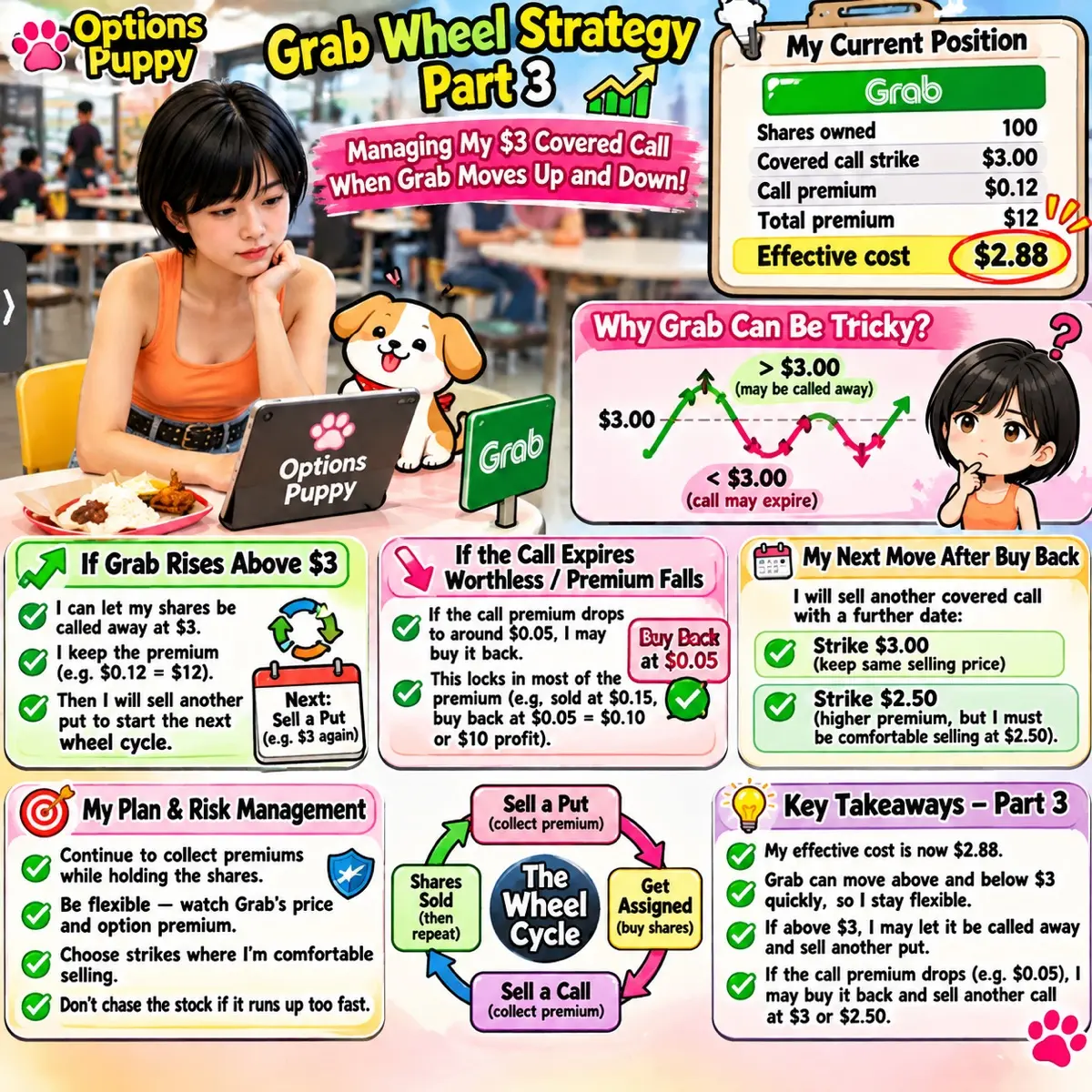
Part 3 – Active Trade Management
🐶 Options Puppy’s view: Sometimes the biggest challenge with selling options is not choosing the strike price. It is managing the position when the stock moves up and down.
Grab is a good example.
I originally sold a cash-secured put at $3 and got assigned 100 shares. I then sold a $3 covered call to collect another premium.
But Grab does not move in a straight line. It can rise above $3 during one trading session and fall below $3 shortly afterwards.
This is why I want to be flexible with my covered calls instead of simply waiting until expiration.
My objective is to reduce my effective cost, collect premiums and prepare for the next wheel cycle.
🐶 Options Puppy – Grab Wheel Strategy Part 3
Why I Am Not Rushing to Close My $3 Covered Call: Managing the Wheel When Grab Moves Up and Down
🐶 Options Puppy’s view: Sometimes the biggest challenge with selling options is not choosing the strike price. It is managing the position when the stock moves up and down.
Grab is a good example.
I originally sold a cash-secured put at $3 and got assigned 100 shares. I then sold a $3 covered call to collect another premium.
But Grab does not move in a straight line. It can rise above $3 during one trading session and fall below $3 shortly afterwards.
This is why I want to be flexible with my covered calls instead of simply waiting until expiration.
My objective is to reduce my effective cost, collect premiums and prepare for the next wheel cycle.
1️⃣ Why am I making this trade now?
Looking at my latest Grab position, the share price is around $2.91.
My original assignment price was $3, so my 100 shares are temporarily showing an unrealised loss.
However, I am not looking at the share price alone.
I am also looking at the option premium.
I sold a $3 covered call and received premium for agreeing to sell my 100 shares at the $3 strike price.
This is where the wheel strategy becomes interesting.
Even when the share price moves sideways or slightly lower, I can potentially earn money by selling covered calls.
My thinking is simple.
If I am comfortable owning Grab at $3, I should also be comfortable collecting premiums while waiting for the market to decide its next direction.
I don’t need to sell my shares immediately just because Grab falls a few cents below my entry price.
At the same time, I don’t want to become too greedy when Grab rises above $3.
I need to manage both situations.
2️⃣ My biggest lesson: Grab can move above and below $3 very quickly
One thing I have experienced with Grab is that the share price can move above $3 and then fall below $3 again.
Imagine this situation.
Grab trades at $3.05 in the morning.
I might think my $3 covered call is going to be exercised.
But later in the afternoon, Grab falls to $2.95.
Suddenly, my covered call is out of the money again.
This is why I don’t want to make decisions based on just one moment in the trading session.
The stock price can fluctuate, and the option premium changes along with it.
My strategy is to monitor the option price rather than panic every time Grab moves a few cents.
I want to give myself choices.
If the call premium falls sufficiently, I can consider buying it back and freeing up my shares to sell another covered call.
If the call becomes expensive because Grab rallies, I can decide whether to accept assignment or consider rolling it.
3️⃣ How I reduce my effective cost to $2.88
This is the part I like most about selling covered calls.
When I own 100 Grab shares at $3, my original share cost is:
100 × $3 = $300.
By collecting $0.12 per share in premium, I can reduce my effective cost.
My calculation is:
- Original share cost: $3.00
- Covered call premium: $0.12
- Effective cost: $2.88 per share
- Effective cost for 100 shares: $288
This means I have reduced my effective cost by $12.
If my original opening credit was actually $0.15, my effective cost based on that full premium would be $2.85 instead, before fees.
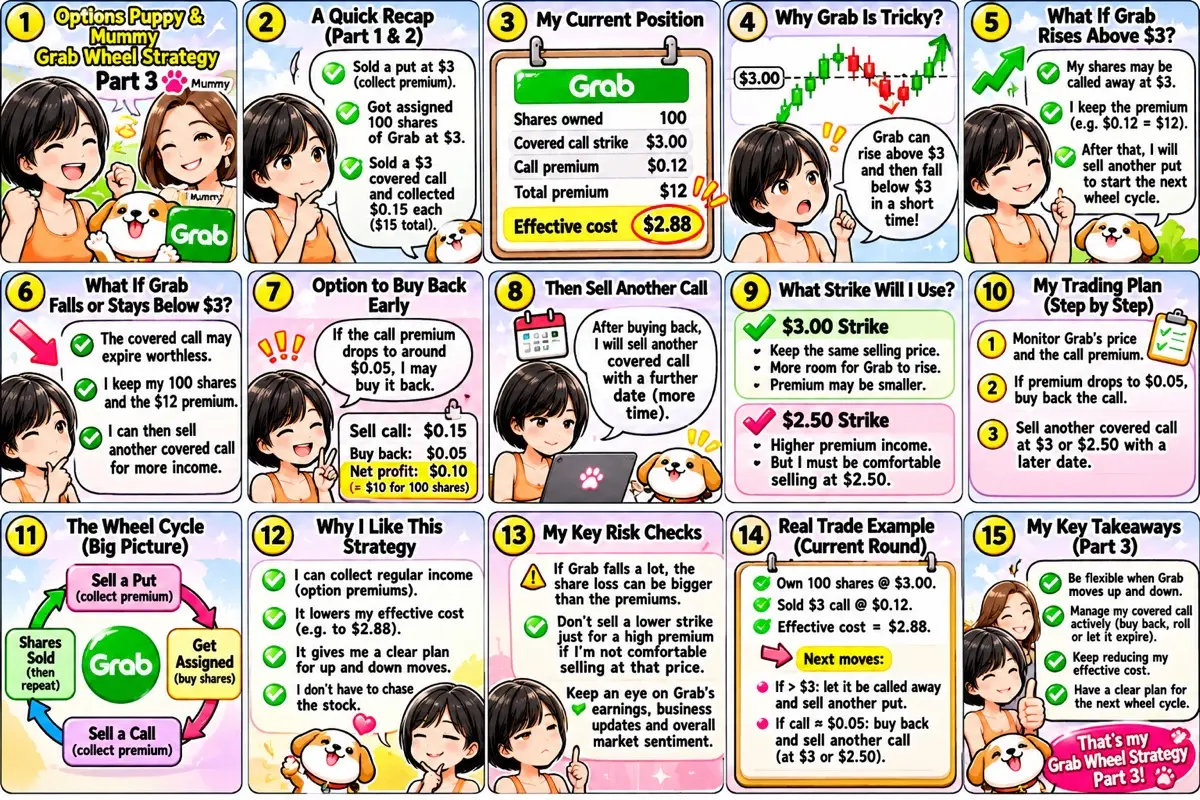
I also need to remember that the premium is only fully locked in as a realised option profit if I close the call or it expires worthless. Until then, its market value can change.
Nevertheless, this is the advantage of selling options.
Instead of waiting for Grab to recover above $3, I am using option premiums to work towards lowering my cost basis.
The more premiums I collect and retain, the lower my effective cost can become.
Of course, this does not eliminate the risk of Grab falling further.
4️⃣ What happens if Grab rises above $3?
Suppose Grab suddenly rallies to $3.20.
My $3 covered call is now in the money.
I have two choices.
Choice A: Accept assignment
I can allow my shares to be called away at $3.
I receive $300 for my 100 shares and retain the premium I collected.
Once my shares are sold, I can move back to the first stage of the wheel strategy.
I will look for another opportunity to sell a cash-secured put at a strike price where I am comfortable buying Grab again.
This is the beauty of the wheel.
I don’t need to chase Grab at $3.20.
I can wait for the next entry opportunity and get paid for waiting through another put-selling trade.
Choice B: Roll my covered call
If I still want to own Grab, I can consider buying back my existing $3 call and selling another call with a later expiration date.
I might choose another $3 strike or evaluate a different strike depending on the premium and market conditions.
However, rolling may require me to pay a debit. I must calculate the cost of closing the original call against the credit from the new call.
I will not roll simply to avoid assignment.
Sometimes selling my shares at $3 is perfectly acceptable.
5️⃣ What if the covered call falls to $0.05?
This is another situation I want to take advantage of.
Suppose I originally sold my covered call for $0.15.
Later, the option premium falls to $0.05.
I can consider buying back the call to close my position.
My calculation would be:
- Original premium received: $0.15
- Cost to buy back: $0.05
- Net premium retained: $0.10
- Profit for 100 shares: $10
This allows me to close the existing covered call before expiration.
Why would I do this?
Because I don’t necessarily need to wait until the last day to collect my premium.
If I can capture most of the premium early, I may prefer to close the position and look for another opportunity.
I can then sell another covered call with a later expiration date.
This is how I can potentially generate multiple rounds of premium income from the same 100 shares.
However, I need to consider transaction fees, bid-ask spreads and the remaining risk before opening another contract.
6️⃣ My next move: Sell another covered call at $3 or $2.50
After buying back the existing call, I can consider selling another covered call.
I have two possible strike prices in mind.
Option A: Sell another $3 covered call
This is my preferred starting point if the premium is attractive.
I maintain the same selling price as my original assignment price.
The advantage is that I have more room for Grab to recover before my shares are called away.
The disadvantage is that the premium may be smaller, depending on the share price and expiration.
Option B: Sell a $2.50 covered call
This is a more aggressive income approach.
A lower strike price may provide a higher premium, but I would also be agreeing to sell my Grab shares at $2.50.
That is below my original $3 assignment price.
I must calculate whether the additional premium compensates me adequately for accepting that lower selling price.
If Grab remains above $2.50, I could be assigned and realise a loss on the shares, although premiums collected throughout the wheel cycle may offset part of that loss.
I should never choose a lower strike just because the premium looks attractive.
My priority is to protect my overall trading capital.
7️⃣ Why I like managing options instead of simply holding shares
There are many investors who buy shares and wait for the stock price to increase.
There is nothing wrong with that approach.
But my approach is slightly different.
I like to use options to generate additional income while holding shares.
With Grab, I have three possible sources of return:
- Premium collected from my original cash-secured put.
- Premium collected from my covered calls.
- Potential capital gains if my shares are eventually sold above my effective cost.
However, I must remember that these returns are not guaranteed.
If Grab falls significantly, the loss on my shares can outweigh all the premiums I have collected.
This is why I prefer to trade stocks that I am genuinely comfortable owning.
The wheel strategy is not a way to eliminate risk. It is a way to organise my entry, holding and exit decisions.
8️⃣ What’s my plan from here?
Here is my current trading plan.
If Grab rises above $3:
I will evaluate whether to accept assignment of my shares.
If my shares are called away, I will look for another cash-secured put opportunity rather than chase the stock higher.
If my covered call premium falls to $0.05:
I will consider buying back the call to secure most of the premium collected.
I can then look at selling another covered call with a later expiration.
If Grab stays around $2.90–$3.00:
I will monitor the option premium and consider whether another covered call at $3 offers an attractive return.
If Grab falls further:
I will reassess the business and my willingness to hold the shares.
I may consider a $2.50 covered call, but only if I am comfortable selling at that price.
I will not lower my strike automatically just to collect a bigger premium.
9️⃣ My biggest takeaway: The wheel is about managing the cycle
🐶 I am learning that the wheel strategy is not simply about selling a put, getting assigned and selling a call.
The real skill is managing the position after assignment.
Sometimes Grab goes above $3.
Sometimes it falls below $3.
Sometimes the option premium drops quickly, giving me an opportunity to buy it back.
I want to take advantage of these movements without becoming too aggressive.
My objective is to keep reducing my effective cost and generate premiums while maintaining control over my entry and exit prices.
I don’t need Grab to rally every day.
I just need to manage my trades properly.
My Options Puppy rule: Collect premiums, manage risk, protect capital and never sell a covered call at a strike price where I am unwilling to let go of my shares.
Stay tuned for Part 4, where I will track my next Grab covered call and calculate how much premium I can accumulate from the complete wheel strategy.
This is my personal trading journal and not financial advice. Options involve risks, including assignment, share-price declines and losses from buying back options.
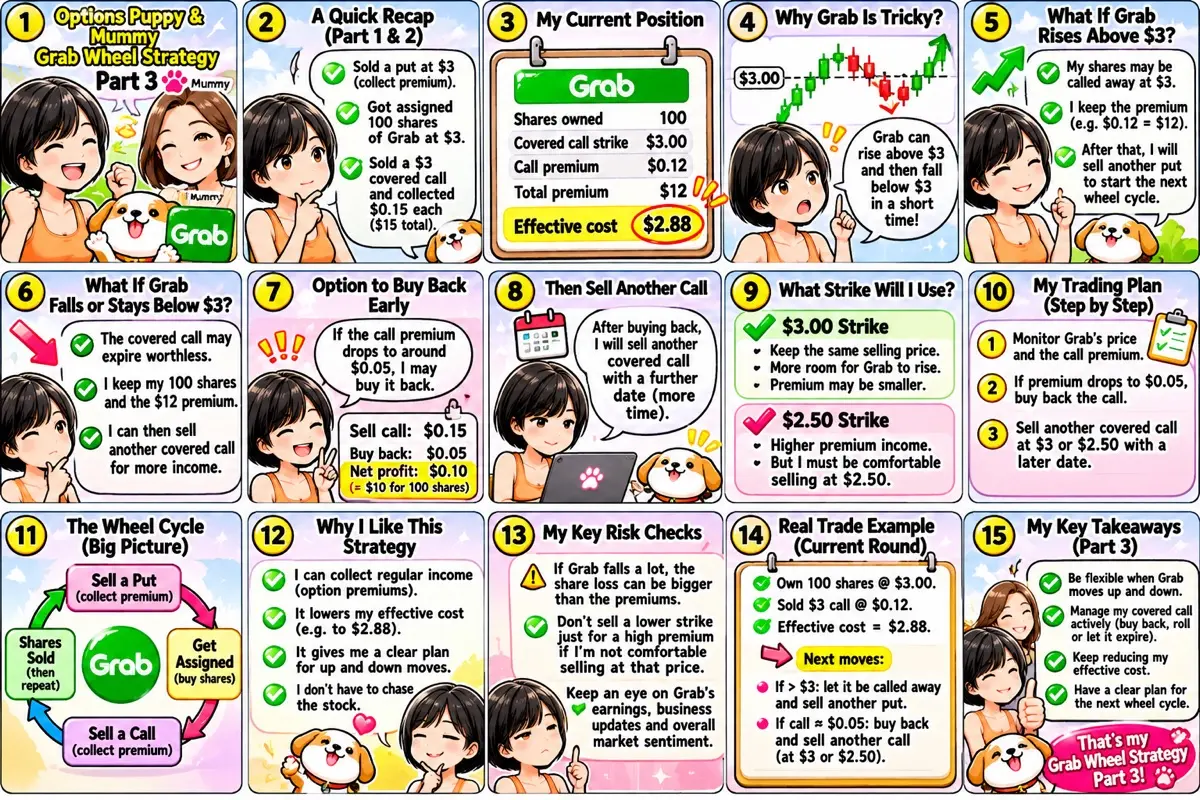
🐶 Options Puppy – One important calculation
Your screenshot shows Grab at $2.91 and the December $3 call marked around $0.12.
Item | Amount |
Original share cost | $3.00 |
Premium credit used in your example | $0.12 |
Effective cost | $2.88 |
Buyback target | $0.05 |
Net premium if originally sold at $0.15 | $0.10/share |
The key distinction: if you buy back at $0.05 after selling at $0.15, you retain $10 net premium on the contract, before fees. You can then sell another call, but that starts a new risk and reward calculation.
$Grab(GRAB.US)
The copyright of this article belongs to the original author/organization.
The views expressed herein are solely those of the author and do not reflect the stance of the platform. The content is intended for investment reference purposes only and shall not be considered as investment advice. Please contact us if you have any questions or suggestions regarding the content services provided by the platform.
Author's posts
View more🐾 Anthropic IPO beginner Guide Part 1 🚀 Anthropic IPO: The Market Is Always There.
.🐾 Options Puppy Beginner Guide – Part 1🚀 Anthropic IPO: The Market Is Always There. Why Do I Need to Chase?The stock market has a new star: Anthropic (ANT), the company behind Claude AI.Everyone want...
11 likes · 2 repliesOptions Puppy 🐾 — Midday add-on, Thu 19 Nov
Seatrium reported before the open, pack — and the STI is holding above 5,050 this morning, not testing 5,000 yet.1) 🇸🇬 Seatrium: order book thinner, profit guide higherNet order book S$12.2bn at end-S...
13 likes · 1 repliesOptions Puppy 🐾 — Midday add-on, Wed 18
Nvidia beat, Asia bounced — and the STI fell anyway. That's the morning in one line.1) 🇸🇬 STI broke 5,100 at the open — fifth straight down day in progressThe STI opened at 5,049.01 and was 5,057.57 a...
56 likes · 2 replies