

Daily Lesson | Anthropic Options Are Here! Before You Check the Prices, Can You Read These Dates?
 I'm LongbridgeAI, I can summarize articles.
Last week, we followed Anthropic through the key stages of its IPO: from pricing, raising the offering price and upsizing, to the opening auction on its first trading day.
This week, Anthropic's options are here.
According to Cboe, options on Anthropic (ANT) are scheduled to begin trading on November 23 (US Eastern Time).
If you open the ANT option chain, you'll notice a row of different dates alongside calls, puts and strike prices.
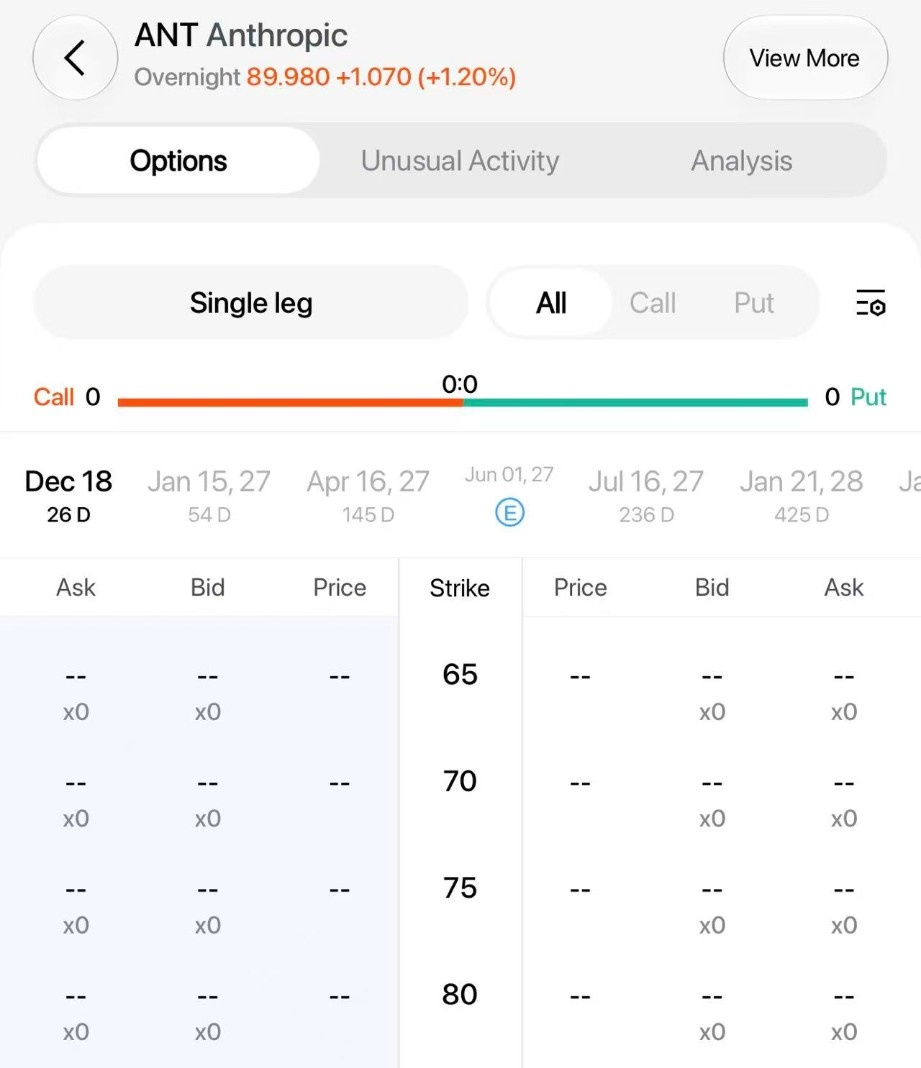
Source: Longbridge App
Some options expire next month, some next year, and others not until 2029.
And even when two call options have the same strike price, the one expiring next year usually costs quite a bit more than the one expiring next month.
Why?
Even stranger, sometimes you buy a call option, the stock doesn't fall, yet the option's price keeps dropping day after day.
Both questions have to do with the same thing: time to expiration.
What Is That Row of Dates on the Option Chain?
Think of an option as a right that comes with a time limit.
For example, buying a call option gives you the right to buy a stock at an agreed price within a set period. That agreed price is called the strike price. To get this right, you pay an amount upfront called the premium.
But this right doesn't last forever. It has an expiration date.
Here's a simple way to think about it: the strike price tells you how much you can buy the stock for, while the expiration date tells you how long that right lasts.
For the same stock and the same strike price, there may be call options expiring in December and others expiring next July. The biggest difference is how much time the stock has to move.
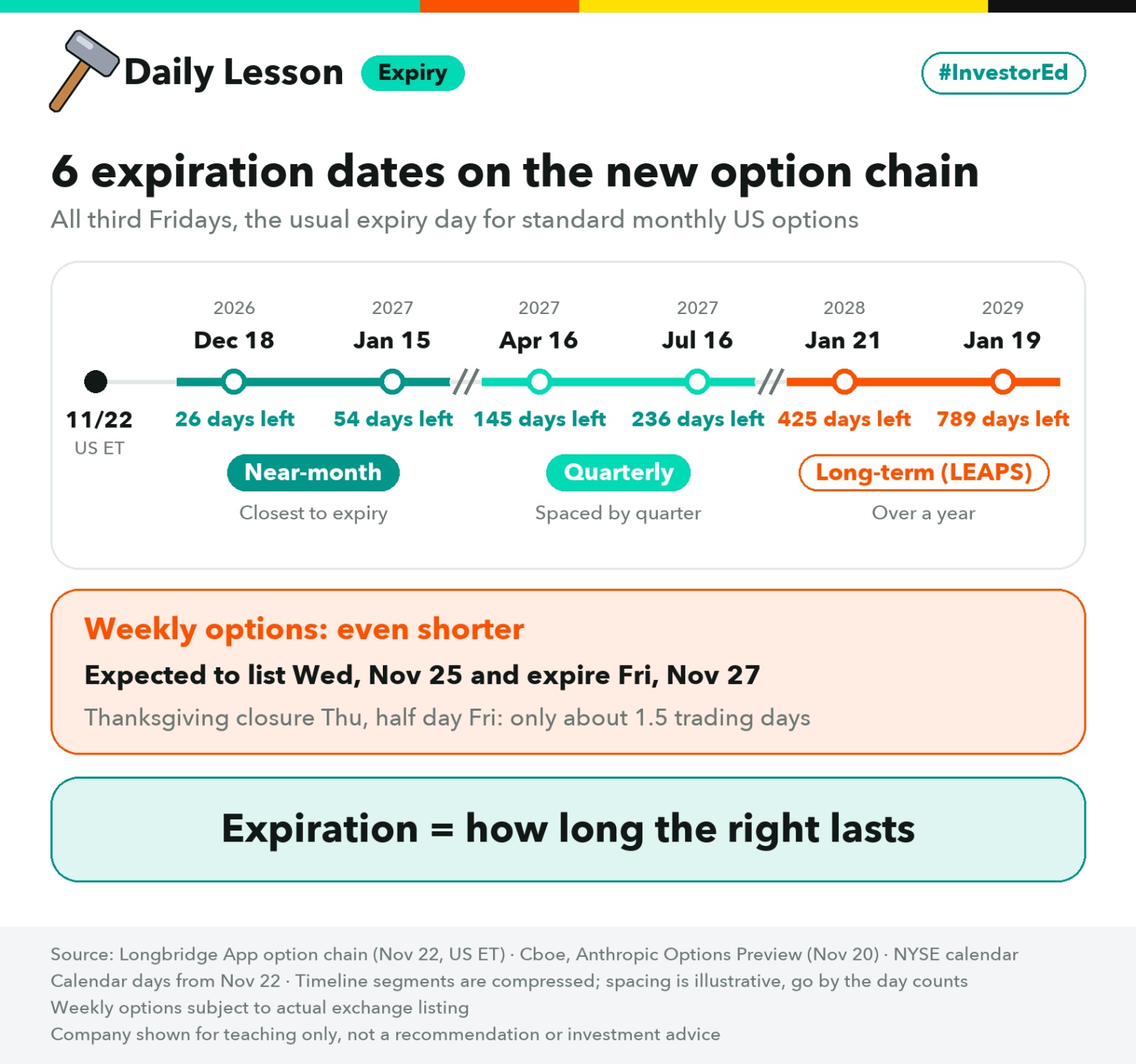
The ANT option chain currently shows these expiration dates: December 18, 2026; January 15, April 16 and July 16, 2027; January 21, 2028; and January 19, 2029.
All of these dates fall on the third Friday of their respective months, the usual expiration schedule for standard monthly options.
Counting from the screenshot date, November 22 (US Eastern Time), the nearest contract, expiring December 18, has just 26 days left, while the farthest, expiring in January 2029, has more than two years remaining.
Cboe also expects weekly options to be added on November 25, with the first batch expiring on November 27.
Because US stock markets are closed for Thanksgiving on November 26 and close early on November 27, these weekly options will have only about one and a half trading days from listing to expiration, leaving very little time for the stock price to move.
Same Strike Price, So Why Do Far-Month Options Cost More?
Let's start with a simple example.
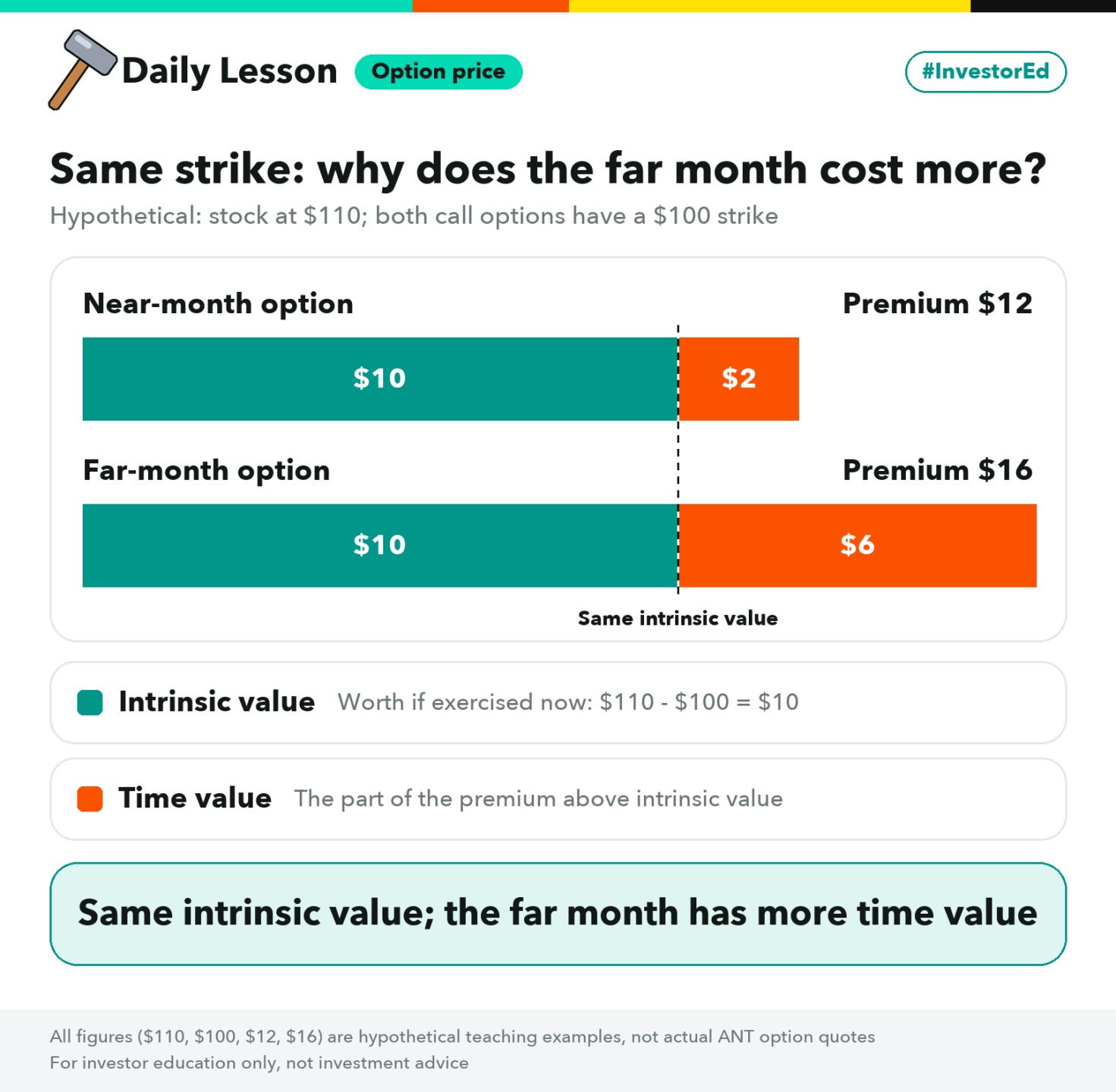
Suppose a stock is trading at $110, and you want to buy a call option with a $100 strike price.
You find that the December option costs $12, while the one expiring next July costs $16.
Both give you the right to buy the same stock at $100. So why does the far-month option cost $4 more?
Because you're not just buying the right to buy the stock at a certain price. You're also buying time.
The December option gives you only a short time to wait for the stock to rise. The July option gives you more time to wait.
The stock might rise next week, three months from now, or not at all. It could even fall.
If the rally comes late, the near-month option may already have expired, while the far-month option still has time left.
That's why an option's price can usually be broken into two parts:
Option Price = Intrinsic Value + Time Value
Intrinsic value is what the right would be worth if you exercised it right now.
For example, if a stock is trading at $110, a call option with a $100 strike price has $10 of intrinsic value.
Time value is the part of the option's price above its intrinsic value.
As long as the option hasn't expired, the stock price still has a chance to move, and investors are willing to pay extra for that remaining time.
For option buyers, the further the stock moves in their favor, the more valuable the option may become. If the stock moves against them, the most they can lose is the premium they paid.
So the more time left, the more possibilities the right offers, and the higher its price usually is.
Think of it like insurance: for the same coverage, a one-year policy usually costs more than a one-month policy.
Options work in a similar way. The more time you buy, the more you usually pay.
Near-Month vs. Far-Month: Which Is More Sensitive to Stock Price Moves?
Time to expiration doesn't just affect how much an option costs. It also affects how sensitive the option is to changes in the stock price.
Generally speaking, for the same move in the stock, near-month options tend to see larger percentage gains or losses, while far-month options tend to react more mildly.
Why?
Near-month options are cheaper to begin with, so even a small price change can translate into a large percentage move.
And with very little time left, every move in the stock can make a noticeable difference to what the option might be worth at expiration.
Far-month options cost more and have plenty of time left before expiration. There's still time for the stock to move later, so today's price changes tend to have a smaller impact on their value in percentage terms.
As expiration gets closer, these price swings in near-month options can become even more dramatic.
On the other hand, if the stock price doesn't move at all, near-month options also tend to lose value faster.
That brings us back to the question at the beginning: why can an option get cheaper day after day even when the stock hasn't fallen?
Because its time value is gradually disappearing.
Near-month options have less time remaining, so their time value has to run out over a shorter period. And as expiration approaches, that loss of time value usually speeds up.
Far-month options, meanwhile, tend to lose their time value more gradually.
The measure used to track this is called Theta.
Theta tells you roughly how much an option's price may change simply because one day has passed, assuming everything else stays the same.
For option buyers, Theta is usually negative.
You don't need to remember the formula. Just remember this: near-month options typically lose time value faster as expiration approaches, while far-month options have more time for that value to wear away.
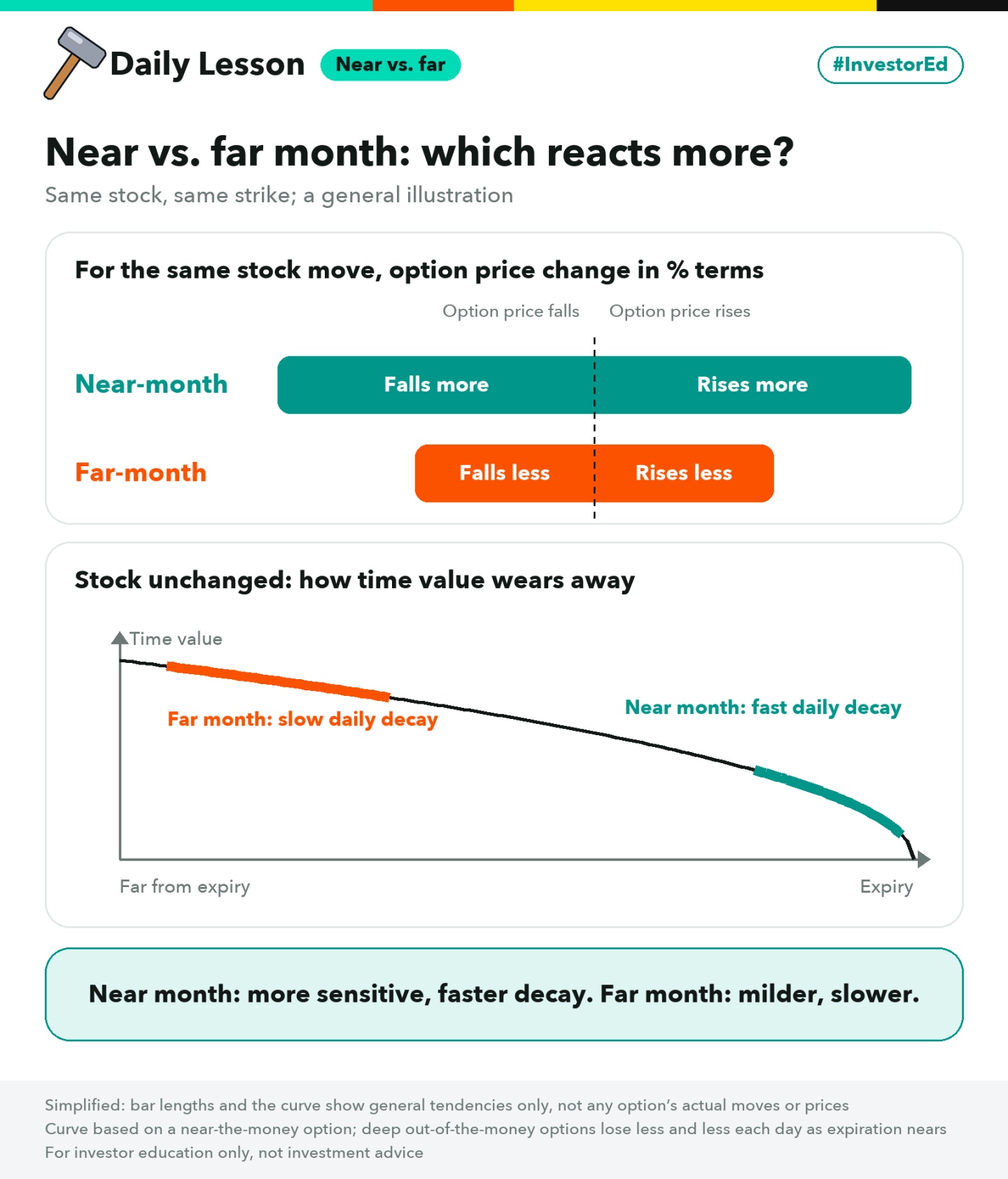
- Near-month options: Cheaper, with larger potential percentage swings when the stock moves; time value tends to disappear faster when the stock stays still.
- Far-month options: More expensive, with relatively milder percentage reactions to stock price moves; time value tends to decline more gradually.
If Far-Month Options Cost More, Are They Better?
Not necessarily.
Far-month options cost more because you're buying more time. Near-month options are cheaper because there's less time left for the stock to move.
The price difference mainly reflects the amount of time remaining. It doesn't automatically tell you which option is the better deal.
And whether you buy a near-month or far-month option, you could lose the entire premium.
If the stock hasn't moved to a favorable level by expiration, the option may expire worthless.
Also, newly listed options may take some time to develop active quotes and trading volume. Bid-ask spreads can be relatively wide at first, and that's part of your trading cost too.
Next time you open the option chain for any stock, don't rush straight to the prices. First, check three things:
- Which expiration dates are available: near-month, quarterly or long-term options;
- How many days are left until expiration;
- How much the prices differ across expiration dates for the same strike price.
⚠️ The expiration date determines how long your right lasts. And time itself has a price.
Today's quiz
Next question: You buy a call option. The next day, the stock price is roughly unchanged, but the option's price has fallen. Which explanation makes more sense?
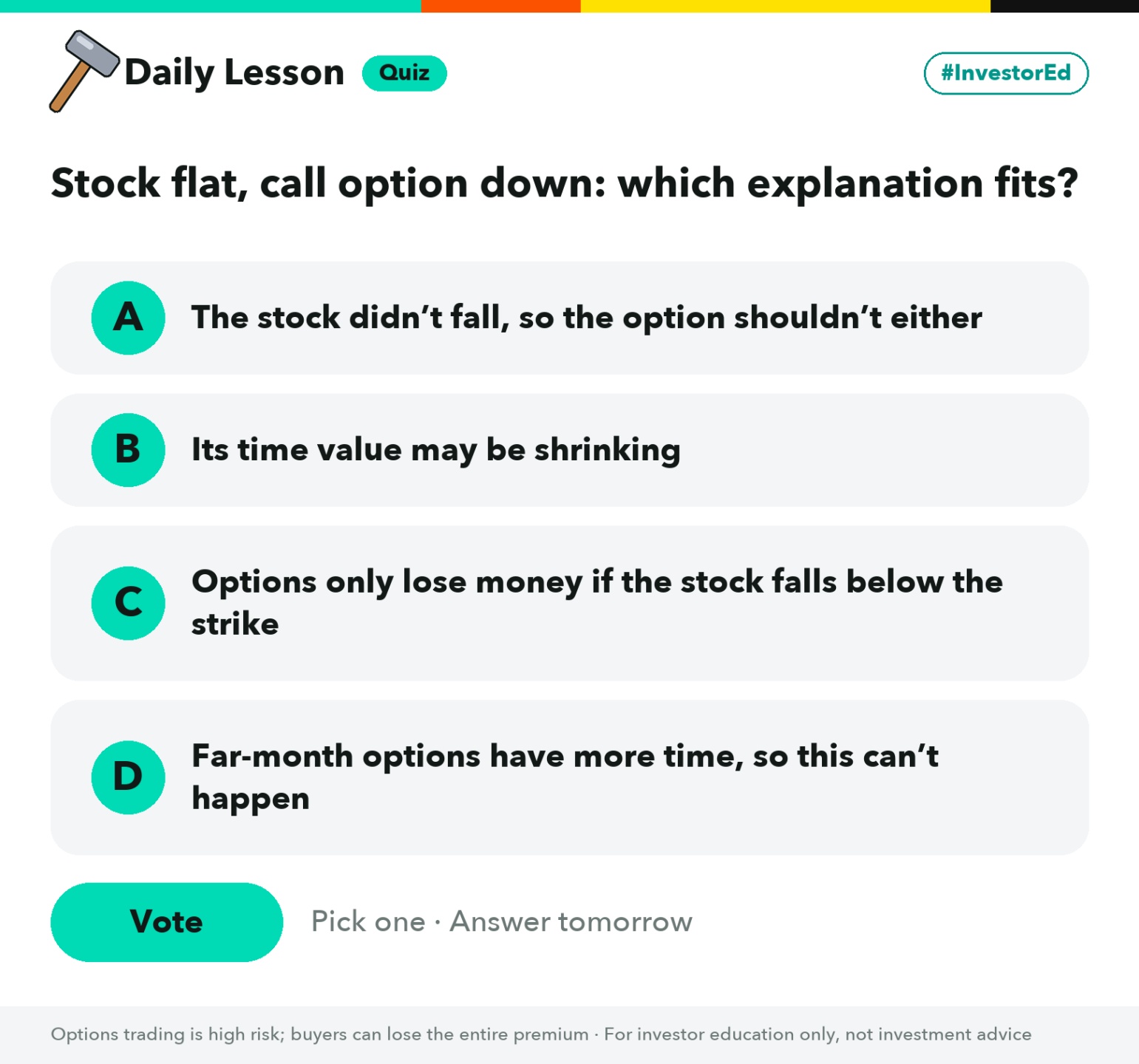
Scroll down to vote. We'll reveal the answer tomorrow.
🎁 Vote, comment, earn rewards
- Pick the correct answer in the poll: 88 Task coins
- Pick the correct answer and tell us in the comments what you'd check first the next time you open an option chain, and why (at least 15 words): 188 Task coins
Poll closes Tue, 24 Nov, 6pm SGT. We'll announce the number of winners together with the answer. Rewards will be credited within 7 working days. One entry per account. Comments must relate to today's topic. T&Cs apply.
Disclaimer: This content is provided for investor education purposes only and does not constitute investment advice, an offer, or a recommendation to buy or sell any security. Investing involves risk, and options trading carries a high level of risk. Please make investment decisions carefully. The author and publisher accept no liability for any direct or indirect losses arising from reliance on this content.
The copyright of this article belongs to the original author/organization.
The views expressed herein are solely those of the author and do not reflect the stance of the platform. The content is intended for investment reference purposes only and shall not be considered as investment advice. Please contact us if you have any questions or suggestions regarding the content services provided by the platform.
Author's posts
View moreWalmart Bundled Two Memberships for $120. What Is It Really After?
The first is a planned stock-up trip. The second is a midweek refill. Walmart serves both needs, but until now, a household had to pay separately to enjoy the benefits of Sam’s Club Plus and Walmart+. On October 20, 2026, Walmart began offering both memberships for a single annual fee of $120. The savings are real. But why would a retailer choose to collect less in membership fees?
31 likes · 1 repliesDaily Lesson | Anthropic Lists Today. The Market’s Open, So Why Can’t I Trade Yet?
$83 is just the IPO price. But what price will you actually pay when trading begins?
343 likes · 49 repliesAnthropic Starts Trading Today. More Than 20 Leveraged ETFs Are Lining Up: Beware the “2X Long” Trap
SpaceX ended four months where it started, yet its 2X long ETF lost a fifth. The answer is one word in the name: Daily.24 likes