
Foreign Capital Feedback: What Our Clients Are Asking After the Plunge (2)
 I'm LongbridgeAI, I can summarize articles.
Forwarded from: Xingzhi US Stocks
What do our research colleagues think about this topic?
Ronald Keung pointed out that with the lowering of entry barriers (especially as the development costs of some recent new models are only a small fraction of existing models), the AI theme may present a potential competitive landscape between capital-rich internet giants and startups.
Eric Sheridan and his team emphasized that the next stage of evolution for the AI theme may shift from the infrastructure layer to the application layer, reflected in aspects such as AI agents, enterprise use cases, rising consumer utility, and shifting computing habits.
These will become identifiable validation points, driving a more linear understanding of capital investment returns in 2025 and beyond.
Specifically, the updates across various industries are as follows:
-
Semiconductors: Due to the impact of declining AI training computing costs, stocks have faced sell-offs, and valuations are under pressure.
-
Software: Benefiting from efficiency improvements and cost reductions, it may accelerate enterprise adoption of AI.
-
Internet/Technology: AI investment returns and capital expenditure levels, especially at the infrastructure level, will be scrutinized more closely.
-
Data Center Operators: Facing short-term demand and pricing pressures, but may achieve a healthier supply-demand balance in the long term.
Peter Oppenheimer reminded investors to pay attention to the fragility of AI investment trades in a strategy report dated September 5 last year, titled "AI: To Buy or Not to Buy, That Is the Question." He mentioned that historically, investors have often focused too much on the innovators themselves, underestimating the impact of competition, and overestimating the returns on capital invested by early innovators. At the same time, investors often underestimate the growth of new entrants in the industry, who can leverage the capital expenditures of other companies to launch new products and services.
Ryan Hammond also pointed out in his October report "AI and US Stocks: Valuation Levels Growing in Phase 2 AI and Maintaining Selectivity in Phase 3 AI Stocks" that although valuations may seem optimistic, earnings have already—and should continue to—support infrastructure stocks in "Phase 2 AI."
Contrary to expectations, we do not believe that the sell-off in tech stocks has fundamentally ended, and the coming days will not just see sporadic small sell-offs. Feedback on DeepSeek is widespread, while the stock price reaction is more of a knee-jerk response.
-
A turning point in U.S. tech trading has emerged, challenging the dominant position.
-
In the short term, it has a negative impact, but in the medium term, it is positive as it accelerates AI adoption.
-
It is beneficial for U.S. tech companies as it will encourage them to increase spending.
4) It is detrimental to U.S.-China relations and increases the risk of additional tariffs on China.
- Analogous to the internet boom—prosperity, collapse, and then the process of popularization.
However, the stock price reaction seems more like a sentiment of "all stocks are doomed."
This reminds me of Peter Oppenheimer's report "AI is Not a Bubble" released in mid-2023. In the report, he draws parallels between AI and previous technological revolutions or bubble periods (see pages 8-10). As new technologies are replicated, costs decrease, and adoption rates increase, the dominance in the stock market will shift from technology producers to technology adopters... or similar expressions.
Young Founder Liang Wenfeng, the Delayed Reaction of Global Capital Markets, and the Controversy Over Trillions in AI Investment
The U.S. capital markets' reaction to DeepSeek over the weekend and last night seems quite delayed. Prior to last Friday and this weekend, mainstream Western media had very limited coverage of DeepSeek and its young founder Mr. Liang Wenfeng.
As early as January 20, DeepSeek released its new product version R1. However, few in the Western investment community and AI community recognized the potential of R1 and the paradigm shift it might bring. Subsequently, on January 21, the global AI community was shocked by the open-source article released by DeepSeek. By January 23, this shockwave began to spread from the global AI community to the global investment community. On January 24, many investors on Wall Street seemed to realize this paradigm shift and began to question DeepSeek.
According to a report from Xinwen Lianbo on January 20, 2025, at 7 PM, Mr. Liang Wenfeng, born in 1985, was regarded as a mathematical genius from a young age and graduated from the prestigious Zhejiang University. He was invited to participate in a discussion in Beijing.
In the field of quantitative trading, some may have already heard of Mr. Liang. He co-founded NingBo High-Flyer Quantitative Investment Partnership in 2016, which later became a well-known quantitative private equity fund. (Introduction to Mr. Liang in Wikipedia)
Looking back at Goldman Sachs' deep report "Top of Mind" released in June 2024, titled "Generative AI: Too Much Spend, Too Little Benefit?" ), which is of great significance. Link: GEN AI: Too Much Spend, Too Little Benefit?
I have personally read it at least three times. Our Head of Global Equity Research, Jim Covello (formerly a top analyst in the U.S. semiconductor sector), clearly pointed out in the report that the tens of trillions of dollars invested in AI are overall inefficient, and investors may ultimately find it difficult to achieve appropriate returns from these investments (he draws a parallel to the internet bubble period and finds similarities).
During our macro conference held in Hong Kong on January 14-15, Jim Covello had an interesting public debate on stage with George Lee (a well-known U.S. TMT banker in Silicon Valley who joined Goldman Sachs' executive team a few years ago). George believes that the tens of trillions of dollars invested in AI will ultimately prove useful and commercially viable.
If you have time, it is definitely worth listening to Jim and George's debate on AI. After 25 minutes and 30 seconds into the video, Jim also discusses DeepSeek, commoditization risk, and Jevons Paradox (the increase in net consumption due to cost reductions).
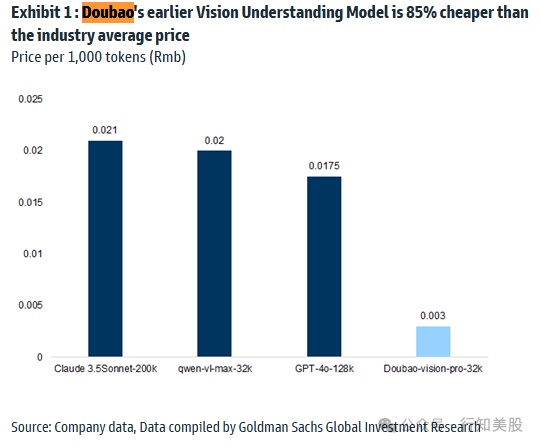
Regarding AI investment opportunities in China, some excellent companies seem to be primarily private enterprises. In addition to DeepSeek, another company is MoonShot (whose AI product "Kimi" is a very popular chatbot among Chinese consumers). Another private company is MiniMax . ByteDance's AI product "Doubao" is one of the most popular consumer-facing AI applications.
Our internet analyst Ronald Keung published a timely analysis article last weekend. The article emphasizes the impact of DeepSeek, ByteDance's Doubao-1.5 Pro, and Moonshot's Kimi k1.5 on China's internet, cloud computing, and data center industries.
Ronald's conclusions include: **At the stock level, for application areas, we believe Tencent has the greatest advantage in launching consumer-facing AI agent applications, thanks to WeChat, which is a super app with social and transactional functions (notably, $TENCENT(00700.HK) recently released its 3D generative model, Hunyuan 3D 2.0). At the same time,we continue to pay attention to ByteDance's AI applications and mobile AI operating systems (such as $XIAOMI-W(01810.HK)) Progress.
In the field of cloud computing/data centers, we have noted geopolitical uncertainties regarding chip and computing power limitations, as well as advancements in training/inference cost optimization. However, it is expected that the cloud computing businesses of internet giants ($Alibaba(BABA.US)being the largest public cloud hyperscale service provider in China) and data centers (such as$GDS(GDS.US),$Vnet(VNET.US)) will benefit from the growing demand for public cloud and AI computing driven by years of increasing AI adoption.
$NVIDIA(NVDA.US)$Apple(AAPL.US)$Microsoft(MSFT.US)$Tesla(TSLA.US)









The copyright of this article belongs to the original author/organization.
The views expressed herein are solely those of the author and do not reflect the stance of the platform. The content is intended for investment reference purposes only and shall not be considered as investment advice. Please contact us if you have any questions or suggestions regarding the content services provided by the platform.