


Some are selling Nvidia, while others continue to hold Apple tightly: The new tier of tech stocks in the eyes of institutions
 I'm LongbridgeAI, I can summarize articles.
The recent 13F quarterly reports reveal how institutional giants are navigating market turbulence. In Q3 2025, the U.S. tech sector remained a focal point, but as the AI frenzy shifted from euphoria to caution, smart money began to diverge. Silicon Valley legend Peter Thiel's moves were particularly noteworthy: he liquidated all 537,000 shares of Nvidia(NVDA) through ThielMacroLLC while slashing Tesla(TSLA) holdings by 76% (from 272,613 to 65,000 shares), and instead increased positions in Microsoft(MSFT) by 79,181 shares and Apple(AAPL) by 49,000 shares.
Thiel's logic is obvious—avoiding high-volatility "pure-AI narrative" stocks in favor of more stable platform giants. This isn't just personal preference but a clear stance on the tech stock "trade-off": chase elasticity or embrace moats? Of course, Thiel isn't alone. Other classic institutions like Warren Buffett's Berkshire Hathaway and Stanley Druckenmiller's Duquesne Family Office also showcased 截然不同的答题风格 in Q3 13F. Buffett continued fine-tuning his tech exposure: slightly reducing Apple (down ~3.33% to 238,212,764 shares), though Apple still holds a core 22.69% weight in his portfolio, while newly acquiring 17.8 million shares of Alphabet(GOOGL), marking his first major bet on cloud platform giants.
Meanwhile, Druckenmiller was more aggressive: fully exiting Microsoft and Nvidia to open new positions in Amazon(AMZN), Meta(META), and Alphabet(GOOGL), signaling a tilt toward social/e-commerce AI applications while avoiding potential bubbles in pure hardware and select platform stocks.
These adjustments aren't random but reflect the "high elasticity vs. moat"权衡 within tech stocks. Let's dive deeper. Chips vs. Platforms: The Elasticity-Moat Tradeoff Tech stocks aren't monolithic. "Pure-AI narrative + high elasticity" names like Nvidia and Tesla rely on market narratives and cyclical volatility: Nvidia's GPU demand is booming, but its 50x+ P/E leaves it vulnerable to any AI spending slowdown; Tesla 更像高 Beta thematic stock, with EV/self-driving concepts shining but 盈利. In contrast, Microsoft and Apple represent "cloud + ecosystem + cash cow" platforms: Azure and Office subscriptions fuel Microsoft's steady cash flow (16% Q3 revenue growth), while Apple's iOS ecosystem and hardware-service integration build an insurmountable moat with reliable annualized returns. Q3 13F shows this tradeoff is now consensus but with varying emphases. Thiel's NVDA/TSLA exit for MSFT/AAPL epitomizes the shift from elasticity to defense.
Buffett trimmed Apple (possibly for tax/rebalancing) but added Alphabet, emphasizing cloud platforms (e.g., Google Cloud) over semiconductors.
Druckenmiller went further: selling NVDA/MSFT for AMZN/META/GOOGL, betting on AI applications (e.g., e-commerce algorithms/metaverse) while dodging hardware 泡沫。
Overall,大佬们 cutting high-elasticity names while adding platforms reflects wariness of an AI cycle peak—泡沫 concerns are spreading from the fringe to the core. The "Tech Hierarchy" Through a 13F Lens Based on these 13F moves, we can map a "tech hierarchy" with three tiers: from ultra-defensive platform giants to high-risk thematic plays. Each tier combines valuation, growth logic, and 大佬 case studies for investor reference.
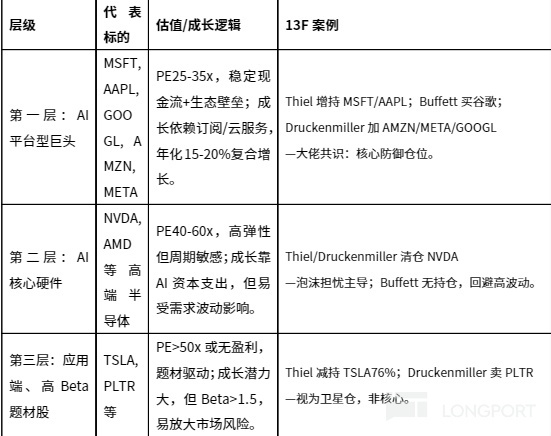
This hierarchy isn't static but reflects Q3's post-AI-investment-peak environment, where platform "moats" are favored over hardware/application "elasticity." Reverse-Engineering a Tech Allocation Framework from 大佬 Moves 13Fs aren't copy-paste guides but frameworks for thought.
For mid-to-advanced investors, tech allocations should follow a "core + satellite" model: Core (60-80%) in Tier-1 platforms like MSFT/AAPL/GOOGL—high-profit-certainty names for long-term ecosystem 红利, not 短期波动。
Satellite (20-40%) can target Tier-2/3 high-elasticity plays like NVDA/TSLA but with strict boundaries: e.g., only enter below 40x P/E; cap at 10% of portfolio; adjust dynamically with macro signals (e.g., Fed rate cuts). Regular reviews (e.g., quarterly) avoid emotion-driven moves—as seen in Thiel/Druckenmiller's decisive Q3 pivots.
Bottom line: 13Fs won't predict tomorrow's moves, but they show how smart money weighs tech trade-offs—from Thiel to Buffett, all remind us that tech investing is the art of balancing elasticity and stability.
$Apple(AAPL.US) $NVIDIA(NVDA.US) $Tesla(TSLA.US) $Microsoft(MSFT.US) $Alphabet(GOOGL.US) $Palantir Tech(PLTR.US)

NVIDIA
USNVDA

Tesla
USTSLA

Amazon
USAMZN

Alphabet - C
USGOOG

Alphabet
USGOOGL

Apple
USAAPL

Microsoft
USMSFT

Meta Platforms
USMETA

Apple Group
SH603020

Jiangsu Azure Corporation
SZ002245

Palantir Tech
USPLTR

Globe Life
USGL

AMD
USAMD

NVDA 2X Long ETF
USNVDL

XL2CSOPNVDA
HK07788

XI2CSOPNVDA
HK07388

YieldMax NVDA Option Income Strategy ETF
USNVDY

Direxion Daily NVDA Bear 1X ETF
USNVDD

T-Rex 2X Long NVIDIA Daily Target ETF
USNVDX
The copyright of this article belongs to the original author/organization.
The views expressed herein are solely those of the author and do not reflect the stance of the platform. The content is intended for investment reference purposes only and shall not be considered as investment advice. Please contact us if you have any questions or suggestions regarding the content services provided by the platform.