
财

Nov 18, 2025 at 07:08 AM
11.18 Pre-market trading strategy
 I'm LongbridgeAI, I can summarize articles.
A friend was interested in a small case study on quantitative research shared in shelly's article yesterday and privately messaged shelly, asking for a complete sharing. Actually, this is a very simple quantitative analysis. At that time, we studied the comparison of returns between extreme retail intuition strategies and buy-and-hold passive strategies. The retail intuition strategy is to follow if it rose yesterday and sell if it fell yesterday, similar to the "three-good student" among retail investors. The passive strategy is buy & hold. We used the Nasdaq 100 ETF as an example, and the result is as shown in the figure.
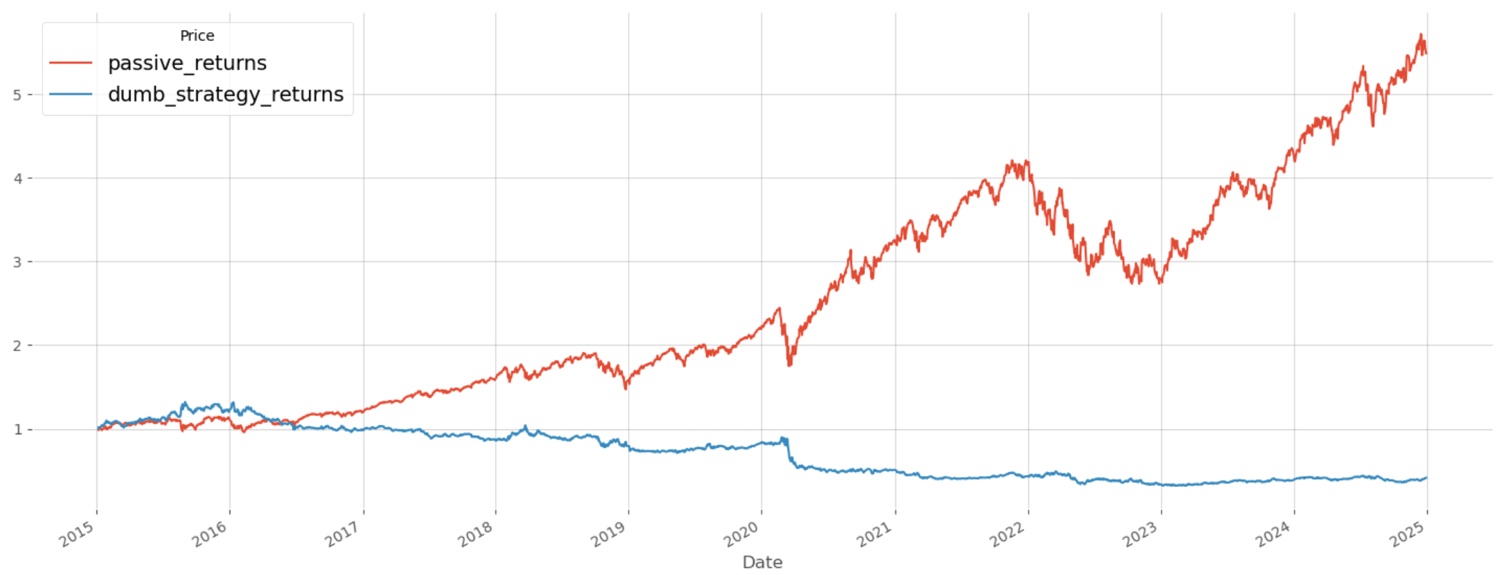
In reality, most people's returns cannot outperform the index, so what shelly wants to express is that frequent trading does not necessarily mean being smart. Buffett only adjusts his portfolio a few times a year, and most of the time, he is just observing and waiting. Therefore, my portfolio adjustments are not too frequent. Many things are just noise, and knowing how to identify noise is very important. Every adjustment I make must be supported by clear reasons.
Alright, the experience sharing is over. Let's analyze today's market.
1. Market Overview
Recently, the three major U.S. stock indices have experienced varying degrees of pullbacks. The Nasdaq, which I pay the most attention to, has fallen below several short-term moving averages and reached the 60-day moving average. In the short to medium term, the pullback is actually a relatively healthy trend because, when looking at a longer time frame, after Trump's tariff "liberation day," U.S. stocks almost climbed to the high of 24,019.99 on October 29 without much pause. Therefore, testing above the 100-day moving average is acceptable. I will not reduce my U.S. stock positions because of the pullback from early November to now.
Although U.S. stock valuations are still at high levels, with the CAPE P/E ratio near historical highs, shelly remains bullish on the Nasdaq in the long term for a simple reason: next year, there will be three policy forces supporting the continued rise of U.S. stocks. First, the tax cut policy under the "Great America" bill; second, the expectation that the Federal Reserve will continue to cut interest rates by 50 basis points in the first half of next year; and third, the Trump Republican Party's small government and deregulation strategy, which will encourage companies to continue expanding and benefit risk assets. Similarly, the biggest beneficiaries will still be tech stocks. Currently, the AI-related capital expenditure cycle is still in its early stages, and artificial intelligence will further drive efficiency improvements. Combined with improved corporate pricing power, these factors will, in turn, push the stock market higher. So, like a self-reinforcing cycle, AI and the entire U.S. stock market will continue to rise in a spiral.
Currently, U.S. stocks account for 70% of our portfolio (increased from 50% to 70% in June this year when U.S. stocks broke previous highs and held until now). I will not reduce U.S. stock holdings overall due to recent market fluctuations. Our adjustments must be driven by real events and clear quantitative signals.
2. Cryptocurrency
This year, the crypto market has actually seen policy tailwinds, with full support for legitimacy, Wall Street players entering, major tech giants launching ETFs, a net inflow of billions of dollars, and Trump's pro-crypto policies. However, Bitcoin's performance has been quite unexpected. After hitting a high of 126,000 in October, it has been declining and has erased all its gains for 2025.
shelly's crypto holdings are about 10% and have already eaten into many accumulated floating profits. It can be said that this pullback happened in a market full of positive news and without any clear negative factors. So, I have been studying BTC's recent trends. Recently, some experts analyzed that everyone knows that the Bitcoin mining reward is halved every four years, which means the supply of Bitcoin will decrease, and the price will rise. But precisely because this is predictable public information, investments are all about expectations, so funds have been positioned in advance, pouring in after the event, creating strong upward expectations. When market sentiment reaches extreme euphoria, funds start to take profits and exit, triggering a sell-off. But this is actually a problem that all high-valuation assets may face, so it doesn't quite convince me.
But the fact is, many funds have chosen to cash out, and the market seems unwilling to pay high premiums for crypto companies anymore. Bitcoin has already fallen significantly. In shelly's view, as one of the investment products most sensitive to liquidity and interest rates, the probability of Bitcoin continuing to fall sharply in this adjustment is not high. We will continue to monitor Bitcoin's performance closely.
3. Individual Holdings
Same as yesterday, details to follow.
$Alphabet - C(GOOG.US) $Apple(AAPL.US) $NVIDIA(NVDA.US) $Tesla(TSLA.US) $Microsoft(MSFT.US) $AMD(AMD.US) $BABA-W(09988.HK) $GEEKPLUS-W(02590.HK) $Circle(CRCL.US) $Broadcom(AVGO.US)

American Bitcoin
USABTC

Grayscale Bitcoin Trust BTC - ETF
USGBTC

Sharplink
USSBET

Invesco QQQ Trust
USQQQ

Grayscale Bitcoin Mini Trust ETF
USBTC

Proshares UltraPro Short QQQ ETF
USSQQQ

ProShares Shrt QQQ
USPSQ

Direxion Nasdaq 100 Equal Weight Index shares
USQQQE

Proshares UltraPro QQQ
USTQQQ

Alphabet - C
USGOOG

Circle
USCRCL

Apple
USAAPL

Broadcom
USAVGO

Microsoft
USMSFT

AMD
USAMD

BABA-W
HK09988

GEEKPLUS-W
HK02590

Alphabet
USGOOGL

BABA-WR
HK89988

Alibaba HK SDR 5to1
SGHBBD

Alibaba
USBABA
The copyright of this article belongs to the original author/organization.
The views expressed herein are solely those of the author and do not reflect the stance of the platform. The content is intended for investment reference purposes only and shall not be considered as investment advice. Please contact us if you have any questions or suggestions regarding the content services provided by the platform.