


How an ordinary investor can understand, buy, and hold a great company like Google
 I'm LongbridgeAI, I can summarize articles.
Recently, Buffett publicly confirmed in an interview that the investment in Alphabet by Berkshire was initially proposed by him personally.
He also frankly admitted that his failure to buy Google earlier in the past was a mistake.
Berkshire first established a position in Alphabet in the third quarter of 2025, then significantly increased its holdings in the first quarter of 2026, and invested another $10 billion through a private placement in June of the same year.
In other words, this is not a tentative investment where one dips a toe in the water, but a long-term heavy position that has been gradually expanded as understanding and confidence deepened.
Seeing Buffett express such confidence in Alphabet, I am naturally very happy.
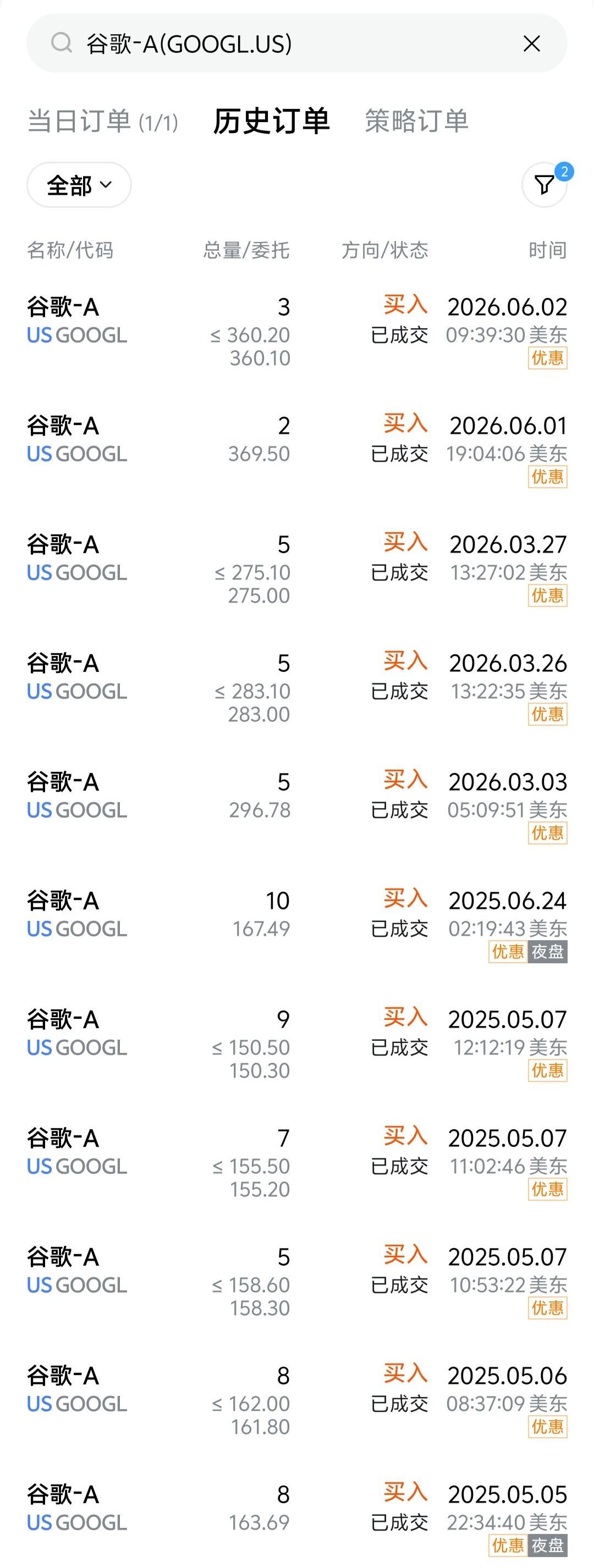
Although I am an investor with a heavy position in NVIDIA, since May 2025, I have also been gradually buying Google, and have written 8 articles revolving around Google, which are collected in the "Google Analysis" series on my personal community homepage.
From the initial "Discussing the Basic Situation of Google," to later in-depth analyses of "Google's Business Model"; from looking back at "Google's Development History and Outlook in the AI Era," to discussing "Appropriate Opportunities for Adding Positions in Google"; and further attempting to use Munger's framework of value investing to write "Viewing Current Google Through Munger's Latticework of Mental Models" and "How Would Munger View Google's Capital Allocation?"
Later, I placed Google within the long-term development of the entire AI industry, writing articles such as "Why NVIDIA, Google, and Microsoft Will See Further Growth in the Future."
These articles were not a series planned from the beginning.
They are more like footprints left along the way as I sought answers to questions constantly raised by the market.
Looking back, the time I started building my position in Google was indeed quite close to the stage when Berkshire established its position in Alphabet, and may even have been slightly earlier.
Of course, I dare not say that my investment level can be compared to Buffett's.
I just want to illustrate through this experience: as long as an ordinary investor is willing to seriously study companies and understand their business models, there is also an opportunity to understand, buy, and hold a great company before the market reaches a consensus.
I. When Buying Google for the First Time, the Market Did Not Truly Like It
I started building my position in Google in May 2025.
Looking back now, Google seems to have become a great company with little controversy.
It possesses the world's most powerful search engine, controls high-frequency products such as YouTube, Android, Chrome, Google Maps, and Gmail, has rapidly growing Google Cloud, and holds globally leading AI models and technological reserves.
But standing at that time, the market had many concerns about Google:
Will ChatGPT disrupt traditional search?
Will users still click on search ads in the future?
Is Google falling behind in the era of generative AI?
How much capital expenditure will Google need to invest to catch up with AI?
Will large models and AI search significantly increase computing costs without bringing revenue of a comparable scale?
Will antitrust litigation shake Google's search distribution system?
What the market discussed most at the time was not how excellent Google was, but whether Google would be disrupted by AI.
The reason I bought Google for the first time was not because these risks had disappeared.
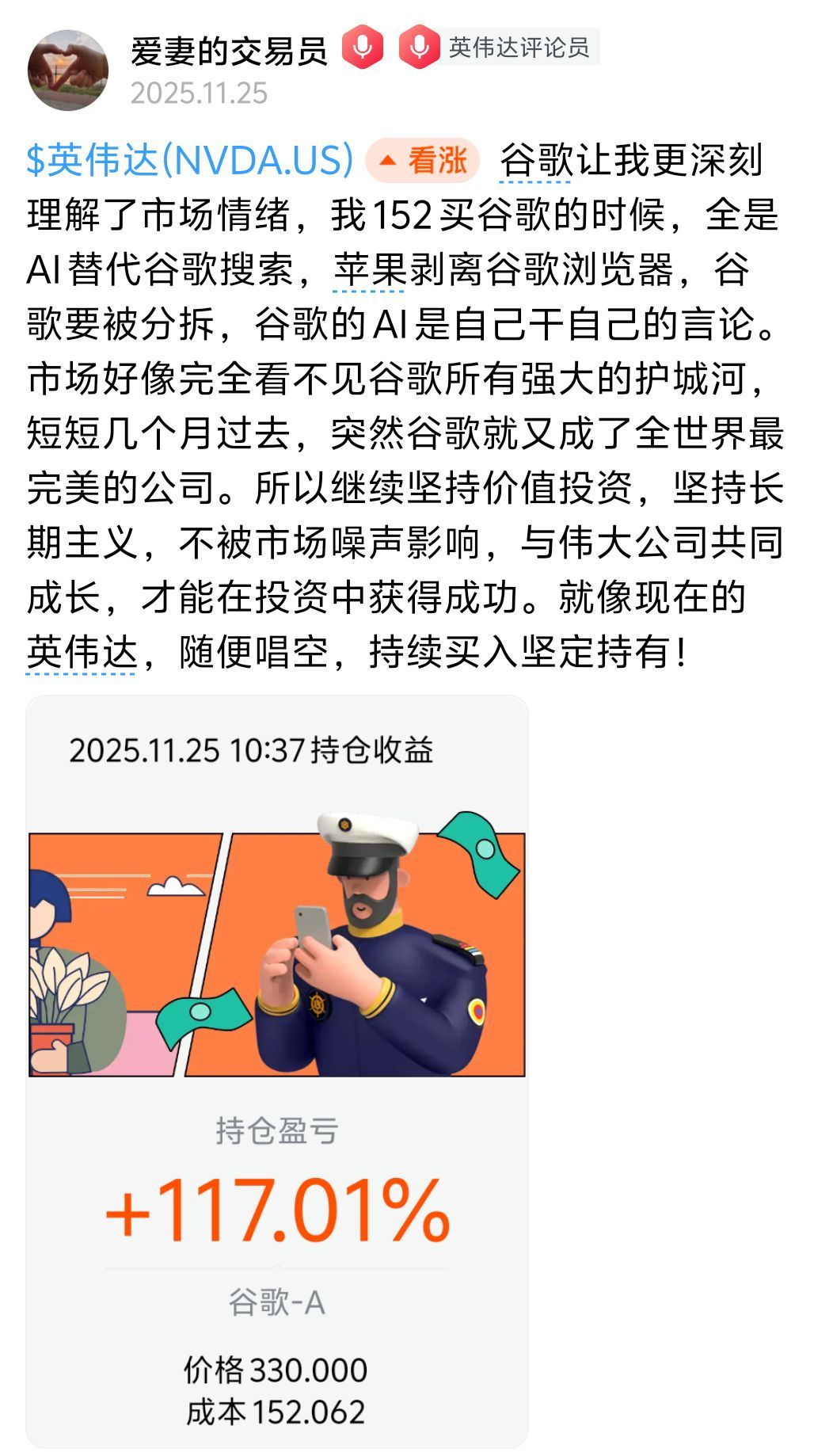
Quite the opposite, I bought it when these risks still existed and market sentiment remained pessimistic.
My most basic judgment at the time was:
The market over-deduced "Google is facing challenges" into "Google's business model is about to be disrupted."
Just as the market begins to question Microsoft today, when investors focus all their attention on short-term risks, stock prices often price in a large amount of pessimistic expectations in advance.
I remember posting discussions in the community at the time, recording how poor the market sentiment was when I first bought Google.
However, for investors, what truly needs to be judged is not whether Google faces challenges.
Any great company will face challenges.
What truly matters is whether these challenges will cause Google to lose its original competitive advantages, or if they will force it to utilize existing resources, talent, cash flow, and user base to complete its next self-evolution.
II. What Google Truly Possesses Is More Than Just a Search Advertising Business
The history of Google's development over the past twenty-plus years is itself a history of continuously expanding its own boundaries.
Starting from search, it subsequently acquired mobile operating systems, browsers, video platforms, maps, cloud computing, office software, and artificial intelligence.
Many people simply understand Google as a search advertising company.
But in my view, what Google truly controls are several of the most important traffic and information entry points in the internet age.
Search is an information entry point, Chrome is a browser entry point, Android is a mobile device entry point, YouTube is a video entry point, Google Maps is a geographic information entry point, and Google Cloud is an important entry point for enterprise digitalization and AI infrastructure.
These products are not isolated businesses.
Together, they form a vast ecosystem that reinforces each other in terms of data, users, distribution, advertising, and artificial intelligence.
As long as these entry points remain in Google's hands, it will not easily lose its value due to changes in any single product form.
Generative AI may indeed change the interaction methods of traditional search, but changing the product form of search does not mean the demand for search itself disappears.
People still need to obtain information, compare products, find services, watch videos, use maps, and handle work.
The real question is not whether users will still search in the future, but who will continue to control the entry point for users to obtain information under new product forms.
In terms of capital, data, computing power, model capabilities, user base, and distribution channels, Google remains one of the companies best capable of completing this transformation.
It is precisely these fundamentals that supported me in starting to buy when market sentiment was at its most pessimistic.
III. The Larger the Position, the Less One Can Rely Solely on Feelings to Hold
When positions are small, it is easy for people to remain optimistic.
If the price rises, one feels their judgment was correct; if it falls, one can comfort themselves that the position size is small anyway.
But as positions continue to increase, the problems faced are completely different.
Every decline forces you to re-answer:
What exactly did I buy?
Where lies Google's true moat?
Can search advertising continue to grow?
Will AI ultimately weaken or strengthen Google?
With such massive capital expenditures every year, can Google earn it back in the future?
Will management invest the originally strong free cash flow into low-return projects?
This is also why I wrote more and more articles about Google later on.
I initially wrote "Discussing the Basic Situation of Google" because I wanted to first understand its business structure and sources of income.
Subsequently, I wrote "Google's Business Model" because knowing what businesses a company has is not enough; more importantly, one must understand why these businesses can sustainably make money and how different businesses reinforce each other.
After studying the business model, I began to look back at Google's development history.
Because how a company has historically responded to technological changes is often more valuable than what management says today.
Google is not facing a technological paradigm shift for the first time.
From PC internet to mobile internet, from traditional text search to video, maps, and recommendation algorithms, it has already experienced multiple shifts in traffic entry points.
Especially in the early days of mobile internet, many people similarly worried that Google would lose its entry points.
But through Android, Chrome, mobile search, and YouTube, Google was not only not disrupted by mobile internet but actually further expanded its ecosystem.
Therefore, when generative AI appeared, I began to seriously consider:
Is this a catastrophic disaster Google has never encountered before, or is it yet another technological revolution requiring a reorganization of product forms?
Later, I studied appropriate opportunities to add positions in Google, attempted to analyze Google using Munger's latticework of mental models, and further discussed Google's capital allocation.
Because once positions truly become large, merely proving that this is a good company is not enough.
One must continue to answer:
Is the current price reasonable?
How will the company's cash flow be used?
Can management continue to invest earned money into high-return businesses?
Is share repurchase truly creating value, or is it merely offsetting the dilution caused by equity incentives?
Are massive AI capital expenditures building the next generation's moat, or will they continuously lower capital returns?
Research must keep pace wherever the position increases.
Otherwise, once the stock price truly drops significantly, so-called long-term holding easily becomes an empty slogan.
IV. Understanding the Company Allows One to Truly Buy During Market Pessimism
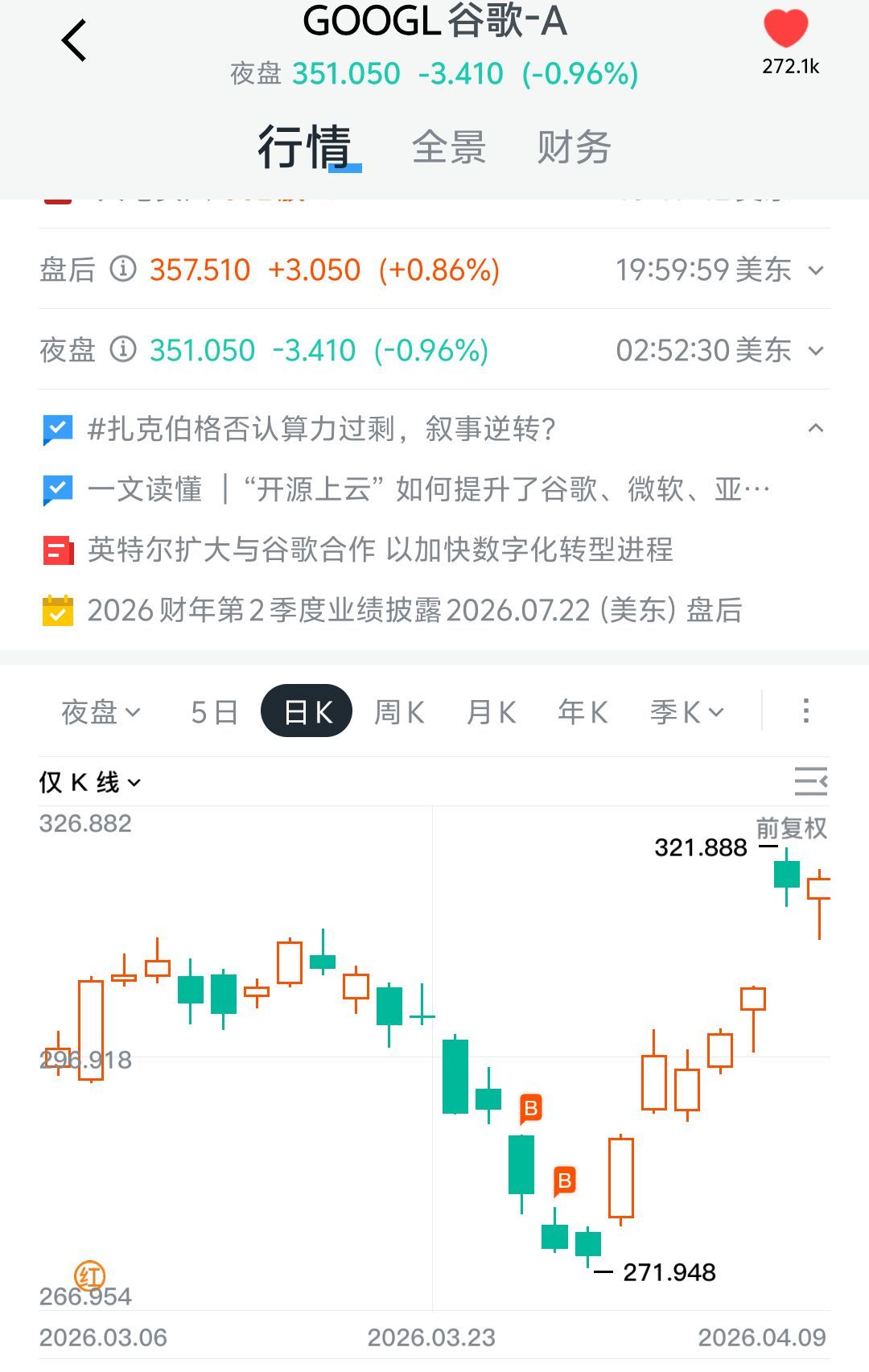
Based on the aforementioned analysis, in March this year, when geopolitical conflicts were most intense and tech stock market sentiment was near freezing point, I still dared to firmly add to my Google position and bought at a relatively low price at that time.
And by May 22, after consecutive rises in Google's stock price and optimistic market sentiment, with the stock price reaching around $388, I again proposed in an article:
Google's price has become too high, the valuation revaluation over the past year and a half is basically complete, and the space for further significant short-term upside may be limited; it is more suitable to wait for a pullback before adding positions.
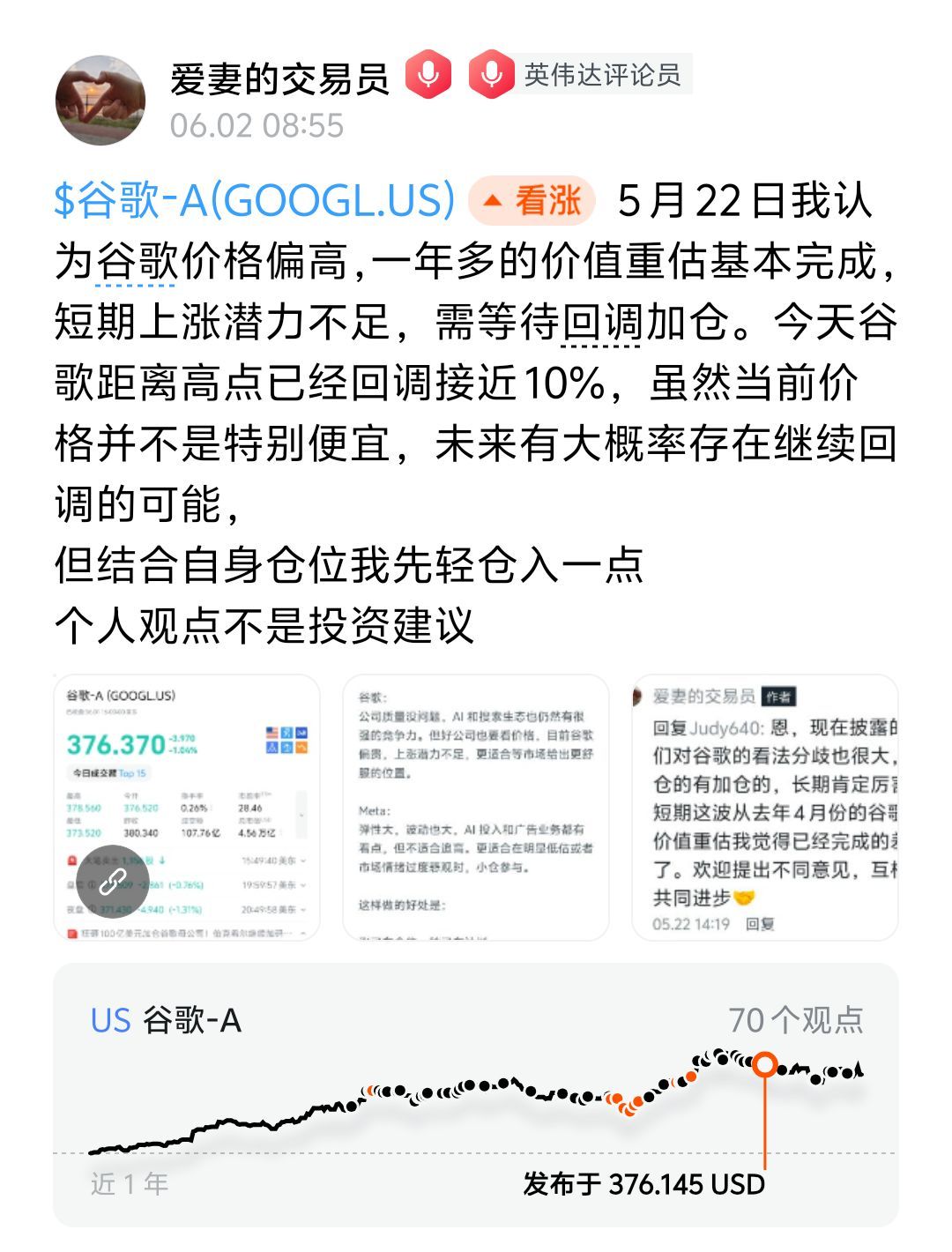
Thereafter, Google's stock price retreated from a high of approximately $408 all the way down to a low of around $330.2.
Of course, I do not believe this demonstrates my ability to accurately predict short-term stock prices.
Short-term predictions are also of little significance to long-term investors.
My judgments still come from a comprehensive analysis of the company's fundamentals, valuation levels, and market sentiment.
Moreover, since I am prepared to hold long-term, I will not overly care about whether each transaction bought a few dollars too expensive, or whether I bought at the absolute lowest point.
But the value of research lies in enabling you to dare to buy when the market is extremely pessimistic, and to maintain restraint when the market is extremely optimistic.
Not being more afraid the lower it falls, nor more excited the higher it rises.
This may well be the greatest significance of an ordinary investor researching companies.
V. Regretting Buying Too Little When Rising, Afraid to Buy When Falling
When researching companies, people always appear rational.
But when one truly opens their account and watches their holdings rise and fall daily, emotions never completely disappear.
When Google rises, I also feel I bought too little.
Seeing the market once again recognize Google's AI capabilities, seeing cloud business continue to grow, and seeing search advertising maintain resilience, I also think:
Since I have researched it so clearly, why didn't I buy a bit more at once back then?
But when the stock price truly falls, people's thoughts change again.
A price that originally seemed very reasonable, when it actually arrives, causes hesitation:
Can it fall a little more?
Does the market know information I don't?
Will AI search truly erode traditional advertising business?
Will capital expenditures spiral out of control?
This is actually a very real contradiction in investing:
Regretting insufficient positions when rising, worrying about excessive positions during pullbacks.
But if a company, after thorough research, has been identified as a quality asset suitable for long-term holding, then determining final returns may not depend on whether every transaction happened to buy at the lowest point.
More importantly, did you establish sufficient positions at a reasonable price, and can you truly hold them after buying?
If the direction is correct, then the greatest risk after buying is sometimes not a short-term drop in stock price, but constantly doubting oneself amidst normal fluctuations, ultimately selling truly excellent assets too early.
VI. From Heavy Individual Stock Positions to Expanding Tech Assets via Indices
Over this past year and a half, my attitude toward Google has undergone obvious changes.
Initially, I just wanted to participate in this company's long-term growth through a portion of my position.
Later, as research deepened, Google gradually became one of the core assets in my portfolio, currently accounting for about 10%.
Subsequently, my entire investment system also changed.
As asset scale increased, I began directing more new funds toward QQQM, hoping to reduce extreme risks associated with individual stocks through indices.
But this does not mean I no longer favor Google.
Quite the opposite, precisely because core companies like Google, Microsoft, and NVIDIA have established relatively satisfactory positions, I have begun allocating more new funds to indices.
Now, regarding my existing Google position, I prefer long-term holding rather than frequent trading due to short-term fluctuations.
To me, Google is no longer just a stock waiting to rise, but an important component of my long-term tech asset allocation.
VII. What Does Buffett Buying Google Actually Validate?
A company one has researched and held long-term eventually enters Berkshire's important holding system. This at least indicates that Google is no longer just a difficult-to-understand, hard-to-value tech company.
However, Buffett buying Google does not prove my investment is necessarily correct.
Even Buffett can make mistakes.
Google may still face risks in the future, including AI competition, regulatory lawsuits, excessively high capital expenditures, and diversion of advertising business.
Investment cannot be simplified to:
"Buffett bought it, so I should buy it too." For me, what this event truly validates is something else: There has never been an uncrossable chasm between tech companies and value investing. Many people simply understand value investing as buying traditional companies with low P/E ratios and stable businesses for many years. But what Munger and Buffett truly care about is never whether a company belongs to consumer, financial, or tech sectors. What truly matters is whether it has an understandable business model, durable competitive advantages, excellent capital returns, and the ability to generate cash flow long-term. Young Google was indeed hard to value. It operated in the rapidly changing internet industry, its future business boundaries were unclear, and technology and competitive landscapes held huge uncertainties. But today's Alphabet is completely different. It possesses one of the world's broadest user bases, controls multiple core internet entry points, generates massive operating cash flow annually, and has the capacity to continuously invest in next-generation technologies. From this perspective, Google is evolving from a typical high-growth tech company into a mature commercial platform possessing both growth potential, a moat, and strong cash flow. It certainly still possesses the high investment and high change characteristic of tech companies. But it increasingly meets the standards of excellent enterprises sought by value investors. Buffett's attitude this time is also not an unreserved bullishness. On one hand, he admits he missed Google in the past; on the other, he remains cautious about the massive capital investments brought by AI competition. I actually believe this attitude is more valuable than simply cheering for the stock. True investment is never about failing to see risks. It is about believing that a company's long-term value is worth bearing these uncertainties even after placing the risks on the table. Finally: What Truly Makes One Hold Stocks Is One's Own Cognition From buying Google for the first time in May 2025 to seeing Buffett publicly confirm this investment today, my greatest feeling about this experience is not that I finally hit upon the right answer. Rather, I understand more and more: What truly makes one hold a company's stock is never others' recommendations, but the cognition built layer by layer about that company oneself. When stock prices rise, cognition prevents blind chasing driven by excitement. When stock prices fall, cognition helps distinguish normal fluctuations from fundamental deterioration. When market narratives change, understanding allows one to avoid modifying judgments daily based on emotions. In the future, Google certainly cannot go smoothly forever. The AI era has just begun, and the form of search products will continue to change. Google needs to invest more funds in building computing power, data centers, and models, and must prove these investments ultimately convert into revenue and profit. It will also face long-term competition from Microsoft, OpenAI, Meta, Amazon, and other AI companies. If one day Google's core entry points are continuously weakened, the commercial loop of search and advertising is broken, and capital expenditures fail to yield reasonable returns long-term, then I must also re-examine my investment logic. Long-term holding does not mean never thinking. Quite the opposite, the more one prepares to hold long-term, the more one needs to continuously observe whether the company's competitive advantages have undergone fundamental changes. But at least so far, I still believe Google is one of the few companies globally capable of simultaneously possessing massive existing businesses, strong free cash flow, and next-generation technological growth opportunities. To me, Google is not just a stock code used to chase short-term gains. It is more like a truly long-term asset in the process of my investment system maturing. From initially understanding its basic situation to researching its business model, development history, AI capabilities, valuation, capital allocation, and long-term growth. As research deepens, my position gradually increases, and my holding mindset becomes increasingly stable. I dare not say I have understood all of Google's future. But at least, I know why I bought, what risks I am bearing, and why I am willing to continue holding. For an ordinary investor, this perhaps constitutes the entire process of understanding, buying, and holding a great company.

Alphabet
USGOOGL

WM Tech
USMAPS

Berkshire Hathaway B
USBRK.B

Berkshire Hathaway
USBRK.A

Alphabet - C
USGOOG

Alphabet Inc Pref Shares GOOGN 6.25 05/15/2029
USGOOGN

Alphabet Inc Pref Shares GOOGM 6.25 05/15/2029
USGOOGM

Microsoft
USMSFT

NVIDIA
USNVDA

GOOGL 1X Short ETF
USGGLS

GOOGL 2X Long ETF
USGGLL

XL2CSOPBRKB
HK07777

GraniteShares 2x Long MSFT Daily ETF
USMSFL

YieldMax MSFT Option Income Strategy ETF
USMSFO

MSFT 1X Short ETF
USMSFD

MSFT 2X Long ETF
USMSFU

T-Rex 2X Long Microsoft Daily Target ETF
USMSFX

Kurv Yield Premium Strategy Microsoft MSFT ETF
USMSFY

NVDA 2X Long ETF
USNVDL
The copyright of this article belongs to the original author/organization.
The views expressed herein are solely those of the author and do not reflect the stance of the platform. The content is intended for investment reference purposes only and shall not be considered as investment advice. Please contact us if you have any questions or suggestions regarding the content services provided by the platform.