

Micron Earnings: Whether Short Orders or Long Contracts, the Pricing Power Is Still in Their Hands! The AI Memory Cycle Keeps Getting Confirmed! What Is the "SCA" the Earnings Call Kept Mentioning?

$2 倍做多美光科技 ETF - Direxion(MUU.US) $2 倍做多 MU ETF - GraniteShares(MULL.US)
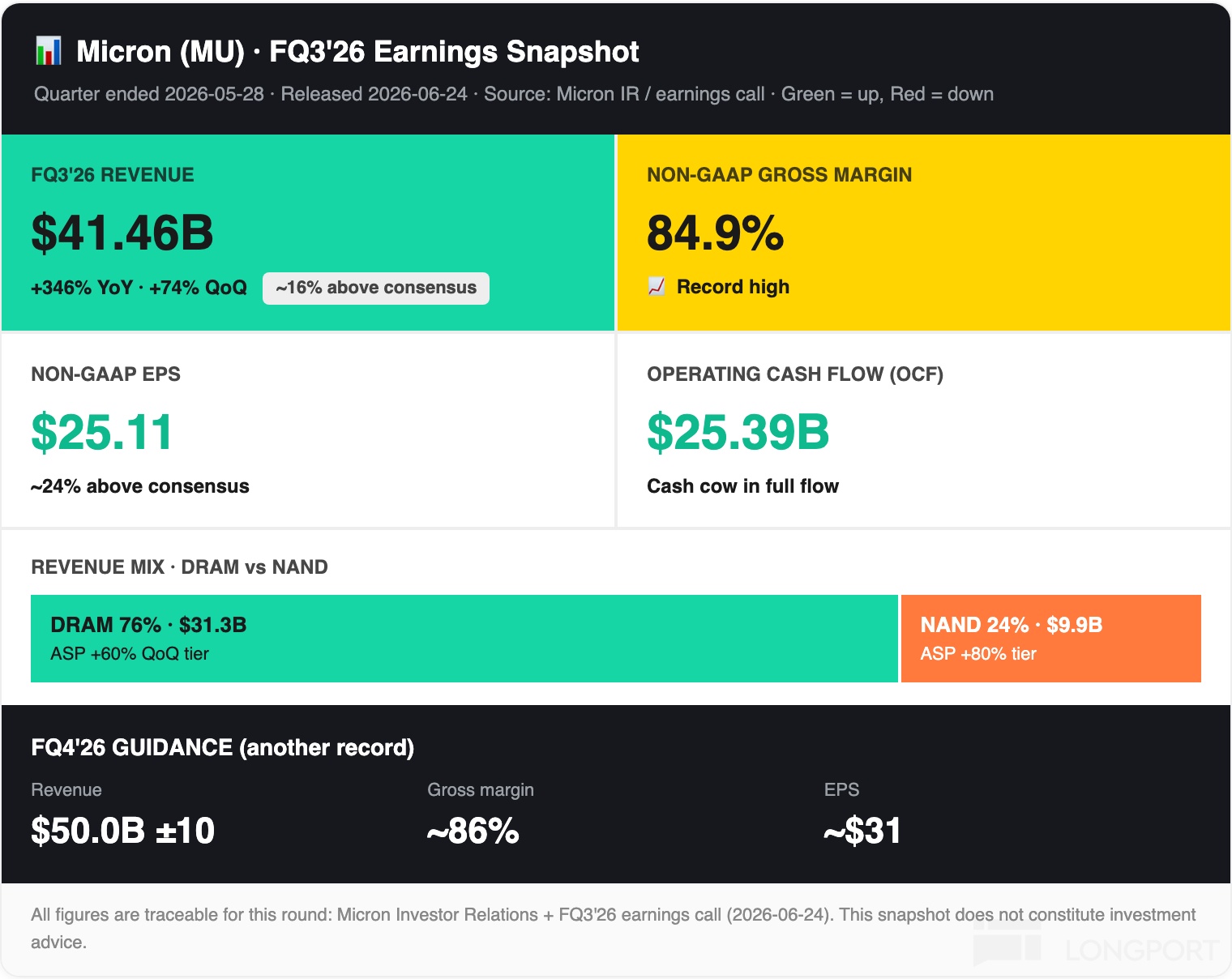
$美光科技(MU.US)'s earnings are out — let's take a look at the segment profits.
1. Cloud Memory / CMBU (Cloud Memory · HBM, ~33%)
Revenue $13.77B, gross margin 83% — the crown jewel of the AI memory super-cycle. The real focus is HBM: HBM3E + HBM4 are already sold out through 2027, with demand booked into 2028; the entire CY2026 HBM supply is fully contracted and locked on both price and volume; HBM4 shipments have already exceeded $1B, and the 12-high ramp speed is 2x that of HBM3E. [Earnings call · 2026-06-24]
New signal on the call: the HBM TAM target was revised up to break $100B by 2027 (pulled forward a year from 2028). This rewrites the old "memory = cyclical commodity" logic into a new "HBM = multi-year contract-locked" logic, further hammering home the growth-stock label.
2. Core Data Center / CDBU (~28%)
Revenue $11.52B, gross margin 87% — the strongest profit engine this quarter, driven by both server DRAM and data center SSD (>$5B, doubled QoQ). Company-wide data center revenue topped $25B, and an annualized run-rate above $100B is no problem — the data center is the real engine this quarter.
3. Mobile & Client / MCBU (~28%)
Revenue $11.52B, gross margin 87%; the consumer end is ramping volume alongside the pricing cycle, with ASP up sharply, turning from a drag over the past two years back into a tailwind.
4. Auto & Embedded / AEBU (~11%)
Revenue $4.63B, gross margin 79% — the smallest and steadiest segment, providing ballast outside the cycle.
On the industry side, Hynix's capacity expansion ignited the global memory chain: SK Hynix +11% (planning a $29.4B Nasdaq raise to expand capacity), Samsung +5%, KOSPI +6% triggering a circuit breaker, Nikkei +2.3%. So Micron's results are seen as "dispelling AI-bubble worries" and further validating the memory super-cycle.
Post-earnings, Wall Street raised targets across the board: D.A. Davidson lifted to $2000 (Street high); Mizuho $1375, Baird $1280 maintaining Buy; only Goldman maintains Hold. Institutions remain at a Strong Buy consensus, average target $1328.
Investment Logic (AI compute → HBM shortage → contract lock-in → expansion)
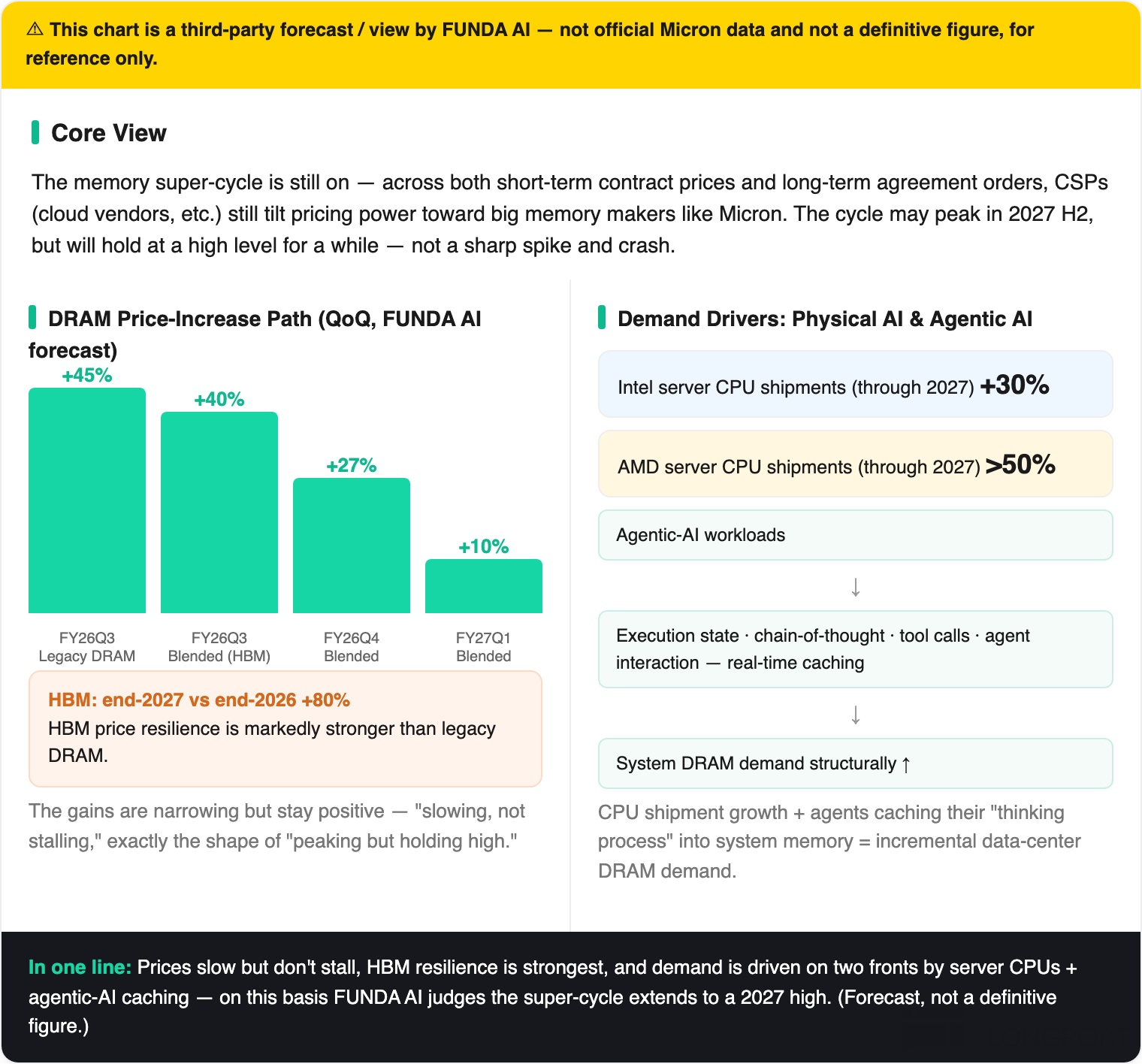
In my view: AI compute demand keeps growing → HBM / high-capacity DRAM shortage → price increases + multi-year contract lock-in ($100B in contracts, 16 SCAs, ~40% of revenue) → cash flow surges (OCF $25.4B) → capex expands advanced-process capacity (FY26 $27B → FY27 $45B+) → more HBM supply.
In this investment-logic chain, the engine is now redlined, but memory's underlying nature is still cyclical: 84.9% gross margin and ASP up +60–85% QoQ to an all-time peak — watch whether this mean-reverts (the cyclical property).
Chart — Bernstein: expects earnings to peak in 2027 and then start to decline.
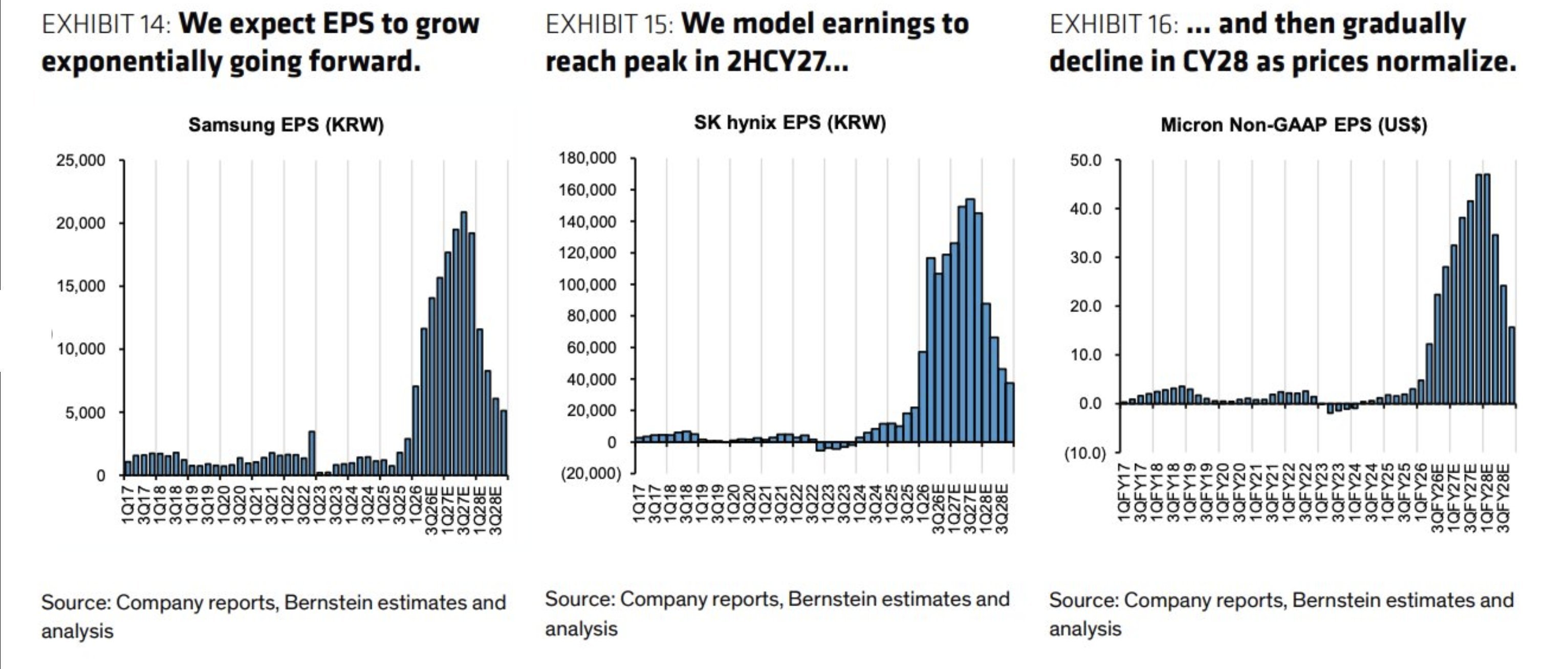
And Micron is pushing capex from $27B (FY26) to $45B+ (FY27) — adding capacity at a historic cyclical peak. This warrants watching the follow-through, since the essence of this industry is volume.
(1) HBM uses 16 SCAs, $100B in contracts plus ~$22B in prepayments / letters of credit to lock about 40% of revenue into "quasi-contracted" status, which — judging by current secondary-market sentiment — does weaken the cyclicality.
(2) But the remaining ~60% is still commodity that floats with spot prices. When the next round of DRAM / NAND spot-price decline comes, whether the "confidence" layer of HBM long-term contracts can hold up secondary-market confidence is worth continuing to track.
A deep dive on the "SCA" that came up so often on this call
SCA (Strategic Customer Agreement) refers to a strategic customer agreement — in plain terms, the long-term orders signed with major customers.
The long-contract share keeps climbing — does that mean Micron's pricing power is especially strong? Or does it mean the cycle is about to turn, and they're rushing to sell capacity at a high price while the pricing power still exists?
Long-term contracts are mostly signed when supply is tightest — customers only lock in long orders because they fear shortages. So a rising long-contract share looks more like a coincident sign of "an overheating cycle," rather than a leading signal of strengthening pricing power.
Once SK Hynix (raising $29.4B) and Samsung expand capacity and supply returns to the market, newly signed long orders will naturally slow, and the higher share is just a result. Besides, HBM is by nature sold on long contracts, so as HBM's revenue share rises, the long-contract share passively rises along with it.
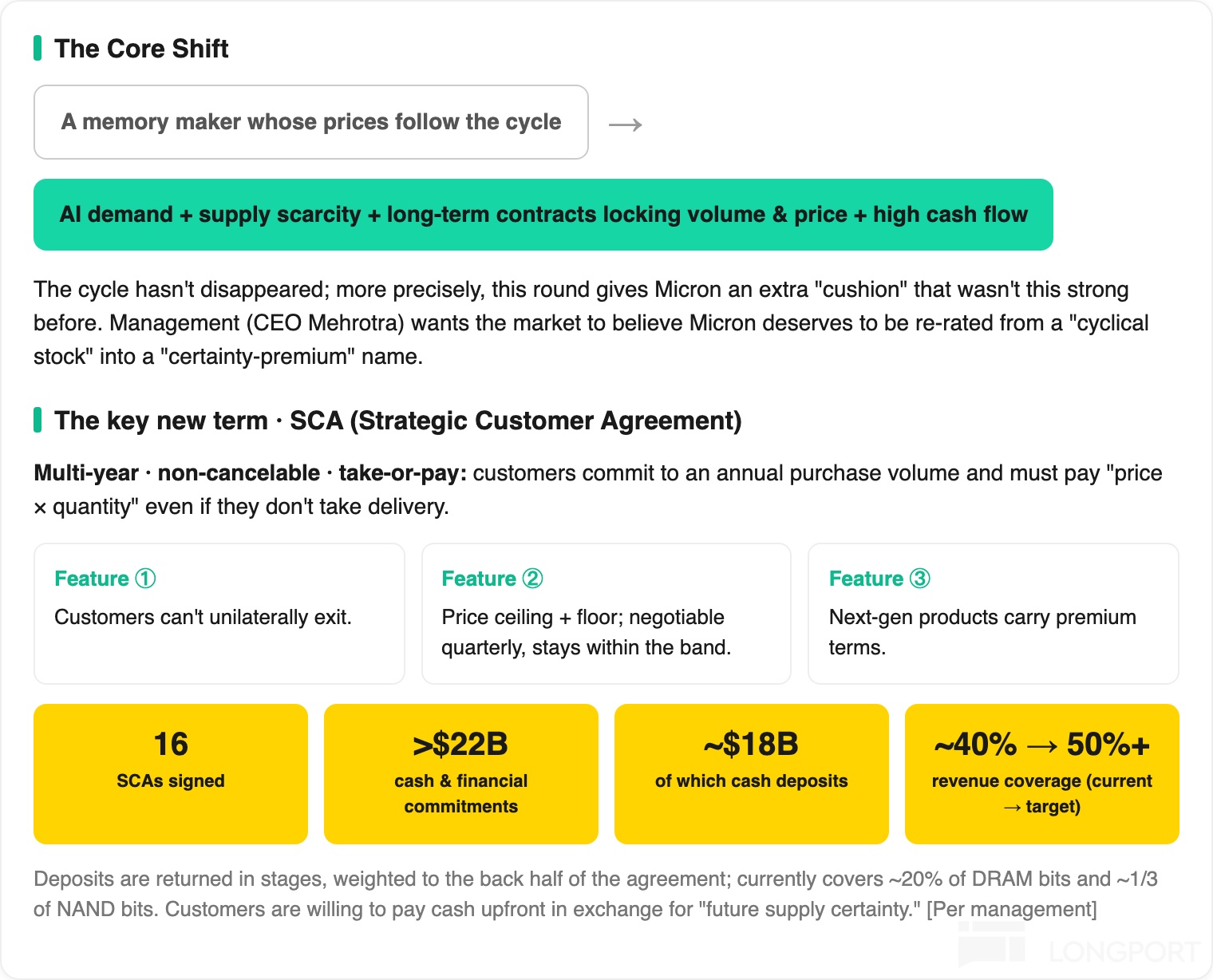
The same rising long-contract share could hide two completely opposite worlds:
One is genuine pricing power — new and renewed contracts hold flat or even rise in price, with prepayments, price floors, and reserved capacity, meaning Micron has handed the price-decline risk over to its customers.
The other is the pricing-power trap — the share is rising, but new-contract prices are actually softening; customers use long orders as a hedge to "prevent future price drops," with the initiative in the buyers' hands. In this case, the higher the share, the more dangerous it is.
Goldman Has Been the Lone "Contrarian"
Of all these investment banks, only Goldman has kept a conservative rating for several quarters now — maintaining Hold with a $900 target.
Goldman's math: normalized EPS $50 × 18x = $900. In other words, valuing by what Micron should earn under normal conditions, a reasonable target is $900. Here's a reference for everyone.
If this thesis of weakening pricing power really holds, what it directly attacks are the two valuation anchors — "normalized EPS" and whether a "premium multiple" is deserved.
Higher contract visibility → the normalized center moves up + it deserves a higher multiple. The current share price (around $1214 after hours) corresponds to peak annualized EPS of about $120, roughly 10x — so the market has actually already priced in part of the "de-cyclicalization" expectation.
So the most dangerous move is: at the cyclical peak, using "the rising long-contract share" as the reason to re-rate the valuation to an irrational, permanently high multiple. Re-rating a strong cyclical property as perpetual growth at the top is the most classic way to lose money in the history of memory stocks.
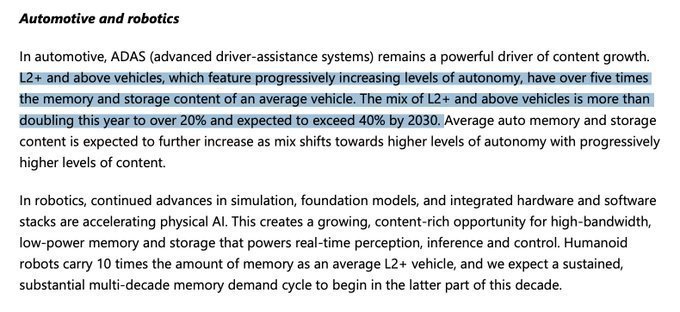
CEO: A humanoid robot's memory capacity is 10x that of an ordinary L2+ vehicle; we expect a sustained and massive new memory-demand cycle to begin in the second half of this decade.
Setting aside management's pie-in-the-sky, assume EPS peaks in 2027 and then starts to decline. Citing $美光科技(MU.US)'s estimated FY2027 EPS of about $120: given the 16 SCA contracts and the future order visibility, an 8–12x multiple should be reasonable.
Lowest target: 120 EPS × 8 PE = $960
Highest target: 120 EPS × 12 PE = $1440; mid-point $1200
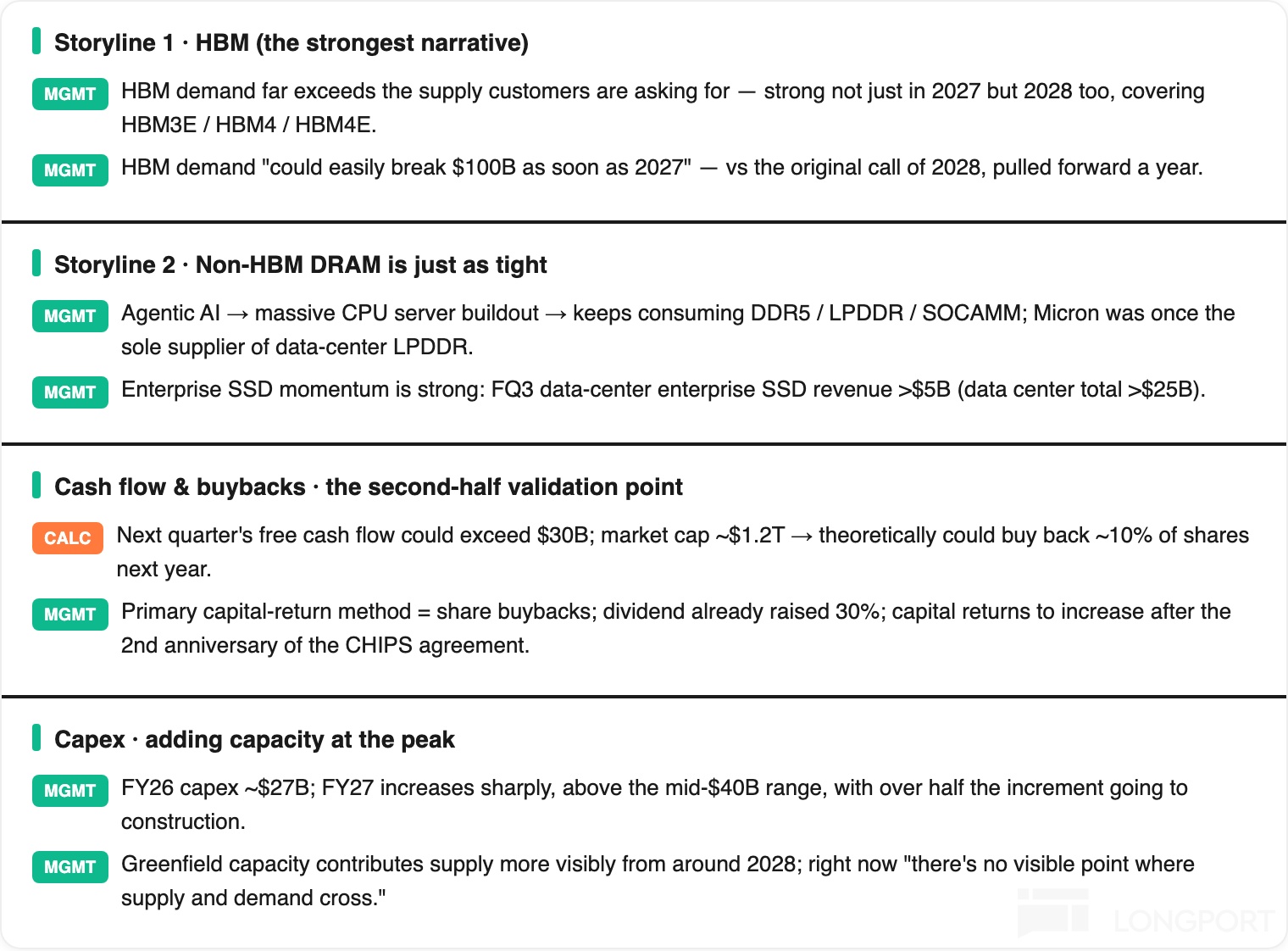
Risk warnings:
- The share price has already priced in plenty of good news — don't just look at the boom and ignore valuation.
- SCA contract prices have floors locked in, but may also cap part of the upside (price ceilings).
- Overly aggressive capex plants the seed for the next round of supply / oversupply risk.
- AI end-demand must materialize; if cloud vendors cut capex, it will show up first in supply-demand and prices.
- Geopolitics / export controls (within the scope of US–China tech restrictions).
本文版权归属原作者/机构所有。
当前内容仅代表作者观点,与本平台立场无关。内容仅供投资者参考,亦不构成任何投资建议。如对本平台提供的内容服务有任何疑问或建议,请联系我们。
