

Part 1 Selling Cash-Secured Puts on Anthropic (ANT): Why I Choose US$70 and US$75
 我是 LongbridgeAI,我可以總結文章信息。
🐾 Options Puppy Beginner Guide – Part 1
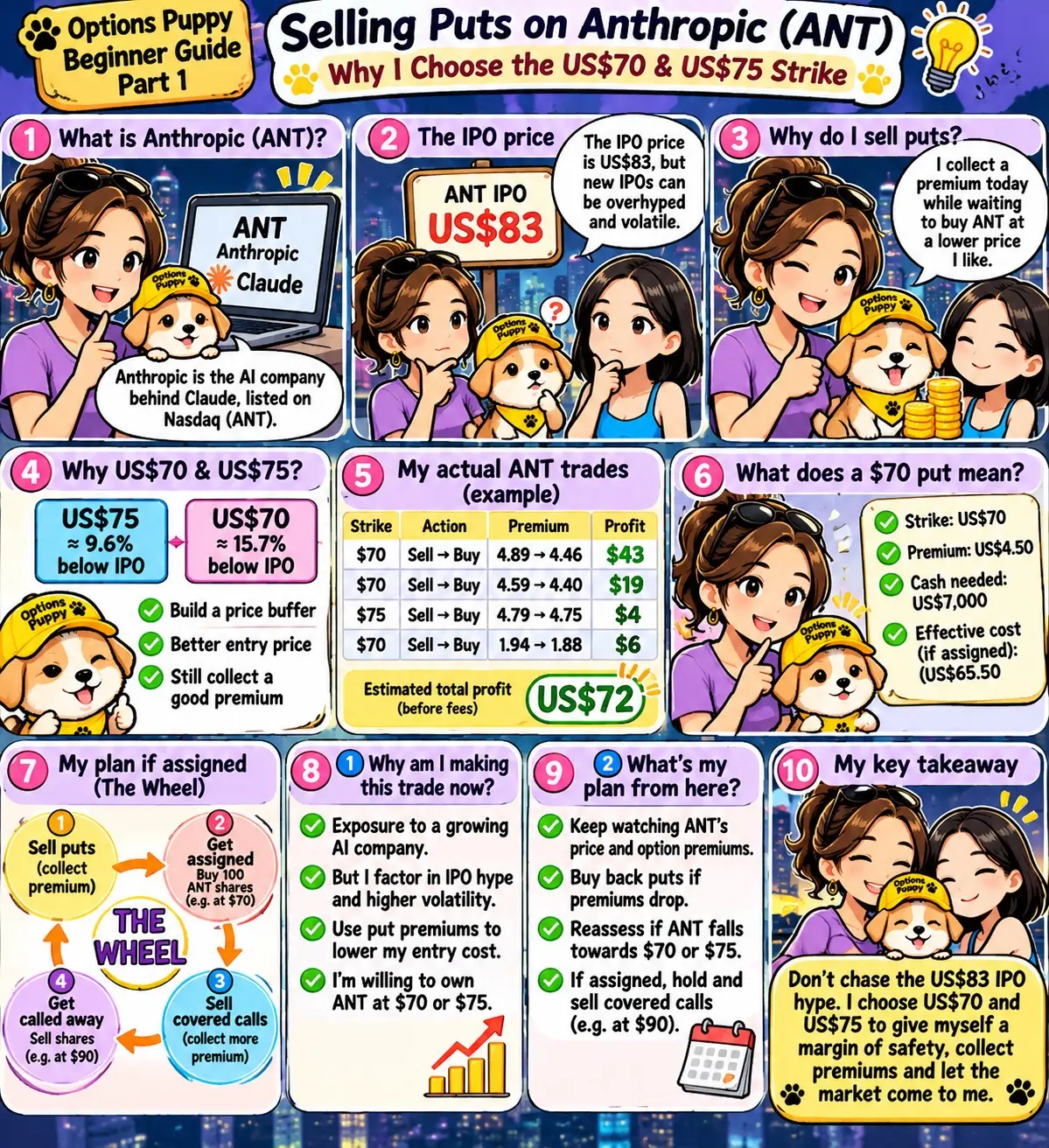
🐶 1. My first question: Do I really want to buy ANT at its IPO price?
When Anthropic entered the public market, its IPO price was US$83 per share.
As an investor, I understand the excitement surrounding artificial intelligence. Anthropic is behind Claude, an AI model competing in a rapidly expanding industry.$Anthropic(ANT.US)
However, I also understand something important about newly listed companies.
A good company does not necessarily mean a good share price.
When a popular technology company launches its IPO, there can be considerable excitement. Investors want to participate, institutions want exposure, and retail investors may rush to buy shares.
This can create an initial wave of buying pressure.
But I do not want to confuse excitement with valuation.
My concern is that the first few trading sessions may reflect hype, expectations and speculation rather than the company’s long-term business value.
Instead of chasing ANT at US$83, I decided to look at selling cash-secured puts at lower prices.
My thinking is simple: if the market becomes more realistic after the IPO excitement, I want to be ready to buy at a price that I find more attractive.
🧠 2. Why I choose US$70 instead of US$83
Let’s look at the difference.
- IPO price: US$83
- My preferred put strike: US$70
- Difference: US$13
That represents approximately 15.7% below the IPO price.
Why does this matter?
I am deliberately giving myself a price cushion.
I do not know whether ANT will trade above US$83, fall to US$75 or experience a deeper correction.
Rather than trying to predict the exact bottom, I choose a strike where I am more comfortable owning the shares.
At US$70, I am not paying the original IPO price.
I am waiting for the market to offer me a potentially better entry point.
This is particularly important for a newly listed AI company because its share price can move considerably as investors discover what the business is actually worth.
🐾 3. Why I also consider US$75
I did not choose only US$70.
I also traded the US$75 put.
Why?
Because I want to explore different entry prices and premium opportunities.
US$75 is approximately 9.6% below the IPO price of US$83.
US$70 is approximately 15.7% below.
My two strikes represent different levels of willingness to buy.
- US$75: I am willing to purchase at a higher price if the premium compensates me sufficiently.
- US$70: I prefer a deeper discount and a lower potential purchase commitment.
The difference is not just US$5.
For 100 shares, the difference in purchase commitment is US$500 per contract.
I must decide whether the additional premium available at US$75 is worth accepting the higher purchase price.
💰 4. Understanding my actual ANT transactions
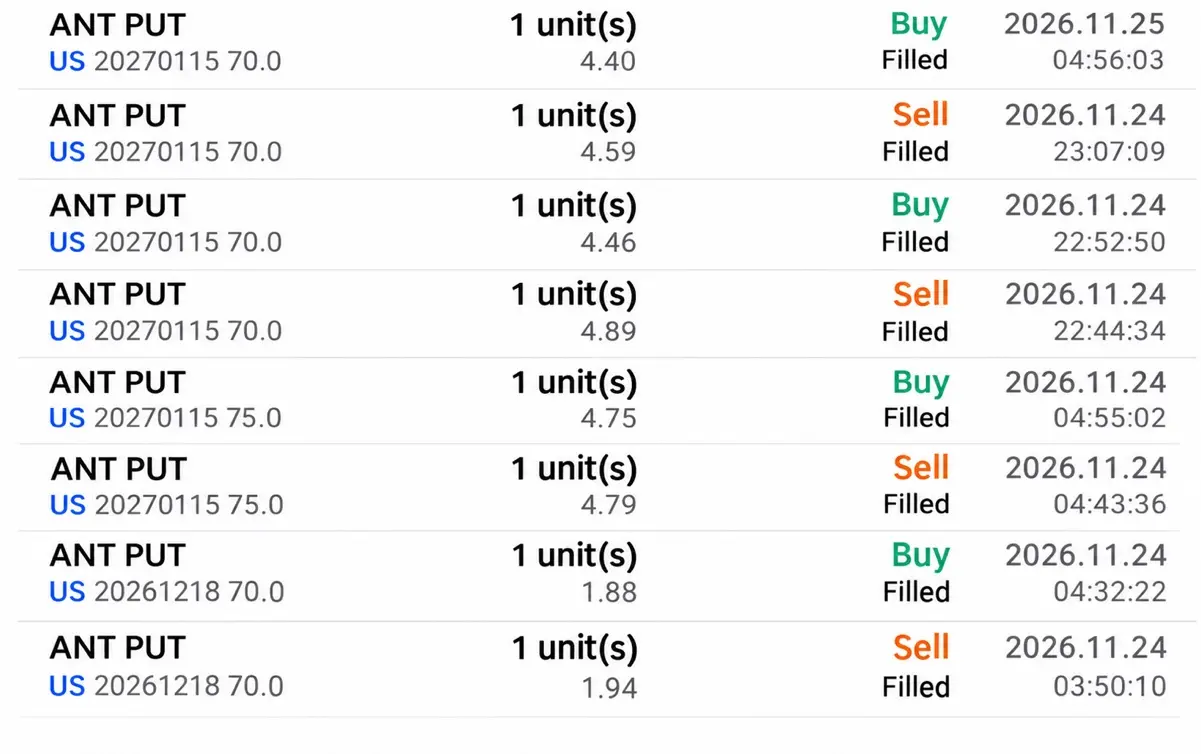
Here is what I traded.
15 January 2027 – US$70 PUT
- Sold at US$4.89
- Bought back at US$4.46
- Sold again at US$4.59
- Bought back at US$4.40
My first completed round trip:
US$4.89 - US$4.46 = US$0.43
US$0.43 × 100 shares = US$43.
My second completed round trip:
US$4.59 - US$4.40 = US$0.19
US$0.19 × 100 shares = US$19.
Total estimated gross profit: US$62.
15 January 2027 – US$75 PUT
- Sold at US$4.79
- Bought back at US$4.75
US$0.04 × 100 shares = US$4.
18 December 2026 – US$70 PUT
- Sold at US$1.94
- Bought back at US$1.88
US$0.06 × 100 shares = US$6.
My estimated gross trading profit from these four completed round trips is US$72 before fees.
I am not waiting for every option to expire worthless.
I am also watching the premium and buying back contracts when the price becomes cheaper.
This allows me to realise a profit and potentially redeploy my capital.
📊 5. What does selling a US$70 put actually mean?
For beginners, let’s simplify the mechanics.
Suppose ANT is trading at US$90.
I sell one US$70 cash-secured put and collect US$4.50 per share.
My calculations:
- Strike price: US$70
- Contract size: 100 shares
- Cash required: US$7,000
- Premium received: US$450
- Effective purchase cost if assigned: US$65.50 per share.
If ANT stays above US$70 at expiration, the put will generally expire worthless and I keep the premium.
If ANT falls below US$70 and I am assigned, I purchase 100 shares at US$70.
After accounting for my US$450 premium, my effective cost becomes US$65.50 per share.
However, this does not mean I cannot lose money.
If ANT falls to US$50, my shares are worth US$5,000 while my effective purchase cost is US$6,550.
I would have an unrealised loss of US$1,550.
This is why I only sell puts on companies that I am genuinely prepared to own.
🚀 6. Why I am interested in Anthropic
My interest in ANT is connected to the long-term development of artificial intelligence.
I want to follow several important areas:
- Claude adoption – Are more businesses using Claude?
- Enterprise revenue – Can Anthropic turn AI demand into recurring revenue?
- Token consumption – Is demand for AI model usage increasing?
- Computing costs – Can the company manage the cost of running increasingly powerful AI models?
- Competition – How will Anthropic compete against OpenAI, Google and other AI developers?
I am particularly interested in the economics of AI tokens.
As businesses integrate AI into their daily operations, they may consume more tokens through applications, agents, coding assistants and automated workflows.
However, increased token consumption does not automatically translate into higher profits.
I still need to examine revenue, infrastructure costs, margins and cash flow.
I am buying into a business opportunity, not simply a popular AI story.
⚖️ 7. Why I do not chase the highest option premium
A common beginner mistake is to look at an option chain and select whichever put offers the highest premium.
I do not think this is the correct approach.
A higher premium can reflect higher implied volatility and greater perceived risk.
For example, the US$75 put may offer a higher premium than the US$70 put.
But I am accepting a higher obligation to purchase the shares.
My decision must consider:
- How much cash I need to reserve.
- How far the strike is from the current share price.
- How much time remains until expiration.
- Whether the premium justifies the risk.
- Whether I am happy to own 100 shares at that strike.
I would rather collect a smaller premium at a price I genuinely like than collect a larger premium at a price where I am uncomfortable being assigned.
🐶 8. My plan if ANT falls to US$70
If I am assigned 100 shares at US$70, I will have to decide whether I want to continue holding ANT.
If my investment thesis remains intact, I can consider the next stage of the wheel strategy.
I can sell covered calls against my 100 shares.
For example, I could consider a US$90 covered call if that is a price where I am happy to sell.
I collect another premium while waiting.
If ANT rises above my call strike and I am assigned, my shares are sold at the agreed strike.
However, I must remember that covered calls limit my upside and do not protect me fully against a falling share price.
The wheel strategy is not a guaranteed income machine.
It is a way of combining cash-secured puts and covered calls while managing my willingness to own the underlying shares.
1️⃣ Why am I making this trade now?
My interest in ANT comes from its position in the growing AI industry.
However, I do not want to chase the excitement surrounding its IPO.
With an IPO price of US$83, I factor in the possibility that early market enthusiasm may push the share price above a level justified by fundamentals.
I therefore choose US$70 and US$75 as my put strikes.
US$70 gives me a larger discount to the IPO price, while US$75 allows me to explore a higher potential entry price in exchange for potentially better premium.
My objective is to collect option income while waiting for a price where I am comfortable becoming a shareholder.
2️⃣ What’s my plan from here?
I will continue monitoring ANT’s share price, trading volume, option premiums and implied volatility.
If premiums decline, I can consider buying back my short puts to lock in profits.
If ANT falls towards my chosen strikes, I will reassess its valuation and business fundamentals.
If assigned at US$70 or US$75, I must be prepared to own 100 shares per contract.
If I become a shareholder, I can consider selling covered calls at a price where I am happy to let the shares go.
My goal is not to predict every movement in ANT.
My goal is to manage my entry price, collect reasonable premiums and avoid allowing IPO excitement to influence my investment decisions.
🐾 Options Puppy final lesson
I do not have to buy a newly listed AI company just because everyone is excited about it.
The IPO price was US$83.
I chose US$70 and US$75 because I wanted a margin of safety against the initial hype.
I am willing to wait, collect premiums and potentially become a shareholder at a lower price.
Sometimes the best trade is not chasing the market.
It is having the patience to let the market come to me.
Disclaimer: This article is for educational purposes only and is not financial advice. Selling puts carries the obligation to purchase shares if assigned. Premiums do not eliminate downside risk, and a newly listed company can experience substantial price volatility. All examples exclude transaction costs.
Looking at space x for contrast
🚀 Options Puppy – Understanding the SpaceX Options Chain
I am looking at the January 15, 2027 put options, with 51 days remaining. The screenshot shows US$130 and US$135 strikes. The US$135 put has a quoted price of US$6.70, with a bid of US$5.00 and ask of US$7.40, and volume of 171 contracts. Before selling, I would examine the bid-ask spread, liquidity and implied volatility. A higher premium can look attractive, but it also comes with risk. My strategy is to identify a strike where I am comfortable owning the underlying shares while collecting premium and managing my capital carefully.
Note: The screenshot does not show the ticker, so I cannot confirm whether this is a SpaceX-related investment.
$SpaceX(SPCX.US)
本文版權歸屬於原作者/機構。
以上內容僅代表作者個人觀點,不代表平台立場。本內容僅供投資參考,不應被視為投資建議。如您對平台提供的內容服務有任何疑問或建議,請聯繫我們。
作者的帖子
查看更多Part 4 是 $2,000 投資組合管理挑戰賽報名的尾聲階段。
📝 2000美元投資組合管理挑戰參與者/團隊名稱:______________________日期:______________________1.我的2000美元投資分配將假設的2000美元分配到不同的……
6 人點讚🎤 投資組合管理講座 – 第3部分 🐾 管理風險、現金儲備以及投資組合在崩盤中的生存之道
核心主題:賺錢很重要,但管理虧損、控制風險並保留足夠的現金才是讓我能夠長期持有的原因。在第一部分中,我討論了集中度風險以及……
10 人點讚 · 1 人回覆🎤 組合管理講座 – 第2a部分 🐾 分散投資:除了科技股,我還能持有哪些資產?
主要主題:我應該不僅在不同公司之間分散投資,還要在不同行業、資產類別、國家和經濟週期之間分散投資。在第1部分中,我討論了我為什麼不應該把更多的……
11 人點讚