Investing in Hong Kong Stocks: The Complete Beginner’s Guide
Hong Kong’s stock market is one of Asia’s premier securities markets, home to thousands of listed companies. This guide offers new investors a complete introduction to Hong Kong equities, from account opening to trading strategies.
TL;DR: The Hong Kong stock market is one of Asia’s major securities markets, offering investors a gateway to China’s core assets. Beginners need to understand the account-opening process, trading rules, stock classifications, and risk management. Through systematic learning and diversified investment strategies, investors can gradually build a resilient portfolio.
For many Hong Kong investors, the Hong Kong stock market is often the first stop when stepping into the world of investing. As one of Asia’s leading securities markets, the Hong Kong Exchange is home to thousands of listed companies with a combined market capitalization of tens of trillions of Hong Kong dollars. Whether you are a beginner just starting out or an investor looking to gain a deeper understanding of how Hong Kong stocks work, this article will guide you from the ground up, offering a comprehensive overview of the fundamentals, trading rules, and practical strategies for investing in Hong Kong stocks.
Understanding the Unique Advantages of the Hong Kong Stock Market
As an international financial center, Hong Kong’s stock market has several features that make it highly attractive to investors. First, it brings together a large number of leading Mainland Chinese enterprises, including industry leaders in technology, finance, consumer sectors, and more, providing investors with a direct channel to participate in China’s economic growth.
Tax Advantages
Hong Kong does not levy capital gains tax, and dividend income is also tax-free, allowing investors to retain the full amount of their trading profits and dividend income. However, when shares are transferred, both buyers and sellers are required to pay stock stamp duty of 0.1% of the transaction amount per trade. Even so, compared with markets that impose dividend taxes or capital gains taxes, the overall tax burden of Hong Kong stocks remains relatively low.
Regulatory Protection
The Securities and Futures Commission (SFC) provides comprehensive regulatory protection for investors. Under SFC regulations, the Investor Compensation Fund offers eligible investors compensation protection of up to HKD 500,000, safeguarding investors’ interests in the event of a default by a licensed intermediary.
Major Categories of Hong Kong Stocks
Understanding the different categories of Hong Kong stocks helps investors select suitable investment targets based on their individual needs.
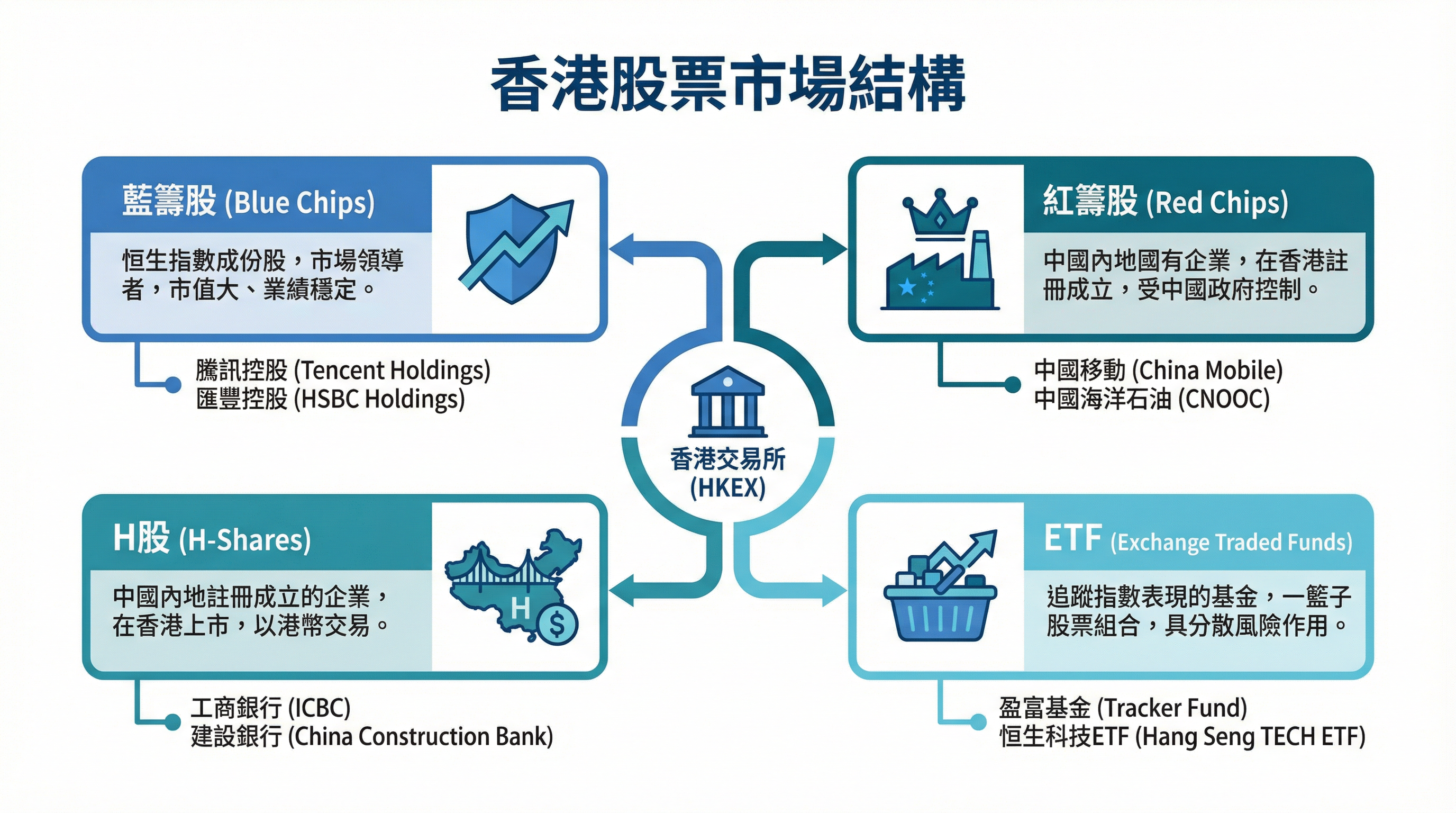
Blue-Chip Stocks
Blue-chip stocks generally refer to the constituent stocks of the Hang Seng Index. These companies typically have large market capitalizations, mature business models, and stable earnings. Blue chips are usually highly liquid and are suitable for investors seeking relatively stable returns.
Red Chips and H-Shares
Red chips refer to companies that are incorporated outside Mainland China but have their primary business operations in Mainland China. H-shares are companies incorporated in Mainland China that are approved by the China Securities Regulatory Commission (CSRC) to list in Hong Kong; they are also commonly referred to as state-owned enterprise (SOE) stocks.
Exchange-Traded Funds
Exchange-traded funds (ETFs) are investment vehicles that track specific indices or assets. For beginners, ETFs offer a convenient way to achieve diversification. For example, the Tracker Fund of Hong Kong, which tracks the Hang Seng Index, allows investors to participate in overall market performance at a relatively low cost.
Account Opening and Choosing a Broker
The first step in investing in Hong Kong stocks is opening a securities account. Investors can choose between traditional banks and online brokers, each with its own advantages.
Comparing Banks and Brokers
Traditional banks provide one-stop wealth management services, but brokerage commissions and administrative fees are generally higher, with per-trade charges potentially exceeding HKD 100. In contrast, online brokers typically offer more competitive pricing, and some even provide low-commission or commission-free promotions, allowing investors to trade at a lower cost.
Documents Required for Account Opening
Generally, opening a securities account requires proof of identity, proof of address, and bank account details. Many brokers now support online account opening, enabling investors to complete the entire application process via their mobile phones. Longbridge Securities offers a convenient account-opening service, making it easy for investors to begin their investing journey.
Detailed Explanation of Hong Kong Stock Trading Rules
Familiarity with Hong Kong stock trading rules is the foundation of successful investing.
Trading Units
Hong Kong stocks are traded in “board lots,” not in single shares. The number of shares per board lot is determined by the listed company and can range from just a few shares to tens of thousands, with significant variation. As a result, the minimum investment amount differs widely across stocks, and investors should pay close attention to the capital required per lot.
Tip: If you have limited capital, consider using a monthly stock investment plan or buying ETFs to lower the entry threshold and gradually build your portfolio.
Trading Hours
Continuous trading hours for Hong Kong stocks are Monday to Friday from 9:30 a.m. to 12:00 p.m., and from 1:00 p.m. to 4:00 p.m. There is also a pre-opening auction session (9:00 a.m. to 9:30 a.m.) and a closing auction session, with the actual closing time randomly determined between 4:08 p.m. and 4:10 p.m.
Settlement Arrangements
Hong Kong stocks operate under a T+2 settlement system, meaning that cash and shares are settled on the second trading day after a transaction. However, investors can still engage in intraday trading (commonly known as “day trading”); proceeds from selling shares can be used immediately to purchase other stocks on the same trading day.
Developing an Investment Strategy
Successful investing requires a clear strategy and strong discipline.
Fundamental Analysis
Fundamental analysis focuses on evaluating a company’s financial condition and business prospects. Investors can refer to indicators such as the price-to-earnings ratio (P/E), price-to-book ratio (P/B), and dividend yield to assess whether a stock is worth investing in. With Longbridge’s analysis tools, investors can access detailed financial data to support their investment decisions.
Technical Analysis
In addition to fundamentals, technical analysis seeks to forecast future price movements by studying historical price trends, trading volume, and chart patterns. Beginners can start by learning basic chart patterns and use them in conjunction with fundamental analysis when making investment decisions.
Diversification
Diversification is a core principle of risk management. Investors should avoid concentrating all their capital in a single stock or sector. Consider holding a mix of different asset types—such as blue-chip stocks, ETFs, and high-dividend stocks—to reduce the risk associated with any single investment.

Key Principles of Risk Management
Investing involves risk, and stock prices can rise or fall. Establishing a robust risk management framework is essential for long-term investment success.
Capital Management
Before investing, make sure you have sufficient emergency reserves. It is generally recommended to set aside liquid funds equivalent to at least six months of living expenses. Investment capital should consist of surplus funds, so that even if losses occur, your daily life will not be affected.
Setting Stop-Loss Levels
Stop-loss orders are an important tool for controlling losses. Investors should define an acceptable loss threshold in advance and sell decisively when the stock price falls to the stop-loss level, preventing losses from escalating.
Continuous Learning
Financial markets change rapidly, and investors need to keep learning to stay on top of market developments, economic trends, and industry progress. By reading financial news, research reports, and participating in an Investing Academy, you can continuously enhance your investment knowledge.
FAQs
What is the minimum investment amount for Hong Kong stocks?
Hong Kong stocks are traded in board lots, and the number of shares per lot varies by company. The entry cost depends on the share price and lot size, ranging from a few hundred to tens of thousands of Hong Kong dollars. If you want to start with a smaller amount, consider a monthly stock investment plan or investing in lower-priced ETFs.
What are the differences between Hong Kong stocks and U.S. stocks?
The main differences include trading hours (Hong Kong stocks trade during Hong Kong daytime hours, while U.S. stocks trade at night), trading units (Hong Kong stocks are traded in board lots, while U.S. stocks can be traded in single shares), and currency (Hong Kong stocks are settled in HKD, while U.S. stocks are settled in USD). Investors can choose based on their daily schedule and investment preferences.
How should beginners pick stocks?
Beginners are advised to start with blue-chip stocks or ETFs, which generally offer higher transparency and relatively lower price volatility. After gaining experience, you can gradually research other types of stocks. The key is to do thorough research and fully understand a company’s business and financial condition before making an investment decision.
Conclusion
Getting started with Hong Kong stock investing may seem complex, but once you master the basics, understand the trading rules, and develop risk management awareness, you can steadily embark on your investing journey. Remember, investing is a long-term learning process—do not rush for quick wins. Staying patient, learning continuously, and accumulating experience step by step is the right approach to achieving long-term investment goals.
Which investment tool you choose depends on your investment objectives, risk tolerance, market outlook, and experience level. No matter which tool you select, you must fully understand its operating mechanisms, risk characteristics, and trading rules, and establish a sound risk management plan. You can learn more about investing through the Longbridge Academy or by downloading the Longbridge App.