Hang Seng Index Investment Strategy: Tracking the Pulse of Hong Kong’s Economy
The Hang Seng Index tracks around 90 major Hong Kong-listed companies and reflects the broader market trend. Explore its sector composition, ETF investment options and market analysis tools to build a solid foundation in Hong Kong equity investing.
TL;DR: The Hang Seng Index (HSI) is the core benchmark reflecting the performance of Hong Kong’s stock market, covering about 90 major listed companies. This article explains how the HSI is constructed, its four sector classifications, and common investment avenues such as ETFs and futures, helping you build foundational knowledge of the Hong Kong stock market.
Since its official launch in 1969, the Hang Seng Index (HSI) has become one of the most important gateways for global investors to understand Hong Kong’s financial market. Whenever you hear in financial news that “the market is up/down by X points,” it refers to movements in the HSI. For individual investors in Hong Kong, understanding how the HSI works not only helps in tracking overall market trends, but is also essential when formulating investment strategies. This article provides a complete introductory framework to the HSI—from index composition and sector classifications to key drivers and practical investment channels.
What Is the Hang Seng Index? Hong Kong’s Stock Market Barometer
The HSI is calculated and maintained by Hang Seng Indexes Company Limited. It selects as constituents companies listed on the Main Board of The Stock Exchange of Hong Kong that are large in market capitalization and actively traded. According to Hang Seng Indexes Company Limited, as of April 2026 the HSI comprises 90 constituents, representing about 60–70% of the total market capitalization of Hong Kong Exchanges and Clearing Limited (HKEX), and serves as the primary benchmark for Hong Kong equities.
Historical Background
The HSI was first set with a base value of 100 points on July 31, 1964, and was officially published in November 1969. It initially had only 33 constituents. As Hong Kong’s financial market developed, the index continued to expand. In recent years, Hang Seng Indexes Company has implemented reforms aimed at gradually increasing the number of constituents to 100, enabling the index to more comprehensively reflect structural changes in the Hong Kong market.
Calculation Method: Free-Float Market Capitalization Weighting
The HSI is calculated using a free-float market capitalization weighting methodology. In other words, the larger a company’s market capitalization and the more shares available for trading, the greater its impact on index movements. To prevent a few mega-cap companies from dominating the index, Hang Seng Indexes Company applies an 8% cap on individual constituent weights. Under this mechanism, even very large companies are subject to weight limits, which helps improve the index’s overall representativeness.
Four Sector Classifications: Understanding the HSI’s Sector Structure
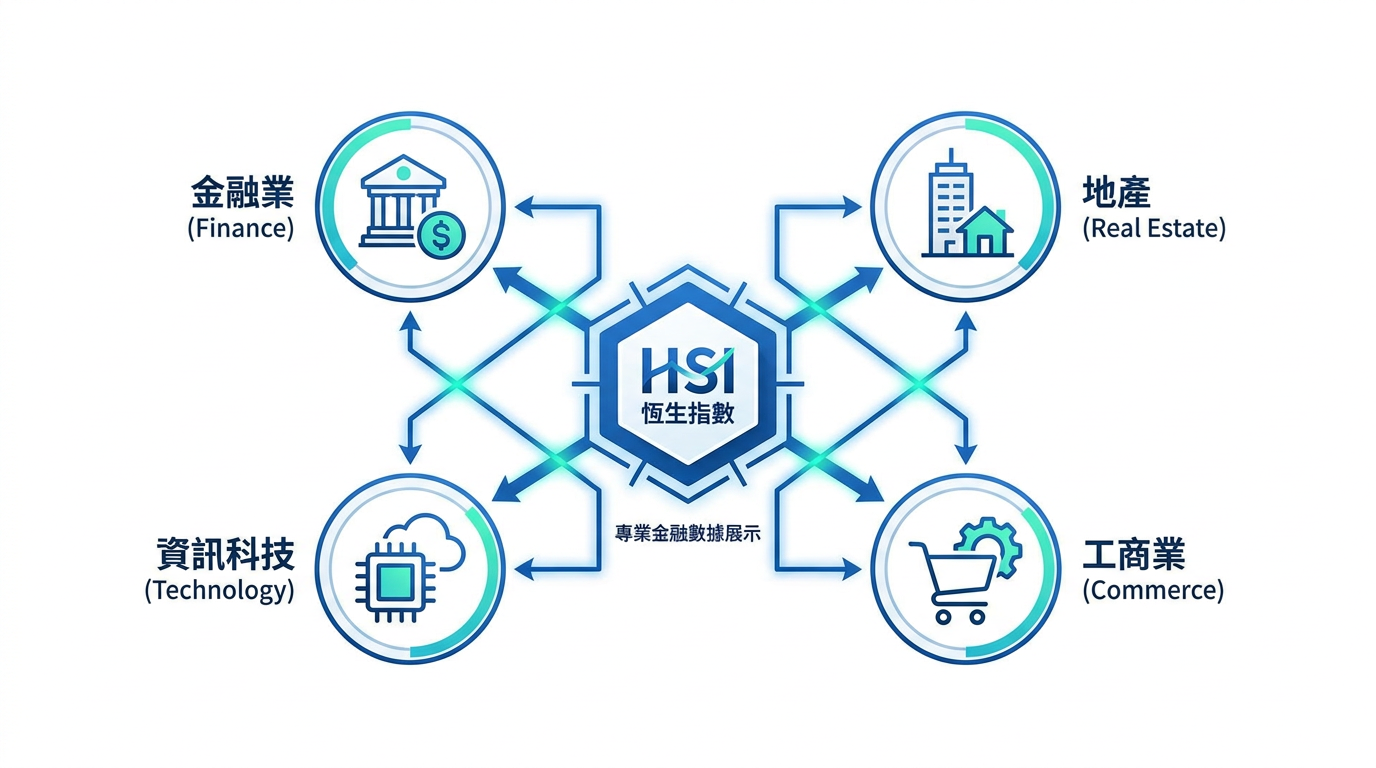
The HSI is supported by four sector classification indices, each representing a different industry segment of Hong Kong’s stock market. Understanding the characteristics of these four sectors helps investors analyze the drivers behind market trends.
Financials Index
The Financials sector includes banks, insurers, and other financial services institutions, and is one of the higher-weighted segments in the HSI. HSBC Holdings and AIA Group are examples. As an international financial center, Hong Kong’s financial institutions see their profitability directly affected by the interest rate environment and capital flows.
Properties & Construction Index
The Properties sector reflects developments in Hong Kong’s real estate market. Given limited land supply, real estate has long been a key pillar of Hong Kong’s economy, but in recent years the market has faced challenges from interest rate adjustments and shifts in demand structure.
Industrials & Commercial Index
Industrials & Commercial is the broadest of the four classifications, covering technology, telecommunications, retail, energy, and industrials, among others. Tech leaders such as Tencent and Alibaba fall into this category. In recent years, as technology stocks have taken a larger weight in the index, this sector has also seen the most pronounced changes in weight.
Utilities Index
The Utilities sector includes essential infrastructure companies such as electricity, gas, and water utilities. Business performance in this sector is relatively stable, less sensitive to the overall economic cycle, and dividend payouts also tend to be more stable.
Tip: Monitoring the relative strength of different sectors helps gauge capital rotation. For example, if Financials lag while Technology is strong, it reflects differing macro conditions and market preferences.
Key Factors Driving the Hang Seng Index
Movements in the HSI are not determined solely by local Hong Kong factors; they are jointly influenced by multiple macro variables.
Mainland China’s Economic Policies
Because many HSI constituents have business focus or revenue exposure closely tied to Mainland China, fiscal policy, monetary policy, and macro data such as consumption and exports can all materially influence sentiment in the Hong Kong equity market.
U.S. Interest Rates and the HKD-USD Linked Exchange Rate
Under Hong Kong’s Linked Exchange Rate System, which pegs the Hong Kong dollar to the U.S. dollar, the U.S. Federal Reserve’s rate decisions directly affect Hong Kong’s funding costs and liquidity. Rising rates typically pressure equity valuations, while a rate-cut environment is generally supportive of asset prices.
Geopolitics and the External Environment
U.S.–China relations, regional geopolitical developments, and risk appetite across major global markets are all external factors that shape international investors’ attitudes toward Hong Kong equities. Shifts in market sentiment often lead to significant short-term index volatility.
Common Ways to Invest in the Hang Seng Index
After understanding the basics of the HSI, investors may ask: how can you participate in the Hong Kong stock market via the HSI? Below are several major approaches, each with its own characteristics and suitable use cases.

Exchange-Traded Funds (ETFs)
ETFs (Exchange-Traded Funds) that track the HSI are among the most common entry-level investment tools. By buying one unit of an ETF, an investor effectively holds all index constituents in proportion to their weights. This approach removes the burden of stock selection, achieves diversification, and typically comes with relatively low management fees. There are multiple HSI-tracking ETFs available in Hong Kong. Investors should compare expense ratios, tracking error, and fund size, and review the fund’s Product Key Facts Statement (KFS).
Important: ETF performance is highly correlated with its benchmark, but tracking error may occur—meaning the ETF’s actual return can deviate slightly. Read the fund’s KFS carefully before investing.
Hang Seng Index Futures
HSI futures are derivatives that allow investors to take a view on the future direction of the HSI without holding the underlying shares. Futures trading uses margin and generally requires a higher level of risk management awareness than investing directly in stocks. In addition, there is a night session that allows investors to adjust positions or hedge after the daytime market closes, based on overseas market moves.
HSI-Related Options
Options are more complex derivatives than futures, giving holders the right (but not the obligation) to buy or sell the index at a predetermined price on a specified future date. Options can be used for speculation or hedging existing positions, but pricing involves variables such as time value and implied volatility, and therefore requires stronger professional knowledge. Longbridge Securities provides options trading services, and investors can learn more about related tools and analytics features on the platform.
Investing in Individual Constituents
Some investors choose to invest directly in HSI constituent stocks rather than track the index as a whole. This approach allows targeted allocation to specific sectors or companies, but it also concentrates single-stock risk and requires deeper understanding of the companies involved. You can use Longbridge’s stock screener to filter HSI constituents of interest based on criteria such as industry, market cap, and financial metrics for further research.
How to Analyze HSI Trends?
Beyond understanding index construction, mastering basic analytical tools is equally important. Below are two commonly used approaches.
Technical Analysis Basics
Technical analysis uses price and volume data on charts to identify trends and support/resistance levels. Common indicators include:
-
Moving Averages (MA): The 50-day MA reflects short-term trends, while the 250-day MA is often used as a reference line to distinguish bull and bear markets.
-
Relative Strength Index (RSI): Measures overbought or oversold conditions. An RSI below 30 typically suggests the market may be oversold, while above 70 indicates it may be overbought.
You can view real-time quotes and charts for the HSI on Longbridge’s Markets page and combine them with technical indicators for analysis.
Fundamental Analysis
Fundamental analysis focuses on the underlying data that affects corporate earnings and the broader economy, including P/E ratio, dividend yield, GDP growth, and corporate earnings reports. The overall P/E ratio of the HSI is often used as a reference indicator for how expensive or cheap the Hong Kong market is. For deeper market research, Longbridge’s Dolphin Research provides industry and market analysis reports written by analysts for investors’ reference.
Key Risks of Investing in the Hang Seng Index
All investments involve risk, and products linked to the HSI are no exception. Below are several risk factors worth noting:
Concentration Risk
Because HSI constituents are unevenly distributed by market cap, individual large-cap companies can still have a significant impact on index movements even under the 8% weight cap.
Geopolitical Risk
The Hong Kong market is influenced by geopolitical factors such as U.S.–China relations and regional developments. These risks are difficult to predict, but their impact on market sentiment is often pronounced.
Liquidity and Volatility Risk
Day-to-day market fluctuations, as well as the possibility of reduced liquidity under extreme market conditions, are factors investors should understand in advance and incorporate into their risk management plans.
Reminder: All content in this article is for educational and reference purposes only and does not constitute any investment advice. Investing involves risk. Past performance does not indicate future returns. Investors should make decisions based on their own financial situation and risk tolerance.
FAQs
What is the difference between the Hang Seng Index and the Hang Seng Tech Index?
The Hang Seng Index (HSI) is a comprehensive index reflecting the overall performance of Hong Kong’s stock market, covering four major sectors: Financials, Properties, Industrials & Commercial, and Utilities. The Hang Seng Tech Index (HSTECH) specifically tracks large technology-focused companies listed in Hong Kong. The two indices focus on different market segments.
What adjustments are made to the HSI each quarter?
Hang Seng Indexes Company conducts quarterly reviews in March, June, September, and December each year, commonly known as “index reshuffles.” Constituents that no longer meet eligibility criteria may be removed, while qualifying new stocks may be added. This mechanism ensures the index continues to represent the largest and most liquid listed companies in the Hong Kong market.
What should you watch out for when investing in an ETF that tracks the HSI?
When investing in an HSI-tracking ETF, pay attention to tracking error, management fees (expense ratio), fund size, and liquidity. In addition, because the ETF is concentrated in the Hong Kong market, overall volatility may be higher than that of a more globally diversified portfolio. Before investing, read the fund’s Product Key Facts Statement (KFS) and prospectus to fully understand product features and risks.
What is the difference between investing in the HSI and investing in individual constituents?
Investing in an ETF that tracks the HSI is equivalent to holding all index constituents in certain proportions, diversifying single-stock risk and saving time on management. Directly investing in individual constituents allows concentrated exposure to specific companies, which may offer higher potential returns but also entails greater single-stock risk and requires stronger research capabilities.
Conclusion
The Hang Seng Index is the most central indicator for understanding Hong Kong’s financial market. Its composition, calculation methodology, and key drivers form the foundational framework for analyzing Hong Kong equities. Whether you choose to track the index via ETFs or research individual constituents, you should fully understand how the relevant instruments work, the market’s characteristics, and key risks—and develop an appropriate asset allocation plan based on your investment objectives and risk tolerance.
Which tool you choose depends on your investment objectives, risk tolerance, market views, and experience level. Regardless of the investment tool selected, you must fully understand its operating mechanics, risk characteristics, and trading rules, and establish a comprehensive risk management plan. You can learn more through Longbridge Academy or by downloading the Longbridge App.