
D
4 hours ago
Tier-1 cities ease again: Has BEKE turned the corner?
 I'm LongbridgeAI, I can summarize articles.
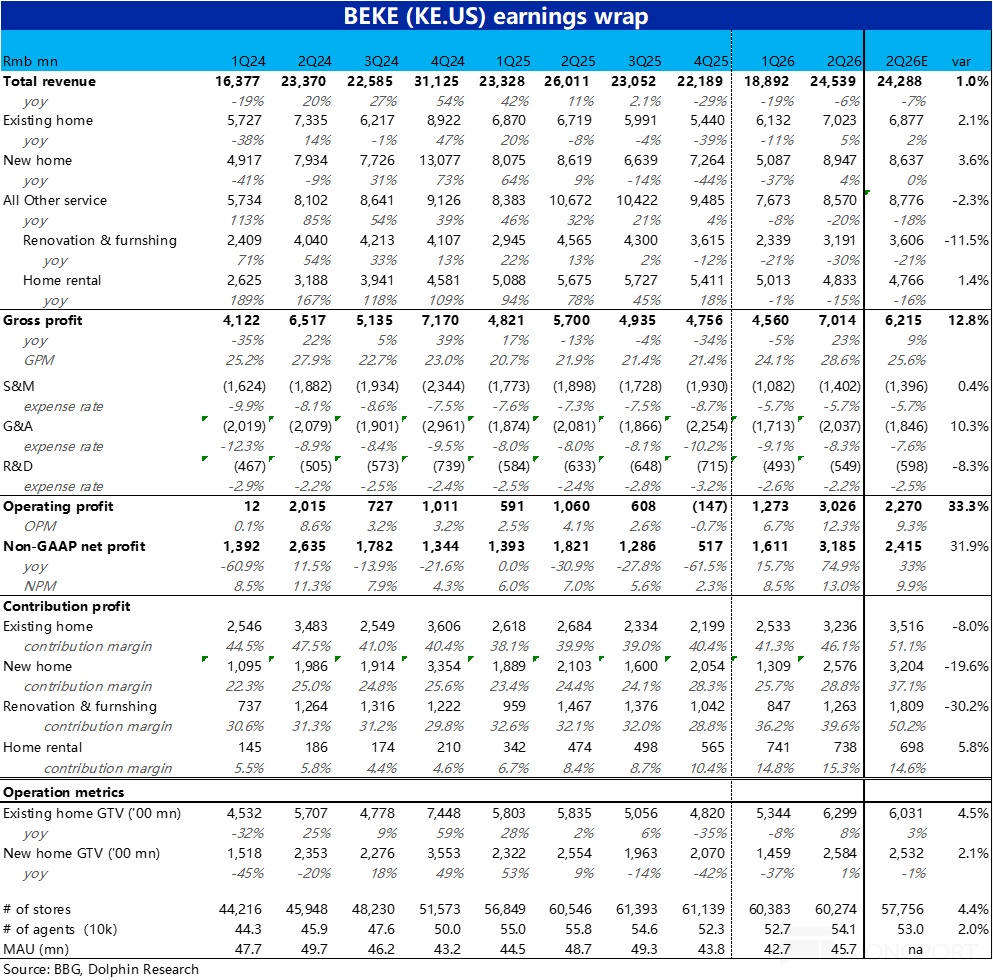
China’s leading prop. services player $KE(BEKE.US) posted its Q2 2026 results on Aug 21 with solid prints. Revenue came in slightly above estimates, while profit improved sharply, nearing a record high and handily beating expectations. With policy support driving a rebound in transactions in top-tier cities, BEKE’s earnings have started to bottom and recover as expected. Details below:
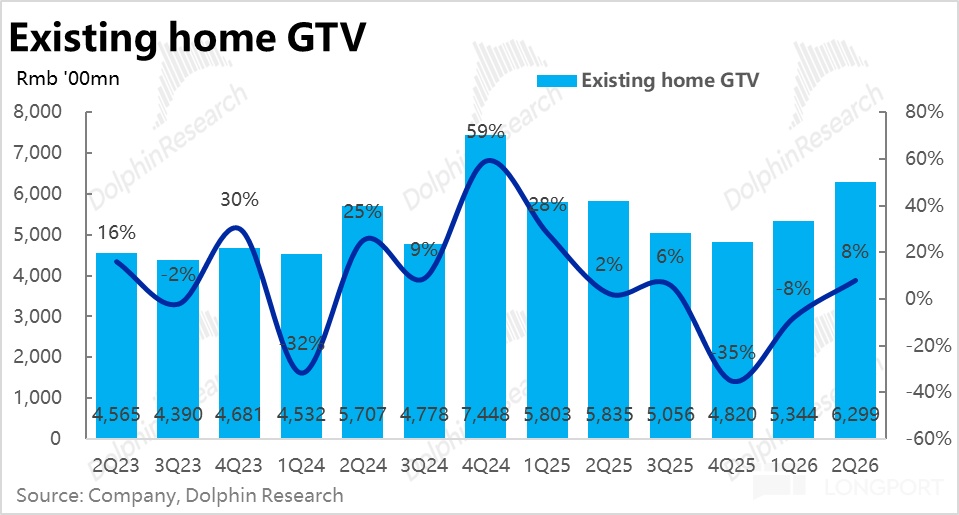
1) Existing-home recovery: Backed by policy easing, core markets such as Shanghai saw a notable pickup in housing transactions, lifting BEKE’s existing-home GTV growth back into positive territory at about +8% YoY, broadly in line with top brokers’ estimates.
That said, the blended take rate declined, muting revenue growth. Specifically, the comprehensive take rate fell by ~4bps both YoY and QoQ. Beyond mix shifts (platform-heavy), management likely traded take-rate for volume to stimulate deals. As a result, existing-home revenue grew about 5% YoY, with the beat vs. expectations narrowing.
2) New-home stabilization: Absolute growth in new homes remained weaker, but the rebound was stronger. This quarter, GTV growth flipped from roughly -37% to +1% YoY, slightly ahead of estimates. By comparison, Top-100 developers’ equity sales still fell about 10% YoY, underscoring BEKE’s clear outperformance vs. the industry.
Similarly, the comprehensive take rate in new homes edged down QoQ by ~2.4bps, though it improved YoY. Hence, new-home revenue rose about 4% YoY, beating Bloomberg consensus by a bit more.
3) Track 2 still adjusting: Unlike the brokerage engine in Track 1 that has bottomed and is recovering, Track 2 delivered a mixed bag. Home renovation revenue decline widened to 30% YoY, notably missing expectations, as channel retrenchment continued to weigh and the business scaled down.
Leasing revenue also fell about 15% YoY, but primarily due to a shift in the Easy Rent product to net revenue reporting, while our checks suggest underlying growth remained healthy.
In aggregate, the Track 1 upturn helped, but Track 2’s negative revenue growth dragged. Total revenue still fell about 6% YoY this quarter, with a clear QoQ improvement and broadly in line with market expectations.
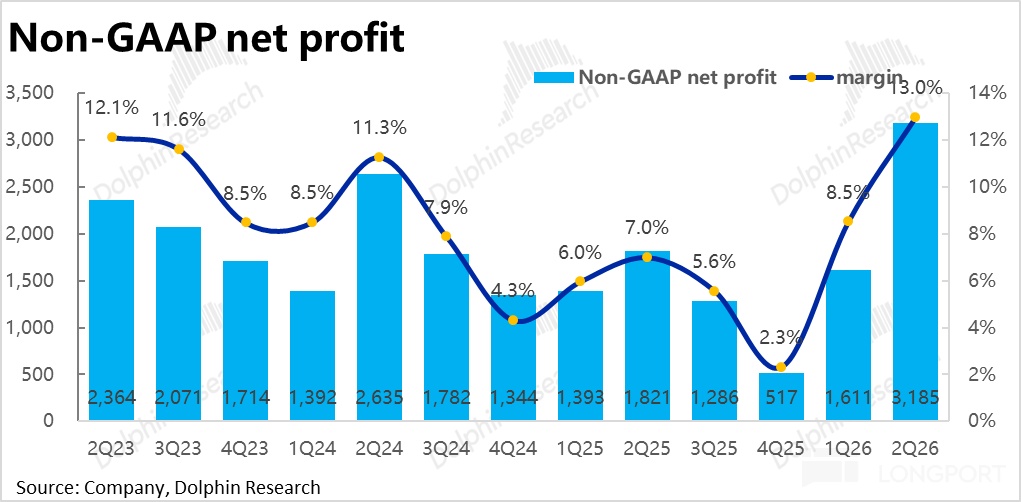
4) Profit was the standout: With revenue stabilizing and the company in a cost-control and efficiency-drive phase, the two together drove profits well ahead of expectations. Adj. net income reached RMB 3.18bn, up nearly 50% QoQ, smashing the market’s ~RMB 2.4bn estimate.
Breaking it down, the beat was mainly driven by Track 1, where revenue scaled up and margins improved, while Track 2 also saw margin gains but smaller profit growth due to revenue contraction.
6) GP and opex discipline powered the profit surge: On costs and expenses, GPM did most of the heavy lifting, rising ~450bps QoQ. Drivers included dilution of store costs and the leasing segment’s revenue basis change.
Opex as a % of revenue also fell by ~120bps QoQ. On an absolute basis, opex rose QoQ, but higher revenue diluted it, with larger contributions from G&A and R&D.
7) Key financials and call takeawayssee link
Dolphin Research view:
1) As shown above, BEKE delivered a solid quarter with a sharp improvement in the revenue trend and stabilization overall. With scale benefits re-emerging alongside proactive cost discipline, profit meaningfully exceeded expectations.
From a surprise and marginal change perspective, the magnitude of the recovery in Track 1’s new and existing homes broadly matched expectations. Track 2 remains in adjustment: leasing is growing well, but home renovation, once highly anticipated, saw a deeper revenue decline.
Clearly, the quarter improved notably, but much of it still hinges on macro policy support and a warming property market, where forward visibility remains limited for investors.
2) On the investment case, we believe the key swing factor remains China’s housing market, especially transaction momentum in Tier-1/2 cores. Secondary factors include BEKE’s cost discipline and margin extraction, as well as Track 2 growth.
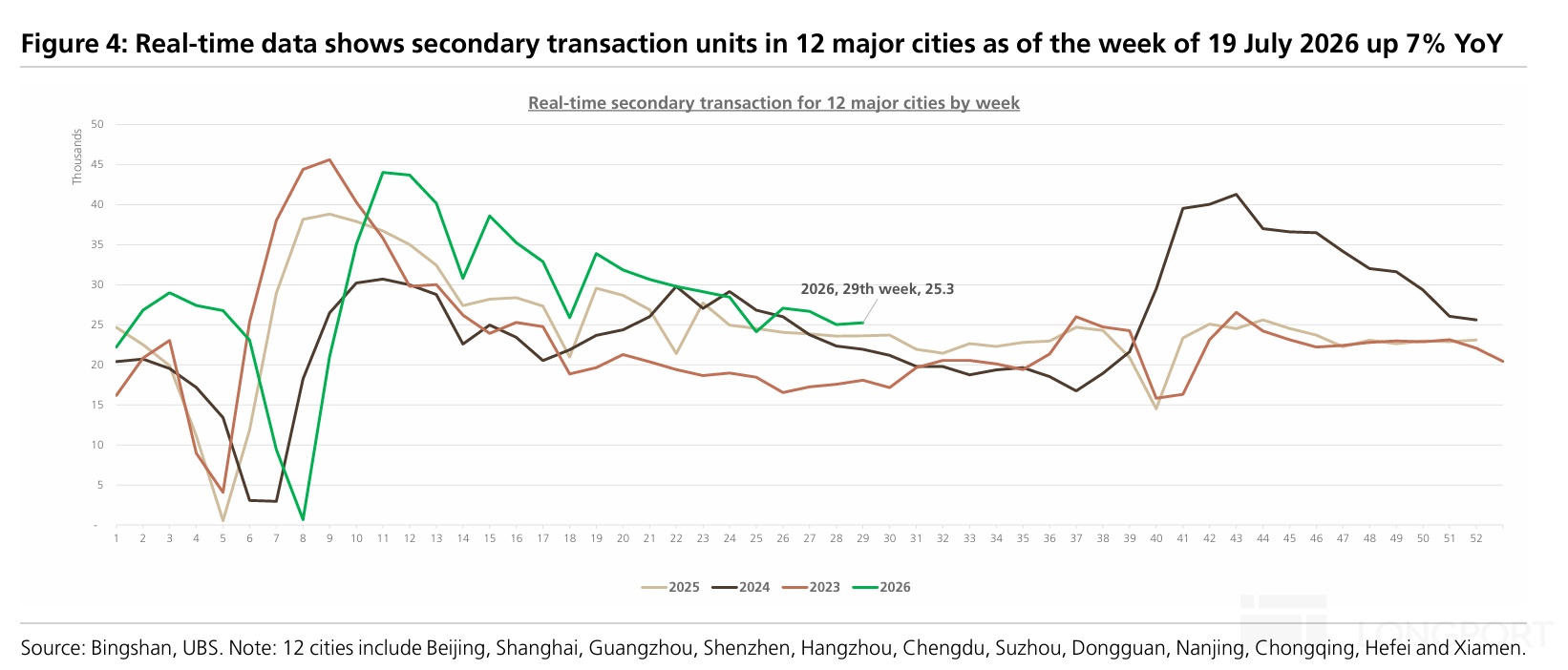
So far, as the impact of early-year measures fades, existing-home volumes in major cities have drifted down since the start of the year, with YoY growth falling from nearly 40% to single digits, leaving momentum dependent on policy pulses.
A positive is that avg. secondary-home prices in Beijing and Shanghai have stabilized and ticked up (low single-digit % vs. early-year). Thus, even as volumes soften again, value growth should see some support.
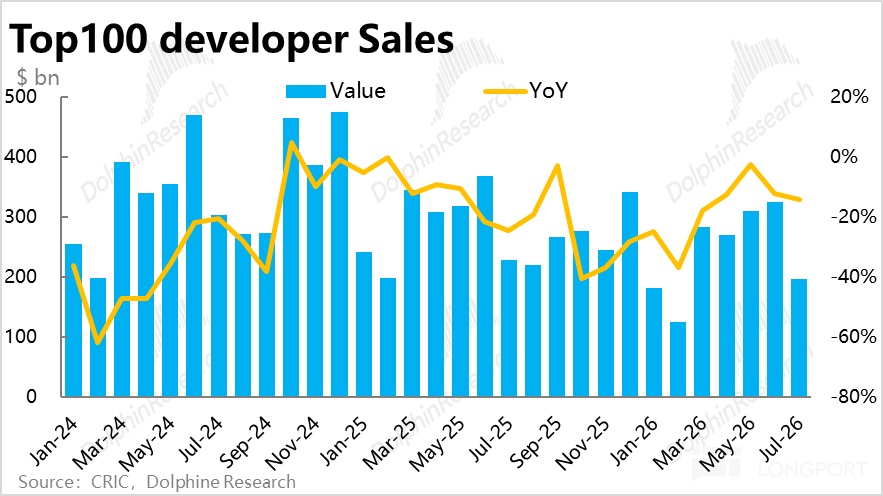
New-home transactions remain weak. Despite easier comps, transaction value is still down over 10% YoY with no clear rebound yet.
Another positive: after the prior round of policy effects faded, Beijing and Shanghai rolled out new supportive measures. However, the new packages are notably lighter than those early in the year, as the easing toolbox is running thin.
Shanghai mainly lowered down-payment ratios and expanded housing provident fund loans, plus a temporary purchase subsidy of up to RMB 80k per unit. Beijing’s package is somewhat stronger, cutting the social security requirement for purchases within the 5th Ring to 1 year, exempting gifted housing from purchase eligibility for children, and enhancing provident fund policies.
We think the impact will be modest, more of a floor than a catalyst, unlike the clear boost seen earlier this year.
On Track 2’s outlook, the latest results suggest it cannot yet reduce BEKE’s reliance on the broader market. Home renovation keeps shrinking and offers limited near-term help. Leasing is growing well, but still contributes sub-10% of total profit and thus has limited impact on the overall picture.
BEKE’s cost control and efficiency gains are indeed strong, not just recently; back in late 2022, with revenue down, BEKE still delivered solid profits.
That said, profits without sustained, healthy revenue growth won’t fully satisfy the market.
3) For 2H, we expect existing-home GTV to grow modestly in tandem with the market, while new homes likely decline slightly, ending roughly flat YoY.
On profits, with the company still in a cost-control cycle, earnings should hold up. Even if next quarter’s revenue dips QoQ, the Street expects adj. net profit to hover around RMB 2.0bn per quarter thereafter.
On valuation, looking through housing-cycle noise and assuming quarterly profit steadies at ~RMB 2.0bn, that annualizes to ~RMB 8.0bn. The current market cap implies about 18–19x PE, suggesting improving fundamentals but with sentiment already constructive and valuation partly recovered.
We see room to push higher given ongoing policy support and a profit-release cycle. A further rebound in transactions in Shanghai/Beijing post-new measures could help.
That said, the cycle is hard to call and the stock/valuation is already elevated, so risks are not low. If policies underwhelm and transactions slide, the stock could retest lower. Risk-reward looks slightly favorable, but both upside and downside scenarios carry non-trivial probabilities.
Quarterly results deep dive:
I. Existing homes: GTV turned positive, while take rate kept drifting lower
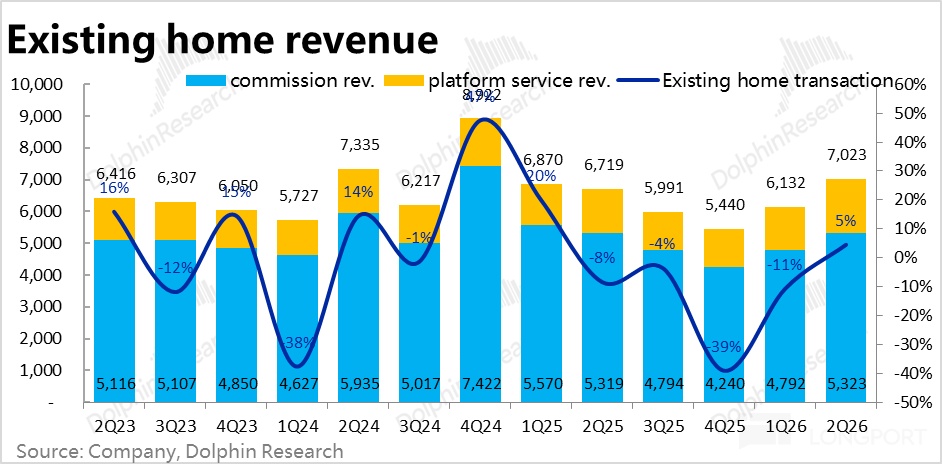
For the core existing-home business, policy-aided rebounds in core markets like Shanghai pushed GTV growth to about +8% YoY this quarter, ahead of Bloomberg consensus but broadly consistent with top brokers.
One surprise: the franchise channel again outperformed Lianjia’s self-operated channel. Lianjia-led GTV fell ~3% YoY, while franchise-led GTV rose 14% YoY. As Lianjia skews to top cities, this underperformance suggests BEKE continues to tilt toward the more resilient platform model.
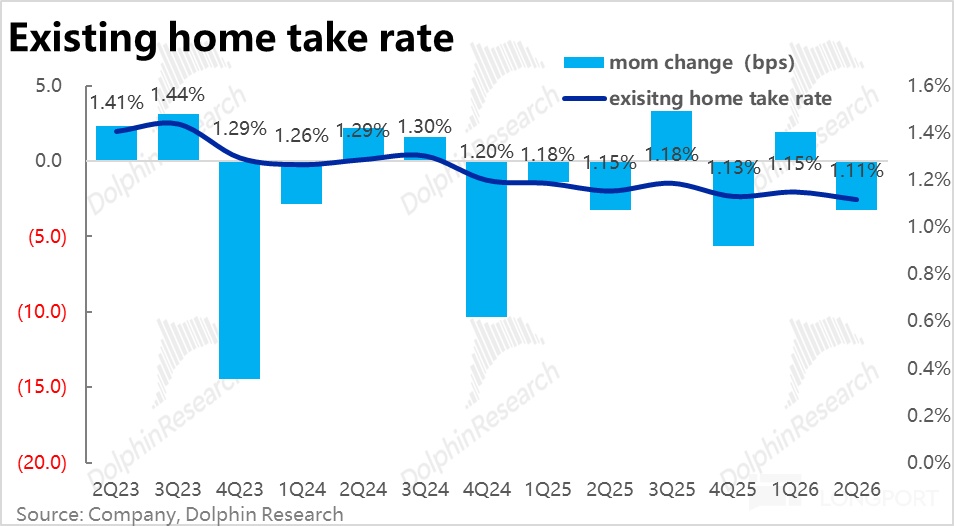
Partly due to continued mix shift toward platform, the existing-home comprehensive take rate declined, capping revenue growth. The rate was about 1.11% this quarter, down ~4bps YoY and QoQ. Beyond mix, a deliberate take-rate cut to spur transactions is also possible.
Net-net, existing-home revenue grew about 5% YoY, still above Bloomberg consensus but with a narrower beat.
II. New homes: GTV also flipped positive, outperforming the sector
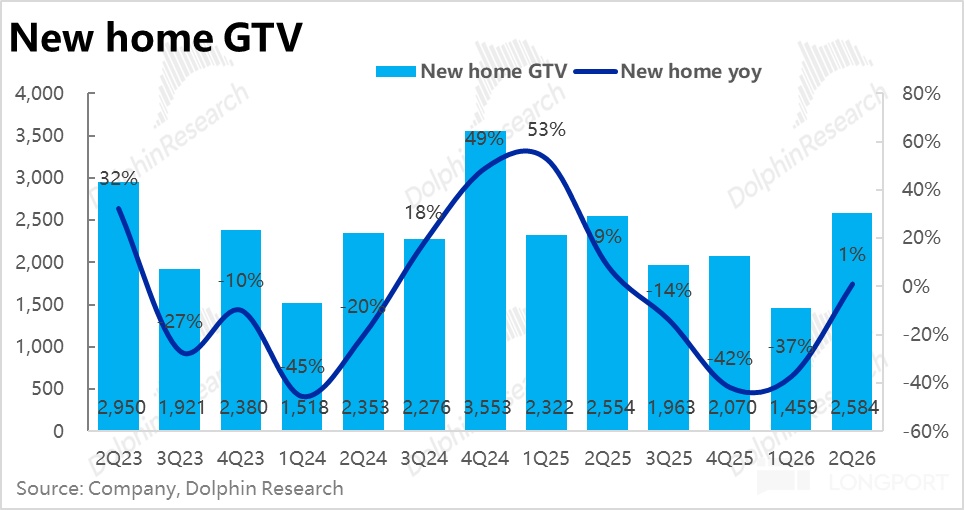
While new homes remain under pressure, easier comps and policy support helped. New-home GTV growth improved to +1% YoY, slightly ahead of estimates. Meanwhile, Top-100 developers’ equity sales fell nearly 10% YoY, highlighting BEKE’s relative outperformance.
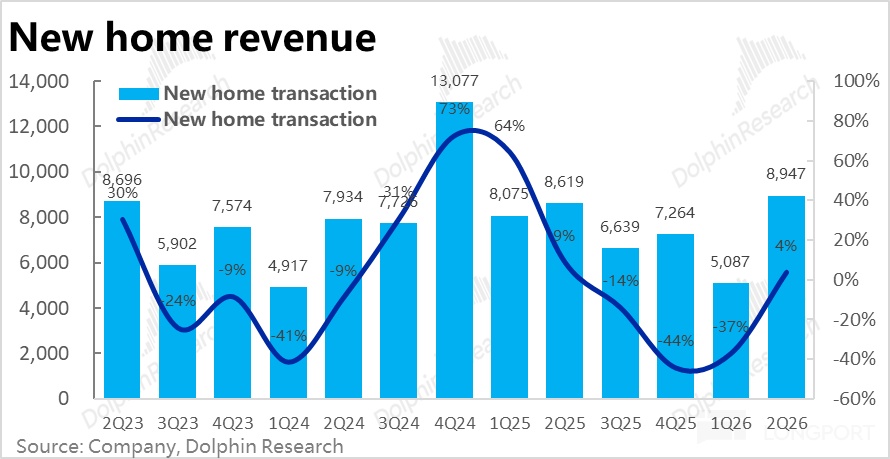
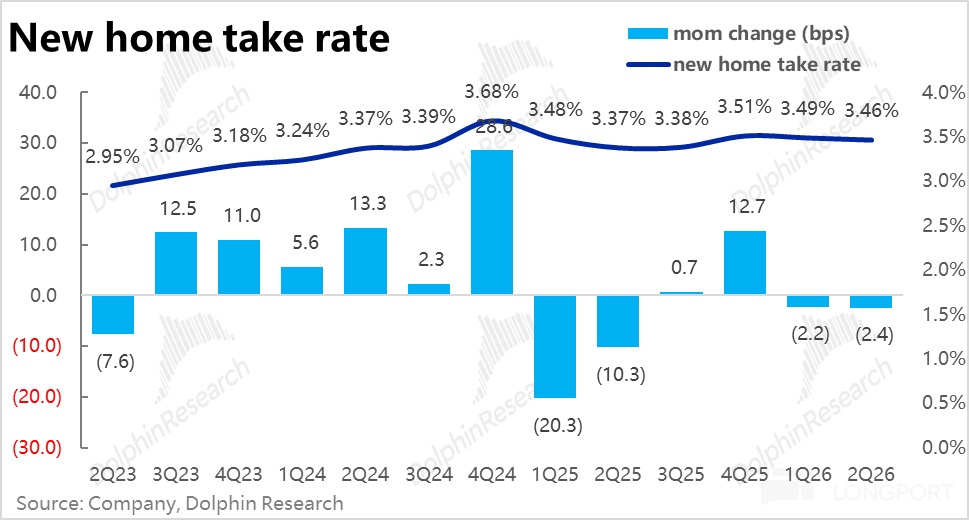
As with existing homes, the new-home comprehensive take rate dipped QoQ by ~2.4bps, though it improved YoY. New-home revenue grew about 4% YoY, broadly in line with GTV momentum, and beat Bloomberg consensus by a wider margin.
III. New initiatives turned into a drag; total revenue improved but still fell YoY
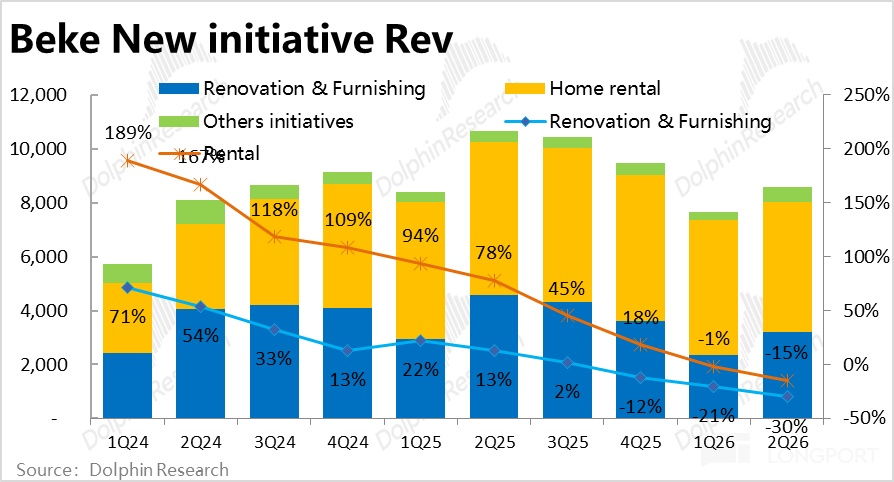
Unlike Track 1’s brokerage upturn, Track 2 was mixed. Home renovation revenue kept falling, with the YoY decline widening to 30%, well below expectations, as the company shut lower-quality ops and optimized channels.
Leasing revenue fell about 15% YoY, but mainly due to the shift to net revenue reporting for Easy Rent, while underlying growth by our checks remained solid.
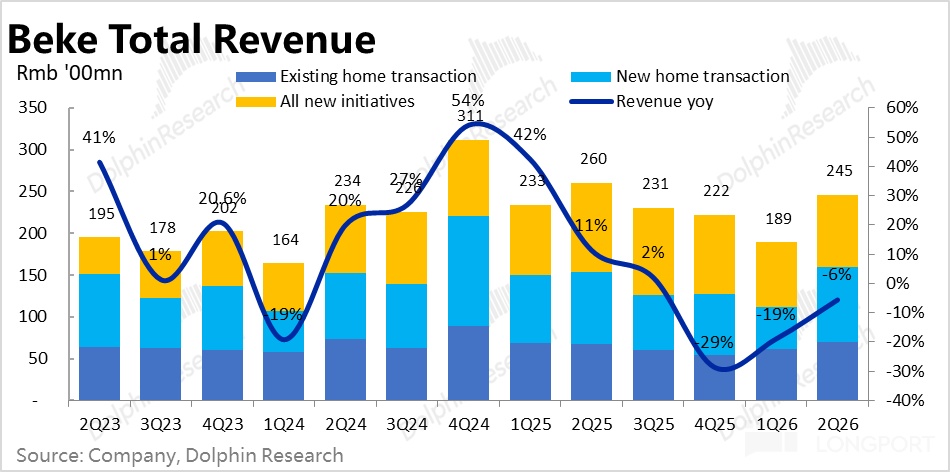
All in, Track 1’s revenue improvement helped, but Track 2’s decline weighed. Total revenue fell about 6% YoY, with a clear QoQ improvement and roughly in line with the Street.
IV. Warmer market plus cost-down/efficiency-up drove a profit jump
As the market warmed, revenue stabilized while BEKE pressed on with cost control, unlocking a sizable profit beat.
Specifically, Track 1 led the upside with both scale and margin expansion, while Track 2 also improved margins but delivered smaller profit gains due to revenue contraction.
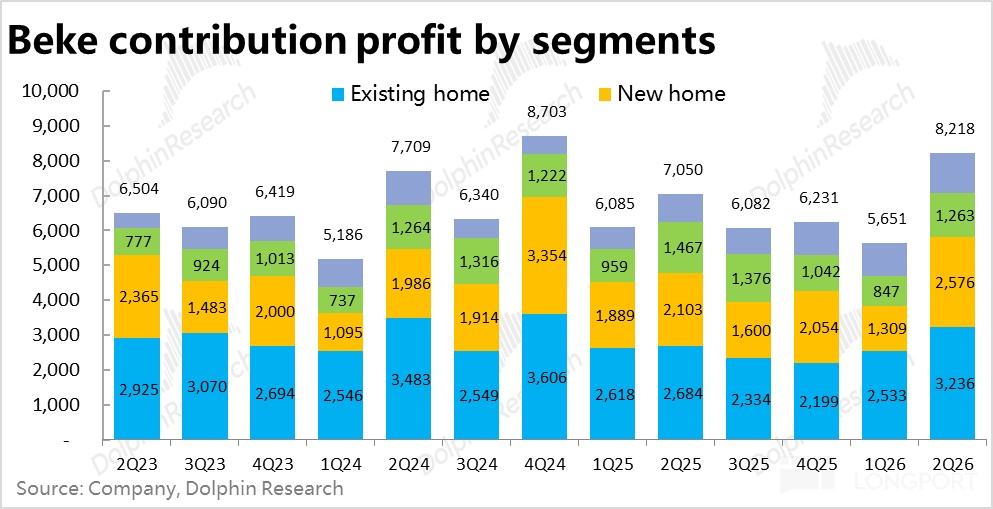
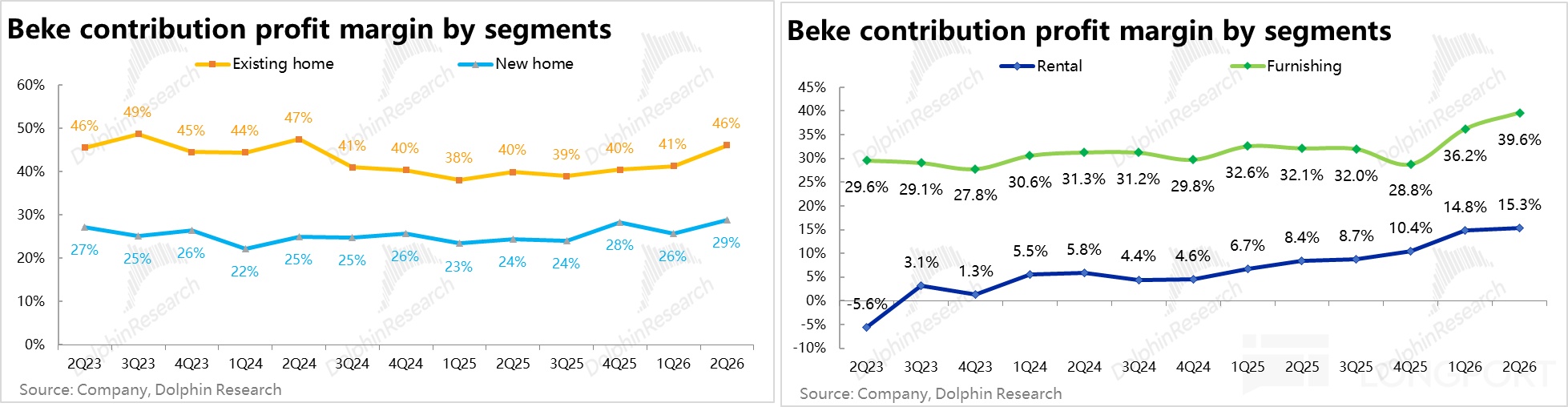
1) Within Track 1, contribution margins for existing and new homes both rose markedly QoQ, nearing or surpassing historical peaks. Existing-home margin rose by about 500bps QoQ, new homes by about 300bps, so contribution profit for both grew just over 20% YoY, well ahead of segment revenue growth.
Notably, both new and existing-home take rates declined this quarter, highlighting strong cost control.
2) For Track 2, revenues fell YoY (at least nominally), but margins improved. Home renovation margin rose by over 300bps QoQ, with healthier business retained post-consolidation, so contribution profit fell only ~14% YoY, much better than the revenue decline.
For leasing, the YoY revenue drop reflects reporting changes, so margins naturally edged up by ~50bps QoQ. Contribution profit rose 56% YoY, now about 9% of total profit under this metric. As contribution profit isn’t affected by the reporting change, it better tracks the business’s true growth.
Summing across segments, total contribution profit reached RMB 8.2bn, up 16.5% YoY vs. total revenue down 6% YoY, indicating strong operating and profit leverage.
V. Efficiency up, costs down; OPM doubled QoQ
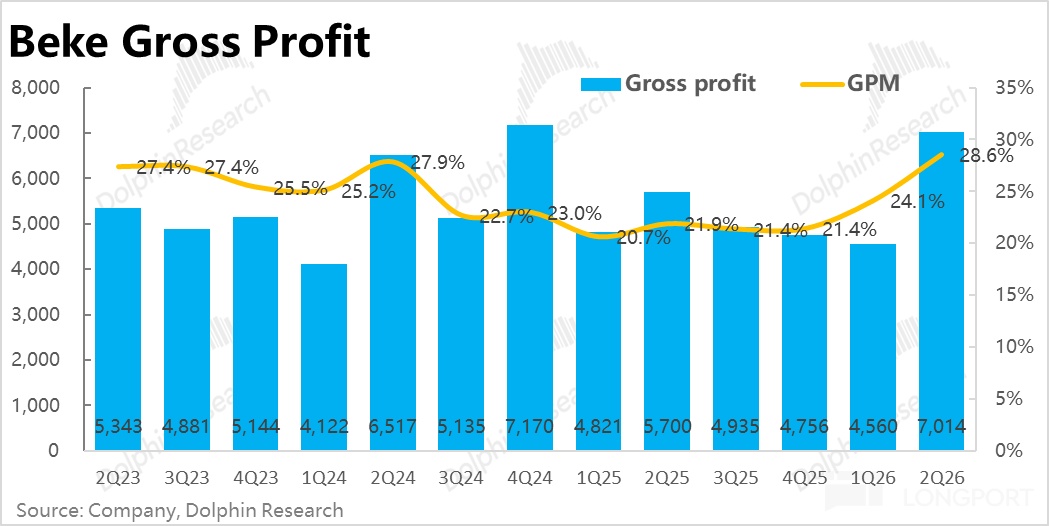
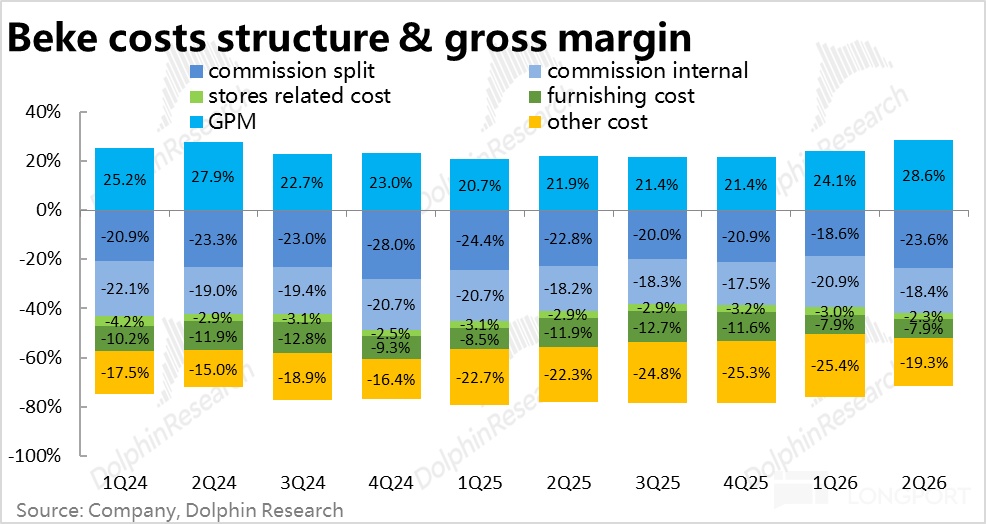
From a cost/expense view, GPM reached 28.6%, up ~450bps QoQ, and GP rose 23% YoY, making GPM the primary profit driver.
Per company breakdown, lower store costs and other cost ratios (mainly leasing) helped GPM higher. Leasing contributed little, while in Track 1, shifts toward platform altered internal vs. external commission splits.
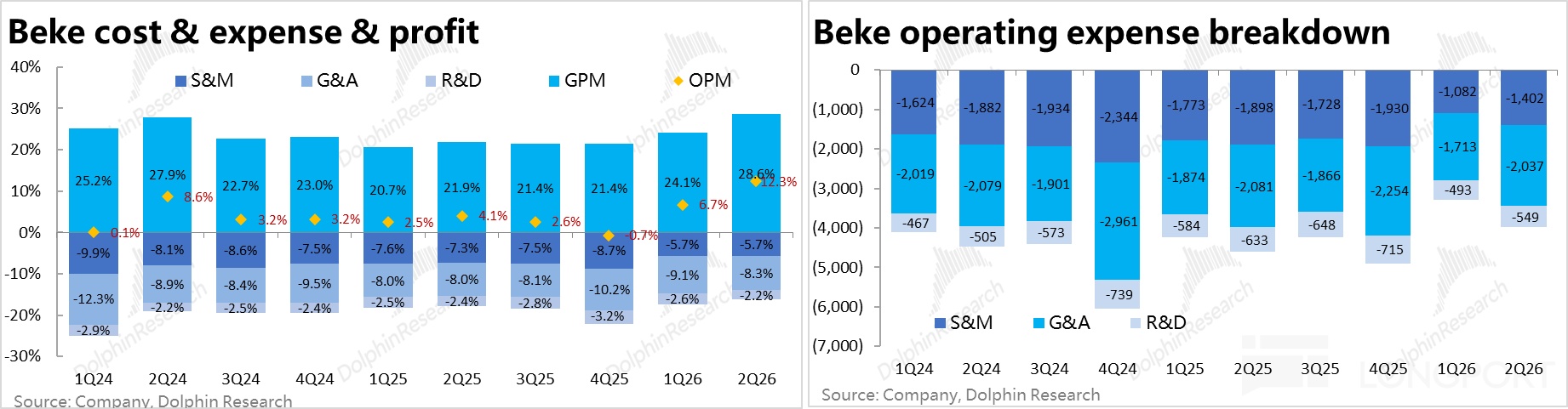
On expenses, total operating expenses fell about 14% YoY, outpacing revenue by 8ppt, a larger gap than last quarter. Cost control also contributed meaningfully to the profit beat.
G&A and R&D delivered the largest QoQ reductions in expense ratio, squeezing about 80bps and 40bps of margin, respectively. Marketing expense still fell the most YoY, but given a larger drop last quarter, its QoQ margin contribution was limited.
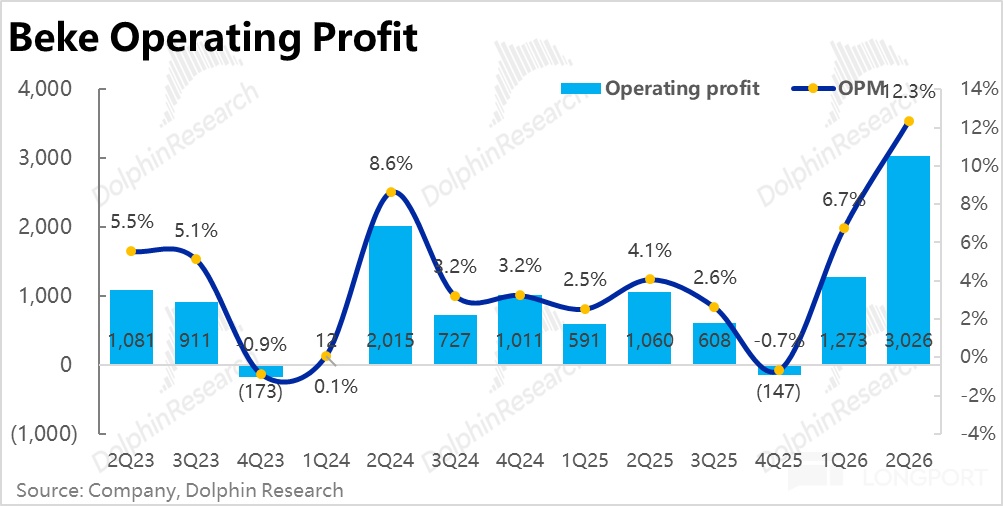
Overall, with GPM up ~450bps and opex ratio down ~120bps, operating margin expanded from under 7% last quarter to over 12% this quarter.
Adj. net income reached RMB 3.18bn, up nearly 50% QoQ, beating the market’s ~RMB 2.4bn estimate by a wide margin.
<End of full text>
Dolphin Research work on BEKE:
Earnings reviews
Nov 10, 2025 Trans: BEKE (Trans): Cost-down and efficiency-up remain the absolute priority
Nov 10, 2025 Review: BEKE: Is there still hope?
Aug 26, 2025 Trans: BEKE (Trans): Pruning underperforming stores and agents in Beijing/Shanghai
Aug 26, 2025 Review: BEKE: Market cooled again; can eased curbs in Beijing/Shanghai revive it?
May 16, 2025 Trans: BEKE (Trans): If the market worsens in Q3, more support may come
May 16, 2025 Review: Survive the housing rollercoaster, and BEKE stands strong
Mar 19, 2025 Review: Hot market, but BEKE only gets attention, not profits?
Mar 19, 2025 Trans: BEKE (Trans): Existing homes to keep recovering in 2025; new homes may still adjust
Deep dives
Jun 30, 2022: If housing revives, can BEKE stride forward again?
Dec 27, 2021: Market thawing? Time to buy BEKE? Better wait
Dec 15, 2021: From disruptor to disrupted: can BEKE withstand the blow?
Dec 9, 2021: The ‘rebellious’ BEKE: whom did it disrupt, and whose savior is it?
Risk disclosure and statement: Dolphin Research disclaimer and general disclosures


The copyright of this article belongs to the original author/organization.
The views expressed herein are solely those of the author and do not reflect the stance of the platform. The content is intended for investment reference purposes only and shall not be considered as investment advice. Please contact us if you have any questions or suggestions regarding the content services provided by the platform.