

Alibaba Cloud: Overseas Compute “Choked Off” by New BIS Rule — Can High Growth Hold Up?
 I'm LongbridgeAI, I can summarize articles.
On Nov 12, Jensen Huang resigned from his roles including CEO of Nvidia amid scandal. In an earlier First Take, Dolphin Research noted that the leadership change looked like a starting gun, likely clearing the way for rules that curb China’s remote access to U.S. compute. $Alibaba(BABA.US) , $BABA-W(09988.HK)
Events then accelerated as expected: on Nov 16, the U.S. Commerce Dept.’s BIS issued new remote-access rules, effectively closing the path for Chinese firms to rent Nvidia compute via overseas DCs. The Remote Access Security Act and the AI Overwatch Act are also advancing, making the intent to choke off Chinese access to high-performance AI chips abundantly clear.
Coincidentally, Alibaba, the most exposed, reports tonight. Ahead of earnings, Dolphin Research runs a quantitative check using Alibaba as a case: if the BIS rules are fully enforced, how large would the impact be on domestic cloud and AI model players.
1. What the new rules say
1.1 Direct imports were already shut
Before the Remote Access route and the AI Overwatch proposal, direct purchases of high-end chips by Chinese firms and their controlled offshore entities had been gradually restricted or banned since 2022. Skipping the back-and-forth (see chart), the latest status as of post-Jan 2026 and pre-these new rules was:
a. GPUs that Chinese firms (and their offshore entities) can legally own (CPUs largely unrestricted) are limited to below-H20 performance chips only, such as L20 and RTX PRO special editions.
b. While H20 and H200 had a theoretical case-by-case approval path into China, domestic regulatory stances meant actual purchases should have been very limited.
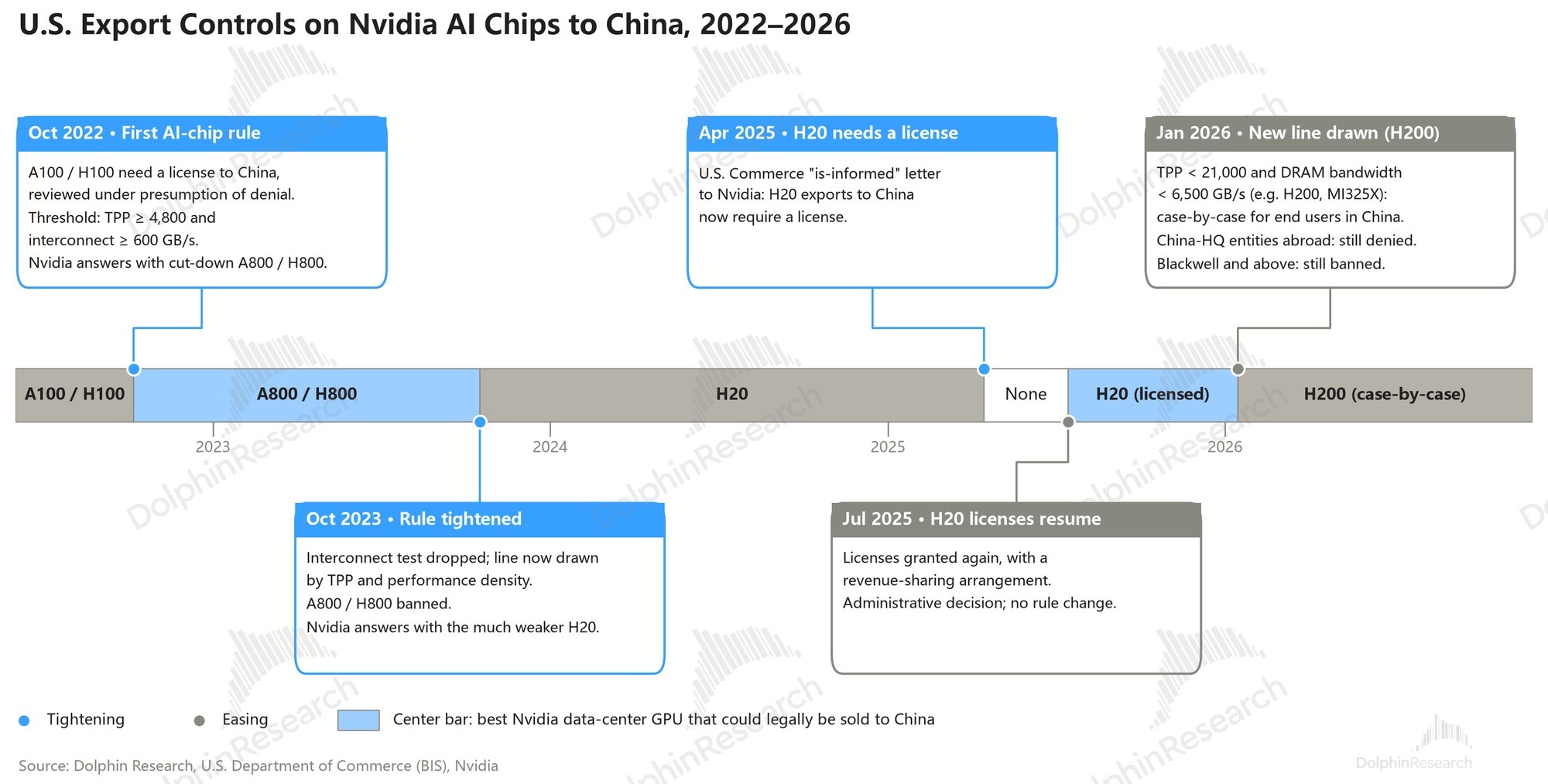
In short, before 2026 the pathway for Chinese firms to legally self-hold overseas mid-range-and-above performance chips was effectively blocked. The only lawful way to use mid-to-high performance U.S. chips left was: third-party DCs buy the chips, then lease them to Chinese customers for remote use.
The recent Remote Access and similar measures aim to close this very loophole. In essence, that path is being cut off.
1.2 Remote Access Act & BIS rules: closing the re-rental gap
The Remote Access Security Act (RASA) and BIS rules target the same issue. RASA provides statutory authority, while the Bureau of Industry & Security implements and details the execution.
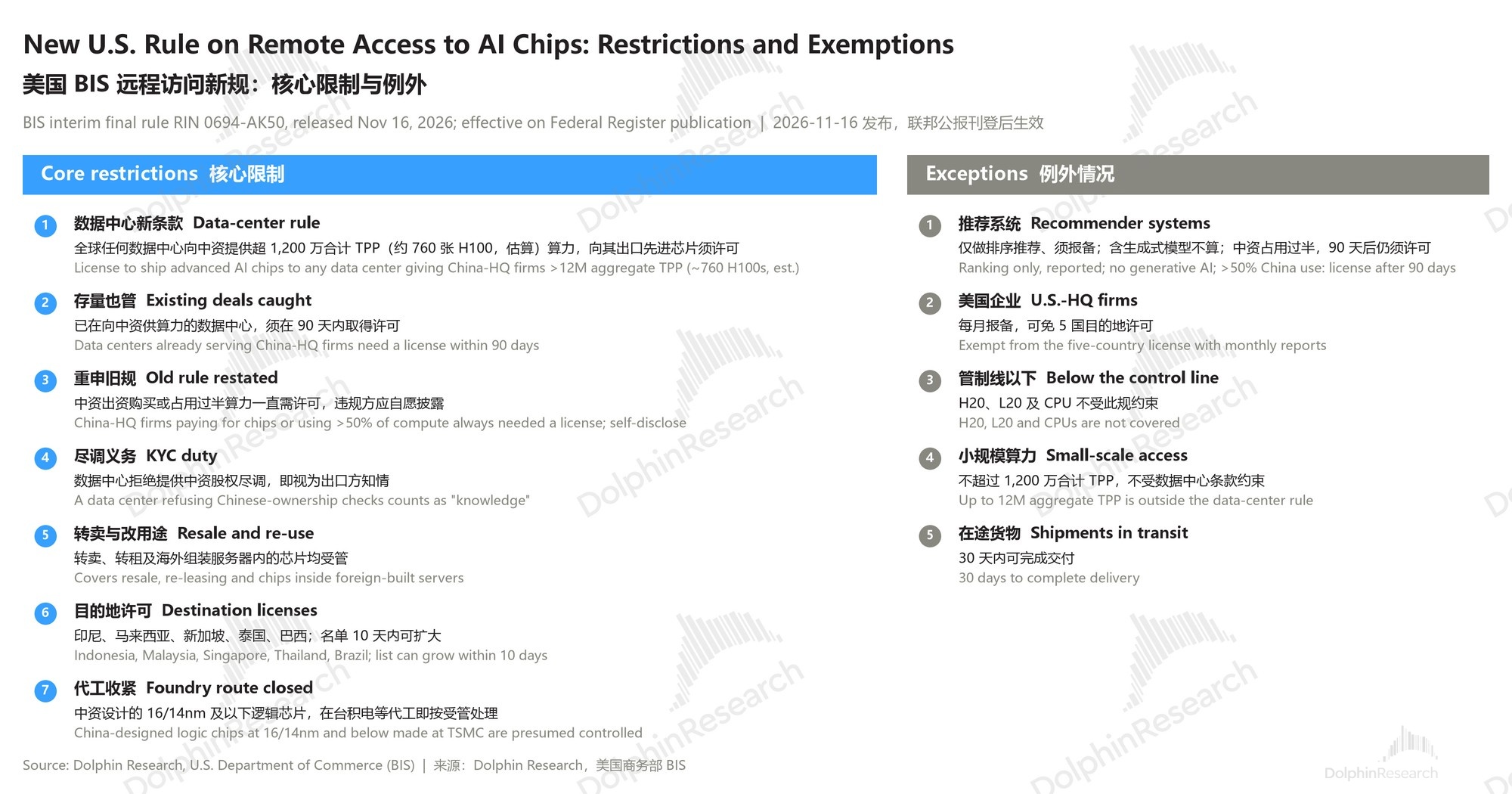
Key BIS details released on the evening of the 16th (to be published in the Federal Register on Nov 19 and effective the same day) for domestic firms include:
a. Any DC leasing aggregate compute above 12 mn TPP to Chinese entities (roughly 700–800 H100 equivalents) must secure licenses to procure U.S. chips.
b. DCs already leasing restricted U.S. chip compute to Chinese entities must obtain licenses within 90 days to continue. Routing through third parties for sub-lease is also covered via look-through review.
c. These DC provisions apply globally; for exports to Indonesia, Malaysia, Singapore, Thailand, and Brazil, separate licenses are required regardless of end-customer (to prevent re-rental), and the list can expand.
d. Overseas foundry work for Chinese-designed high-performance chips at or below 16/14nm nodes is likewise restricted.
Small carve-outs left for Chinese firms include:
a. Compute dedicated to recommendation/ranking for e-commerce, social media, etc., can proceed with BIS notification without the above license. However, if a Chinese entity uses over half of a DC’s capacity, a license is still required even for recommendations.
1.3 AI Overwatch Act: a stricter upgrade to direct-import curbs
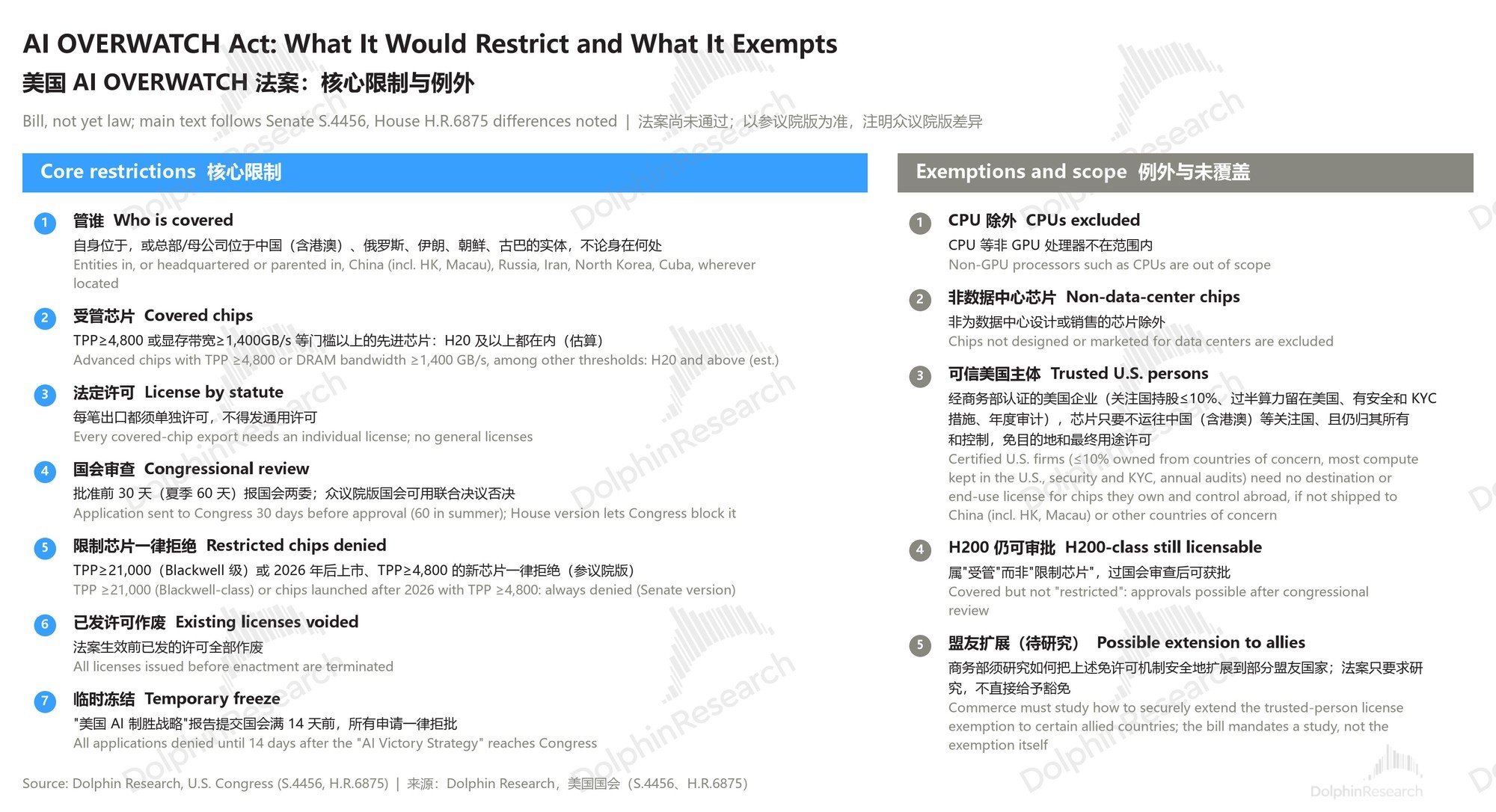
The AI Overwatch Act is essentially an upgraded curb on direct GPU purchases by Chinese and other designated entities versus prior regimes. The main changes are:
Each China-bound export license must be notified to Congress before BIS approval. The legal basis shifts from flexible administrative rules to clear statute, making adjustments harder and less negotiable.
The bill has not yet passed, but both chambers aim to tuck it into the year-end NDAA, potentially effective by year-end. Key points include:
a. Targets include entities in China (incl. HK/Macau), Russia, Iran, and two other countries, plus their offshore entities.
b. Chips with TPP ≥ 4,800 or memory bandwidth ≥ 1,400 GB/s (i.e., H20 and above up to H200) require case-by-case licenses, with no general licenses.
c. Chips with TPP ≥ 21,000 (B100 and above), or post-2026 chips with TPP ≥ 4,800, are fully banned from sale.
d. Once enacted, all previously issued licenses are void and must be re-applied.
The remaining carve-out is that CPUs and non-DC chips (phones, PCs, other consumer) are not restricted. In theory, H200 imported directly into China could still be reviewed case by case, but Nvidia has stated it will stop selling H200 to China, effectively sealing that path.
1.4 All paths to U.S. chips for Chinese firms are closed
In sum, if these bills and rules all land, Chinese firms’ lawful access to U.S. chips (mid-performance and above) would be comprehensively shut. Self-procurement, direct leasing, third-party sub-leasing, and even using TSMC or others to foundry high-performance chips would be infeasible, and even existing leases could be revoked, forcing a pivot to domestic chips.
2. Using Alibaba as an example: how big is the domestic impact?
Assuming full implementation and strict enforcement, and ignoring any illicit channels, Dolphin Research runs a quantitative analysis using Alibaba, one of the largest domestic cloud providers and AI model developers.
2.1 Original compute plan: 20 GW by 2032, one-quarter overseas, T-Head as the main incremental driver
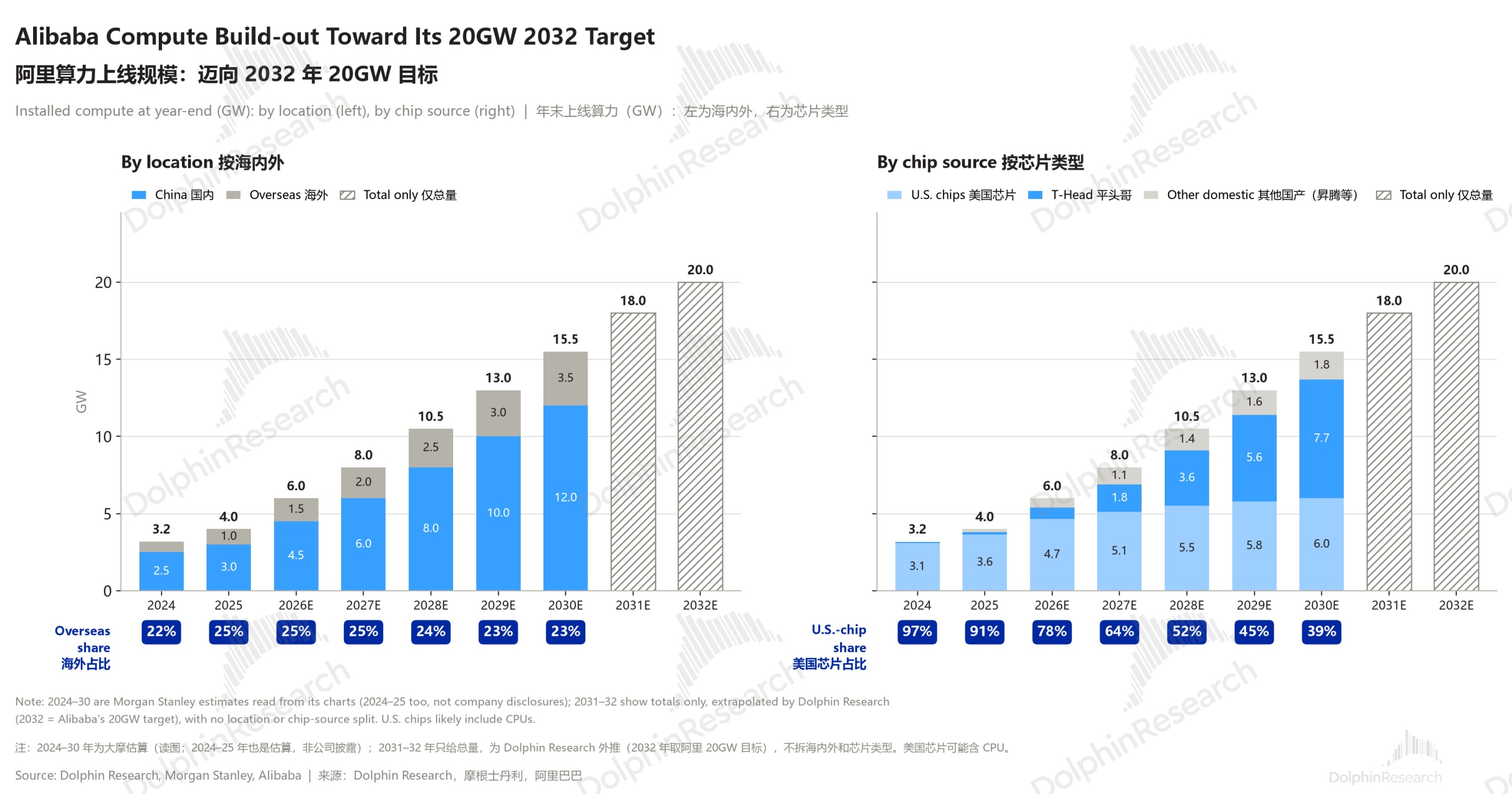
Pre-rule, Alibaba had an official anchor for its compute plan: 2032 DC power usage at 10x 2022, i.e., from roughly 2 GW in 2022 to around 20 GW by 2032 (self-built plus leased). Based on third-party forecasts, the plan breaks down by region and chip source as follows:
By region: overseas around one-quarter. Overseas capacity rises from ~1 GW in 2025 to ~3.5 GW in 2030, with share steady at 22–25%. By chip: U.S. chip share drops from ~90% to ~40%. Around 90% of compute in 2025 relies on U.S. chips, then domestic chips including T-Head ramp as U.S. imports stall, cutting the U.S. share to ~40% by 2030.
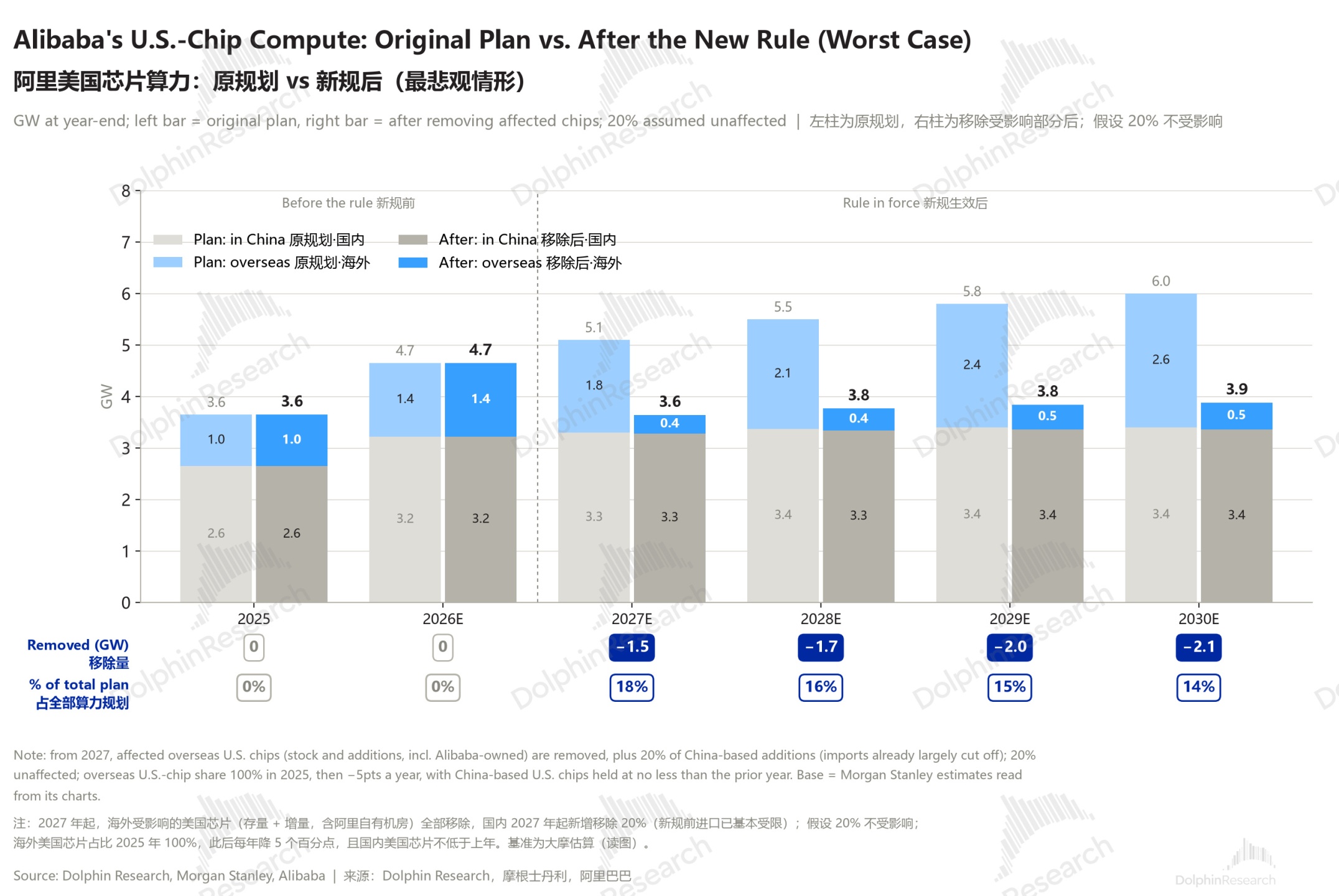
2.2 Isolating U.S. chips: about 1.5 GW removed in 2027, nearly one-fifth of the original, mostly overseas
Looking only at the U.S. chip-based portion, the planned increment was almost entirely overseas: overseas U.S.-chip compute grows from ~1.0 GW in 2025 to ~2.6 GW in 2030.
Domestic compute inches from ~3.2 GW in 2026 to ~3.4 GW (imports were already choked, with only small CPU and low-end GPU allowed). Under full enforcement, Dolphin Research assumes:
a. For overseas deployments: ~20% remains unaffected (CPUs, GPUs below H20, and Alibaba’s own overseas capacity share). All other additions and installed base are removed.
b. For domestic deployments: installed base by end-2026 remains in use, and from 2027 onward, planned U.S. chip additions are cut by 20% (incremental impact is limited since imports were already largely blocked).
Conclusion: 2027–2030 removals equal 18–14% of the original plan, with impact easing over time as domestic chips ramp. The largest hit is in 2027: removals reach 1.46 GW and, absent backfill, net additions drop from 2.0 GW to ~0.55 GW.
2.3 Can domestic chips carry the original plan: chip counts are essentially enough, allocation is the constraint
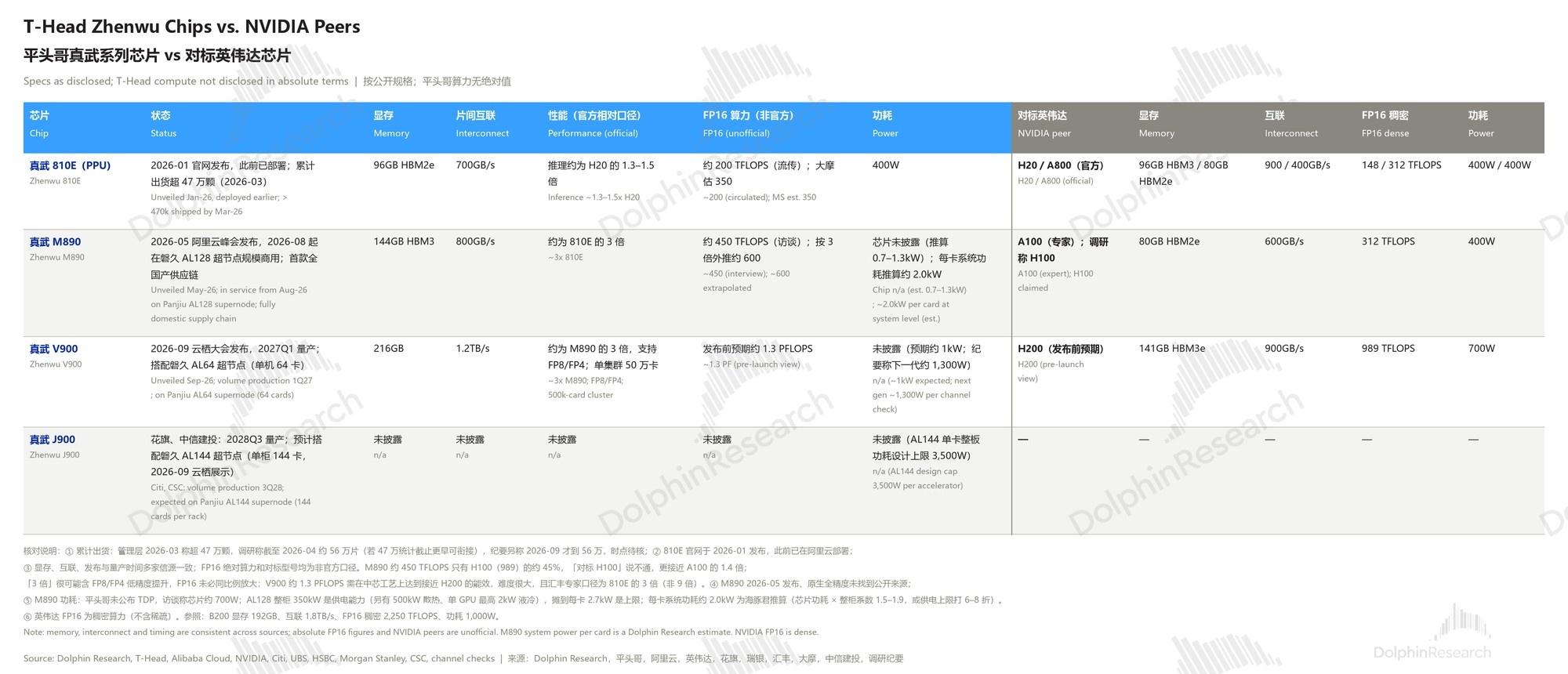
The next question: do T-Head and other domestic chips have sufficient shipments to meet the original plan. And post-rules, is there incremental output to partially offset lost U.S. compute.
Bottom line: domestic chips can meet the original plan, but T-Head’s capacity is basically fully allocated in 2027–28, leaving backfill to other domestic chips with limited coverage; from 2029, T-Head’s ramp can restore most removed capacity. That said, domestic chips are more ‘good enough’ than ‘high-end,’ and HBM and advanced packaging may be bottlenecks.
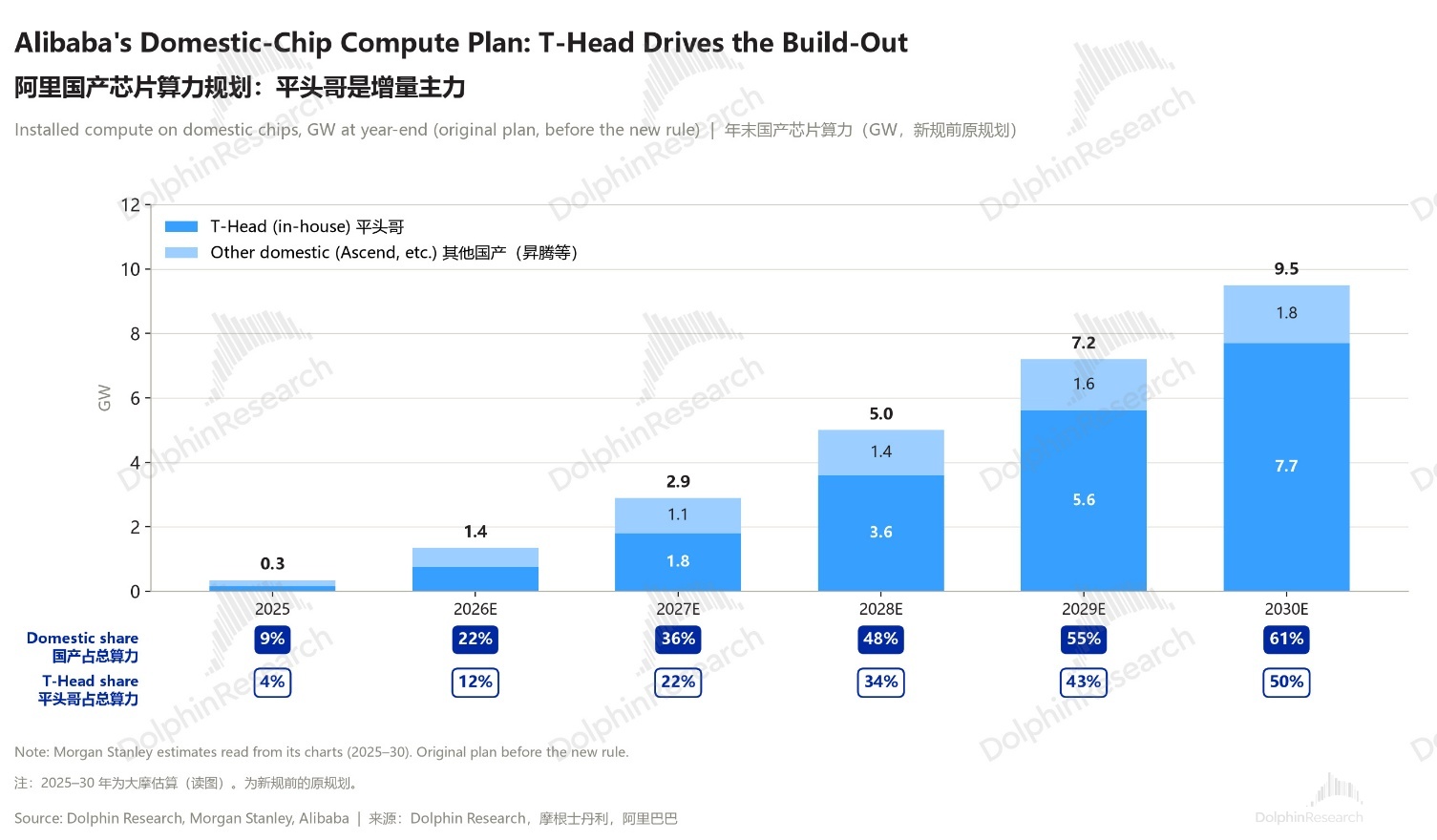
Under the original plan, domestic-chip-based compute (T-Head plus others) grows from ~1.4 GW in 2026 to ~9.5 GW in 2030, reaching 61% of total by end-2030. The vast majority is T-Head for Alibaba’s own use, with other domestic chips at roughly a 4:1 ratio.
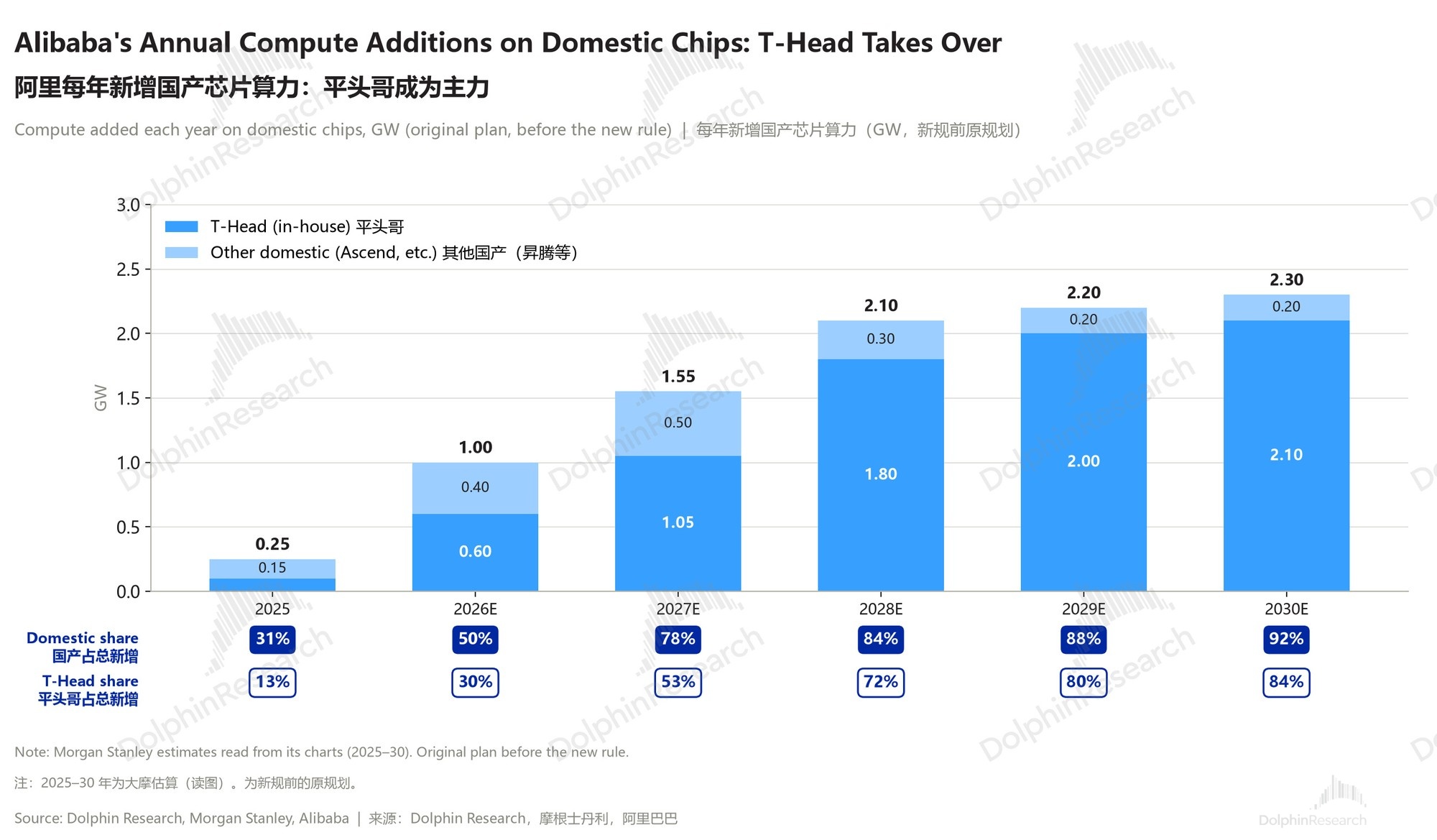
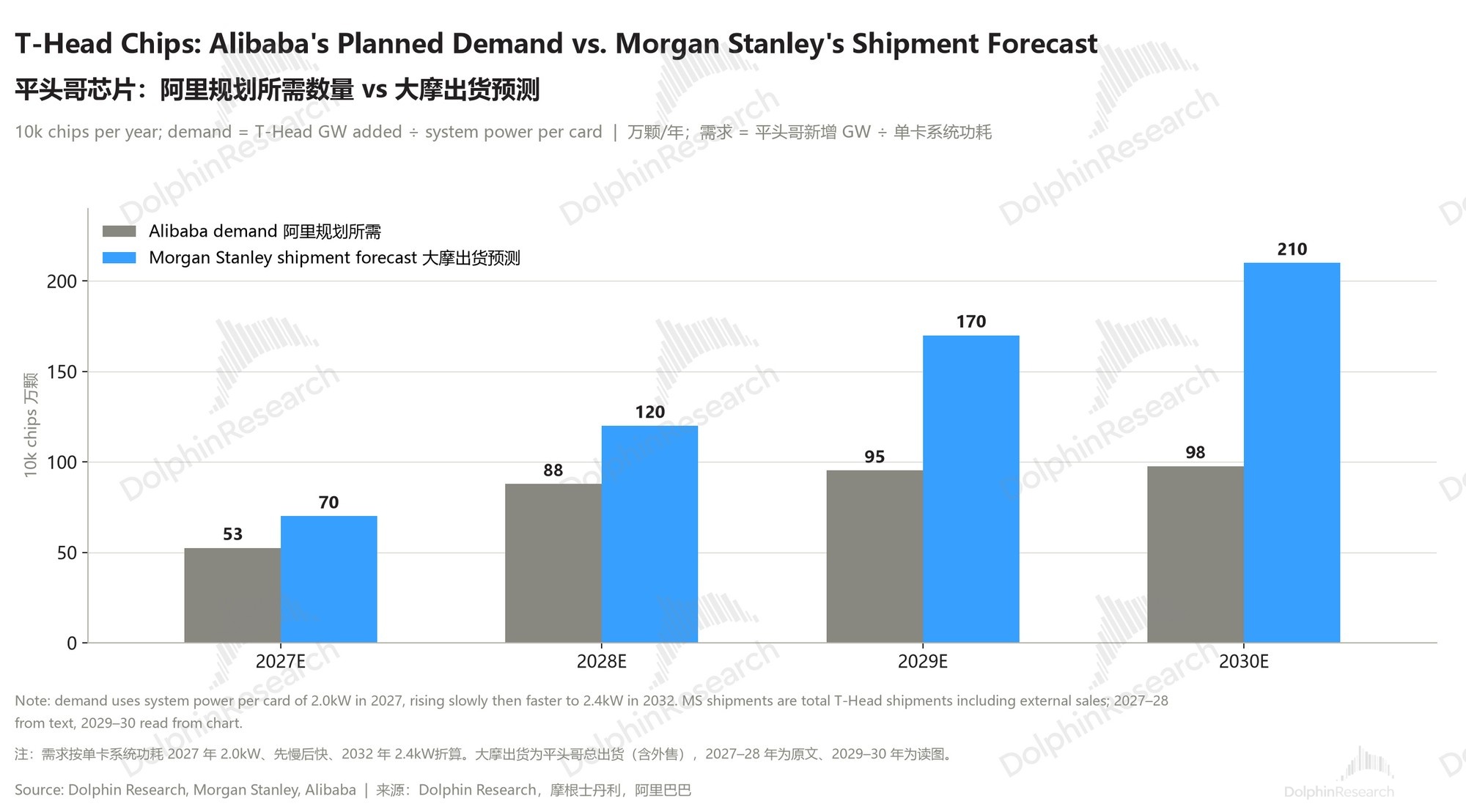
a. Key assumption — power per card: To convert power (GW) into chip counts, we reference research: M890 max power ~2.7 kW per card, next-gen PPU at ~4.5 kW. Assume T-Head averages ~2.0 kW per card in 2027, rising to ~2.4 kW, as prior gens draw less and chips seldom run at max power.
b. T-Head supply: just enough for the base plan, no spare. Under the above power assumptions, meeting the original incremental plan requires ~530k and ~880k T-Head cards in 2027–28. Field checks suggest T-Head output at ~500k and ~900k, basically fully absorbed in-house (Morgan Stanley has a higher case at 700k and 1.2 mn units, which would create surplus to backfill lost U.S. compute).
c. Other domestic chips: total is enough, access is uncertain. Alibaba’s plan adds only 0.2–0.5 GW per year, which at 1.6–2.0 kW per card implies up to ~300k cards. Foreign brokers estimate Huawei alone could ship 600–800k cards in 2027–28, and others add more, so total supply looks ample.
However, Huawei is a cloud competitor, and after the new rules, everyone will scramble for domestic compute. Whether Alibaba can secure enough allocation is uncertain.
d. Wafer capacity: ample in total, constrained by allocation. With ~30 good T-Head dies per wafer (45% yield), T-Head’s annual wafer needs from 2027 (~17k–37k) are under 10% of domestic advanced-node capacity (field checks put 2028 capacity at ~42k wpm). Wafer capacity is ample, and sub-10% allocation to T-Head should be manageable. Real bottlenecks are likely HBM and advanced packaging; if domestic ramp lags and overseas vendors like Samsung remain key, those could become choke points under the new regime.
2) Can domestic chips fill the U.S. gap?
Answer: yes, but slowly and not much in 2027–28; most recovery comes from 2029. With T-Head fully allocated to the original plan in 2027–28, backfill relies on Huawei, Cambricon, and others, with limited coverage.
From 2029, T-Head’s ramp should provide ample surplus to offset lost U.S. compute.
The key is whether Alibaba can secure more non–T-Head domestic chips in 2027–28. In 2027 that is difficult, and an extra 100k cards already looks optimistic as Alibaba had planned to take a large share of Huawei’s supply; with new rules, competition intensifies and domestic HBM is scarce.
From 2028, adding ~200k cards per year is possible but likely at a material premium, and Huawei is a direct cloud competitor, adding uncertainty. This dynamic benefits the domestic semi supply chain.
Even if GW scale is restored, the high-performance gap remains: some removed U.S. chips were B-series high-end parts used for Qwen pre-training. Domestic chips at best match H200 today, adequate for general inference and external rental, but still strained for frontier model training.
3. Demand allocation: the shortfall falls mainly on external rentals
3.1 Compute allocation: external rentals were ~60% pre-rules; post-rules the shortfall sits mostly there
Having sized the supply change pre/post rules, the next question is how Alibaba reallocates compute.
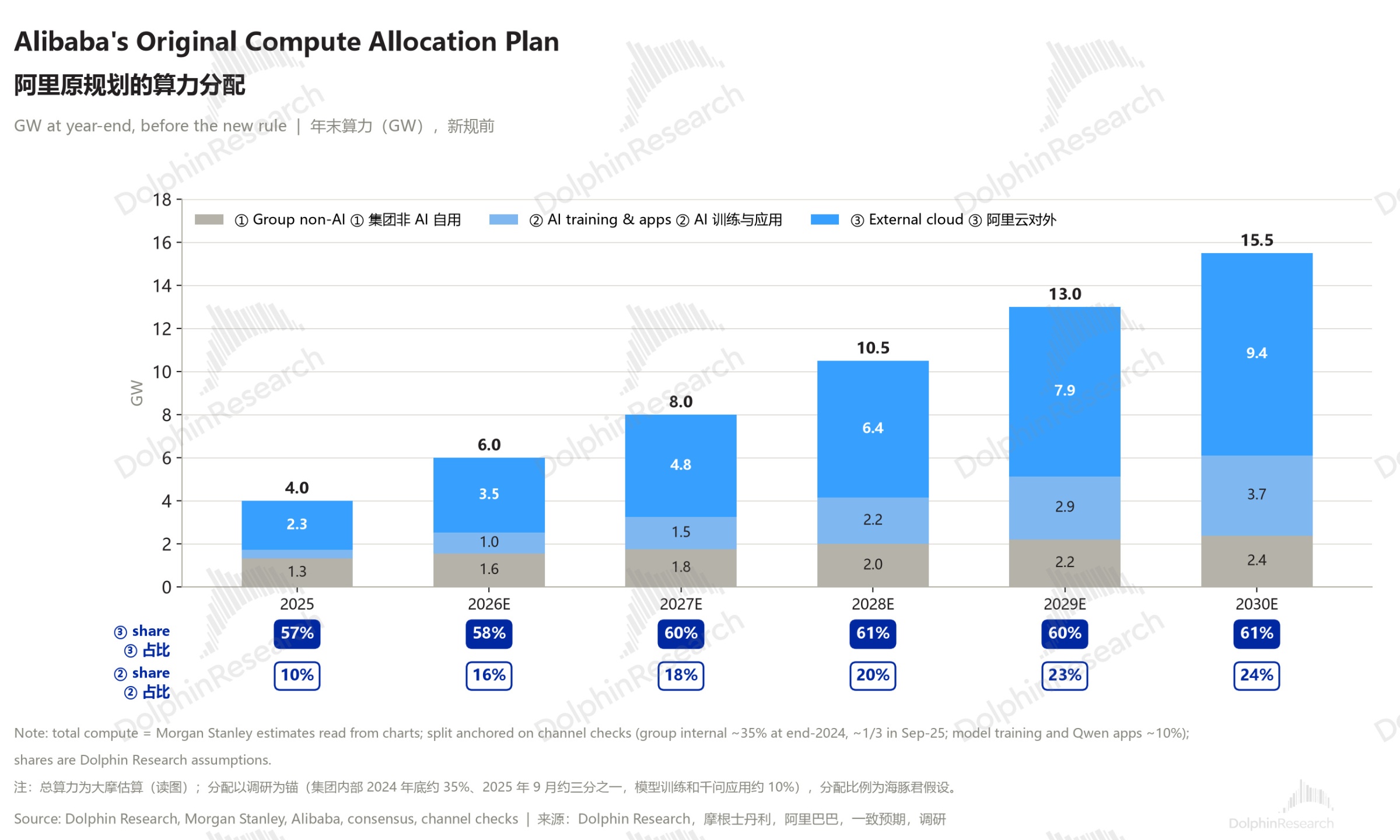
For clarity, we split compute into three uses: ① non-AI internal use (e-comm, Cainiao, Amap, and other traditional services); ② AI training and applications (Qwen R&D and apps like Qwen, Qianwen Office); ③ Alibaba Cloud external sales/rentals (IaaS, Bailian MaaS, Ant Group, etc.).
Based on field checks: by end-2024, internal use was ~35%, with the rest external. By Sep 2025, non-AI internal was ~one-third, and model training plus Qwen apps were ~10%. We approximate distribution under the original plan (see chart).
1) Pre-rules: external rentals at ~60%, AI self-use rising
Under the original allocation: ① non-AI internal demand is sticky and grows slowly, diluting from ~33% to ~15%; ② AI training and apps grow fastest from ~0.4 GW in late-2025 (~10%) to ~3.7 GW by late-2030 (~24%); ③ Alibaba Cloud external remains the bulk at 57–61%.
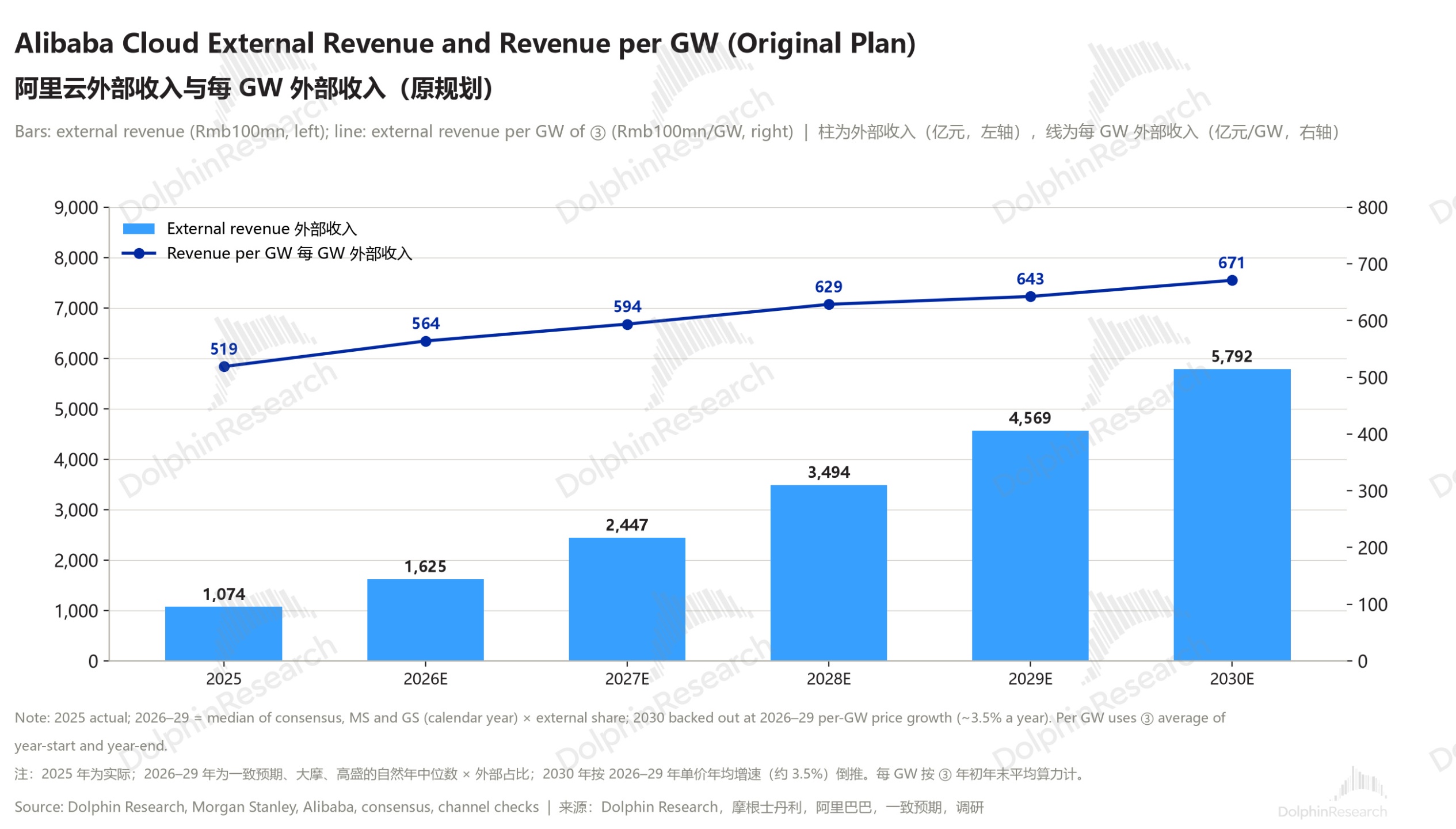
To validate, we compare Street expectations for external cloud revenue with rentable compute and derive RMB 56–67 bn per GW in 2026–30, which aligns with field pricing (M890 at ~RMB 52 bn/GW; neutral at RMB 45–50 bn/GW).
2) Post-rules: the shortfall is borne mainly by external rentals
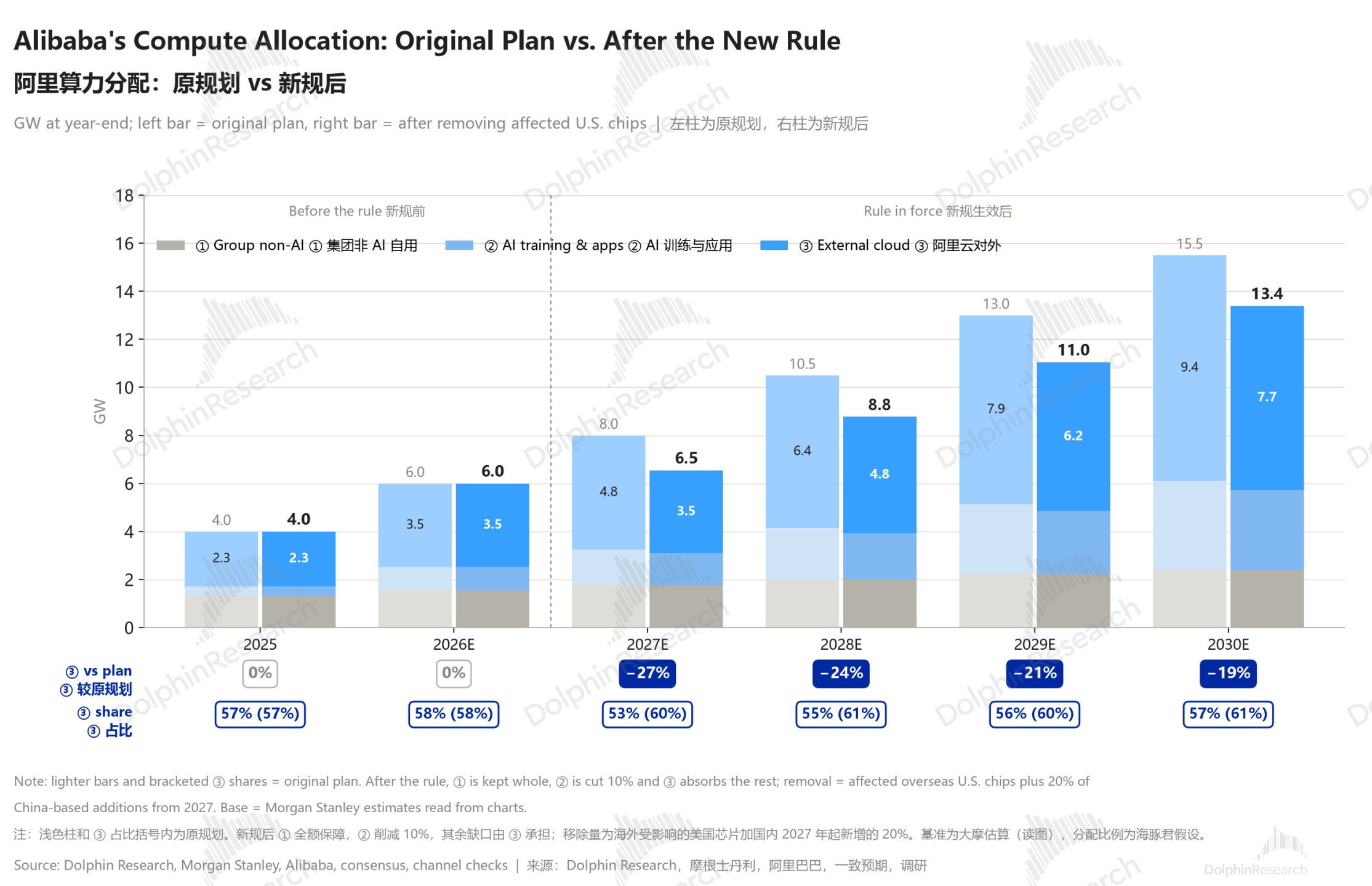
With a tighter market post-rules, the company will need to replan allocation. Dolphin Research’s post-rules allocation logic assumes: a. non-AI internal usage is broadly unchanged; b. prioritize AI training and apps; c. leave most of the gap to external rentals.
New allocation by bucket:
AI training and apps: prioritized with only ~10% below the original plan, adding ~0.15–0.37 GW per year. But removals include B-series used for Qwen pre-training, so training capacity falls more than GW figures suggest (see 4.2).
Alibaba Cloud external: across 2027–30, nearly 90% of removed capacity each year is absorbed by the external rental bucket. Versus the original plan, rentable capacity is down ~19–27%, with the largest cut in 2027, leaving external capacity almost flat YoY (original plan was +37%).
3.2 Revenue impact: 2027 cannot meet the +50% bar; limited backfill in 2027–28
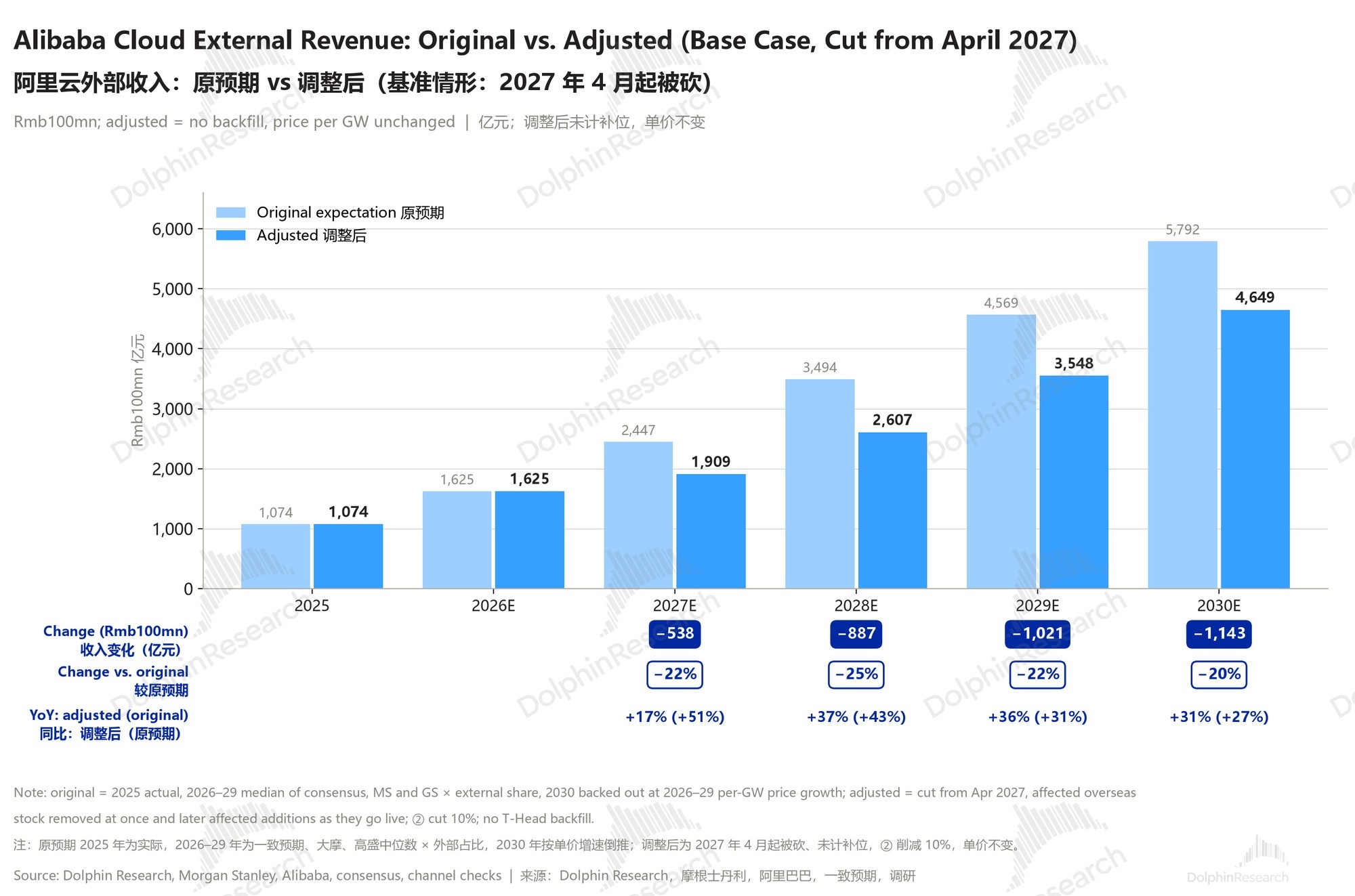
1) Base case cuts external revenue by nearly one-quarter
Base case: cut from Apr. The exact timing of overseas capacity removal is unclear; we assume removal from Apr 2027. Pricing per GW follows the original plan without adjustment.
Under this, Alibaba Cloud external revenue would be ~20–25% below prior expectations, with 2027 hit the hardest, taking growth from 51% down to just 17%.
We hold unit pricing flat for now due to offsetting effects:
a. Mix drags: removals are mainly higher-end U.S. B-series with premium rental rates, while backfill is domestic, earning less per GW.
b. Tighter supply boosts domestic pricing: with constrained capacity, even lower-priced domestic compute likely reprices upward. Which force dominates needs monitoring.
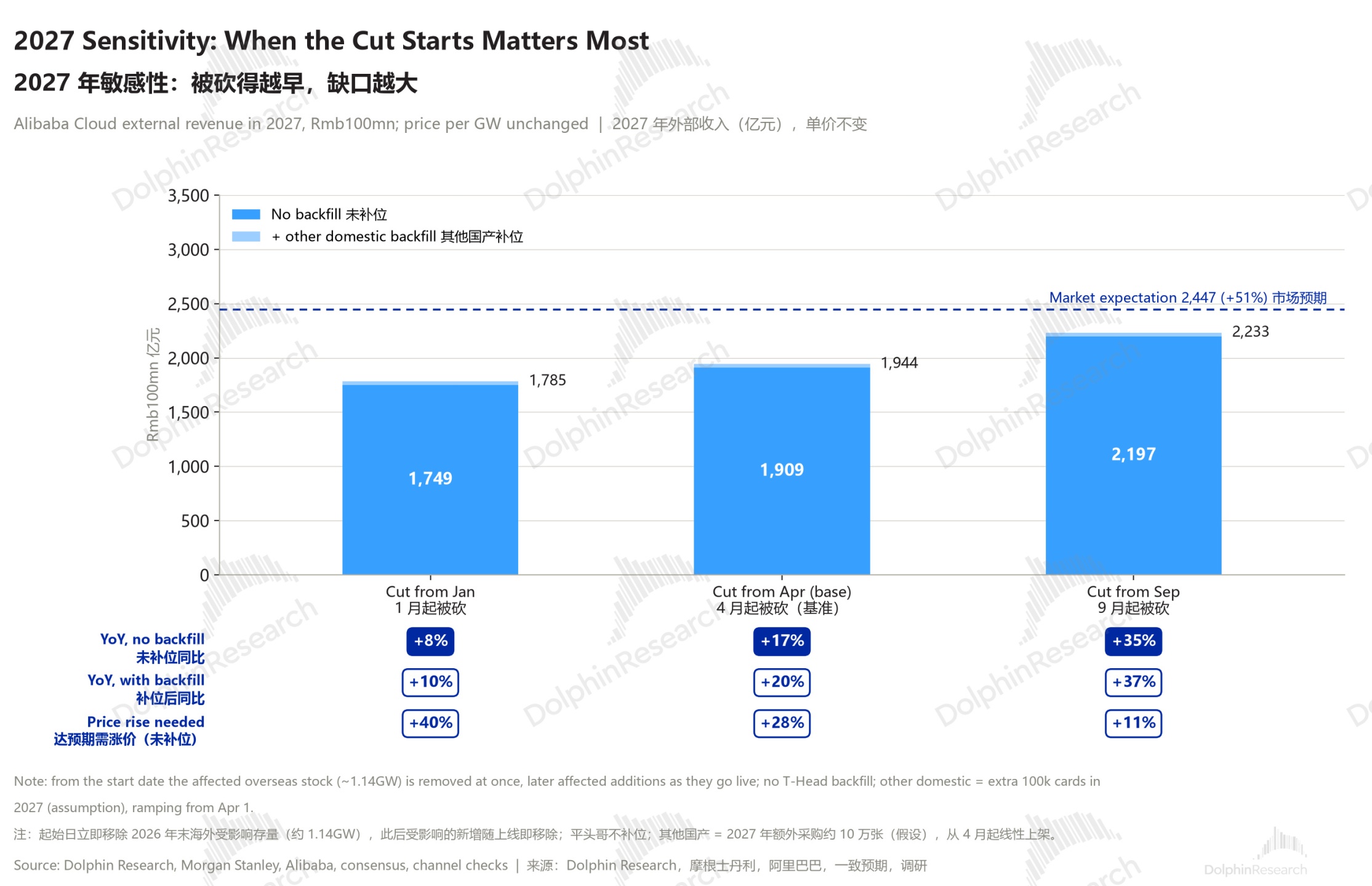
2) Timing scenarios: in the worst case, 2027 external growth falls to 8%
For 2027 specifically, timing matters. Beyond the base case, we test Jan and Sep cuts: if cuts start in Jan, 2027 external cloud revenue growth falls to just 8%; if cuts start in Sep, growth slows to 35%.
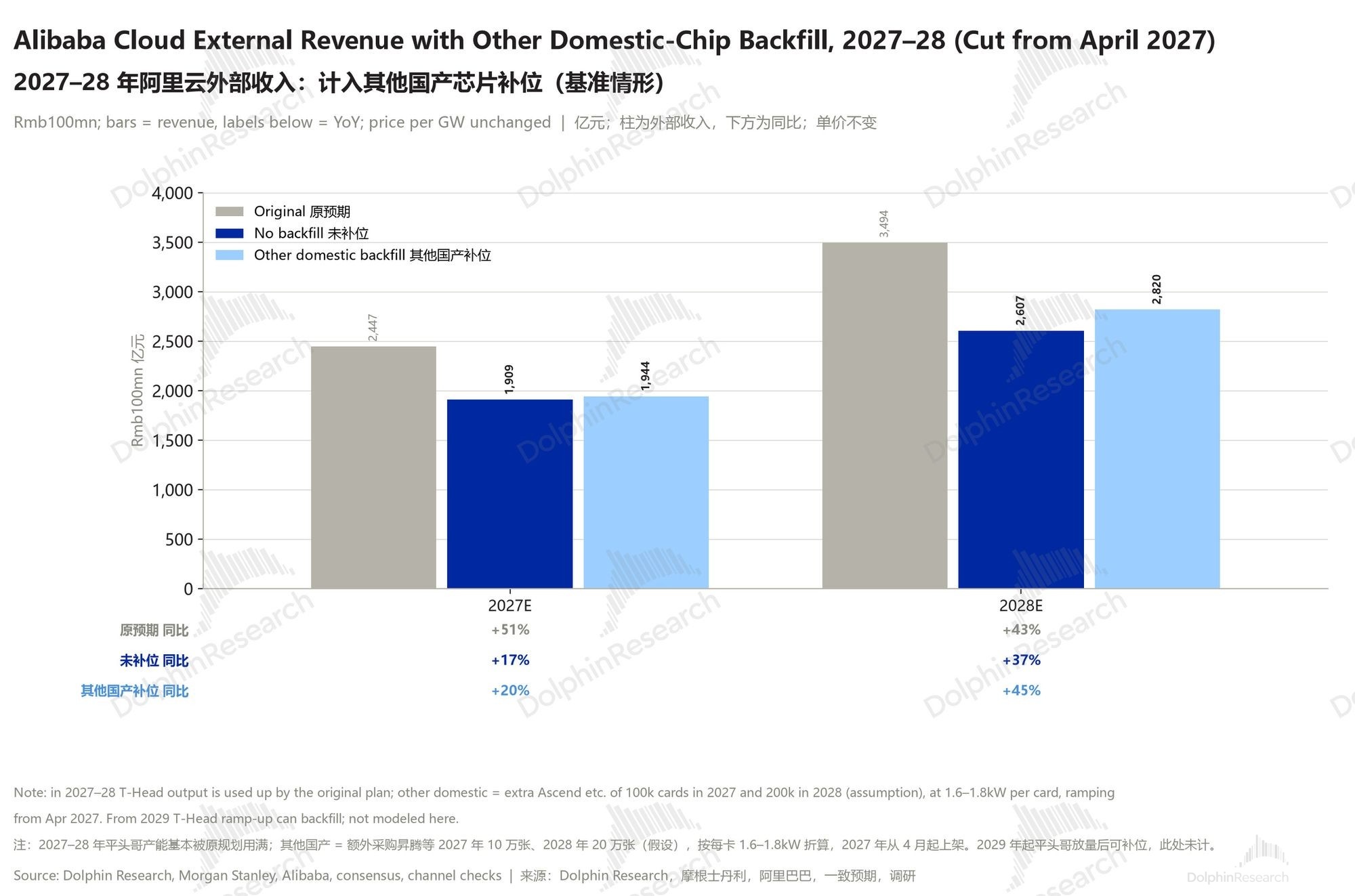
3) Including backfill from other domestic chips: for the peak-impact years 2027–28, if domestic compute partially fills the gap, how much external growth can be recovered.
With T-Head fully allocated to the original plan in these two years, backfill hinges on extra Huawei, Cambricon, and other domestic cards: assume an extra ~100k in 2027 (~0.16 GW) and ~200k in 2028 (~0.36 GW),
ramping online from Apr 2027.
Then under the base case of overseas cuts starting in Apr, 2027 external revenue growth recovers from ~+17% to ~+20%, still well below prior expectations; the 2028 gap vs. prior expectations narrows from ~25% to ~19%.
From 2029, T-Head ramps and can fully backfill, so we do not detail further.
4. Beyond the math: qualitative considerations
4.1 Who gets compute first: most will prioritize internal models
The trade-off under scarcity: with overseas cut and domestic in short supply, all cloud and model players must choose between internal models and external rentals.
Most will prioritize internal: only with strong internal models can cloud and AI apps stay competitive. Also, with external cuts and limited high-end card stock, rental rates likely rise, offsetting part of revenue loss via pricing.
This underpins the Chapter 3 assumption to fully protect ①, trim ② slightly, and let ③ external rentals bear most of the gap.
4.2 Training is hit hardest; inference impact is milder
Domestic cards are largely sufficient for inference: inference has lower per-card and interconnect demands; domestic 810E, M890, etc., are adequate for general inference, limiting impact on external rentals and apps like Qwen.
Training is more affected: frontier pre-training needs single clusters of tens of thousands of cards, and field checks show B-series high-end GPUs are pivotal for top-tier domestic model pre-training.
By FP16 dense compute and rack-normalized per-card power, B-series deliver ~4–5x M890 compute per kW. Domestic cards are weaker per card, require larger clusters and denser interconnect, and the software stack lags CUDA.
Even if GW capacity is restored, flagship model training could slow, widening the gap vs. overseas frontier models.
4.3 Consolidation likely among domestic foundation models
With high-end compute scarce, China likely cannot support both the tech giants and many independents in chasing frontier models. Among giants like Alibaba, ByteDance, and Tencent, independents other than DeepSeek may be most affected:
a. Giants lack spare capacity to rent out: those expanding compute will keep it for in-house models, leaving little for independents.
b. Independents are first to be hit: they have weaker capital and fundraising than giants, and less room to reallocate internal vs. external capacity, risking ‘no cards available.’ This hurts both R&D and user experience.
c. Outcome: leading giants, especially with in-house chips (Alibaba’s T-Head, Huawei Ascend), are advantaged; some independents may drop frontier training, pivot to apps, or be consolidated.
4.4 T-Head: backfilling will crowd out external sales and could cap its standalone IPO valuation
Backfill crowds out external: Morgan Stanley previously assumed Alibaba self-use would fall from ~80% of T-Head shipments in 2027 to ~50% by 2030, implying rising external sales over time.
Post-rules, as T-Head ramps from 2029, surplus will first backfill Alibaba’s lost U.S. compute. Chips originally slated for external customers shift back in-house, reducing T-Head’s external revenue and customer count vs. prior expectations.
Valuation overhang: as T-Head preps for a standalone listing, if external is crowded out, it looks more like Alibaba’s internal supply unit, with smaller revenue and less independence. That could weigh on IPO pricing and valuation.
4.6 Beyond chips: HBM and advanced packaging may bottleneck before wafers
HBM: since Dec 2024, the U.S. restricts HBM2E and above exports to China, while domestic HBM is still ramping. M890’s 144 GB and V900’s 216 GB VRAM both rely on HBM, which could bottleneck T-Head’s ramp before wafers.
Advanced packaging and foundry: domestic CoWoS-like capacity is limited; the new rules also restrict overseas foundry for China-designed 16/14nm-and-below chips. If any T-Head products still rely on Samsung or others, they must shift to SMIC and compete with Huawei for capacity.
4.7 China’s policy response: faster import substitution and rare-earth counters
While negative for domestic cloud and model players, this accelerates the ‘import substitution’ thesis for domestic chip design, HBM, and the broader semi chain. In response to incremental U.S. moves, China could counter in areas like rare earths.
Whether the full slate of restrictions lands as-is will likely involve push-and-pull.
5. Finale: the script is written, but which version Alibaba gets — the bearish Jan ‘plug-pull,’ the base Apr cut, or a milder Sep start with half-year buffering — is hard to call.
The key is tonight’s call: how overseas compute will be handled, how much T-Head and other domestic cards can backfill, and whether next year’s growth guide holds. Dolphin Research will update forecasts and valuation after results. Let’s watch Alibaba’s print and call together tonight.
<End of text>
Risk disclosure and disclaimer: Dolphin Research Disclaimer and General Disclosure
The copyright of this article belongs to the original author/organization.
The views expressed herein are solely those of the author and do not reflect the stance of the platform. The content is intended for investment reference purposes only and shall not be considered as investment advice. Please contact us if you have any questions or suggestions regarding the content services provided by the platform.