

Walmart: AI 'stumbles'; is the retail king a safe haven?
 I'm LongbridgeAI, I can summarize articles.
Before the U.S. market open on Nov 19, 2026 (Beijing time), Walmart (WMT) released its FY27 Q3 results, covering Aug 1 to Oct 31, 2026. $Walmart(WMT.US)
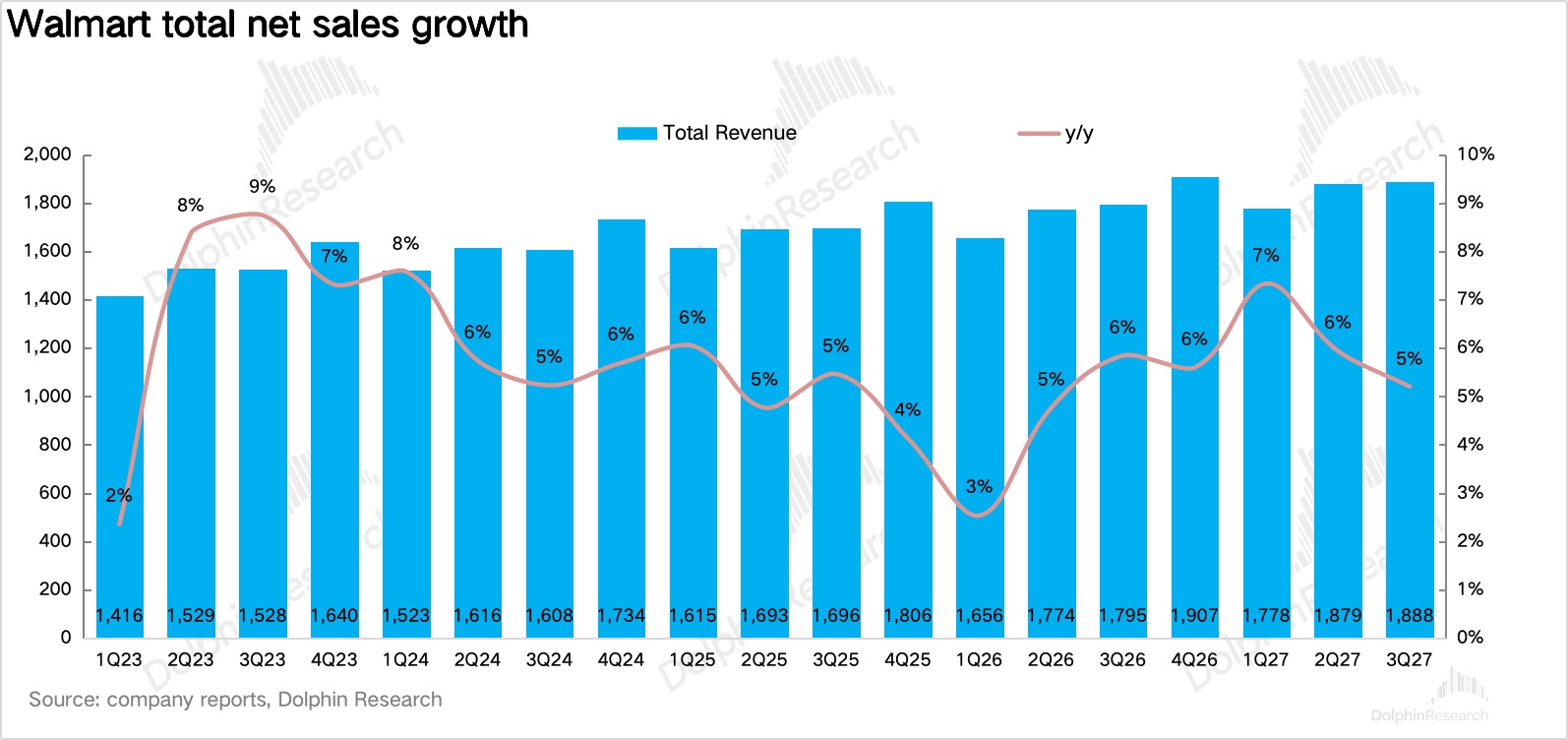
Overall, profits came in well above prior company guidance, and full-year guidance was raised again. However, U.S. traffic did not accelerate despite broad price cuts, and implied Q4 profit guidance was below the Street, sending the stock slightly lower pre-market.
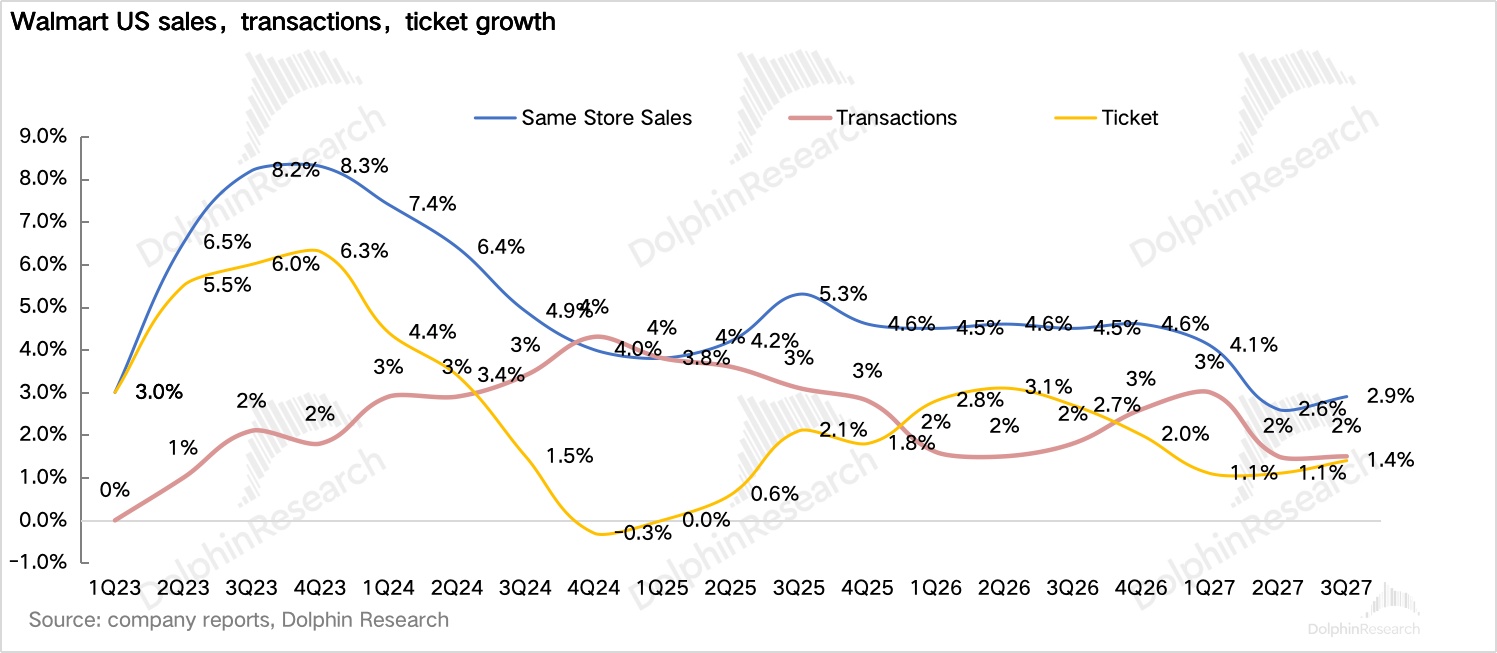
1. Walmart U.S.: modest comp re-acceleration, but traffic still flatlining. Core North America comps rose 2.9% YoY, up slightly vs. 2.6% in Q2.
The mix was less ideal: transactions were up 1.5%, unchanged vs. Q2. Avg. ticket rose 1.4% (Q2: +1.1%), the main driver of higher comps, helped by a narrower drag from egg deflation and cost passthrough to end prices in diesel and freight.
E-commerce remained the strongest business, up 23%, contributing approx. 530bps to comps, with store-fulfilled delivery up 40%+, ads up 37%, and Marketplace up 49%. The company also disclosed for the first time that GMV in general merchandise grew at a mid-single digit rate, faster than 1P GM’s low-single digit growth, indicating a shift from 1P to the 3P platform.
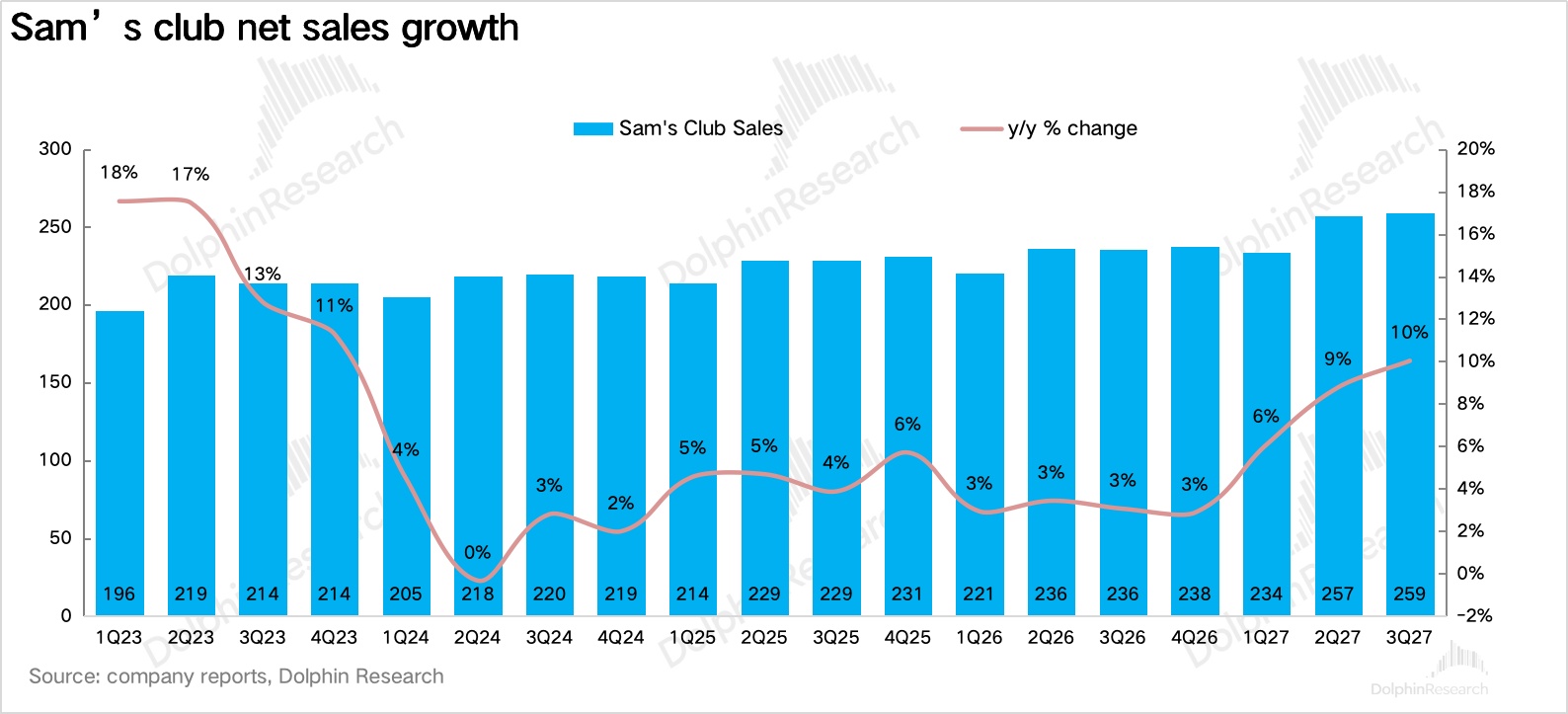
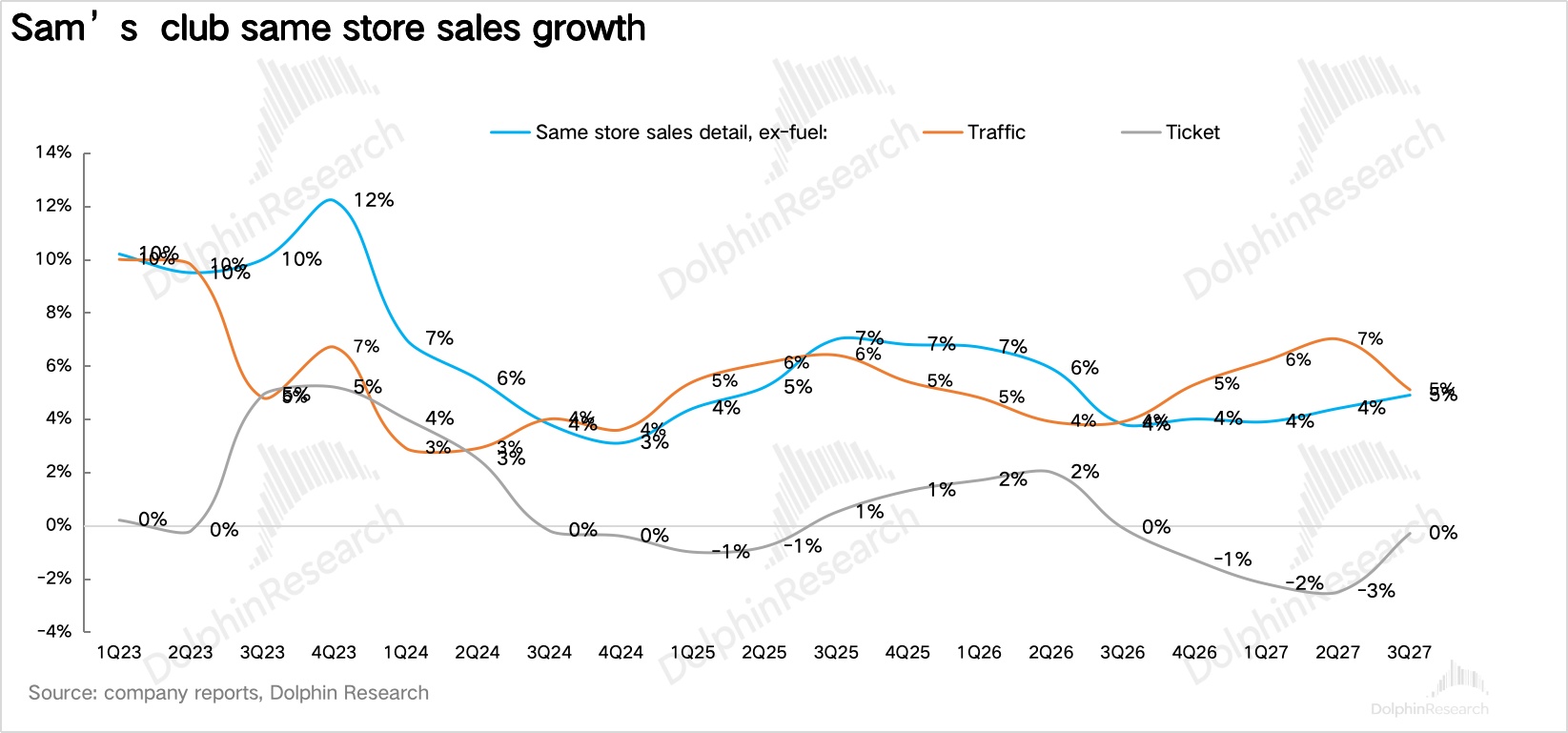
2. Sam’s Club U.S.: revenue accelerating, profit declining. Ex-fuel, Sam’s comps rose 4.9% (Q2: 4.4%), marking a second straight quarter of acceleration and the fastest comp growth among the three segments.
Transactions were up 5.1%, while avg. ticket fell 0.3%, with the decline narrowing notably vs. Q2. E-commerce rose 30%, contributing about 520bps to comps, and club-fulfilled delivery posted triple-digit growth.
Profit trends were weaker, with OP down 15.8% YoY, primarily due to the new bundled membership 'Walmart+ & Sam’s Plus', which requires allocating part of the fee to Walmart U.S.; management said this drag will persist until Q3 next year.
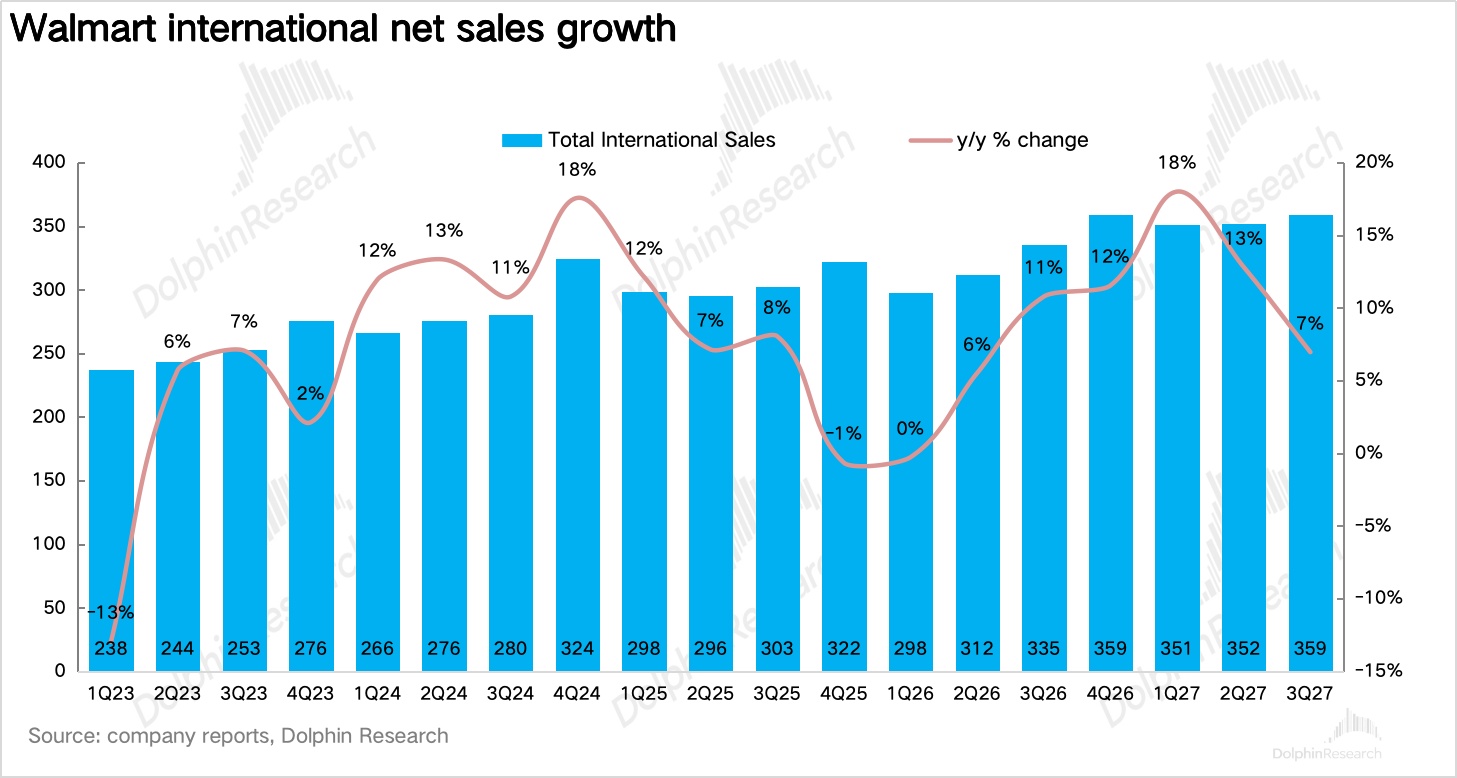
3. Walmart International: promo timing shift weighed on growth; China accelerated. International revenue was $35.9bn, up 7.0% YoY, but up only 3.3% at constant FX, mainly because Flipkart’s Big Billion Days was shifted from Q3 to Q4, a ~500bps drag, driving Intl e-commerce down 2% YoY.
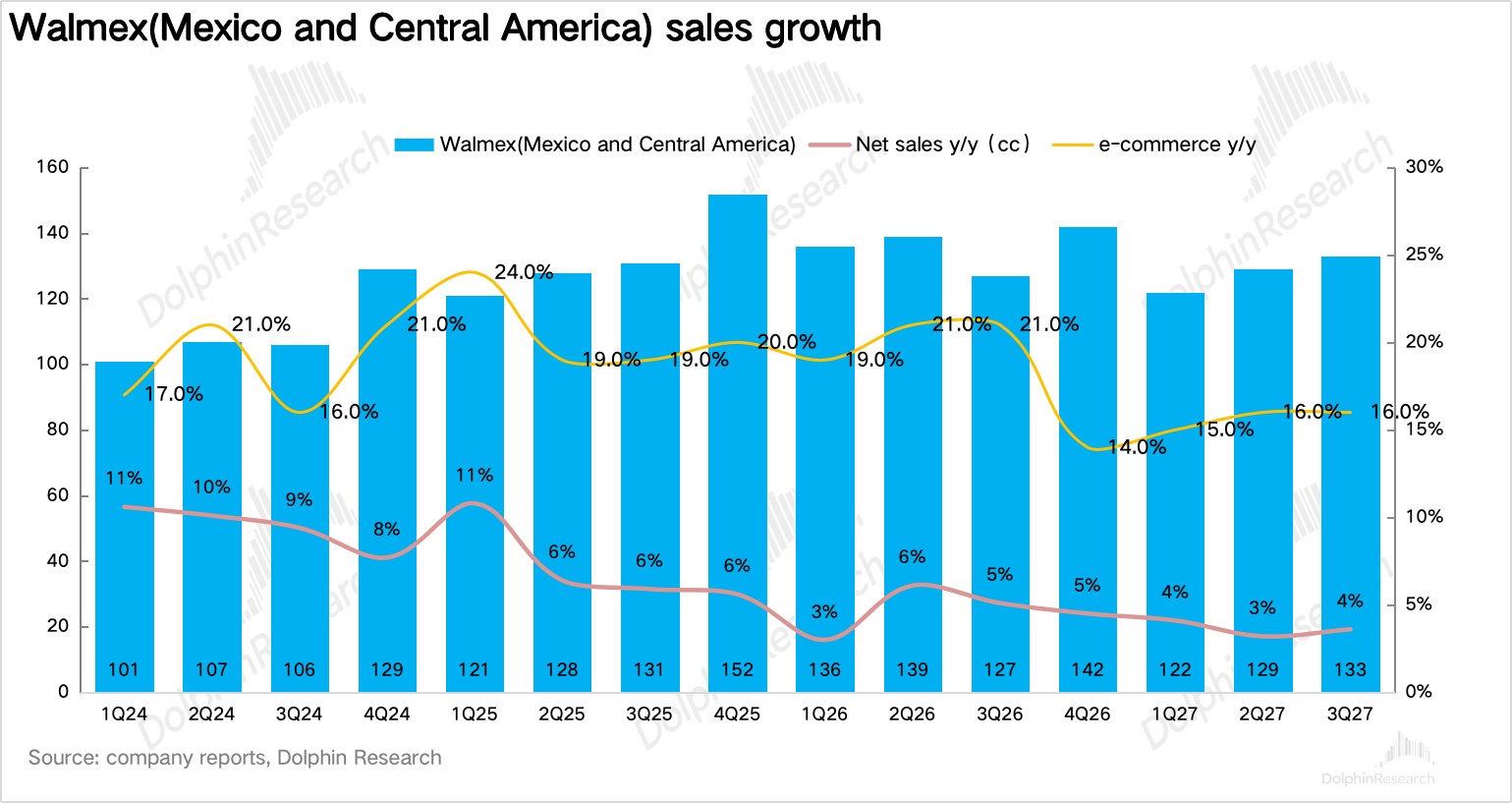
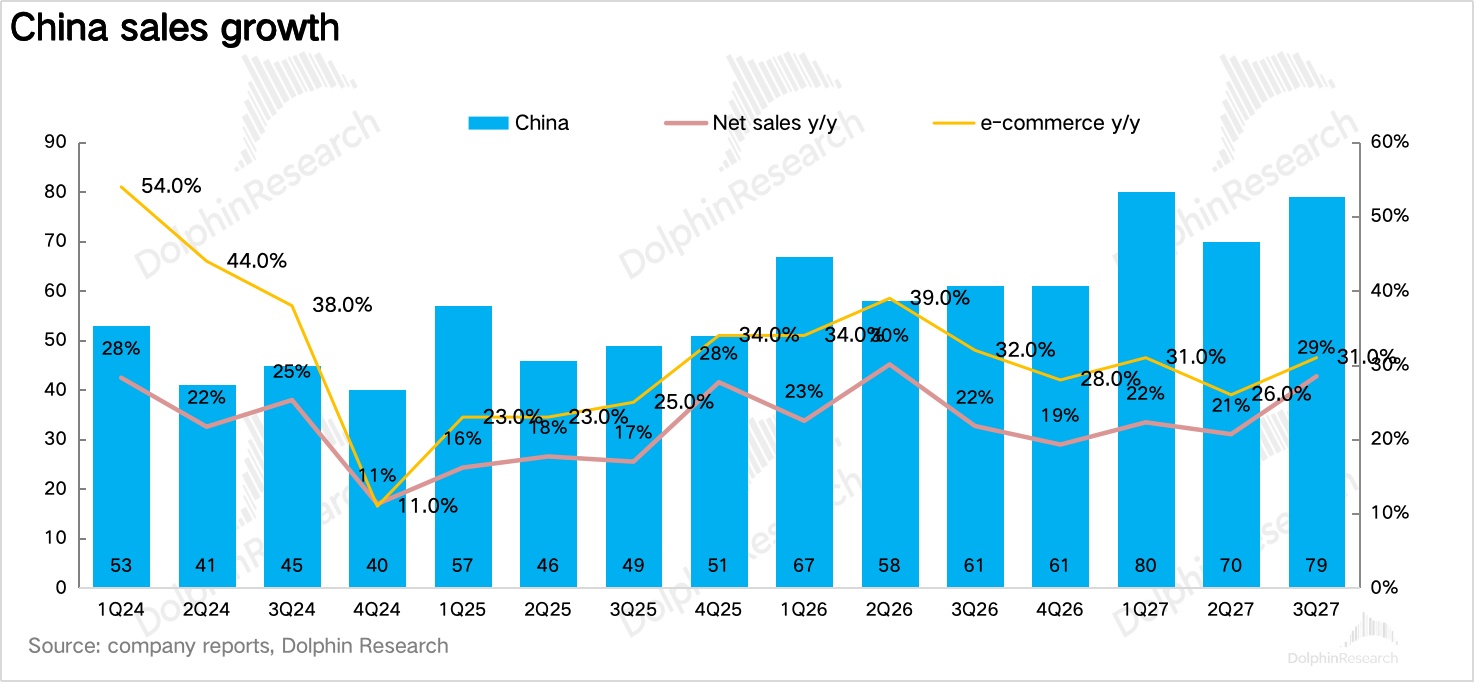
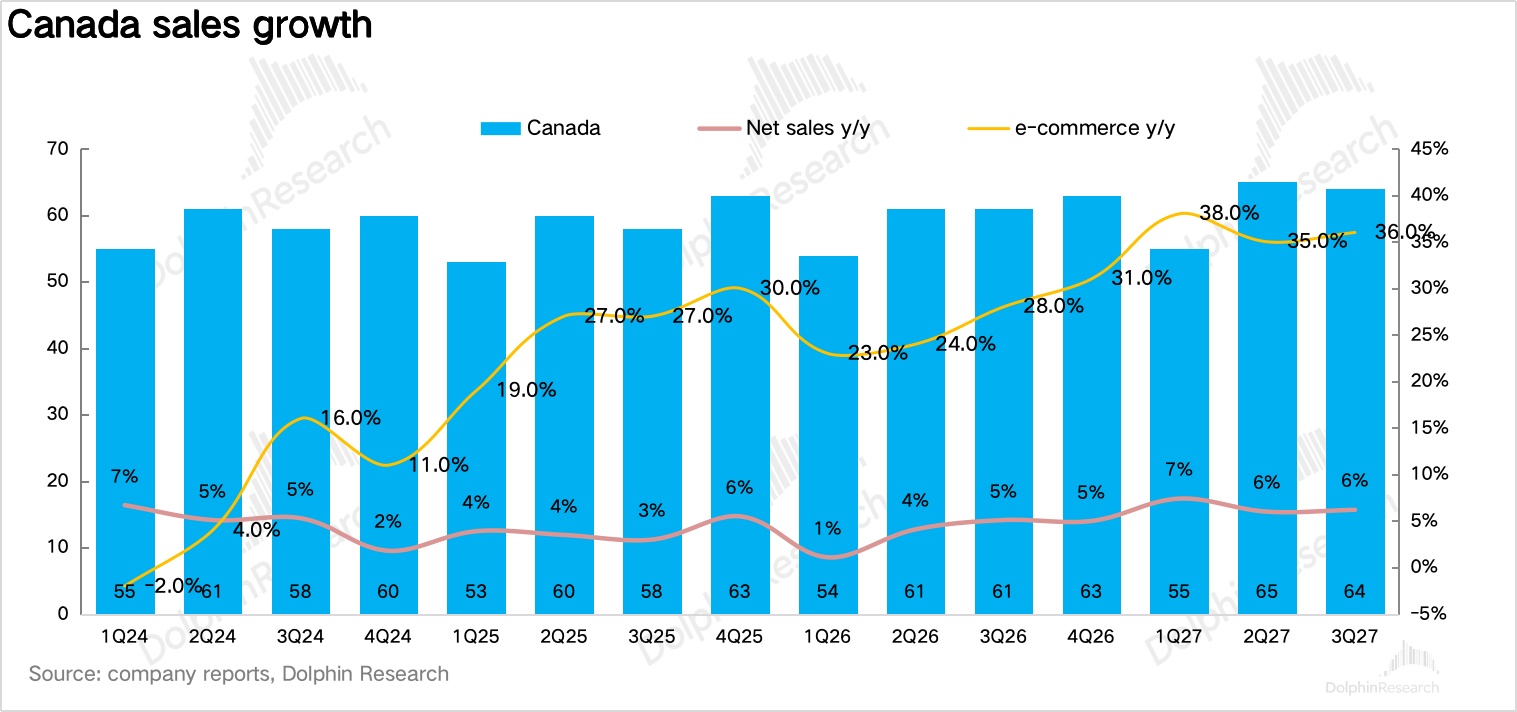
By market, China grew 28.5% at constant FX, a clear acceleration vs. 20.7% in Q2, with comps up 14.3% and Sam’s remaining the growth engine. Mexico (+3.6%) and Canada (+6.2%) were steady, but OP declined due to strategic investments in wages and pricing.
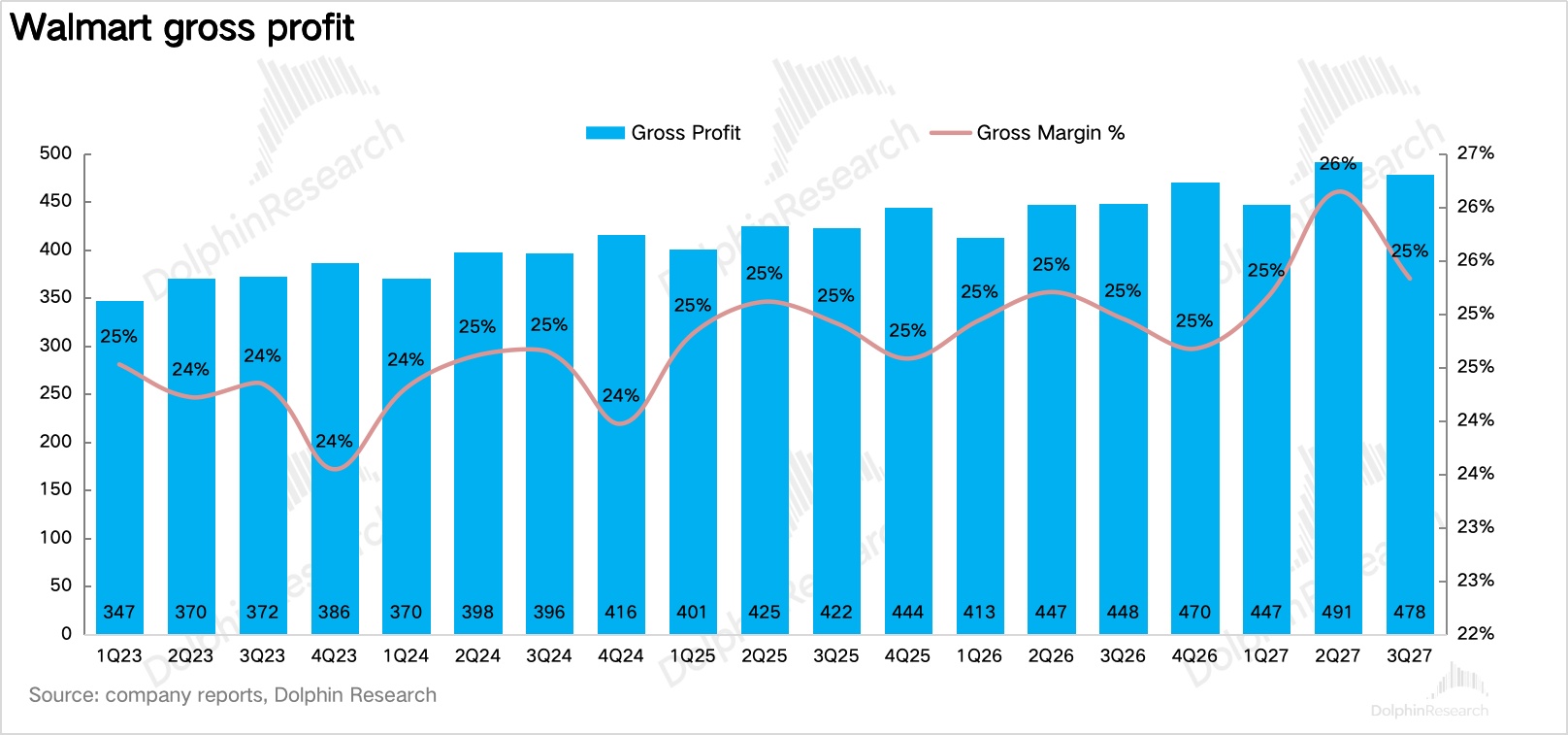
4. High-margin businesses continued to 'backstop' results; profits beat guidance. GPM expanded 28bps YoY to 24.5%, with Walmart U.S. GPM up 50bps, driven by a richer mix from ads and category mix gains from lower drug prices.
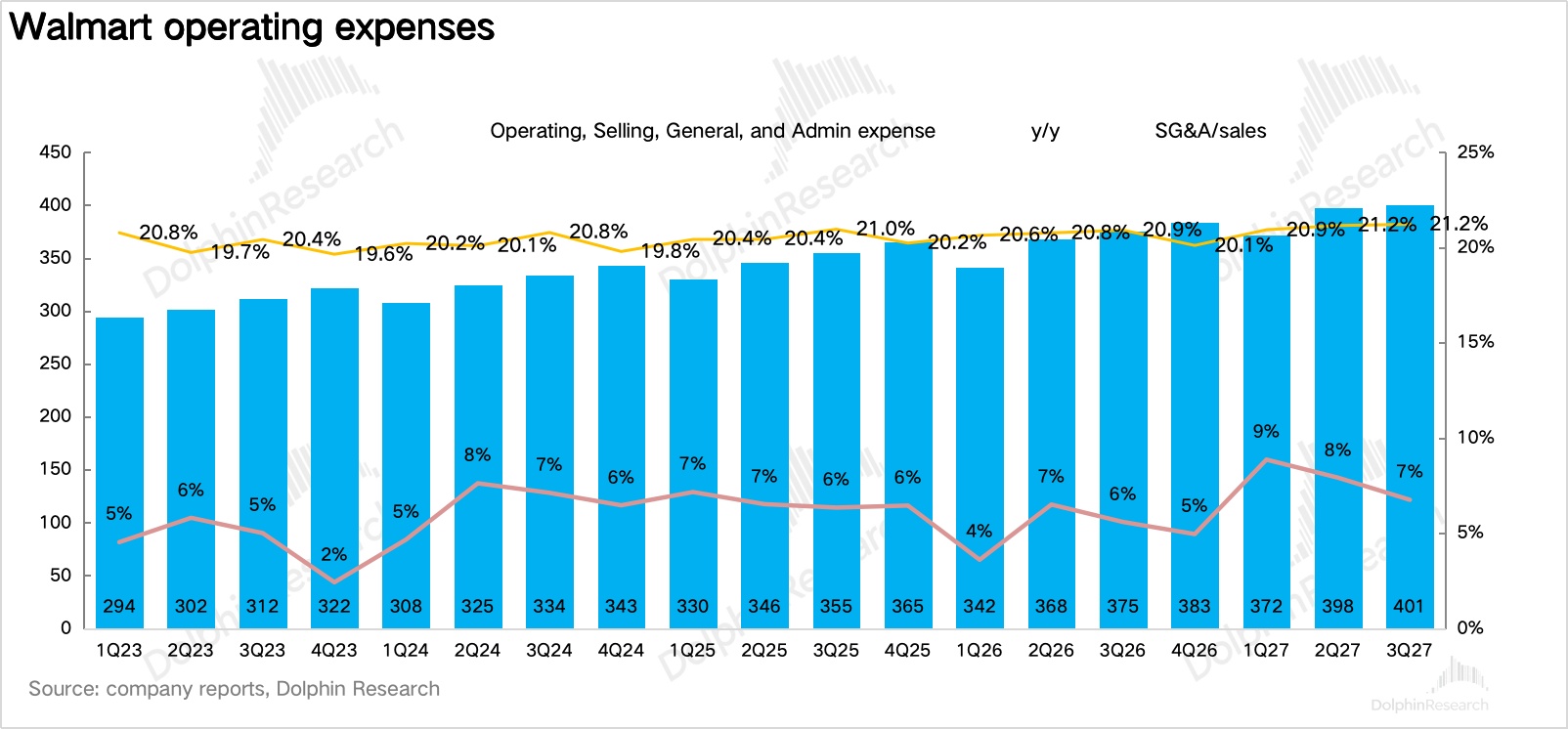
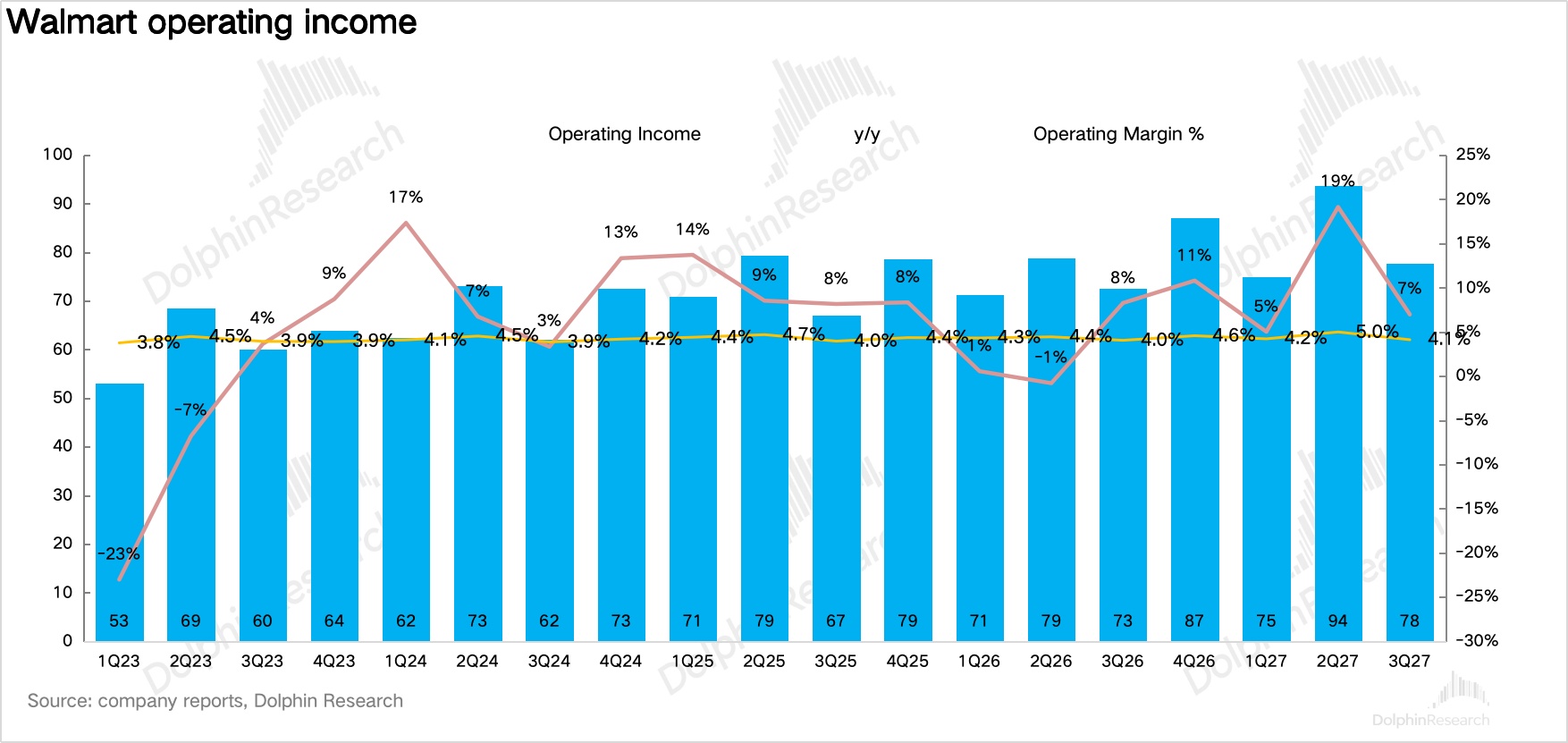
On opex, higher depreciation from capex and rising self-insurance claims lifted the adj. opex ratio by 34bps YoY to 21.5%. Adj. OP at constant FX rose 5.5% YoY, topping the prior company guide of +2% to +4%.
5. Full-year guidance raised, but implied Q4 profit looks soft. The company lifted full-year constant FX sales growth from 4.0%-5.0% to 4.9%-5.2%, and adj. OP from 7.0%-8.5% to 8.0%-8.6%, while adj. EPS was raised from $2.80-$2.87 to $2.84-$2.89.
On this math, implied Q4 adj. EPS is about $0.72-$0.77, below the prior Street estimate of roughly $0.78. With Flipkart’s promo timing shift also boosting Q4 revenue, the guide appears conservative.
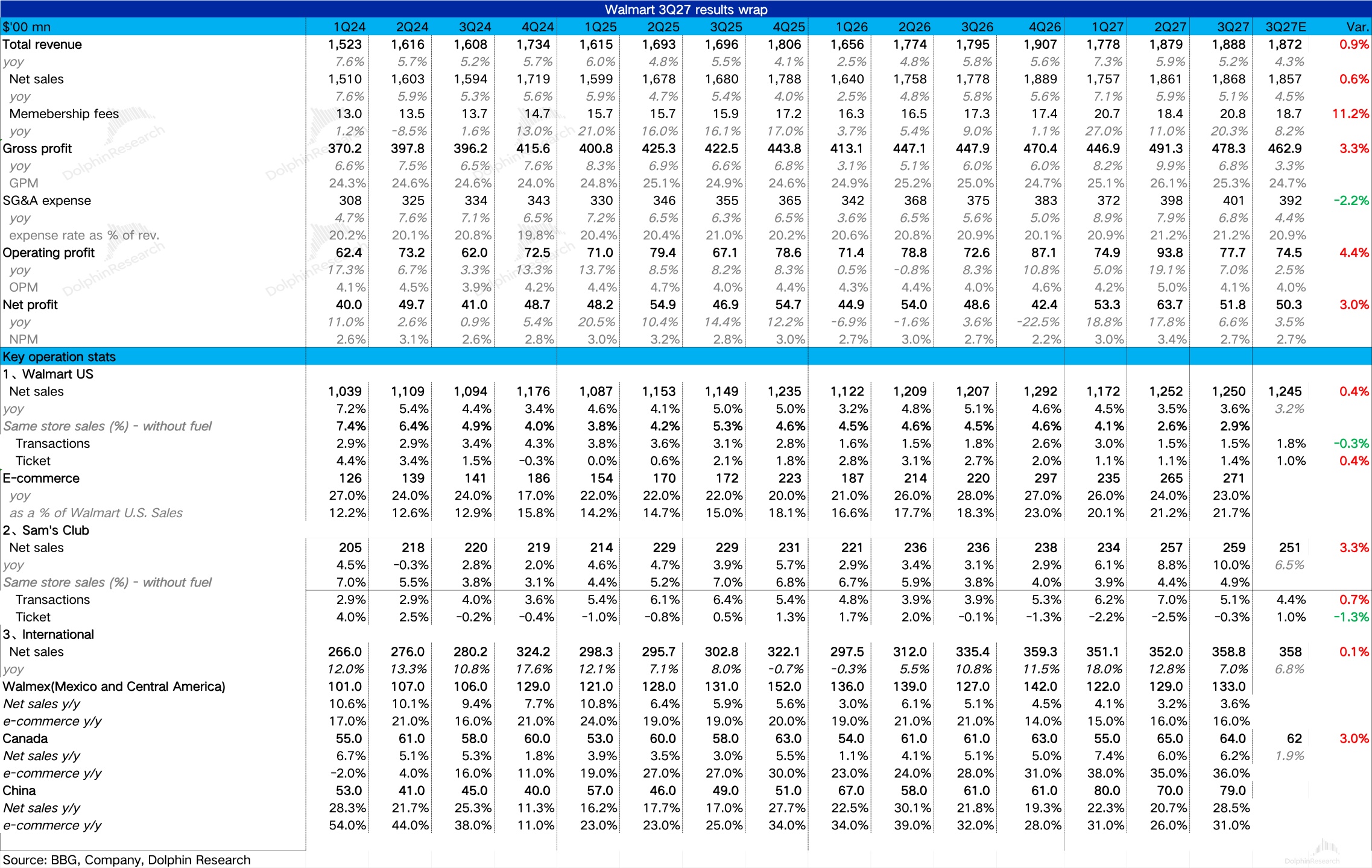
6. Key financial snapshot:
Walmart earnings call transcript: 'Walmart (Trans): Raises FY guidance again; e-comm ex-ads near breakeven'
Dolphin Research’s overall take:
This is the first scorecard since the one-off tariff rebate in Q2 was reinvested into price cuts, so the comp print itself matters less; the key is whether traffic improved. It did not perform well.
Since Jul, Walmart lifted the number of discounted items to as many as 12k, yet U.S. transactions rose 1.5% in Q3, unchanged vs. Q2. This suggests the latest round of price cuts mainly defended traffic rather than accelerating it.
The company also emphasized that share gains came mainly from higher-income households. Dolphin Research sees two implications: Walmart’s appeal to middle/high-income consumers continues to strengthen; lower-income shoppers remain under pressure from high fuel and prices, and discounts alone are not driving more frequent trips.
Two risks bear watching: global inventories rose 8.1% YoY, outpacing revenue, which management attributed to strategic buys and seasonal timing; but if Q4 demand undershoots, there could be pricing pressure to clear inventory. Also, capex rose by $4bn YoY in the first three quarters, FCF fell by $2bn YoY, and Walmart issued $6.5bn in long-term debt in Q3, signaling a 'heavy investment' phase.
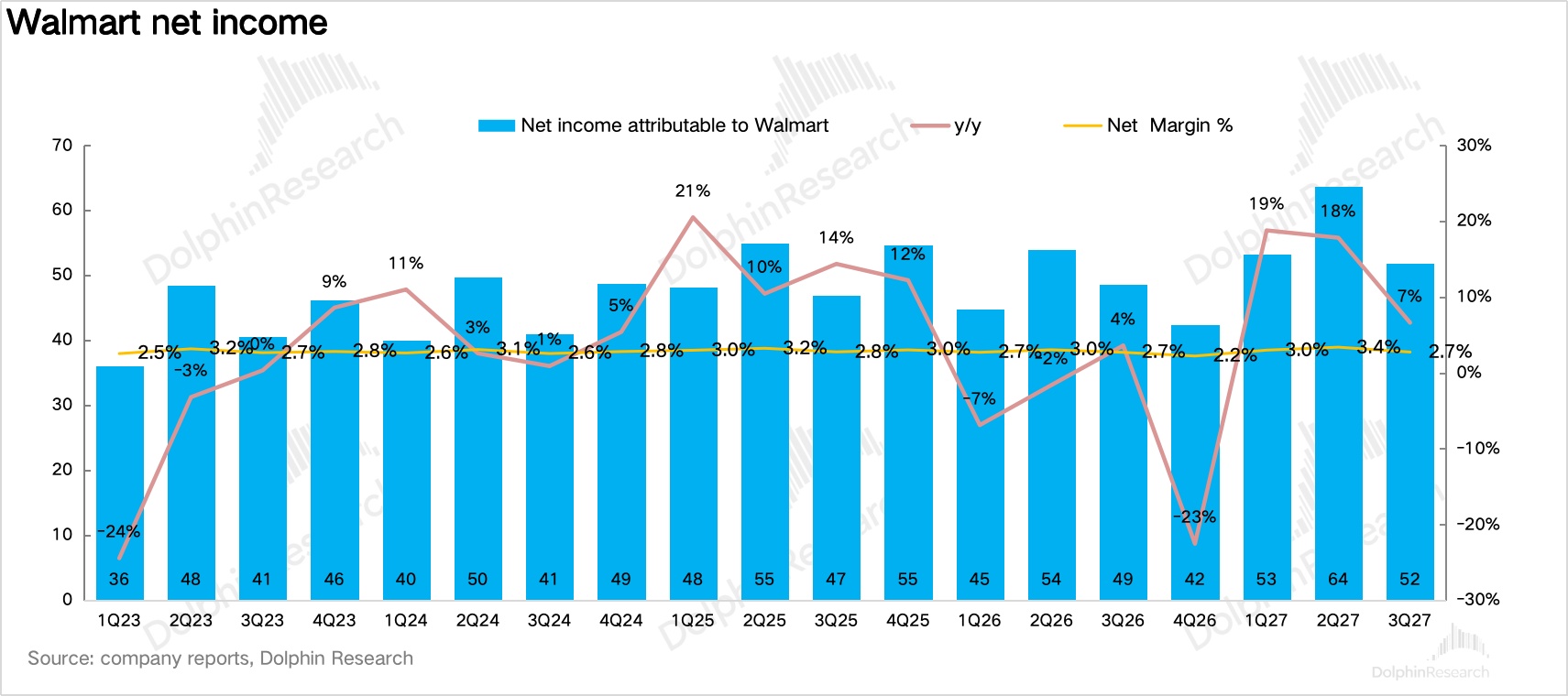
Valuation: Based on the raised full-year guide, FY27 adj. net income to shareholders is about $22.8bn (range: $22.6bn-$23.0bn). Assuming FY28 profit growth slows to about 7% as tariff rebates roll off and bundled membership allocations persist, adj. net income would be about $24.4bn, implying roughly 41x.
Under the medium-term framework of 'sales +4%-5%, OP +~8%', the current multiple is already high vs. profit growth, and sits at the upper end even among high-quality consumer names.
While Q3 again supports Walmart’s long-term platform thesis, the quality of the profit beat was mixed, traffic didn’t accelerate, and Q4 implied profit looks soft. Dolphin Research believes it will be hard for the multiple to expand further near term. As such, it prefers to wait for the FY28 P/E to fall below 35x, implying a market cap of about $854bn (stock price around $107) before adding.
Below is the detailed breakdown:
I. Investment framework
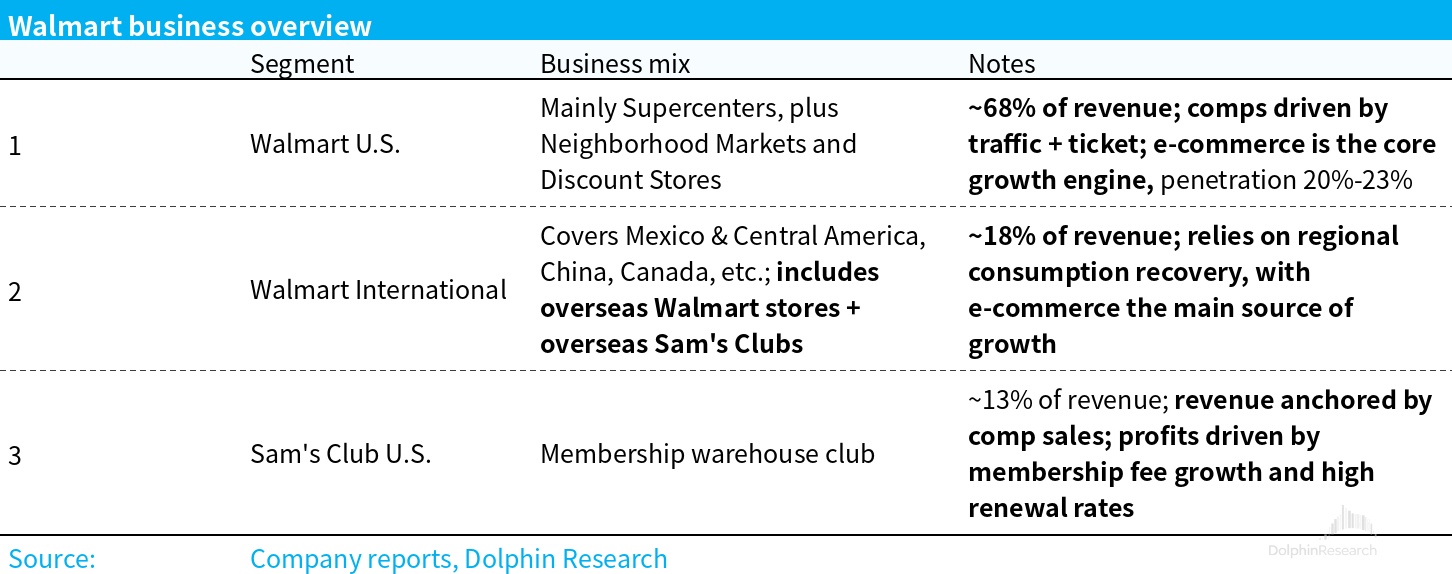
Per company disclosures, revenue growth can be decomposed into three segments: Walmart U.S., Walmart International, and Sam’s Club U.S.; each segment’s growth can be further broken into comps (volume × price), net new stores, and e-commerce.
(1) Walmart U.S. is the core base, with FY26 revenue of about $483bn, or ~68% of total.
The format is led by Supercenters, complemented by Neighborhood Markets and Discount Stores.
Comps can be further decomposed into transactions and avg. ticket.
E-commerce is the key growth engine, now at about 20%-23% of segment revenue.
Within e-commerce: 1P sales, 3P Marketplace, Walmart Connect (retail media), and Walmart+ (paid membership). Ads and memberships are the core profit engines.
(2) Walmart International covers Mexico & Central America (Walmex), China, and Canada, including both Walmart stores and overseas Sam’s Clubs, with FY26 revenue of about $130bn, or ~18% of total.
E-commerce penetration varies: China is above 50% (largely via Sam’s online); India’s Flipkart is a leading platform under Walmart control, operating independently, not yet profitable but narrowing losses. Walmex’s e-commerce penetration is about 8%-9%, replicating the U.S. ads + Marketplace model in an early high-growth phase.
(3) Sam’s Club U.S. is a membership-based warehouse club, with FY26 revenue of about $93bn, ~13% of total. The top line relies on steady comps from stores, while profitability leverages member fee growth and high renewal rates, and digital features like Scan & Go and Club Pickup raise e-commerce penetration. Versus Costco, Sam’s is more aggressive on pricing, but still trails in curation and in-club service experience.
II. Walmart U.S.: share gains led by higher-income households
2.1 Comps: traffic flattish, avg. ticket recovering
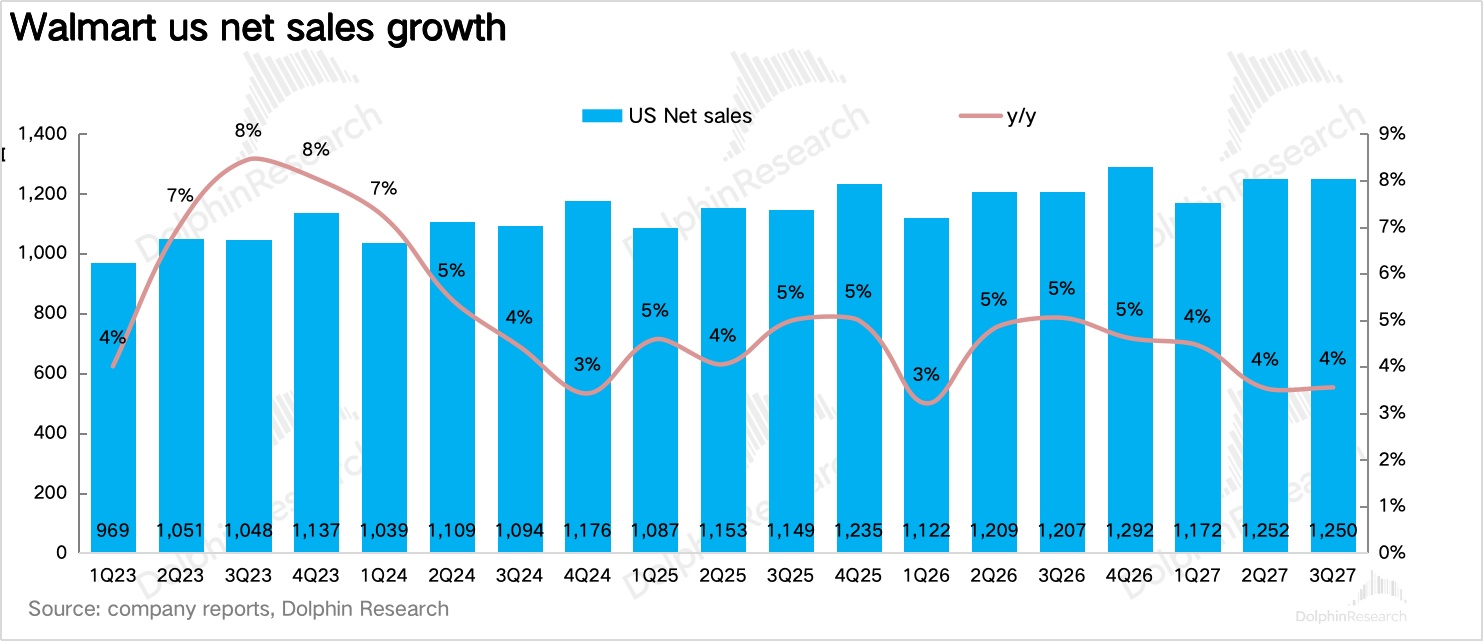
Net sales were $125.0bn, up 3.6% YoY; ex-fuel comps rose 2.9%, with transactions up 1.5% and avg. ticket up 1.4%. Category inflation averaged 1.2%.
By category: Grocery delivered mid-single digit growth with share and unit gains, with like-for-like inflation at 1.4%, and egg deflation a ~40bps drag. Health & wellness declined low-single digits; while scripts grew mid-single digits with share gains, the 'Maximum Fair Price' (MFP) policy drove steep Rx price cuts, an ~800bps drag on sales.
GM grew low-single digits, with toys and auto care stronger; private label mix rose 30bps. Like-for-like inflation was 0.3%, ~140bps lower than Q2.
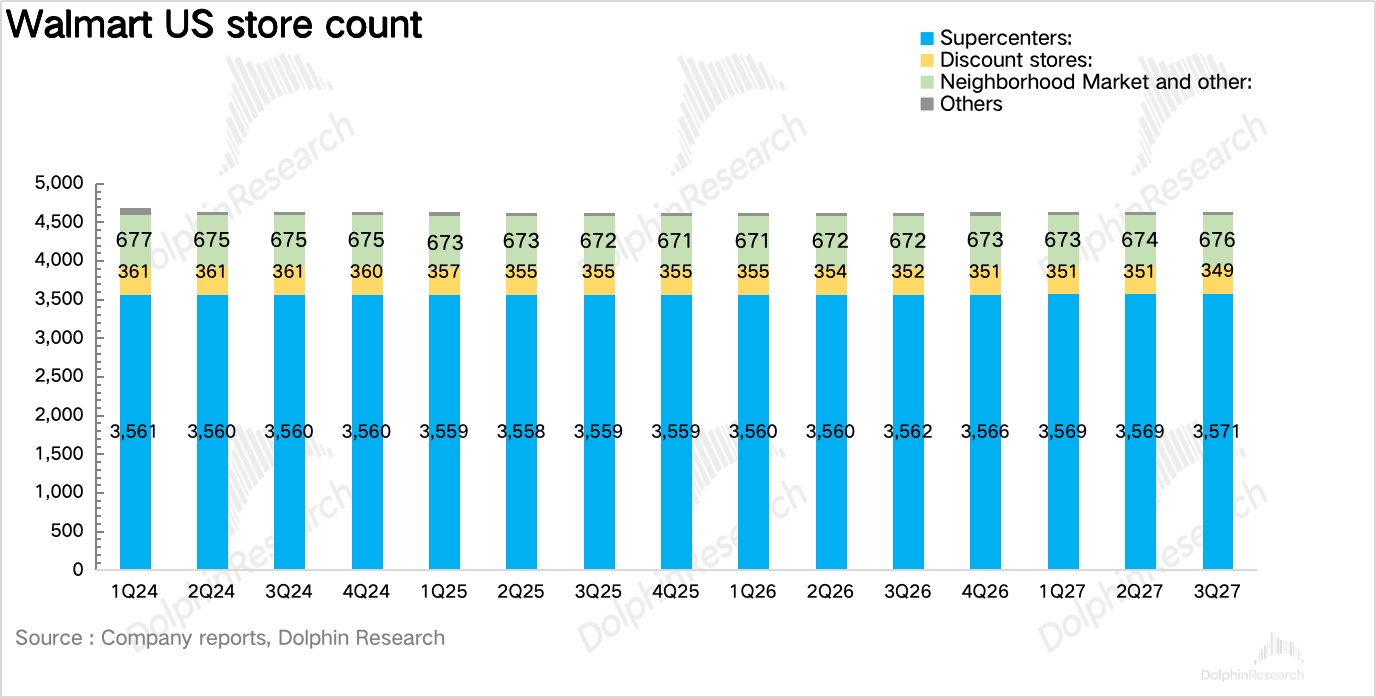
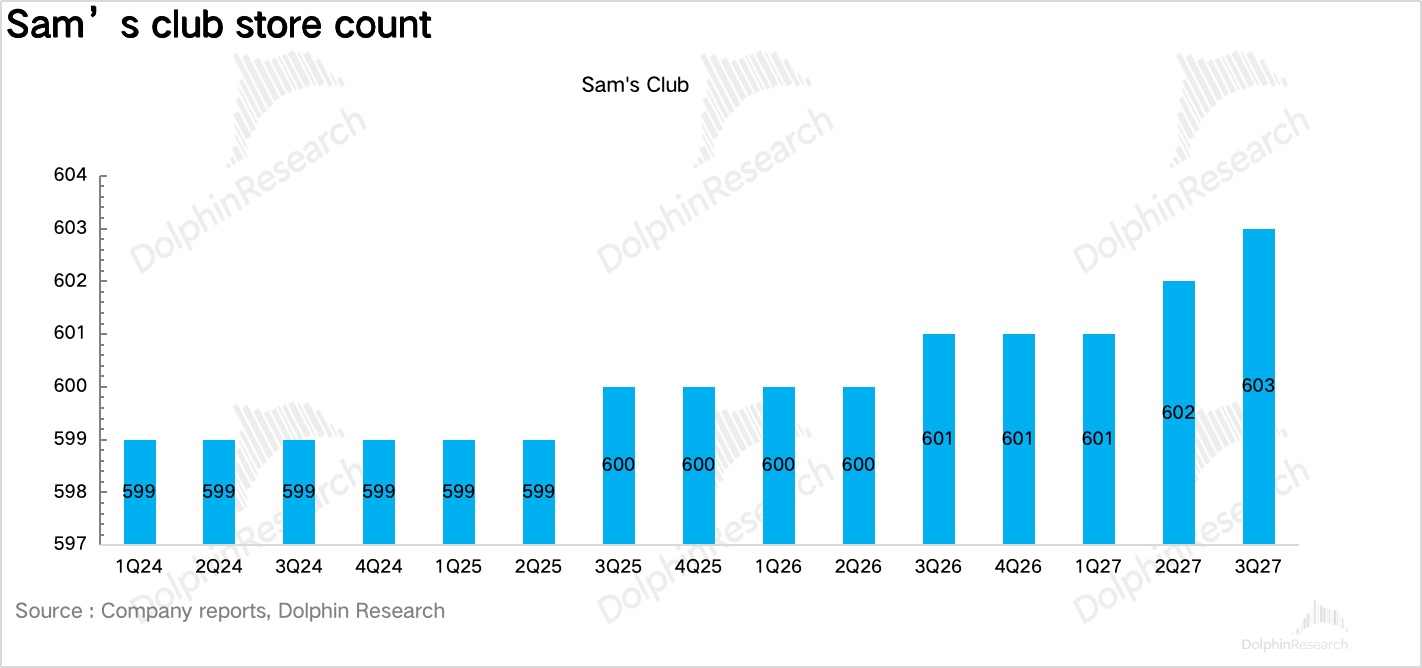
On stores, 2 Neighborhood Markets were opened this quarter; YTD, 3 Supercenters and 3 Neighborhood Markets were added, and about 475 remodels were completed.
2.2 E-commerce and high-margin businesses
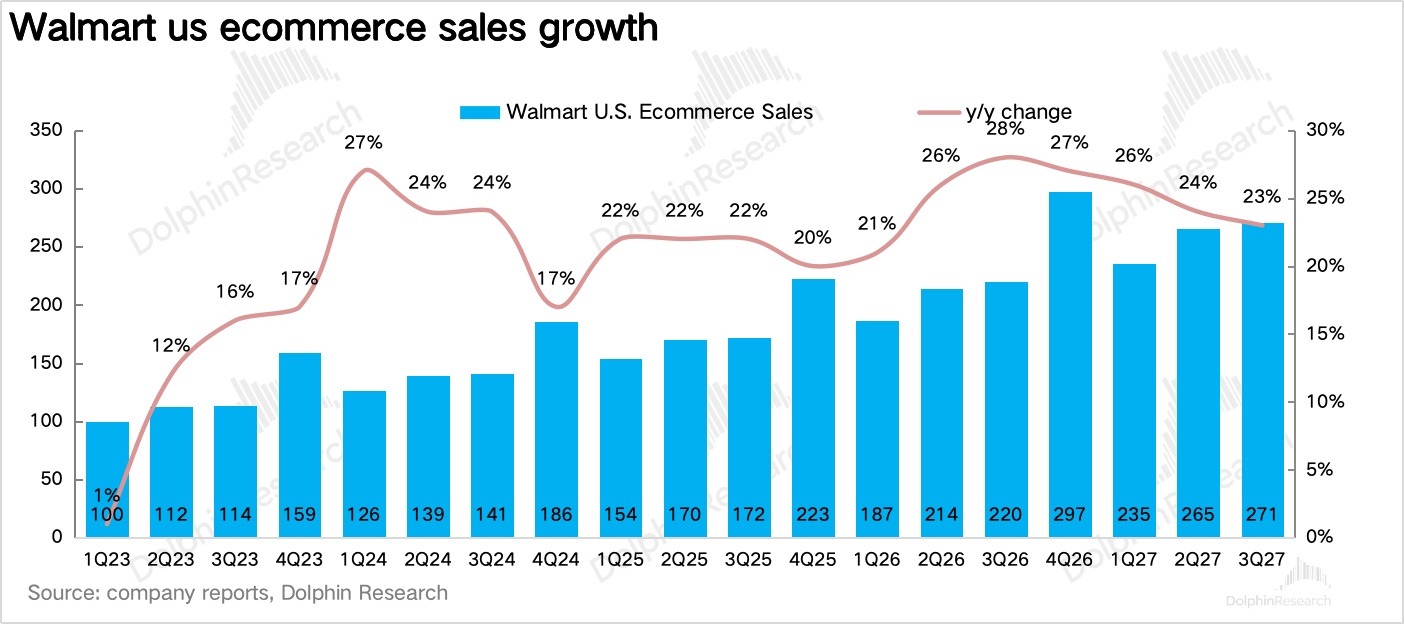
Walmart U.S. e-commerce grew 23%, contributing about 530bps to comps, marking the 11th straight quarter above 20%.
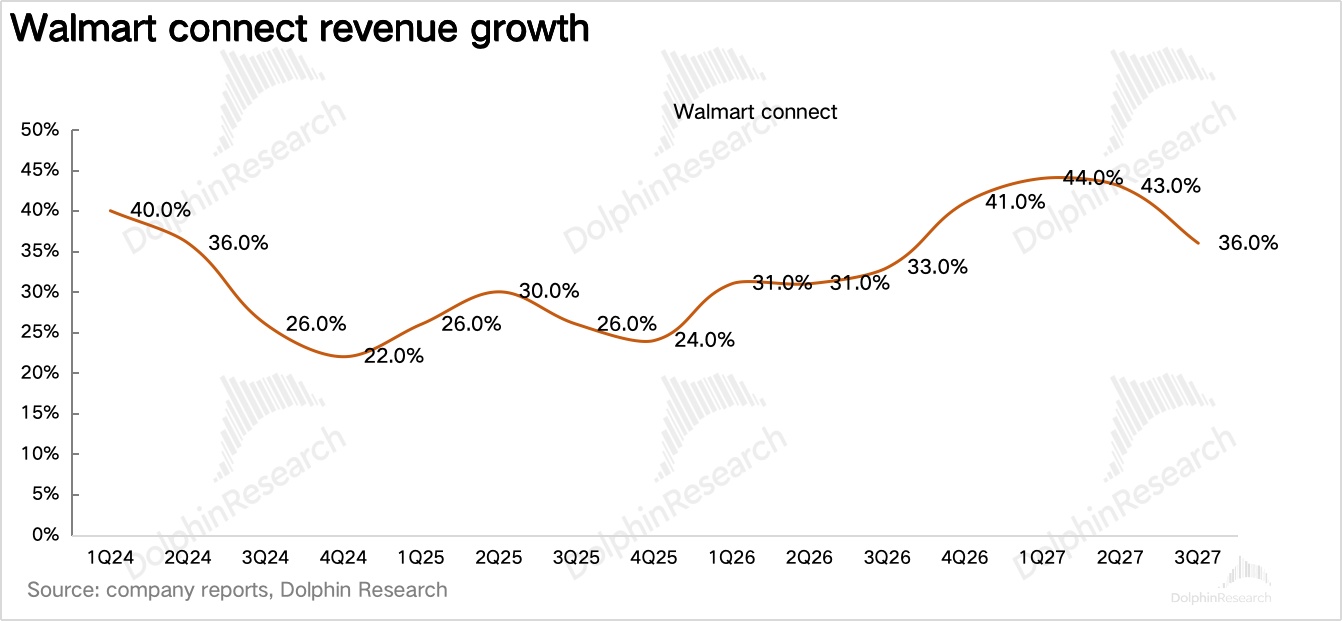
By component, store-fulfilled delivery grew 40%+, and orders delivered within 3 hours now exceed 37% of store-fulfilled orders. Ads rose 37%, with Walmart Connect up 36% ex-VIZIO and Vibe. Marketplace rose 49%, with strength in furniture, hardware tools, and toys.
On memberships, U.S. membership and other income rose 43%, driven by the new bundled Walmart+ & Sam’s Plus at $120 per year.
2.3 Profit: GPM gains offset higher opex ratio
Walmart U.S. GPM expanded 50bps YoY to 28.1%, led by richer mix from retail media and category mix gains from Rx price cuts. The opex ratio rose 45bps to 23.8%, driven by higher depreciation from capex and higher self-insurance claims.
OP was $6.3bn, up 9.0% YoY, with OPM up 25bps to 5.1%. Inventory rose 5.2% YoY, driven by strategic buys and cost inflation.
III. Sam’s Club: revenue accelerating, profits under pressure
Sam’s delivered the fastest comps among the three segments this quarter, ex-fuel, with further acceleration vs. Q2, mostly transaction-led. Unlike H1, avg. ticket declines narrowed sharply and were essentially flat.
Dolphin Research believes this shows improving quality of growth: in H1, traffic relied heavily on fuel stations amid high gas prices, and avg. ticket fell as low-price grocery mix rose; in Q3, fuel prices eased, yet traffic stayed strong and avg. ticket stabilized, implying more trips for shopping itself rather than fuel detours.
E-commerce and younger members are the two key drivers, with club-fulfilled delivery growing triple digits. Sam’s now covers 65% of U.S. households with under-3-hour delivery, with over a quarter of fast deliveries arriving within 1 hour.
On member mix, Gen Z and Millennials accounted for more than half of new members, and over half opted for Plus. Dolphin Research views this as critical: younger cohorts have longer lifecycles and higher adoption of digital services such as delivery, a key differentiator vs. Costco.
IV. Walmart International: China accelerates; Mexico and Canada remain in investment mode
International net sales were $35.9bn, up 7.0% YoY, or 3.3% at constant FX. The slowdown mainly reflects Flipkart’s BBD moving from Q3 to Q4, a ~500bps drag, with international e-commerce and ads down YoY as a result.
Ex this timing shift, a common pattern emerged: club formats are outperforming across markets.
China: accelerating against the tide, with Sam’s as the core driver. Growth and comps both accelerated vs. Q2, a standout given a soft domestic consumption backdrop.
We see two drivers: Sam’s membership model has an edge amid consumption divergence, as middle-class demand for 'quality and certainty' has not shrunk and is consolidating into leading channels. Second, Walmart stores have also picked up the pace, suggesting Sam’s supply chain and rapid delivery capabilities are spilling over to hypermarkets.
On profits, private label mix gains and category mix improvements lifted GPM; China and India were the main profit contributors for International.
Mexico (Walmex): comps weakening; growth leaning on openings and Sam’s. Comps slowed further vs. Q2, with growth led by Sam’s while Walmart formats remained under pressure. Meanwhile, Walmex opened nearly 200 stores over the past 12 months, keeping a brisk opening pace.
Dolphin Research believes this implies Mexico is relying more on 'new stores' than 'comps'. In a weaker purchasing-power environment, continuing rapid openings risks cannibalizing legacy stores, and with ongoing wage and price investments, profits have started to decline.
Canada: trading profit for penetration; Walmart+ off to a good start. Growth was steady, with e-commerce still above 30% YoY, and the newly launched Walmart+ beating management expectations. To gain share, Walmart invested in both pricing and wages, pressuring GPM and OP.
Dolphin Research maintains: Canada is in the early stage of replicating the U.S. 'e-commerce + membership' flywheel; near-term profit pressure is a deliberate choice, and the key is whether Walmart+ can scale within one to two years to pull through high-margin ads.
V. High-margin businesses 'backstop' profits, but opex pressure is rising
Q3 GPM expanded 28bps YoY to 24.5%, driven by three factors: higher mix of high-margin businesses such as retail media in Walmart U.S.; lower Rx prices compressing low-margin drug revenue and improving category mix; and the Flipkart promo timing shift moving low-margin event sales into Q4.
Partly offset by lower fuel margins at Sam’s. By segment, Walmart U.S. GPM rose 50bps, the only clear improver, while Sam’s fell 110bps due to fulfillment costs and price investments.
On opex, higher depreciation from capex and rising self-insurance claims lifted the adj. opex ratio by 34bps YoY to 21.5%, the third straight quarter of YoY increase.
The rising opex ratio reflects heavier investment in automation, remodels, and fulfillment networks, with capex up $4bn YoY in the first three quarters. These investments should enhance efficiency long term, but will weigh on profits until depreciation headwinds subside.
Adj. OP at constant FX rose 5.5% YoY, ahead of constant-FX net sales growth of 4.4%, and above the company’s prior +2%-4% guidance range.
<End of text>
Dolphin Research’s prior Walmart coverage:
Earnings analysis:
Aug 21, 2026: ‘Walmart: Solid results, valuation is the culprit’
May 22, 2026: Walmart: With fuel prices surging, can the retail king hold the line?
Deep dive:
Apr 21, 2026: Walmart: What forged the 'trillion-dollar retail icon'?
Risk disclosure and statement: Dolphin Research disclaimer and general disclosure
The copyright of this article belongs to the original author/organization.
The views expressed herein are solely those of the author and do not reflect the stance of the platform. The content is intended for investment reference purposes only and shall not be considered as investment advice. Please contact us if you have any questions or suggestions regarding the content services provided by the platform.