Guide to IPO ETFs: Diversified Access to New Listings
IPO ETFs offer diversified exposure to newly listed companies through a single trade. Discover how they work, their benefits, risks, and how to access them.
TL;DR: An Initial Public Offering Exchange-Traded Fund (IPO ETF) is a fund that holds shares of recently listed companies, giving investors diversified exposure to new market entrants with a single trade. Rather than selecting individual IPOs, investors can spread their risk across a basket of newly public companies. Like all investments, IPO ETFs carry risks — including higher volatility — and are best understood before committing capital.
Initial public offerings (IPOs) attract significant investor attention, but picking individual IPO stocks requires substantial research, timing judgement, and tolerance for sharp price swings. For investors seeking exposure to newly listed companies without concentrating risk on a single name, IPO exchange-traded funds (ETFs) offer a structured alternative. This guide explains what IPO ETFs are, how they work, what risks to consider, and how to access them through a regulated platform.
What Is an IPO ETF?
An exchange-traded fund (ETF) is a type of investment fund that holds a collection of assets — such as stocks, bonds, or commodities — and trades on a stock exchange like an ordinary share. Investors can buy and sell ETF units throughout the trading day at market prices.
An IPO ETF is a specific category of ETF designed to hold shares of companies that have recently completed their initial public offerings. Rather than investing in an established index such as the S&P 500, an IPO ETF focuses on new market entrants, typically companies listed within the past one to three years.
By pooling exposure to dozens of newly public companies, an IPO ETF provides portfolio diversification within the IPO segment. Investors gain access to a broad cross-section of recent listings through a single transaction, rather than having to evaluate and buy each IPO individually. You can explore the full range of ETF products available to investors on the Longbridge products overview page.
What Counts as an "IPO" for These Funds?
Most IPO ETFs use a rolling time window — typically two to three years from listing date — to define eligibility. Once a company "ages out" of this window, it is removed at the next rebalancing. This means the fund continuously refreshes to reflect the latest wave of public listings, rather than holding companies that have long since become established market participants.
How IPO ETFs Work
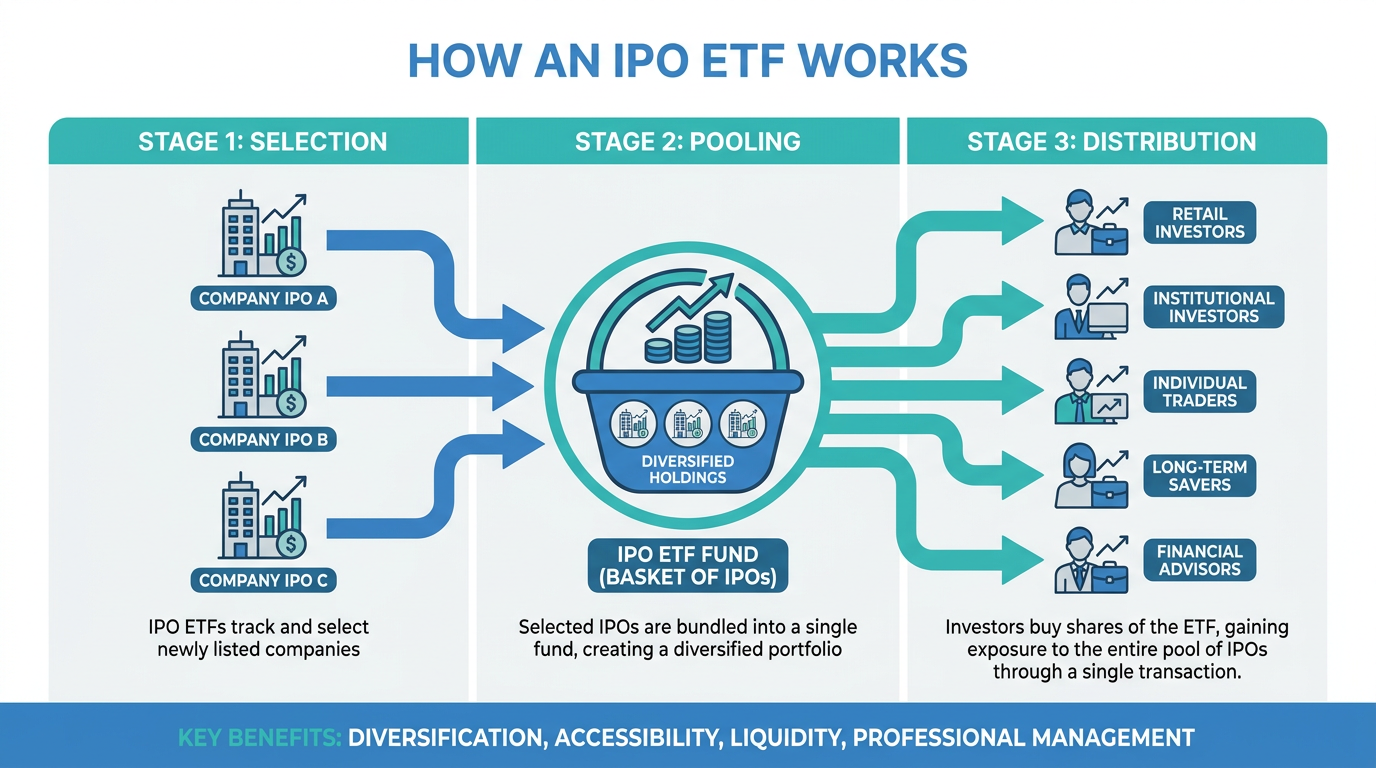
Index Tracking and Portfolio Construction
Most IPO ETFs follow a rules-based index, with the index provider setting clear criteria — such as minimum market capitalisation, minimum trading volume, and listing recency — that determine which companies qualify for inclusion.
For example, some IPO ETFs track an index comprising larger and more frequently traded recently listed companies. Holdings may be weighted by float-adjusted market capitalisation, with a cap on the proportion any single holding can represent at the time of rebalancing, which helps limit concentration risk.
Quarterly Rebalancing
IPO ETFs typically rebalance on a quarterly schedule. The fund provider — not individual investors — adds newly qualified companies, removes those that have aged beyond the eligibility window, and adjusts existing weightings. From an investor's perspective, the portfolio refreshes automatically to stay focused on current listings.
Most IPO ETFs are passively managed, replicating a rules-based index at lower cost. A smaller number are actively managed, where a fund manager selects holdings based on qualitative judgement; these tend to carry higher fees.
Key Features of IPO ETFs
Diversification Across New Listings
One of the central features of an IPO ETF is the spread of risk across multiple companies. Individual IPOs are inherently unpredictable — a company that generates significant pre-listing excitement, often visible in grey market price indicators, may underperform once trading begins, while a less high-profile listing may outperform over time. Holding a basket of recently listed companies means that no single stock's performance dominates the overall portfolio.
Exchange-Traded Accessibility and Transparency
Because IPO ETFs trade on stock exchanges, they offer the same liquidity as ordinary shares. Investors can buy or sell units at any point during market hours, responding to developments in real time. Index-based IPO ETFs also publish their holdings regularly, allowing investors to see exactly which companies are held and at what weight — supporting more informed portfolio decisions.
Risks and Considerations

Investing in IPO ETFs carries specific risks that investors should understand fully before committing capital.
Higher Volatility
Newly listed companies typically lack the extended public trading history of established stocks. Their share prices can move sharply in response to early earnings reports, analyst initiations, or the expiry of insider lock-up periods (the point at which early investors and company insiders become permitted to sell their shares). As a result, IPO ETFs tend to be more volatile than broad-market index funds.
Note: Volatility in an IPO ETF reflects the combined price movements of all its holdings. While diversification reduces the impact of any single stock's decline, the overall fund can still experience significant drawdowns during periods of broad market weakness or when the IPO market itself loses momentum.
Sector Concentration
IPO activity tends to cluster in certain sectors at different points in the economic cycle. During technology-driven markets, an IPO ETF may carry a substantial proportion in a single sector. Investors should review the fund's sector breakdown to assess whether this creates unintended concentration in their broader portfolio.
Performance Variability
IPO ETF performance can vary considerably from year to year and does not consistently track broader market benchmarks. Returns from IPO-focused funds have at times trailed broad-market indices over multi-year periods, while individual years have seen both outperformance and underperformance. Past performance does not indicate future results.
Fees
IPO ETFs typically carry higher expense ratios than broad-market index ETFs, reflecting the more specialised nature of the strategy. Investors should review a fund's total expense ratio before investing, as recurring fees reduce net returns over time.
Lock-Up Expiry Risk
When companies list publicly, early shareholders are typically restricted from selling for a set period — commonly six months. When this lock-up expires, additional shares enter the market and can place downward pressure on the stock price. IPO ETFs holding these stocks may be affected.
Notable IPO ETF Examples
Several IPO ETFs are listed on US exchanges and accessible to international investors through regulated brokerage platforms. The following examples are provided for educational context only and do not constitute a recommendation.
Renaissance IPO ETF (IPO): Tracks the Renaissance IPO Index, focusing on larger and more frequently traded recent US listings. It rebalances quarterly and holds companies for approximately three years post-IPO.
Renaissance International IPO ETF (IPOS): Applies a similar methodology to IPOs outside the United States, offering exposure across developed and emerging international markets.
First Trust US Equity Opportunities ETF (FPX): Targets large US IPOs and spin-offs, holding them for up to approximately 1,000 days to capture the post-listing growth phase.
How to Access IPO ETFs Through a Brokerage
Accessing IPO ETFs follows the same steps as buying any exchange-traded security on a regulated platform.
Step 1 — Open a brokerage account: To trade US-listed ETFs, investors need an account with a regulated brokerage offering US market access. Longbridge is licensed by the Monetary Authority of Singapore (MAS) and provides access to US ETFs. Account opening is available via MyInfo/SingPass for eligible Singapore residents.
Step 2 — Fund your account: Transfer funds in the relevant currency once your account is active. Confirm available deposit methods and processing times with your platform.
Step 3 — Search for the ETF: Locate the fund by its ticker symbol. Review holdings, sector breakdown, and the expense ratio before proceeding. A stock screener can help filter and compare investment instruments.
Step 4 — Place your order: Choose a market order (executes at the current price) or a limit order (executes only at or below a price you set). Limit orders are worth considering for volatile instruments.
Tip: For instruments that can be volatile — such as IPO ETFs — limit orders can help avoid buying at an unexpectedly high price during rapid price movements.
Step 5 — Monitor your position: Review your holding periodically as the fund rebalances quarterly.
Frequently Asked Questions
What is the difference between an IPO ETF and buying a single IPO stock?
When you invest directly in an IPO — a process that, in Singapore, involves balloting and share allotment — you take on the full risk and potential return of one company. An IPO ETF holds shares across many recently listed companies simultaneously, so the performance of any single stock has a more limited effect on your overall position.
Do IPO ETFs buy shares at the listing price?
Generally, no. Most IPO ETFs purchase shares in the secondary market after trading has begun on the stock exchange, rather than participating in the initial offering itself. This means they avoid some first-day volatility but also do not capture price movements that occur on listing day.
Are IPO ETFs suitable for all investors?
IPO ETFs carry higher risk than broad-market index funds. Some investors use them as a satellite component within a diversified portfolio. They are not generally considered conservative or capital-preservation investments, and investors should assess their own risk tolerance before proceeding.
Can Singapore-based investors access US-listed IPO ETFs?
Yes, through MAS-licensed brokerage platforms that provide US market access. Longbridge is an MAS-licensed platform offering US ETF access for eligible account holders.
What fees apply to IPO ETFs?
IPO ETFs charge an expense ratio — an annual fee expressed as a percentage of assets, deducted from the fund's returns. Brokerage trading commissions may also apply. Review applicable fees on the Longbridge pricing page before trading.
Conclusion
IPO ETFs provide a structured way to gain diversified exposure to newly listed companies without concentrating risk on individual stocks. By holding a rolling basket of recent listings, the fund refreshes continuously as new companies enter the public market. However, higher volatility, sector concentration, fees, and performance variability are meaningful risks that investors must weigh against their own financial situation and objectives.
A thorough understanding of how the instrument works — from index construction and quarterly rebalancing to lock-up expiry risk — is essential before committing capital.
The choice of financial instruments depends on your investment objectives, risk tolerance, market outlook, and experience level. Regardless of the method selected, it is essential to fully understand its mechanics, risk characteristics, and execution rules, while maintaining a robust risk management plan. You can learn more about investment strategies through the Longbridge Academy or by downloading the Longbridge App.