Initial Public Offering: A Complete IPO Basics Guide
An initial public offering (IPO) marks a company's transition from private to public ownership. This guide explains the process, risks, and how to invest.
TL;DR: An initial public offering (IPO) is when a private company sells its shares to the public for the first time, transitioning to a publicly traded company. This guide covers how the IPO process works, what investors should know, and how to participate in IPOs in Singapore.
When a company decides to go public through an initial public offering, it is making a significant decision in its growth journey. For investors, an IPO can represent an opportunity to invest in a company at an early stage of its public life. Understanding how the process works is essential before participating in any listing.
This guide covers the fundamentals of IPOs: what they are, why companies pursue them, how the process unfolds from preparation to trading, and what retail investors in Singapore should know before applying for IPO shares.
What Is an Initial Public Offering?
An initial public offering (IPO) is the process by which a privately held company first offers its shares to the general public on a stock exchange. Before an IPO, a company's ownership typically rests with its founders, employees, and a small group of private investors such as venture capital or private equity firms.
When the company goes public, it lists its shares on an exchange, such as the Singapore Exchange (SGX), the New York Stock Exchange (NYSE), or NASDAQ. From that point onwards, any member of the public can buy or sell those shares through a brokerage account.
The transition from private to public ownership is commonly referred to as "floating" or "going public". It marks a significant milestone in a company's development, bringing new capital, greater visibility, and increased regulatory obligations.
Why Do Companies Go Public?
Companies pursue an IPO for several reasons, and it is rarely about one factor alone:
- Raising capital: Proceeds from an IPO can fund research and development, business expansion, debt repayment, or acquisitions.
- Providing liquidity: Early investors, founders, and employees who hold shares in the private company may sell some of their stake through the IPO, converting illiquid holdings into tradeable shares.
- Enhancing credibility: A public listing raises a company's profile with customers, partners, and potential employees.
- Attracting talent: Public companies can offer stock options or share-based compensation as part of employee packages.
Going public also introduces significant obligations, including regular financial disclosures, shareholder meetings, and compliance with exchange and regulatory requirements.
The IPO Process: From Private to Public
The IPO process is structured and can take anywhere from several months to over a year to complete. Each stage plays a specific role in ensuring the offering is fairly priced and properly regulated.
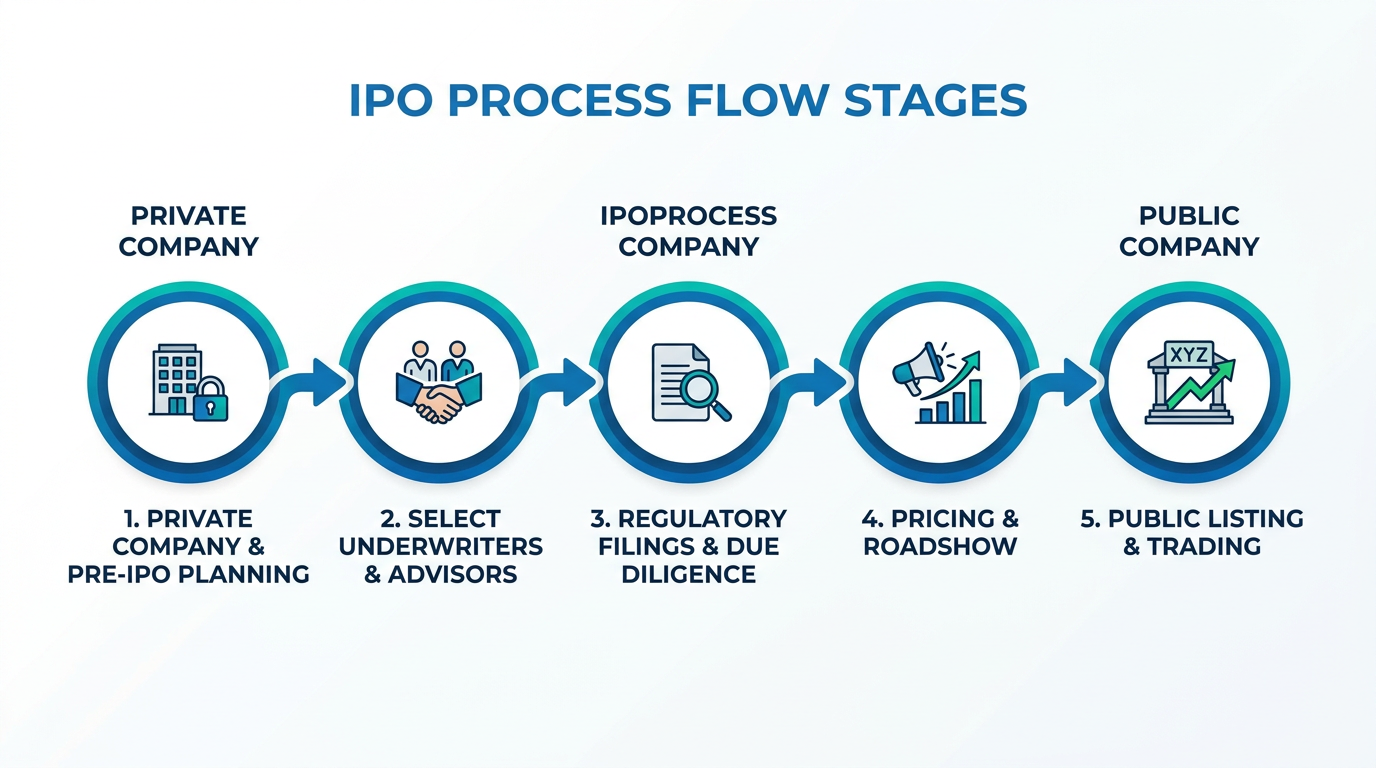
Stage 1: Selecting an Underwriter
The company engages one or more investment banks, known as underwriters, to manage the IPO. The underwriter advises on the offering structure, conducts due diligence, helps set the share price, and distributes shares to investors. Under a firm commitment arrangement, the underwriter purchases all offered shares and resells them to the public. Under a best efforts arrangement, the underwriter sells as many shares as possible without guaranteeing the full amount.
Stage 2: Regulatory Filing and Due Diligence
The company prepares a registration statement and a prospectus for submission to the relevant regulator. In Singapore, companies listing on the SGX must comply with requirements set by the Monetary Authority of Singapore (MAS) and SGX listing rules. The prospectus outlines the company's business model, financial history, management team, use of proceeds, and risk factors. Investors should read it carefully before applying.
Stage 3: The Roadshow
Company management and underwriters conduct a roadshow, presenting to institutional investors such as fund managers and insurance companies. The roadshow gauges demand and informs the final share price.
Stage 4: Pricing and Listing
Based on roadshow demand, underwriters and the company determine the final IPO price. Shares begin trading on the exchange the following business day. The opening market price may be higher or lower than the IPO price, depending on supply and demand. There is no guarantee that a stock will trade above its IPO price after listing.
Tip: Always read the prospectus before participating in an IPO. It contains important information about the company's financial condition, business strategy, and the risks involved.
Understanding IPO Share Allocation
Not everyone who applies for IPO shares will receive them. When demand for an IPO exceeds the number of available shares, the offering is said to be oversubscribed. In such cases, shares are allocated through a ballot process.
In Singapore, retail investors typically apply for IPO shares through the public tranche, which is separate from the institutional tranche. The allocation method depends on whether the offering is oversubscribed or undersubscribed.
For a detailed explanation of how the allocation process works in Singapore, including how balloting scores are calculated and what oversubscription means for retail applicants, you can refer to the guide on IPO allotment and how shares are allocated in Singapore.
The Lock-Up Period
Following an IPO, insiders such as company founders, executives, and pre-IPO investors are typically subject to a lock-up period, usually ranging from 90 to 180 days, during which they cannot sell their shares on the open market. Once this period ends, a release of shares may affect the stock price as additional supply enters the market.
How to Participate in an IPO in Singapore
For retail investors in Singapore, participating in an IPO on the SGX requires four key steps:
-
Open a Central Depository (CDP) account: This account holds your securities. Applications can be submitted via SingPass and MyInfo, and processing typically takes several business days.
-
Maintain a linked local bank account: Required to fund your IPO application.
-
Apply during the public offer period: Submit applications via internet banking or an automated teller machine (ATM) before the closing date, typically by 12pm. Each CDP account may submit only one application.
-
Check results: Successful applicants have shares credited to their CDP account, which can then be sold through any linked brokerage.
For investors looking for a platform that provides comprehensive market access alongside tools to analyse listings and track market data, the Longbridge platform supports trading across Singapore, US, and Hong Kong markets, offering access to diverse investment products including stocks, exchange-traded funds (ETFs), and real estate investment trusts (REITs).
The Grey Market: Pre-Listing Price Signals
Before an IPO begins trading officially, there is often activity in what is known as the grey market, where conditional trades are executed based on expectations of the listing price. Grey market prices can indicate early investor sentiment, though they do not guarantee actual trading prices. For a closer look at how this works, see the guide on the IPO grey market and pre-listing price indicators.
Risks and Considerations When Investing in IPOs

IPOs can offer investors early access to companies in their growth phase, but they also carry risks that are distinct from investing in established, long-listed companies.
Limited Financial History
IPO candidates often have a shorter track record of public financial reporting. Investors rely heavily on the prospectus, which represents the company's own disclosures and projections, with limited independent analysis available at listing.
Price Volatility
IPO shares can experience significant price swings in the days and weeks following listing. First-day price movements may not reflect long-term value. Some stocks trade below their IPO price after listing, while others may trade above it. Past IPO performance does not indicate future results.
Allocation Uncertainty and Lock-Up Risk
In a heavily oversubscribed IPO, retail investors may receive few or no shares despite their application. Additionally, when insider lock-up periods expire, additional shares entering the market may place downward pressure on the stock price.
A balanced approach involves reading the prospectus thoroughly, understanding the business model, and assessing how an investment fits within an overall strategy. Refer to our financial statements guide for tools to evaluate a company's financial health ahead of an IPO.
Tip: Never invest in an IPO based solely on its hype or a company's name recognition. Review the financials, risk factors, and use of proceeds outlined in the prospectus before committing capital.
Frequently Asked Questions
What is the difference between an IPO price and the opening market price?
The IPO price is the price at which shares are sold to investors in the initial offering, set by the company and underwriters based on demand from the roadshow. The opening market price is the price at which shares first trade on the exchange when the market opens, which is determined by supply and demand at that moment. These two prices may differ, sometimes significantly.
Can retail investors always participate in an IPO?
Not necessarily. Many IPOs allocate the majority of shares to institutional investors such as fund managers and pension funds. Retail investors typically access shares through a public tranche, which is a smaller portion of the total offering. In some cases, particularly for smaller or less prominent offerings, retail participation may be more limited.
How long does the IPO process take?
The IPO process typically takes between six months and over a year, depending on the complexity of the company, regulatory requirements in the target market, and market conditions. Preparation, regulatory filings, due diligence, and the roadshow all contribute to the timeline.
What is an IPO prospectus?
The prospectus is a legal document that a company is required to publish as part of the IPO process. It contains detailed information about the company's business, financial statements, management team, risk factors, and how it intends to use the capital raised. Regulators such as MAS in Singapore require companies to publish a prospectus before they can offer shares to the public.
Conclusion
An initial public offering marks a company's transition from private ownership to public markets. For investors, IPOs can represent opportunities to access growing companies, but they require careful evaluation. Understanding the mechanics, from underwriter selection and prospectus filing through to share allocation and post-listing behaviour, provides a solid foundation for making informed decisions. Before participating, it is prudent to read the prospectus, assess the business fundamentals, and consider how an investment aligns with individual financial goals and risk tolerance.
The choice of financial instruments depends on your investment objectives, risk tolerance, market outlook, and experience level. Regardless of the method selected, it is essential to fully understand its mechanics, risk characteristics, and execution rules, while maintaining a robust risk management plan. You can learn more about investment strategies through the Longbridge Academy or by downloading the Longbridge App.