What is the S&P 500 Index? A Complete Guide
The S&P 500 is a stock market index tracking 500 large US companies. Learn how it works, how companies qualify, and how investors gain exposure to it.
TL;DR: The S&P 500 is a stock market index that tracks 500 large, publicly listed companies in the United States. It is widely used as a benchmark for US stock market performance. Investors cannot buy the index directly, but can gain exposure through exchange-traded funds (ETFs) and index mutual funds.
If you have ever heard someone say "the market is up today," they were most likely referring to the S&P 500. Formally known as the Standard & Poor's 500 index, this benchmark tracks 500 of the largest publicly traded companies in the United States and is commonly used to gauge the health of the American economy. For investors in Singapore exploring US equities, understanding the S&P 500 — and practical details such as US market trading hours in Singapore time — is a foundational step. This guide explains what it is, how it works, what risks it carries, and how investors typically gain exposure to it.
What Is the S&P 500 Index?
The S&P 500 is a stock market index created and maintained by S&P Dow Jones Indices. It tracks the share performance of 500 large companies listed on US exchanges such as the New York Stock Exchange (NYSE) and the Nasdaq. It is widely cited as covering a substantial share of the total market capitalisation of US-listed companies.
The "S&P" stands for Standard & Poor's, which emerged when Poor's Publishing merged with the Standard Statistics Company in 1941. The index was expanded to its current 500-company format in 1957. Today, it serves as a reference point for fund managers, economists, and individual investors worldwide.
How Does the S&P 500 Compare to Other Indices?
The S&P 500 is often compared to two other major US benchmarks.
- The Dow Jones Industrial Average (DJIA) tracks only 30 large companies and uses price weighting, meaning stocks with higher share prices carry more influence. The S&P 500's broader scope makes it more representative of the overall US market.
- The Nasdaq 100 tracks 100 large non-financial companies on the Nasdaq exchange. It is more concentrated in technology and growth-oriented businesses, whereas the S&P 500 spans all major sectors.
How the S&P 500 Index Works
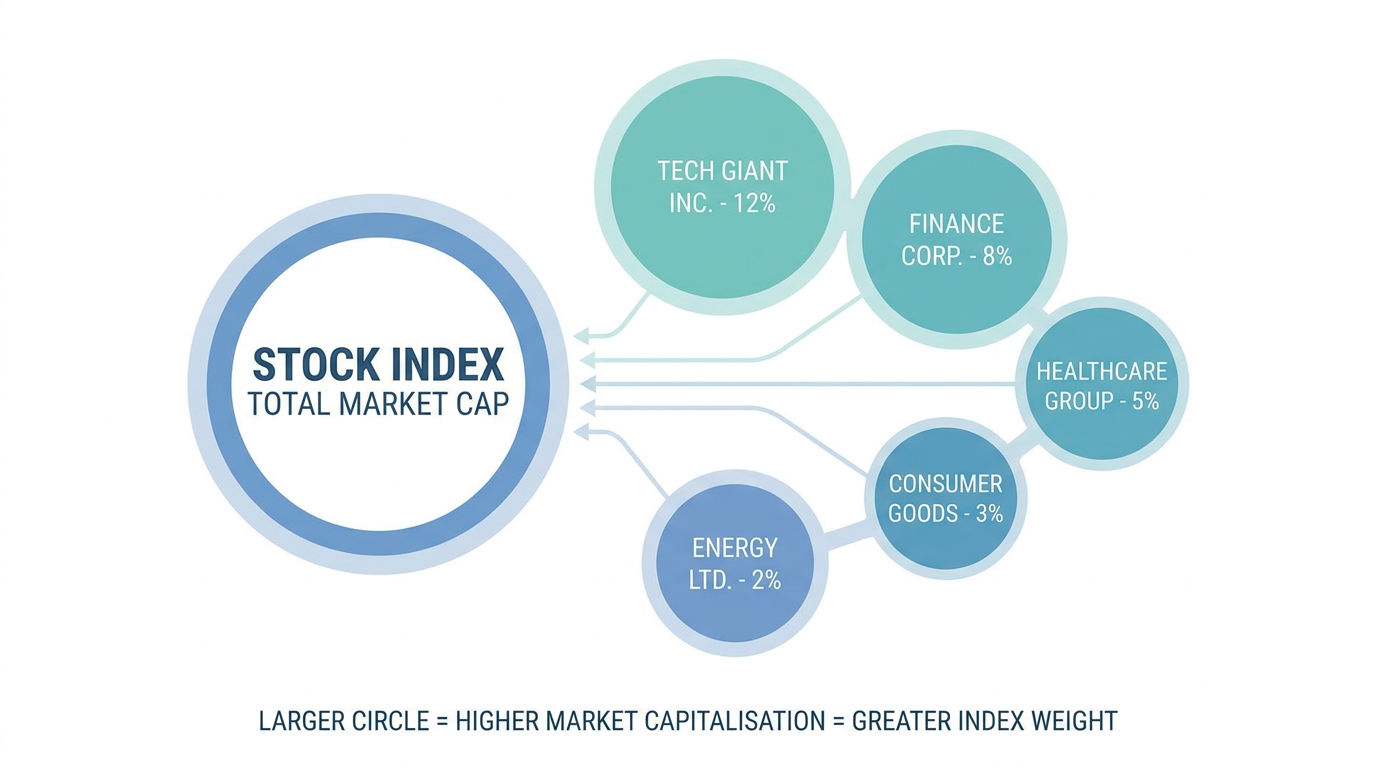
The S&P 500 uses market capitalisation weighting. Each company's influence on the index is proportional to its market cap, which is calculated by multiplying its current share price by the total number of shares outstanding.
For example (for illustration purposes only): if a company has a market cap of USD 2 trillion and the combined market cap of all 500 companies totals USD 40 trillion, that company represents 5% of the index. A price move in a large company therefore has a far greater effect on the index than the same move in a smaller one.
Because of this weighting method, the largest constituents can account for a sizeable share of the total index market cap, and this concentration shifts over time. You can track US market performance in real time to monitor how these dynamics shift.
How Companies Join the Index
A dedicated S&P Dow Jones Indices committee selects constituents based on defined criteria. To be eligible, a company must generally:
- Be incorporated in the United States with a primary listing on a US exchange
- Have completed its IPO (initial public offering) at least 12 months prior
- Meet a minimum market capitalisation threshold set by the index committee
- Demonstrate adequate liquidity
- Have reported positive earnings in the most recent quarter, and cumulatively over the most recent four quarters
The committee reviews the index regularly and may add or remove companies when their circumstances change, keeping the index relevant as the economy evolves.
Sectors and Diversification Within the S&P 500
The S&P 500 groups companies into 11 sectors under the Global Industry Classification Standard (GICS), including Information Technology, Health Care, Financials, Consumer Discretionary, Industrials, and Utilities, among others. This spread means the index is not reliant on any single industry.
However, sector weightings can shift significantly over time. When technology companies carry high valuations, their sector's share of the index rises. This means the index's sector composition at any given moment may not match an investor's preferred allocation.

Many companies within the index also pay dividends, although dividend yields vary over time and are not guaranteed. A subset of index constituents are known as S&P 500 Dividend Aristocrats: companies that have increased dividend payments for at least 25 consecutive years, though past dividend history does not guarantee future payments. Investors focused on cash flow can also consider dividend ETFs for building passive income as a complementary approach.
Historical Performance and What It Means
Over the long run, the S&P 500 has historically generated positive total returns including dividends, though figures depend heavily on the period measured and on whether returns are adjusted for inflation. Returns vary widely year to year, with strong gains in some years and substantial losses in others. Past performance is not indicative of future results.
Important: Past performance figures are provided for context only. They do not guarantee or predict future returns. All investments carry risk, including the possibility of loss.
For up-to-date market commentary, you can refer to the latest market news and analysis to stay informed about conditions affecting US equities.
Risks and Limitations to Understand
The S&P 500 offers broad US equity exposure, but it has clear limitations:
Concentration risk: Because of market-cap weighting, a small group of large companies drives much of the index's performance. A downturn in a single dominant sector can have an outsized impact on the overall index.
Geographic concentration: The S&P 500 covers only US-listed companies. It does not provide exposure to international markets in Asia, Europe, or elsewhere — investors looking to diversify regionally might also consider investing in Hong Kong stocks from Singapore.
Large-cap bias: The index is limited to large companies. Smaller and mid-sized firms are not included, even if they have different risk or growth characteristics.
Excluded asset classes: The index is equity-only. It does not cover bonds, commodities, or other asset classes that investors might hold in a balanced portfolio.
For a broader view of how different asset types interact in a portfolio, you can explore more investment insights through educational resources.
Ways to Gain Exposure to the S&P 500
Investors cannot buy the S&P 500 index directly. Instead, several vehicles track its performance:
Exchange-Traded Funds (ETFs): S&P 500 ETFs trade on exchanges like individual stocks, offering intraday liquidity. They typically carry relatively low annual fees and are widely used investment instruments.
Index Mutual Funds: These work similarly to ETFs but are priced once daily at market close. They are commonly available through retirement accounts and brokerage platforms.
Derivatives: Futures and options contracts based on the S&P 500 are available on regulated exchanges, though these instruments are more complex and carry additional risks suited to more experienced market participants.
Note: Longbridge provides access to a broad range of investment products including US market ETFs, stocks, options, and REITs for Singapore-based investors.
Frequently Asked Questions
Can I buy the S&P 500 directly?
No. The S&P 500 is an index, not a financial instrument. Investors gain exposure through ETFs, index mutual funds, or derivatives that track the index's performance.
Does the S&P 500 include dividends?
The standard price-return version of the S&P 500 does not include dividends. However, a total return version exists that accounts for reinvested dividends. ETFs and mutual funds handle dividends differently: some distribute them to investors, others reinvest them within the fund.
How does the S&P 500 differ from the Nasdaq 100?
The S&P 500 covers 500 large US companies across all sectors. The Nasdaq 100 tracks 100 large non-financial companies on the Nasdaq exchange, with a heavier concentration in technology, media, and communications businesses.
Is the S&P 500 relevant for investors outside the US?
Yes. It serves as a global benchmark for US large-cap equity performance. Singapore-based investors can access S&P 500 exposure through internationally listed ETFs, subject to their local regulatory environment. Currency risk is an additional consideration, as the index is denominated in US dollars.
Conclusion
The S&P 500 tracks 500 large US companies across all major sectors and serves as one of the most widely referenced benchmarks for US equity performance. Its market capitalisation-weighted structure means larger companies have a disproportionate influence on its movement, and its geographic and asset-class scope is limited to US-listed equities. Understanding both the mechanics and the constraints of the index is important before considering any investment that tracks it.
As with all financial decisions, the right approach depends on your individual circumstances, objectives, and risk tolerance. The choice of financial instruments depends on your investment objectives, risk tolerance, market outlook, and experience level. Regardless of the method selected, it is essential to fully understand its mechanics, risk characteristics, and execution rules, while maintaining a robust risk management plan. You can learn more about investment strategies through the Longbridge Academy or by downloading the Longbridge App.