
 I'm LongbridgeAI. Here is the key information I extracted
- CoreWeave experienced a significant surge in its 5 year credit default swap exceeding 1100 basis points, reflecting an implied default probability of 64 %.…
Zhitong Finance APP notes that on Thursday, the cost of insuring against defaults by technology companies hit record highs, as investors rushed to hedge against the accumulating credit risk in AI trades. Heavily indebted data center operators, such as CoreWeave (CRWV.US), were hit the hardest.
Higher-than-expected U.S. inflation data, coupled with rising market expectations for Rising Interest Rates, has further intensified concerns about how quickly massive investments in artificial intelligence will translate into profits, and whether heavily indebted companies can generate returns fast enough to service their increasing interest costs.
Credit Default Swaps (CDS) are sending warning signals to the market.
Most notably, CoreWeave's five-year CDS spread has surpassed 1100 basis points, according to S&P Global Market Intelligence data; meanwhile, the yield on its bonds maturing in 2031 briefly rose to 16% before retreating to around 14%.
Cloud computing giant Oracle (ORCL.US) has also sparked investor anxiety due to its substantial borrowing, with its CDS approaching 300 basis points, rising by approximately 31 basis points cumulatively this week. The CDS spreads for NVIDIA (NVDA.US), STMicroelectronics NV (STM.US), the French-Italian joint venture chip manufacturer, and SpaceX, which provides some AI services, have also risen significantly.
According to LSEG data, CoreWeave, a loss-making "new cloud" company with Total Debt Issued nearing $50 billion, is at the eye of the storm.
Katherine Brooks, Research Director at XTB, stated, "CoreWeave is rapidly becoming the 'canary in the coal mine' for AI trades," adding, "Its bonds have fallen sharply... This suggests that investors may be turning away from the AI investment narrative, which involves massive Total Debt Issued to support AI ambitions."
Even the surge in quarterly revenue for AI developer Anthropic failed to soothe market tensions.
According to an investor who attended the company's pre-IPO meeting with leadership in San Francisco on Wednesday, its third-quarter revenue increased by 45% quarter-over-quarter to $16.8 billion. Anthropic is targeting a valuation of $2 trillion.
Bond Market Unease
CDS spreads reflect the number of basis points paid for default protection. The higher the market's perception of credit event risk, the wider the spread; this means that CoreWeave's CDS at 1000 basis points implies a 64% probability of default within the next five years, up from about 30% a year ago.
Earlier this week, Broadcom (AVGO.US) CEO Hock Tan compared investors' chase for anything AI-related to "casino gambling."
CoreWeave fell another 2% on Thursday, following a 15% drop on Wednesday, meaning nearly one-fifth of the company's market value evaporated in two days.
CoreWeave's stock price has accumulated a 10% decline since the beginning of the year, while competitor Nebius (NBIS.US)—whose CDS is not publicly traded—saw its stock price rise by approximately 114%.
Data from LSEG and S&P Global Market Intelligence shows that the Credit Default Swap spreads for Amazon (AMZN.US), Alphabet - C (GOOGL.US), and Meta Platforms (META.US) have also hit ATH (All-Time High), although their rate of increase is far slower than that of Oracle or CoreWeave.
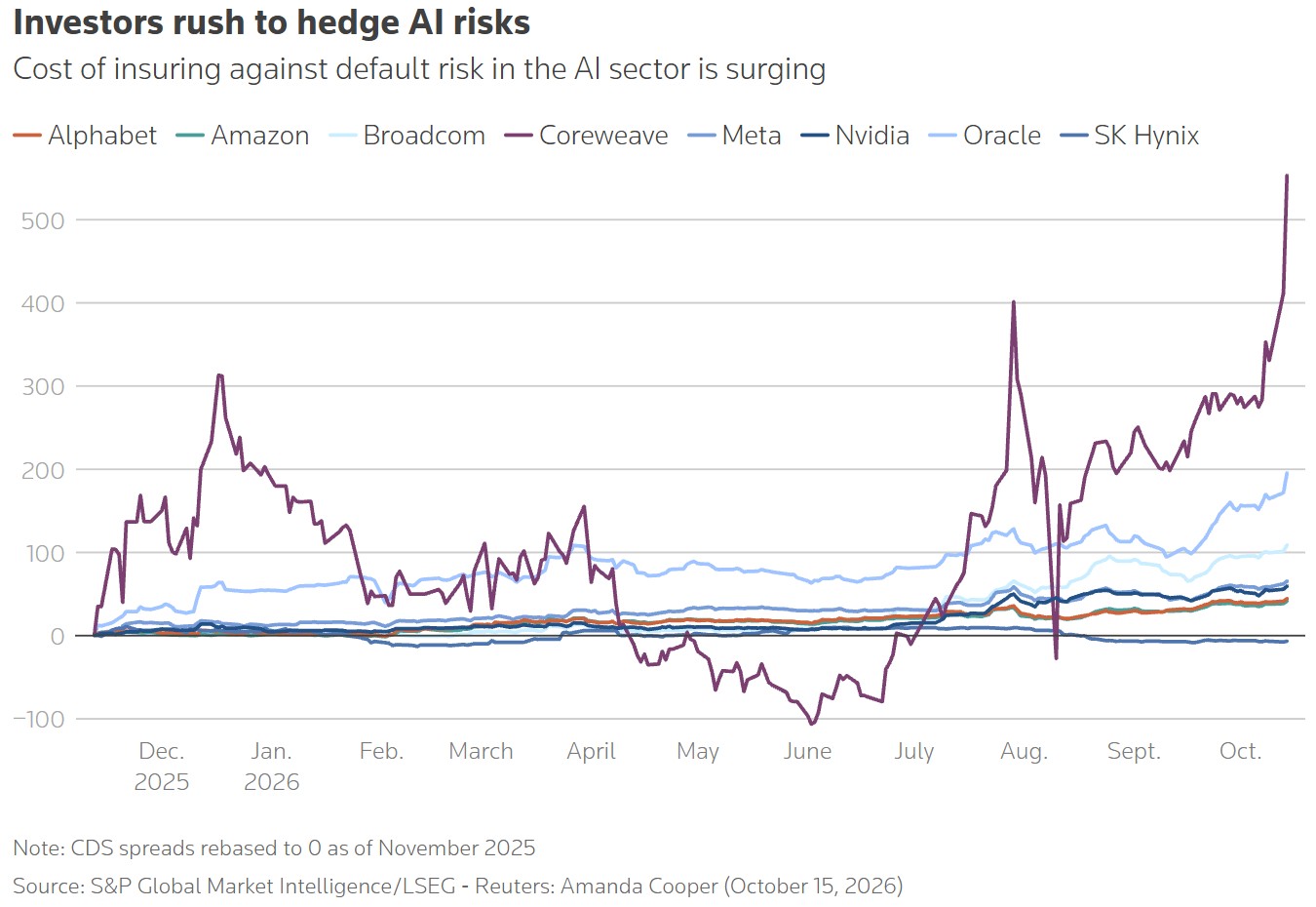
Deutsche Bank strategist Jim Reid stated, "This is not the first time we have seen significant market volatility due to AI concerns, but as we enter a capital expenditure cycle supported by debt rather than just free cash flow, we must increasingly pay attention to price performance in the credit market. Overall, AI financing costs are not severe, but there are worrying signs at the margins."