
 I'm LongbridgeAI. Here is the key information I extracted
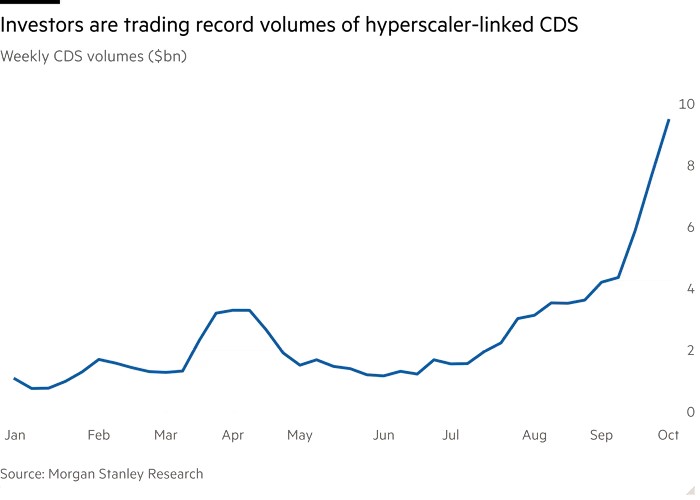
- Morgan Stanley data indicates that the weekly average trading volume for these derivatives surged past 9 billion dollars in September from less than 2 billion dollars in July.…
CLS Agency, October 20 (Editor: Xiaoxiang) The latest signs indicate that global investors are currently scrambling to buy Credit Default Swaps (CDS)—the derivative instrument that rose to prominence during the 2008 subprime mortgage crisis—in an attempt to build a firewall for their portfolios against the potential "domino effect" should the AI boom collapse.
The borrowing wave driven by the financing of trillions of dollars in artificial intelligence infrastructure spending is pushing up market demand for these insurance-like derivatives. If the debt of the companies linked to these derivatives defaults, compensation will be paid to the buyers.
Data from Morgan Stanley's research team shows that in September, the average weekly trading volume of CDS linked to bonds issued by Oracle, SpaceX, Alphabet, Amazon, Meta, Broadcom, and NVIDIA exceeded $9 billion, whereas in July, this figure was less than $2 billion.
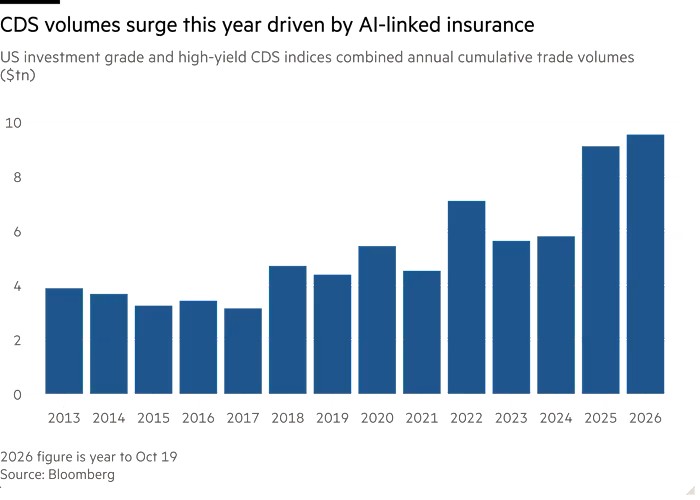
Bloomberg data also shows that year-to-date, the trading volume of the US Corporate CDS Index has already surpassed the total for the entire previous year.
A clear signal of the market's growing unease with this "AI lending frenzy" is that the cost of purchasing CDS linked to multiple AI-related companies has hit record highs this month.
In recent days, CDS spreads have continued to rise not only among companies perceived by investors as higher risk—such as AI cloud computing service provider CoreWeave—but also broadly among those considered relatively safe, such as Microsoft.
Manish Kabra, Head of US Equity Strategy at Société Générale, stated, "CDS has become a key barometer for measuring investor sentiment regarding the financing of hyperscale cloud providers and the overall AI trade. Market focus is increasingly concentrating on two aspects: CDS and free cash flow."
Surge in Cross-Market Demand
Morgan Stanley's data shows that since the beginning of this year, the scale of AI-related debt issuance has soared significantly—companies have raised approximately $466 billion so far in 2026, compared to just $101 billion during the same period in 2025. These funds are being used for infrastructure construction such as data centers and chips.
Although the borrowing fever has cooled somewhat from its peak in June, many investors state bluntly that there are numerous heavy-weight borrowers exposed to AI risks. Coupled with market doubts about whether companies can truly achieve commercial monetization from massive AI investments, this has jointly catalyzed strong demand for CDS.
Jim Caron, Chief Investment Officer of the Portfolio Solutions Team at Morgan Stanley Investment Management, stated: "Obviously, when you are in a market with highly concentrated risk, the amulet you most want to buy is CDS."
He added that for investors, these swap contracts are also an extremely "cost-effective hedging tool."
In the past, CDS was primarily a tool used by pure credit market investors, but today, multi-asset fund managers and equity fund managers are increasingly using these swaps to hedge AI-related exposures at a lower cost, driving their prices to historical highs.
Caron said: "Part of the demand comes from genuine bond investors who want to hedge their portfolios; another part comes from multi-asset investors and equity speculators who are trying to find a low-cost hedging tool to protect against the risks brought by technology stock exposures."
Growing Concerns Over an AI Bubble
The intertwined financial connections within the AI industry chain have further heightened market vigilance against an industry bubble. Many investors revealed that this high level of bundling has prompted traders to heavily buy CDS for infrastructure giants supplying underlying computing power to OpenAI and Anthropic—such as Oracle and Alphabet.
Gavan Nolan, Executive Director at S&P Global Market Intelligence, stated: "There is a complexity premium reflected in the pricing of these tech companies." He was referring to the complex and interconnected financing structure of the industry. He added that the increasingly common large intraday fluctuations in CDS spreads indicate that "there is still significant uncertainty in the market."
This month, the five-year CDS spread for Meta has risen to 108 basis points, meaning that purchasing default protection for $10 million in debt requires an annual payment of $108,000. The spread for derivatives related to NVIDIA has risen to 101 basis points, both hitting record highs. The cost of default protection for Alphabet and Amazon debt has also risen to historical highest levels.
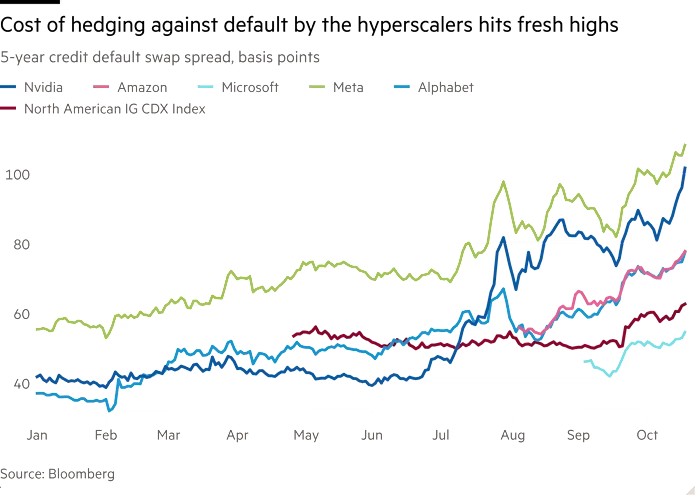
However, although the CDS prices for some tech giants continue to rise, their spreads remain relatively low compared to AI companies that investors perceive as higher risk. The latter carry higher risk, partly due to excessive debt levels.
On Monday, Oracle's CDS spread was quoted at 322 basis points, compared to just 144 basis points at the beginning of the year. The CDS for Elon Musk's SpaceX rose to a record 226 basis points earlier this week, whereas when the contract first began trading in late June, the spread was only 110 basis points.
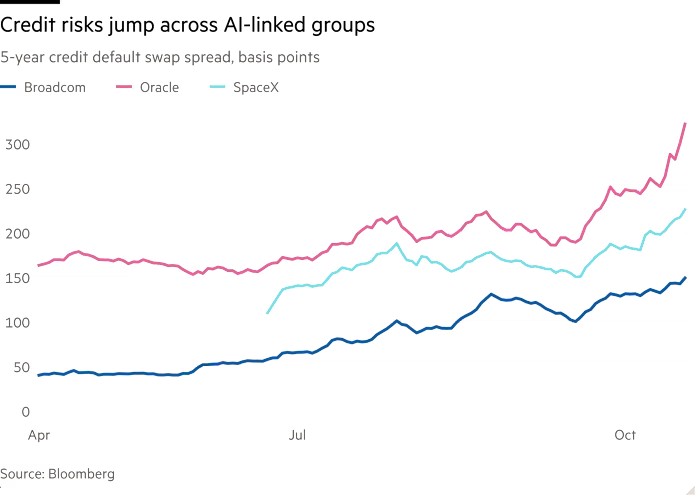
Note: The red line represents Oracle CDS prices, light blue for SpaceX, and dark blue for Broadcom
Many investors consider CDS a relatively low-cost and straightforward risk protection tool that can help them guard against a market crash. Société Générale's Kabra added: "You can choose to buy CDS, or you can buy stock put options, and sometimes the volatility of these stocks can be extremely high. In the stock market, hedging assets with greater volatility is extremely difficult and costly."
The object of greatest concern in the market is undoubtedly the new cloud computing service provider CoreWeave. The price of some of the company's bonds has fallen into the distressed asset range indicative of default risk. The five-year CDS spread linked to the company's debt is currently around 1090 basis points. Due to extremely strong demand, if a buyer purchases $10 million in default protection, they need to pay $1.82 million upfront, plus an additional quarterly payment of $125,000.
S&P Global Market Intelligence's Nolan added: "Once a company's CDS spread exceeds 1000 basis points... the core of market pricing no longer focuses on the probability of default, but shifts directly to calculating the expected recovery rate of principal for bondholders."