
 I'm LongbridgeAI. Here is the key information I extracted
- These AI firms' CDS-to-cash bond bases have turned positive as unexposed institutions heavily buy protection to hedge against heavy debt and supplier financing, pushing chipmakers' spreads up by over 170%.…
Barclays released a comprehensive report on the credit default swap (CDS) market for artificial intelligence-related companies, pointing out that with the significant expansion of capital expenditures, the credit risk of AI-related companies has been significantly repriced, with both CDS trading volumes and spreads showing a sharp upward trend.
On October 29, Barclays' report indicated that ten core AI companies, including hyperscale cloud service providers like Google, Amazon, Meta, Microsoft, and Oracle, as well as chip manufacturers like AMD, Broadcom, and NVIDIA, currently account for only 8% of the CDX Investment Grade Index components but represent 16% of the index's implied credit risk.
Barclays emphasized that over the past six months, the credit risk of these ten companies has expanded, with all currently near the upper end of their six-month volatility ranges.
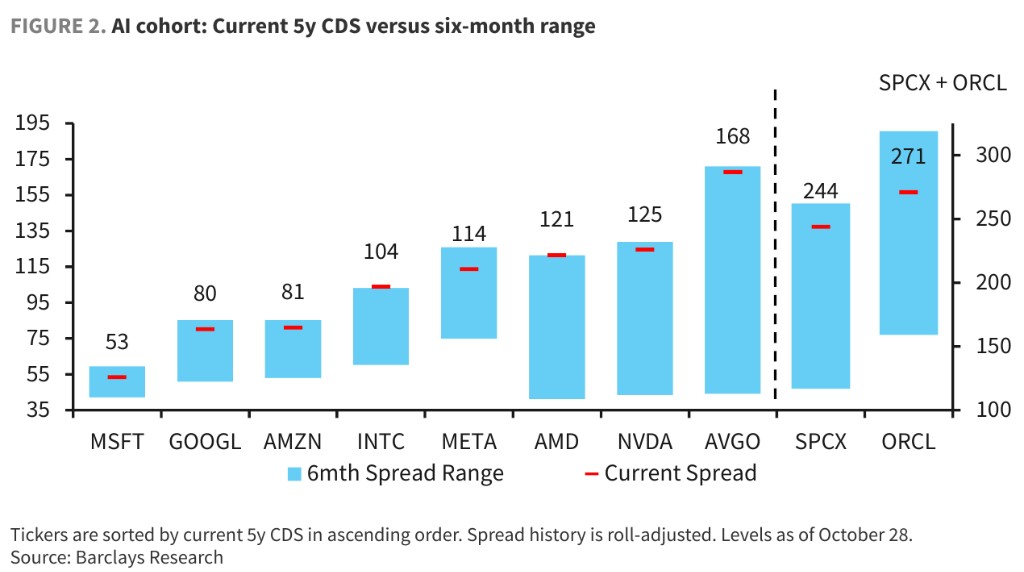
(AI Group: Comparison of the six-month range for current 5-year CDS)
This means that investors holding this investment-grade index have passively assumed a large amount of volatility risk in the AI sector. Furthermore, the basis between CDS and cash bonds for these core AI companies has turned positive, meaning the cost of purchasing default protection has exceeded the additional yield generated by holding these companies' bonds.
According to Bloomberg, this anomaly is mainly due to a large number of institutions that do not hold related bonds (such as hedging equity funds and banks) aggressively buying CDS to hedge against huge AI capital expenditures and related loan risks.
This technical movement is extremely similar to the logic of credit hedging and basis distortion seen in 2008. At that time, many institutions that did not hold subprime mortgage bonds (such as hedge funds and investment banks), driven by macro bearishness or risk aversion, bet on default risk by buying CDS protection. This intensive "naked hedging" derivative buying pressure pushed CDS spreads extremely high, even exceeding the credit spreads of the spot bonds themselves, directly pushing the CDS-cash bond basis into positive territory.
As Barclays released this report, the financing needs of leading tech companies continued to put pressure on the market. Recently, Microsoft initiated a bond issuance exceeding $25 billion, Amazon added over $48 billion in long-term debt in a single quarter, and Broadcom also plans to raise up to $21 billion early next year.
These massive financings have further increased market hedging demand, causing the CDS costs for related companies to hit historical highs.
Shift in Credit Characteristics of Chip Manufacturers, Significant Widening of Spreads
In this wave of credit repricing, the widening of CDS spreads for chip manufacturers has been the most significant.
Six months ago, the CDS spreads for Broadcom, AMD, and NVIDIA were at the lowest levels in their category, hovering around 40 basis points.

(AI Group 5-year CDS, six months ago vs. now, sorted by six-month change magnitude)
However, today the CDS spreads of these three companies have jumped to the forefront. Broadcom's 5-year CDS surged by 258% in six months, AMD rose by 177%, and NVIDIA rose by 172%. In comparison, AAA-rated Microsoft rose by only 20%.
Barclays pointed out in the report that as chip suppliers begin to provide loans to customers to purchase their chips (i.e., supplier financing), the credit market has begun to view these companies as lending institutions with highly concentrated loan books.
For example, after banks expressed doubts about Anthropic's $63 billion chip deal, Broadcom stepped in to provide guarantees. Based on this, Barclays recommends buying 5-year CDS protection on Broadcom as a macro strategy to hedge against broader AI financing pressures.
Positive Basis and Hedging Demand Drive Surge in Trading Volume
The turning positive of the basis between CDS and cash bonds is the most significant technical feature of the current AI credit market.
Over the past year, the basis for non-AI companies in the CDX Investment Grade Index has remained largely negative, meaning CDS spreads were lower than bond spreads. However, the basis for the AI group has risen by about 50 basis points and turned positive. This positive basis is particularly evident among chip manufacturers and Oracle.

(The CDS-cash bond basis for the AI group has now turned positive, while the basis for the non-AI group remains negative)
This structural change is accompanied by an explosive growth in trading volume. As of October 23, the 4-week average weekly trading volume for hyperscale cloud service providers reached approximately $6 billion, a year-over-year surge of about 740%; the weekly trading volume for chip manufacturers reached $3 billion, a year-over-year skyrocketing increase of 1900%.
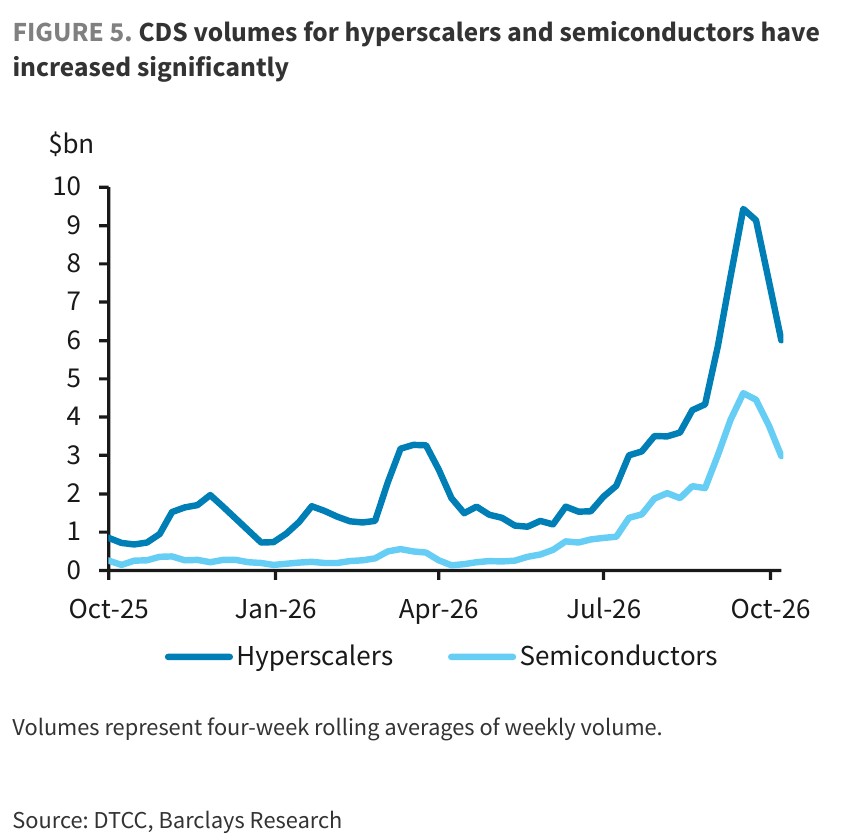
(CDS trading volumes for hyperscale cloud service providers and semiconductor companies have increased significantly)
Open interest data also confirms the continuous inflow of capital. The net open interest notional value for hyperscale cloud service providers has doubled from about $5 billion a year ago to $20 billion, while for chip manufacturers, it has increased from about $1.9 billion to $8.6 billion.
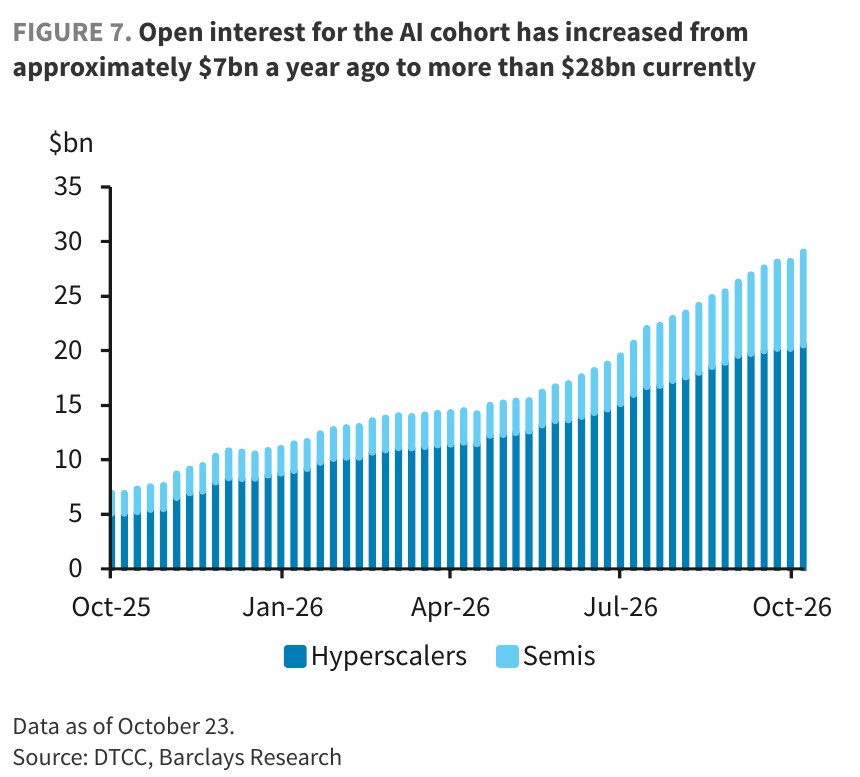
(Open interest for the AI group has increased from about $7 billion a year ago to over $28 billion currently)
These 10 AI companies currently account for nearly 14% of all open interest in single-name CDS for American corporations, far higher than the 4% recorded a year ago.
Curve Shape Divergence, Trading Strategies Highlight Individual Stock Differences
By analyzing the comparison of 3-year and 5-year spread differences in the CDS curve, Barclays pointed out pricing anomalies for individual companies.
For example, Amazon and Google have comparable 5-year CDS levels (80-81 basis points), but Amazon's 3s5s curve (the spread difference between 3-year and 5-year) is only 18 basis points, appearing overly flat.
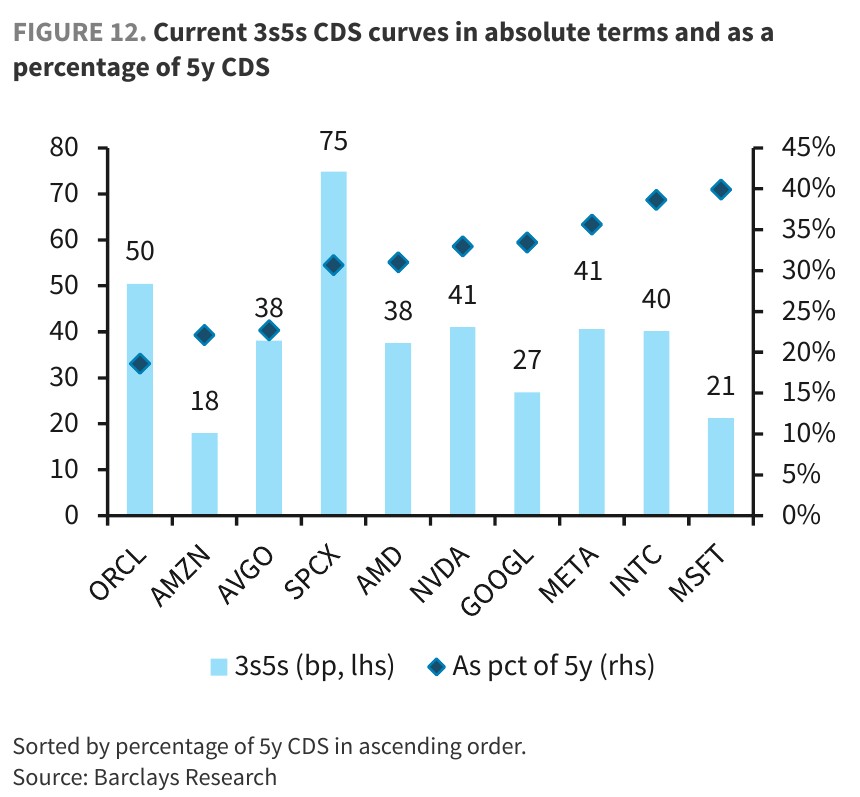
(Current absolute values of the 3s5s CDS curve, and as a percentage of the 5-year CDS)
Barclays believes this may be related to buying pressure caused by a term loan Amazon took out in June, and recommends buying 5-year protection on Amazon or constructing a steepening trade portfolio.
Subsequent earnings data confirmed the necessity of hedging, with Amazon reporting a third-quarter free cash flow consumption of $33.5 billion and capital expenditures as high as $77.3 billion.
As the most liquid CDS underlying asset in the market, Oracle's basis is at a high level within the sample.
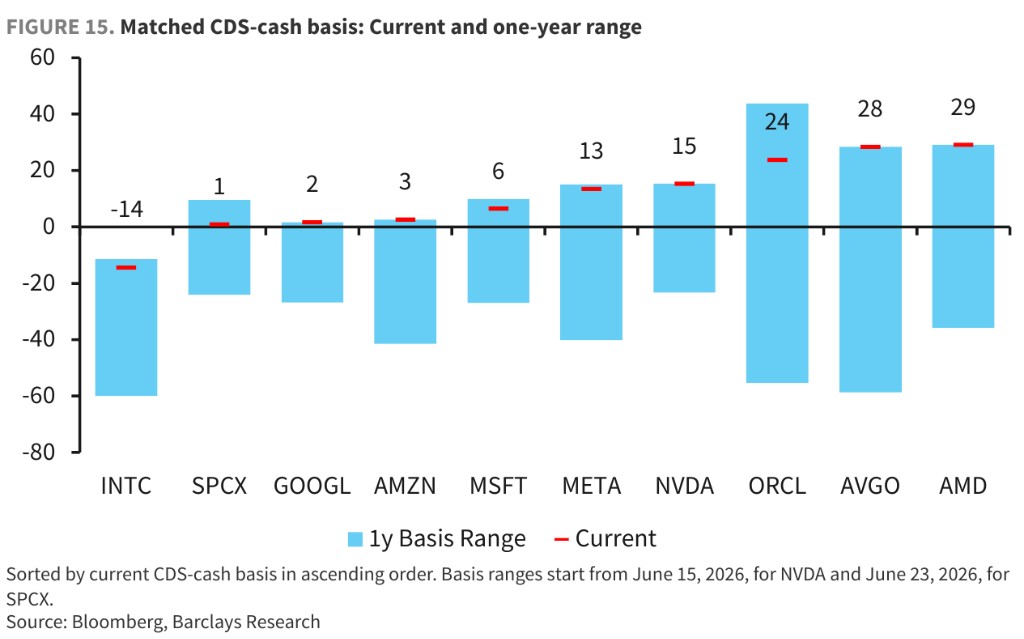
(Comparison chart of the current CDS-cash bond basis position within a one-year range)
Barclays recommends selling the 5-year basis on Oracle, i.e., selling bonds maturing in 2032 while simultaneously selling CDS protection, to bet on the convergence of the basis. Previously, Oracle announced setting an additional financing cap of $20 billion for the coming years.
Furthermore, Intel is the only company in the sample with a basis still in negative territory (-14 basis points) and a relatively steep curve, mainly because it has not deeply participated in the supplier financing model of its peers. However, after releasing weak performance guidance, its stock price recorded its largest single-day drop since 1982.
Microcosm of the High-Yield Market: CoreWeave's High Cost of Default Protection
Beyond the investment-grade sector, CoreWeave, as the only directly related AI company CDS in the CDX High Yield Index, has become a unique window for observing credit risks in data centers and new cloud service providers.
Currently, CoreWeave's 5-year CDS is priced using "points upfront," reaching 15.5 points. This pricing mode, typically used for distressed debt, highlights the market's high alertness to its risk.
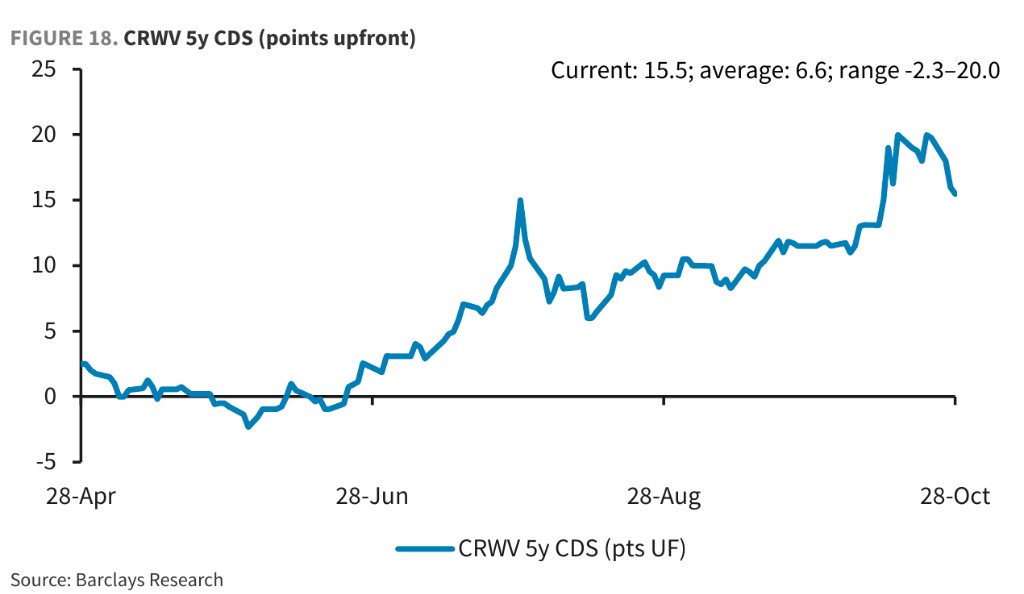
(CoreWeave 5-year CDS, quoted in points upfront)
Data shows that CoreWeave's weekly CDS trading volume has risen from $32 million a year ago to $302 million, with open interest increasing to $850 million.

(CoreWeave's weekly trading volume has risen from $32 million a year ago to $302 million, with open interest increasing to $850 million)
Although some analysts maintain an "overweight" rating on CoreWeave bonds, the high upfront cost of 15.5 points for default protection indicates that the CDS market is pricing in a more stringent assessment of the potential default risk of its business model.