
 I'm LongbridgeAI. Here is the key information I extracted
- The Philadelphia Semiconductor Index dropped 5.3%, and Nvidia fell 4.1% to reach a new closing low since July 2025.…
It is 2026-11-17 Singapore time. Dolphin Research brings you a quick take on global markets.

Trading focus: Former AI bulls are slashing post-2028 accelerator demand, with the largest cuts on Nvidia. The U.S. Dept. of Commerce formally closed the remote-compute loophole. The Philly Semi Index fell 5.3% on Mon, and Nvidia -4.1% to the lowest close since Jul 2025.
Asia led the selloff: TWSE -6.0%, KOSPI -3.6%. China B300 spot has tripled, and Alibaba and Tencent report this week.
Macro mood: A 25bp Dec hike is fully priced. Fed Chair Waller said staff are scenario-planning for three AI outcomes, including an 'AI bubble burst'. VIX rose 19% to 22.9, and gold hit a 1Y+ low. China Oct retail sales were up just 0.4% YoY.
Core index/stock moves: S&P 500 -1.9%, Nasdaq 100 -2.7%. Memory, optical modules and new cloud led declines (SanDisk -8.6%, Lumentum -8.5%, IREN -9.8%, GDS -14.7%), while Apple and Microsoft fell only ~1%. Post-earnings, H World +8.9%, XPeng +3.2%.
Near-term watch:
Tonight: U.S. Oct retail sales (SGT 21:30), several Fed speakers.
Tomorrow morning: Nvidia earnings (U.S. after-hours).
Wed–Thu: Shenzhen APEC Leaders Meeting, China–Russia–U.S. trilateral; Tencent and Alibaba earnings, Anthropic pricing/listing, Fed minutes.

$NVIDIA.US , $Taiwan Semiconductor.US , $Micron Tech.US , $Sandisk.US , $AMD.US , $Broadcom.US , $SK Hynix.US , $Advantest Corp..JP , $Alibaba.US , $BABA-W.HK , $TENCENT.HK , $GDS.US , $GDS-SW.HK , $Nebius.US , $Baidu.US , $BIDU-W.HK , $XPeng.US , $XPENG-W.HK , $H World.US , $HWORLD-S.HK , $S&P 500.US , $NASDAQ-100.US , PHLX Semiconductor Index, TAIEX, KOSPI, $Hang Seng TECH Index.HK
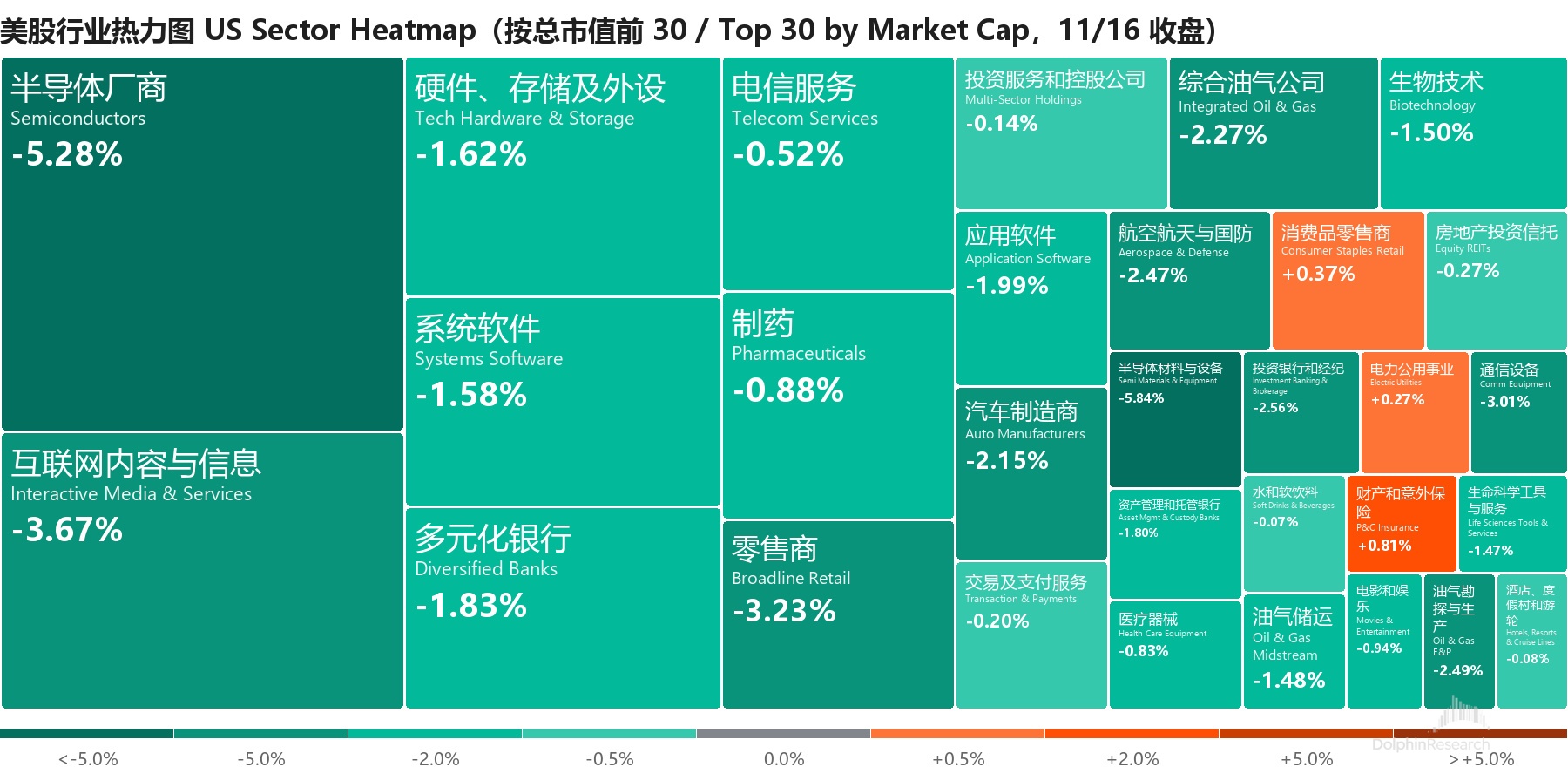

1. SemiAnalysis cuts Nvidia 30%–60% on out-years; semis slide 5% ahead of earnings
SanDisk -8.6% / Micron -7.6% / TSMC -6.3% / AMD -5.6% / Nvidia -4.1% / Broadcom -3.9%
Demand cuts: SemiAnalysis lowered AI accelerator spend by 28% for 2028 and 40% for 2030 in a client note, and trimmed 2030 power demand by 34%. The rationale: slower growth at frontier labs and tighter capital markets.
For Nvidia, 2027–2030 shipments measured by compute-revenue capacity were cut by 22%/39%/56%/66%. Across 2026–2030, Nvidia accounts for 66% of the reduction in total silicon area.
Post-cut, SA’s outlook now aligns more with typical Wall St. models, a notable shift from one of the most vocal AI bulls. Some also say without Jensen Huang, suppliers will no longer prioritize Nvidia equally, with 70%+ of 2028 capacity potentially outside Nvidia.
Memory also hit: 2028 HBM bit demand was reduced by 30%, implying a more balanced market and lower HBM price assumptions, at odds with the prior consensus of HBM price gains through 2027.
Nvidia disclosed supply and capacity commitments jumped from $119 bn to $279 bn last quarter, driven mainly by memory, according to sell-side citing the company.
Only foundry still has faith: TSMC -6.3%: JP Morgan said management sounded confident recently, with supply still falling short even vs. discounted demand forecasts and low oversupply risk. Semiconductor longs in Asia and the U.S. are using it as financing collateral.
CEO saga drags on: Trump said on Mon he would not oppose Jensen Huang returning, briefly lifting Nvidia. CNBC later reported the BOD remains focused on the probe and has not discussed his return, sending shares back down. FT/Bloomberg said Huang has agreed to testify before Congress.
Barron’s, citing SEC filings, noted that in Mar Huang moved ~60 mn shares of Nvidia worth $10+ bn into an irrevocable family trust.
2. U.S. formally blocks remote compute: overseas DCs need licenses to serve China; domestic B300 spot has tripled ahead of Alibaba/Tencent prints
GDS -14.7% / 21Vianet -11.4% / DigitalOcean -8.6% / Alibaba -4.0% / Tencent +1.0% (HK)
BIS action: The U.S. Bureau of Industry and Security issued an interim final rule on Mon: any data center globally (incl. colocation) providing more than 12 mn 'total TPP' of compute to entities headquartered in China or Macau requires a license for export/transfer, subject to case-by-case review.
On a TPP basis, this equates to roughly 760 H100s or 330 B200s, a low threshold.
Legacy capacity also needs licenses: Overseas DCs that already serve Chinese clients at scale must obtain licenses within 90 days post-effective date to continue service. DCs must look through ownership to prevent evasion via restructuring or spin-offs.
Five SEA countries move to case-by-case: Exports of advanced chips to Indonesia, Malaysia, Singapore, Brazil and Thailand will all require licenses, with U.S.-headquartered customers eligible for reporting-based exemptions. Recommendation systems for e-commerce and social platforms are not restricted, and the Biden-era 'AI diffusion rule' is formally repealed.
Who gets hit first: GDS at one point dropped 21.7% intraday; it owns ~19% of DayOne, which derives most revenue from Malaysia. Sen. Cantwell’s letter named Alibaba and ByteDance as users of overseas DCs, both large GDS customers.
There are losers abroad too: about 75% of tokens on DigitalOcean’s platform come from open-source models, and management highlighted Chinese models. Kimi K3’s licensing requires the host to remit up to 30% rev-share to Moonshot AI. (Dolphin Research original)
Domestic spot up 3x: Channel checks suggest B300 full-system spot in China jumped from RMB 4–5 mn in H1 to RMB 15–16 mn. Monthly card inflows fell from 2,000–3,000 to a few hundred, and only 16 of 128 units ordered in Jul have arrived.
Big tech is relying on inventory (as of Jul, Alibaba Cloud ~7,000–10,000 units; ByteDance ~10,000). Model developers are the main buyers of high-priced spot. New rental rates have risen to RMB 200k+ per month, while early 5Y contracts remain locked at teens.
Inference is tightening too: DeepSeek introduced daily caps for free users and shortened per-prompt input length, with some users hitting the limit in under two hours.
Morgan Stanley offers first quant take: If Chinese customers are barred from signing new leases that use incremental U.S. GPUs, the cloud revenue embedded in Alibaba’s guidance would see about 8% impact in FY28 and 17%–20% in FY29–31.
Per Goldman citing IDC, in H1 China DC AI accelerator shipments were Nvidia 34% (678k units), Huawei 28% (575k), and Pingtouge 7% (141k).
3. The 'Jensen Huang put' loosens: new clouds and DC money just got more expensive
IREN -9.8% / Nebius -7.6% / CoreWeave -6.1% / Oracle -5.0% / Amazon -3.3%
Backstop shrinks: WSJ and Reuters reported that before stepping down, Jensen required partners to take customer prepayments before allocating GPUs, meaning Nvidia will no longer be the sole funding source.
Harder to break ground: Since the midterms, at least 38 local jurisdictions passed measures restricting AI DC expansions. Some Ohio referendums ban projects over 250MW or freeze new development.
SemiAnalysis also expects DC development in Texas to pause, pushing Anthropic’s 700MW TPU buildout from 2027 to 2028.
Dolphin Research view: For new clouds, Nvidia’s guarantees and allocations underpin financing credit. As that credit loosens, funding premia must reset. The price-hike tailwind for new clouds is largely priced; from here, it is about delivery cadence and ROI — who can energize sites on time and secure funding without Nvidia backstops deserves the multiple. (Dolphin Research original)

1. Dec hike priced; Waller preps for an AI bubble scenario
Hike pricing: Kansas City Fed’s Schmid said inflation is 'uncomfortably above 2% and moving the wrong way'. Markets have fully priced a 25bp hike in Dec.
Waller remarks: Waller said staff are drafting contingency plans for three AI outcomes: a productivity boom, mass unemployment, and a tech bubble burst. The latter implies lower expected AI returns, falling equities, slower growth and a notable rise in unemployment, and he did not signal policy direction.
USTs and USD: The 10Y UST yield was 5.11% (-2bps) and 2Y 4.82% (-2.5bps). DXY at 103.5, near a 19M high.
China Oct data: Retail sales +0.4% YoY (+1.1% in Sep), ex-auto +2.5%. Industrial production above-scale +4.8%. Jan–Oct FAI -8.1%, with property dev’t -21.6%.
2. High-beta assets (11/16)
VIX +18.7% to 22.9: Investors cut exposure ahead of Nvidia earnings and Anthropic’s listing.
Crude -3.2% to -3.6%: WTI $85.72 and Brent $92.44, ample physical supply outweighed Middle East risk premia.
Gold -0.8% to $3,853.6 and silver -4.6%: At a 1Y+ low, with tech losses prompting gold-for-collateral selling. LME copper fell to a 4M low at $13,256/ton as expected AI DC slowdown weighed on demand.
Bitcoin around $64.3k: It dipped to ~$62k over the weekend and is -16% MTD. $1.78 bn in liquidations from 11/13–15, and spot BTC ETFs saw $1 bn outflows last week. Higher hike odds and a strong USD undercut the Aug ‘currency debasement’ narrative that had supported gold and BTC.
3. Compute and memory pricing (11/17)
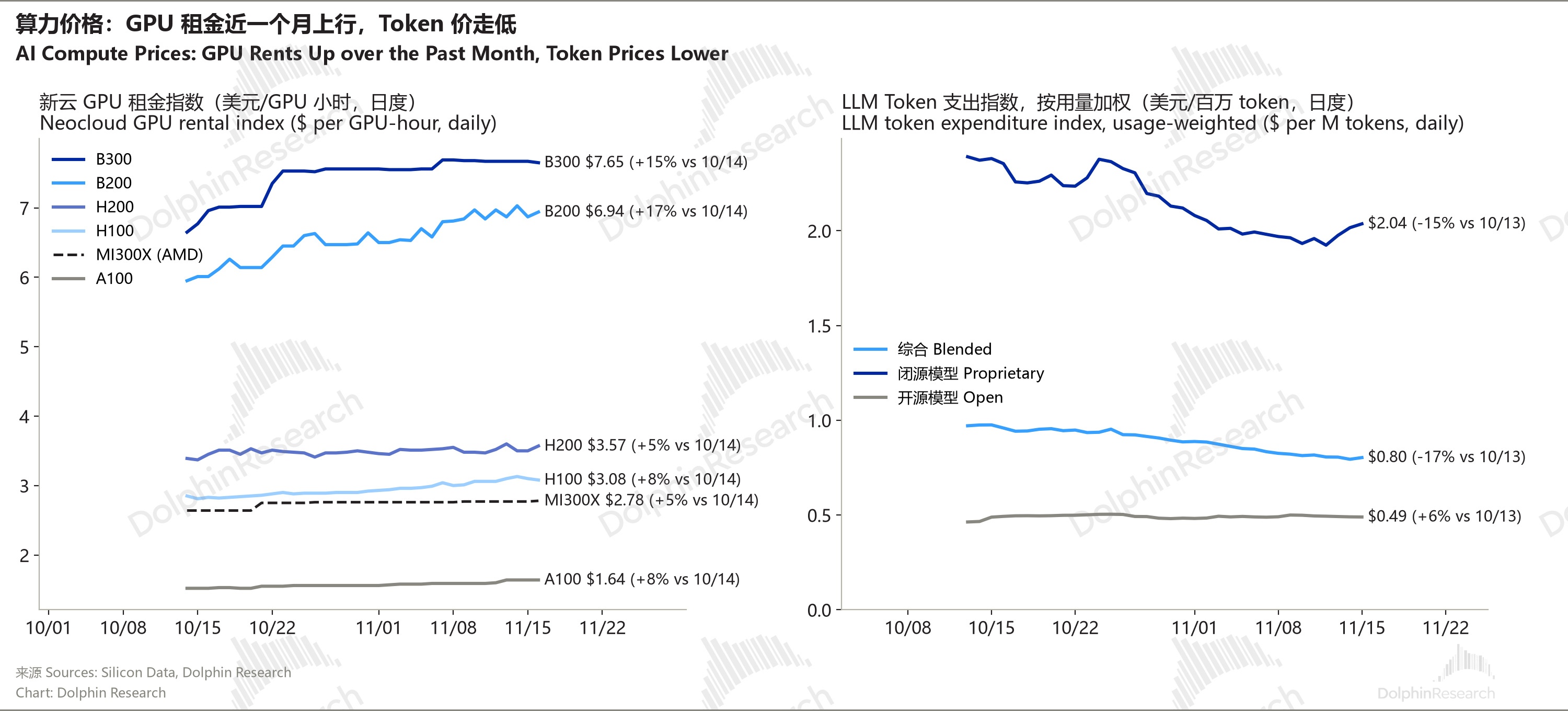
GPU rental rates are still inching higher, while token prices are mixed — closed-source up, open-source down, and blended down.
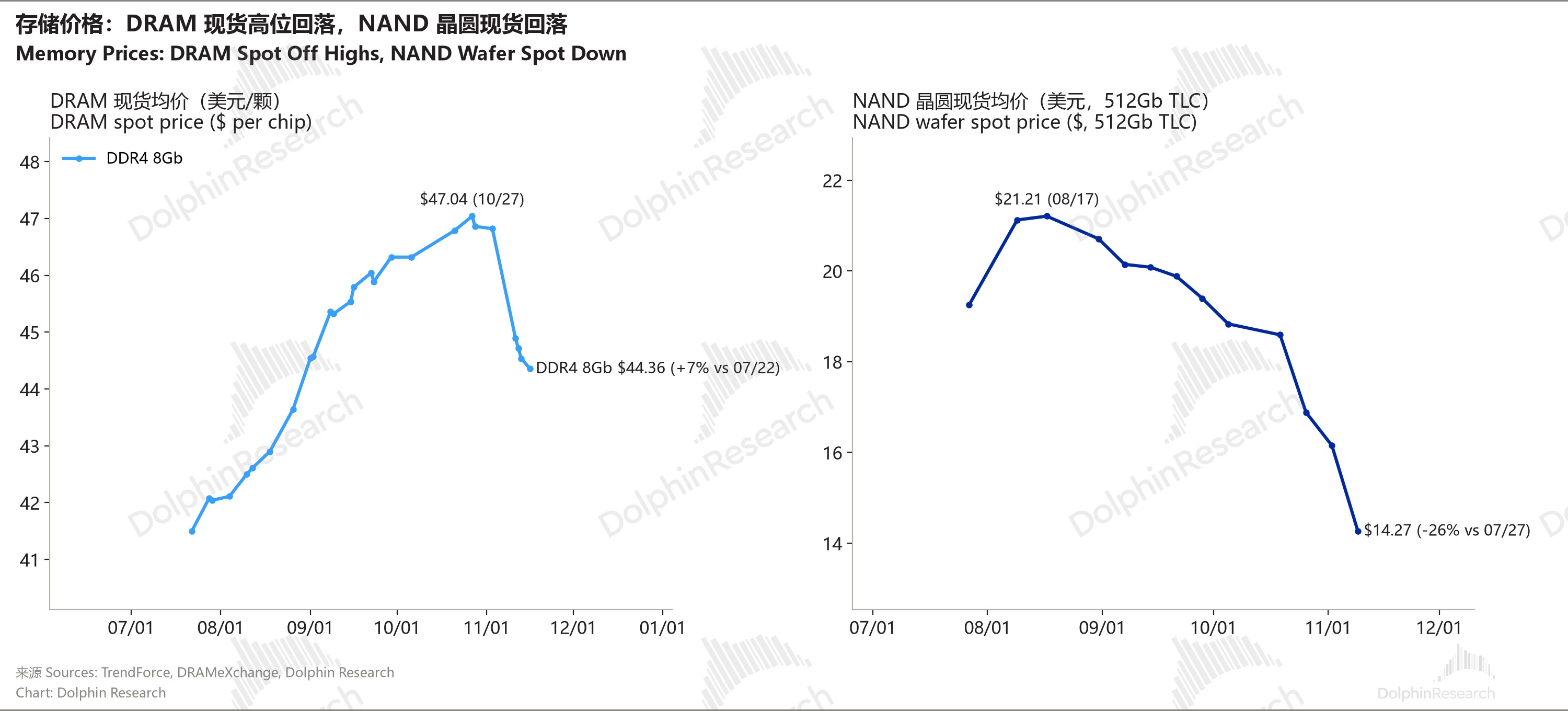
Memory spot: DRAM is falling with a slower pace of decline, while NAND remains in a downtrend. That said, per TrendForce, generic MLC NAND ASPs were flat MoM, SLC NAND saw structural hikes of 5%–10% but not broad-based, and consumer SSD and some NAND channel prices softened.
4. Asia open and today’s setup (11/17)
Asia open today: Nikkei 225 opened -0.6%, KOSPI -1.8%.
China compute: With BIS rules in force and domestic B300 spot up 3x, HK cloud and IDC names face pressure (GDS ADR -14.7%), while the domestic compute substitution theme strengthens. China A-share optical modules fell 8%+ on Mon; watch for stabilization.
Policy window: The Shenzhen APEC Leaders Meeting runs 11/18–19, and Xi will meet Putin and Trump for a China–Russia–U.S. trilateral. Any signal on chip controls is the key watchpoint.


BIDU|$25.2 bn|-5.4%
Q3 revenue RMB 30.8 bn. Ad revenue -23% (legacy search -25%, AI-native marketing -11%), worsening QoQ, and mobile Baidu MAU fell by 40 mn QoQ.
AI cloud infra +94% and GPU cloud +191% helped core revenue return to +1% growth. The company is using long-term prepaids to lock in compute demand and will pay its first dividend by year-end.
GAAP OP was only RMB 670 mn, and non-GAAP RMB 1.7 bn. Q3 capex RMB 7 bn, with FY at RMB 30–35 bn.
Dolphin view: BIDU remains a tale of two halves, but the cold gets colder: ads cannot cover cash needs, AI apps and AI-native marketing cannot fill the search erosion gap, and compute profits must be plowed back into infra (1GW plan to double in 1–2 years). Low valuation alone is not a buy case; wait for Kunlun chip catalysts. (First Take)(Earnings Review)(Earnings Call Transcript)
H World HTHT|+8.9%
Q3 revenue RMB 7.75 bn, +11.3%, and franchise revenue RMB 4.16 bn, +25.7%. FY revenue guidance raised to +9%–10%, and franchise revenue +22%–23%.
H World China RevPAR +0.1%, and same-store RevPAR decline widened from -3.0% to -4.4%. Net adds of 489 hotels, but the pipeline shrank QoQ.
Adj. EBITDA margin 39.8%, and management will step up brand, membership and tech investments starting Q4, implying near-term margin volatility.
Dolphin view: The key is 'monetization per room'. Franchise room count rose only ~12.5% and RevPAR was flattish, yet franchise revenue rose 26%, driven by pricing power over franchisees and value-added services such as supply chain.
The cost of same-store softness is borne mainly by franchisees, but the real watchout is a shrinking pipeline that could slow 2027 openings. Valuation re-rating needs a haircut; 17–18x implies about 11%–18% upside. (First Take)(Earnings Review)(Earnings Call Transcript)
BEKE|+4.4%
Q3 adj. net profit RMB 2.605 bn, +102.6% YoY, with net margin at 12.4%. Revenue -8.9% YoY.
Existing-home GTV +3%, better than expected but slowed ~8ppt vs. last quarter. Franchise channel GTV +9%, while Lianjia self-operated was ~-7%. New-home GTV +5%, ~1ppt faster QoQ.
Dolphin view: Both growth metrics and profitability (especially the latter) beat, underpinned by cost control, efficiency gains and business mix optimization, and the platformization strategy is becoming clearer and more successful. On a QoQ basis, policy tailwinds faded at the margin, with GTV growth and margins down vs. last quarter; strong alpha still bows to the industry cycle. (First Take)(Earnings Call Transcript)

GOOGL|$3.49 tn|-4.1% / META|$1.60 tn|-2.4%
The TPU chain was also hit by SA cuts: shipments for MediaTek-designed TPU v9i, initially slated to sell externally to Anthropic, were lowered by 42% over its lifecycle. Bridgewater cut Google and Amazon, and added to Nvidia, Broadcom, Micron and SanDisk in Q3.
MSFT|$3.85 tn|-1.1%
The Ignite conference kicks off today.

XPeng XPEV|$9.3 bn|+3.2%
Q3 revenue RMB 24.3 bn, about 7% above consensus, and ASP rose 11% QoQ to RMB 183k, driven by the higher-priced GX and exports.
GPM 18.9%, auto GPM 13.1% (vs. 12.5% expected), and core operating loss narrowed from RMB 1.33 bn to RMB 1.03 bn.
Q4 delivery guidance 169k–174k units and revenue RMB 30.4–31.8 bn, both above consensus. Management targets 2x+ overseas sales by 2027, and IRON humanoid robots to mass-produce next year.
Dolphin view: The key signal is that, with the 'service income supports margin' model fading, the auto business’ own profitability is improving. Mix shift from GX, scale effects and cost-down from in-house chips offset raw-material inflation, reinforcing the mid-term 'auto volume + AI optionality' case; watch monthly deliveries topping 60k in Nov–Dec, IRON mass production by year-end, and Robotaxi opening to the public. (First Take)(Earnings Review)(Earnings Call Transcript)
TSLA|$1.50 tn|-2.7% / SPCX|$1.87 tn|-1.3%
Goldman reiterated Buy on SpaceX with a $245 PT, citing its 15th flight with all 33 Raptors operating nominally and 14 orbits, the longest for Starship, lowering full reuse risk.

ARM -8.1% / Marvell -7.3% / Intel -7.0% / Lam Research -6.7% / ASML -5.9% / Applied Materials -5.5%
Broad-based selling followed SA’s cuts, with 'almost everyone pulled into the downdraft'. CPU basket -6.9%, and semi-equipment basket -4.8%.
Intel fell another 3.5% after-hours: Nvidia’s 13F showed Q3 cuts of 25% in Intel and 20% in Nokia.
Bloom Energy -7.7% / Vertiv -6.6% / GE Vernova -4.9%
AI infra names followed lower, with the AI power basket -4.6% and nuclear -5.4% per trackers. LME copper hit a 4M low as markets traded a slowdown in DC construction.
Palantir PLTR|-4.5%
Reuters said European militaries are seeking alternatives, with Germany’s shortlist excluding Palantir.
Reddit RDDT|-5.7%
Piper flagged Oct MAUs down 12% MoM in the U.S. and 13% international.


| Date | Event | What to watch |
| 11/17 Tue | U.S. Oct retail sales (SGT 21:30); Fed speakers Barkin, Musalem, Harker; Nvidia, JD earnings (Nvidia U.S. after-hours) | See Nvidia preview below |
| 11/18 Wed | Tencent, Palo Alto earnings; Anthropic pricing after-hours; Shenzhen APEC Leaders Mtg (to 11/19) | See Tencent preview below; chatter of Anthropic IPO 10–20x oversubscribed with ~$5 bn orders |
| 11/19 Thu | Alibaba (U.S. pre-mkt), Lenovo earnings; Anthropic lists on Nasdaq; FOMC minutes (SGT early morning) | See Alibaba preview below |
| This week | Xi to meet Putin and Trump in a China–Russia–U.S. trilateral; WSJ says Gov. to name 20+ 'AI national champions' (incl. Nvidia, Amazon, Microsoft, OpenAI, Anthropic) | Any sign of chip-control easing |

Nvidia NVDA|11/17 U.S. after-hours
Watchpoints: Quarterly numbers should be fine. Consensus revenue is $108.7 bn (+91% YoY), and UBS models $111–112 bn with next-quarter guidance near $130 bn (vs. street ~$125 bn).
The debate is on the out-years: UBS cut 2028 revenue from $985 bn to $885 bn and PT to $240 on scrutiny of Singapore/Malaysia sales and DC readiness delays.
Dolphin focus: Whether the implied ~70% FY28 growth is trimmed, the magnitude of cloud backlog (last quarter $2 tn+), GPM headwinds from memory price hikes, and disclosures on China/remote-compute revenue.
Tencent 0700.HK|11/18
Watchpoints: Goldman expects Q3 revenue +9% and adj. EBIT -1%, with games and marketing services at +8% and +19%, respectively. Heavier AI spend drags OPM by 420bps YoY to 32.4%.
YTD shares -36%, on ~11x P/E near historical lows. The market will focus on capex and funding beyond 2027, WorkBuddy agent monetization, and Hy4 flash, whose eval cost is 1/8 of peers.
Dolphin focus: Capex (Q2 RMB 52.8 bn, 26% of revenue) and FCF (Q2 -RMB 13.8 bn), and the growth of games and ads (Q2 +22%).
Alibaba BABA|11/19 U.S. pre-mkt
Watchpoints: Morgan Stanley expects external cloud revenue +55% (Q2 +45%) and cloud EBITA margin 13.5%, and Goldman sees cloud growth at 53%. Focus is on chip access, Qwen strategy and capex gaps.
Goldman projects FY27–29 capex at $105 bn in total, with about a $6 bn funding gap in FY28. The newly released Qwen4-Max flagship will not open-source its weights.
Dolphin focus: External cloud revenue growth (last quarter +45%), AI-related revenue (last quarter RMB 12.376 bn), capex and FCF (last quarter -RMB 44.67 bn), and whether long-term cloud growth guidance changes under remote-compute restrictions.
<End here>
Recent daily recap
2026-11-16: Dolphin Daily | No Jensen, No Winners in the SOX? A 'Comeback Coalition' Is Forming
2026-11-13: Dolphin Daily | Jensen Out: AMD and Broadcom Feast, Neoclouds Suffer!
Risk disclosure and disclaimer: Dolphin Research Disclaimer and General Disclosure