
 I'm LongbridgeAI, I can summarize articles.
11 days, a founder premium reset and then replenished. $954.3 billion, the market revalued a person's future.
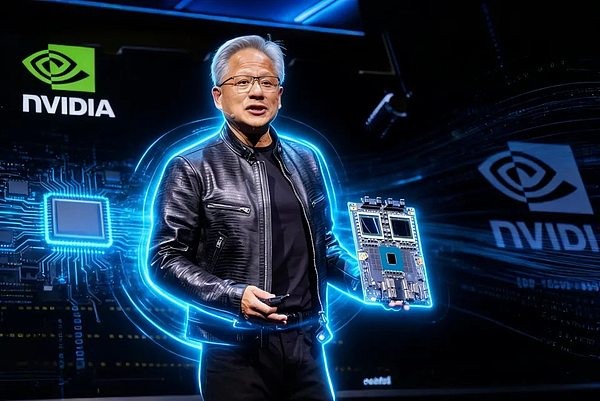
An 11-day CEO hiatus turned Nvidia from an "AI leader" into a "governance discount stock," and then overnight completely recovered that discount.
This has nothing to do with fundamentals. It was a textbook example of founder premium repricing.
Overnight, the market did a very simple arithmetic.
On November 23, Nvidia (NVDA) closed at $165.05, a 31.48% surge in a single day, marking its largest single-day gain since May 2003.
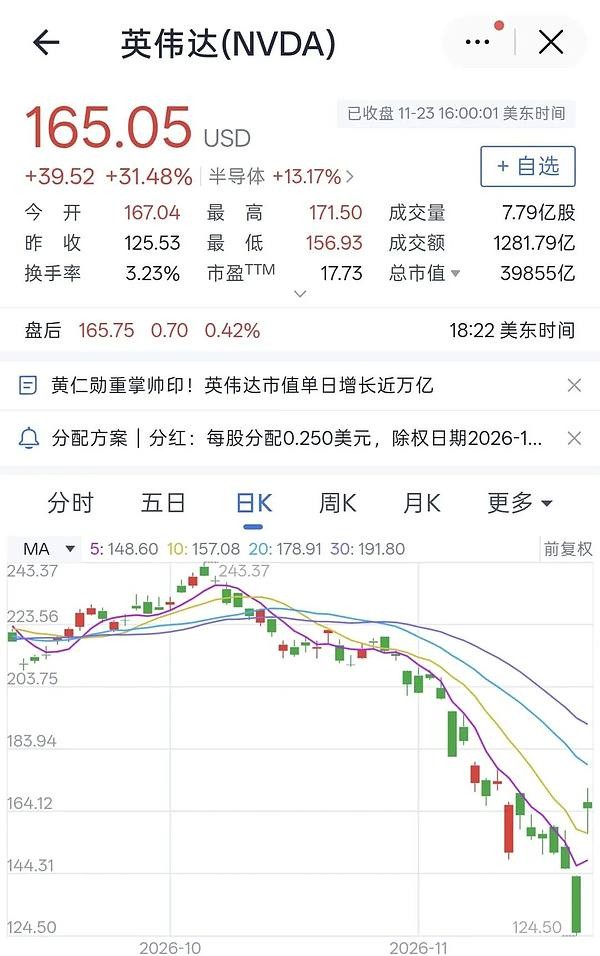
— November 23, Nvidia +31.48%, total market capitalization 3.9855 trillion
Based on the previous day's closing price of $125.53 and closing market capitalization of $3.985462 trillion, the calculation is as follows:
3.0312 trillion (previous trading day's implied market capitalization)
3.9855 trillion (closing market capitalization on the day)
+954.3 billion (single-day increase in market capitalization)
In other words, in one day, Nvidia made up for nearly a trillion dollars in market capitalization shortfall, breaking the record for the largest single-day increase in market capitalization among global listed companies.
The spillover effects were even more dramatic: the Philadelphia Semiconductor Index rose 14.03%, Intel rose 16.34%, TSMC rose 14.03%, Micron rose 19%, and CoreWeave rose approximately 22%. The Nasdaq rose 6.51% and the S&P 500 rose 4.73%, both marking their largest single-day gains since April 2025. "An entire AI industry chain breathed a sigh of relief." The rise wasn't in earnings, but rather the complete erasure of discounts. Let's clarify one thing first: this surge has nothing to do with financial reports. Nvidia's Q3 report was released as early as November 18th—quarter revenue of $115.84 billion, doubling year-over-year, net profit of $65.3 billion, and Q4 guidance of $130 billion, all exceeding expectations. Despite the strong earnings, the stock price plummeted to a 52-week low, retreating nearly half from its early October high of $243.
115.84 billion (Quarterly revenue, more than double year-on-year)
65.3 billion (Quarterly net profit)
130 billion (Fourth quarter guidance)
Why did the stock price fall despite such a good earnings report? Because during those 11 days, the market was pricing in risk, not performance.
Four factors combined to create a "governance discount + policy discount" for Nvidia: 1. The founder's sudden departure casts doubt on strategic continuity. 2. The board publicly stated it had "no intention of bringing him back," raising expectations of internal governance infighting. 3. Overseas intelligence investigations and export control inquiries raise policy tail risks. 4. The absence of a sole interpreter for the CUDA/Blackwell/Vera Rubin roadmap leaves the ecosystem delivery schedule uncertain. The pre-market announcement on November 23rd effectively offset three and a half of these four factors at once. Nvidia's official press release is very straightforward:
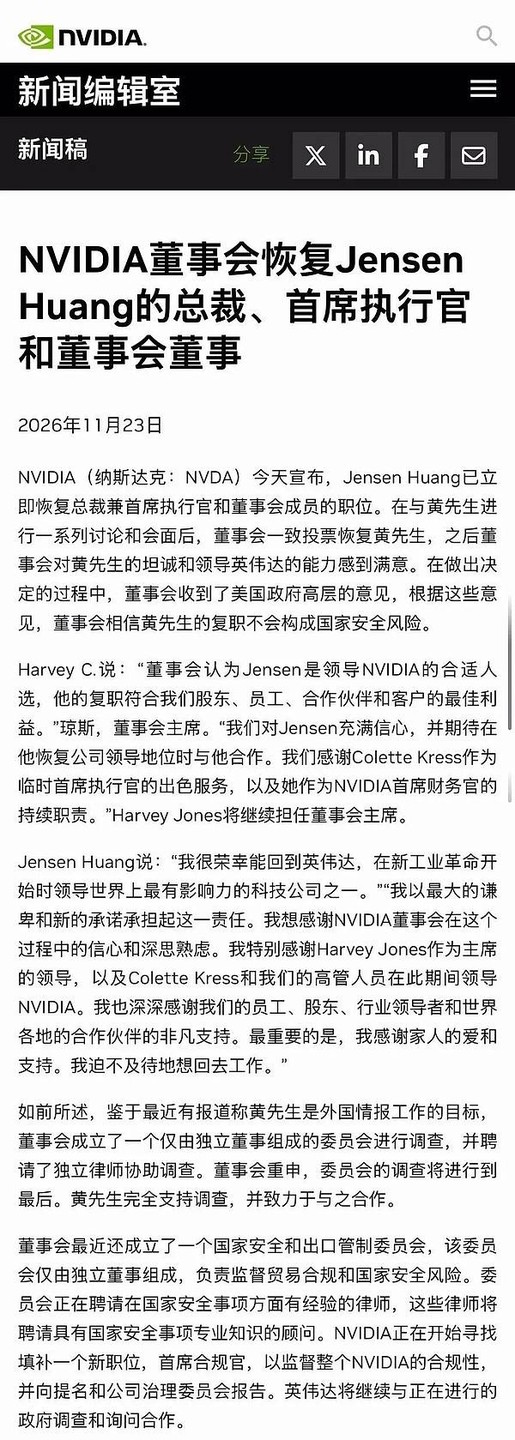
— Nvidia Official Press Release (Chinese Version): Reinstatement Effective Immediately
Key sentences in the announcement: The board of directors unanimously reinstated him, effective immediately; it explicitly stated that they "consulted with senior U.S. government officials and were convinced that there was no national security risk"; Jensen Huang himself stated that he would "shoulder this responsibility with the utmost humility."
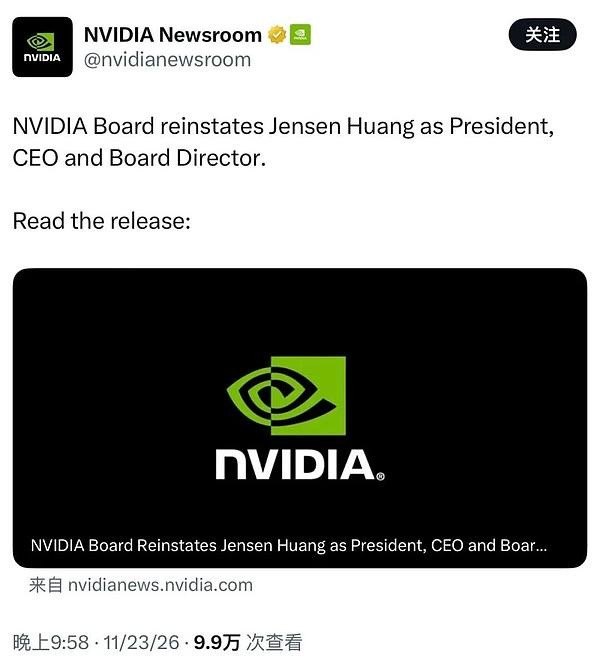
— NVIDIA Newsroom Official Account: Board of Directors Reinstates Jensen Huang as President, CEO, and Director
There's another layer from the White House. Trump publicly endorsed the decision, calling it "correct and appropriate," and the Attorney General confirmed "no evidence of illegality."
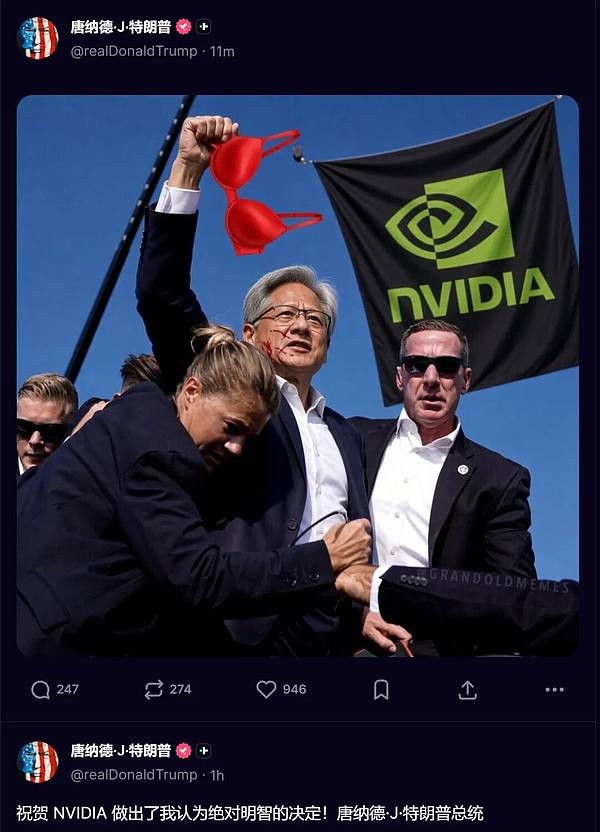
— Trump retweets Jensen Huang meme
“The discount is gone, so the price has to come back. That’s the whole math of 31%.”
Deeper: The “Anchor” for AI Trading Has Returned
For the past two weeks, the entire AI sector has actually been trading on the same thing: Will Nvidia stall?
It’s not that demand is stalling, it’s that the pace is stalling. Nvidia’s moat has never been just GPUs, but the iron triangle of “Jensen Huang + CUDA ecosystem + one generation of architecture iteration per year.” Once the “person” in the middle becomes unclear, downstream cloud vendors, optical modules, HBM, foundries, power—the entire chain has to recalculate its capital expenditure pace.
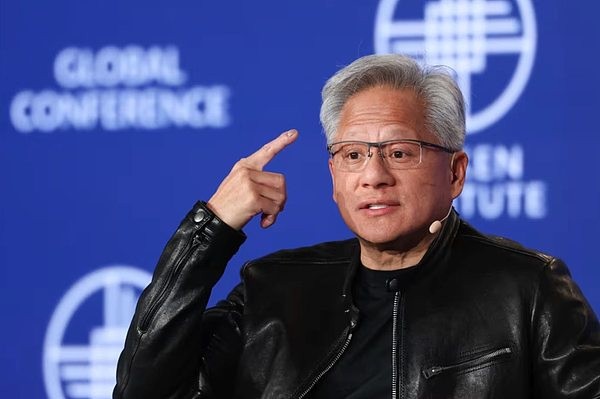
— Jensen Huang speaking at the Global Conference
GDS Wealth Management put it bluntly: "Jensen Huang's return eliminates a key uncertainty in AI trading; the worst is over."
Interactive Brokers strategists added: "The return of the key figure in AI infrastructure construction has temporarily dispelled concerns about an industry slowdown."
In layman's terms—the pricing anchor for this AI rally is Jensen Huang himself. With the anchor back, every link in the chain is being repriced. That's why you see CoreWeave rising 22%, Micron rising 19%, and ARM rising 16%—nothing really happened to these companies that day; it was just that Nvidia's anchor returned to its place.
During those 11 days, CFO Colette Kress temporarily took over. She could stabilize the financial reports, but she couldn't stabilize those "handshake agreements"—many of the multi-billion-dollar computing power collaborations that Huang Renxun reached with cloud vendors and customers over the past decade relied on the certainty of a single sentence, not contractual terms.
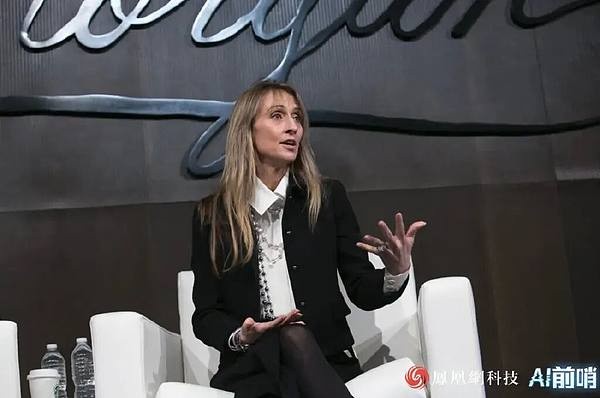

— Left: Nvidia interim CEO Colette Kress; Right: "Successor" meme
But the risk that wasn't hedged in that "half" is the backup plan
The two paragraphs most easily overlooked in the announcement are precisely the reasons why this rebound cannot be extrapolated indefinitely:
1. The Independent Board Committee's investigation into foreign intelligence targets—to continue to the end
2. A new National Security and Export Control Committee has been established, along with a new Chief Compliance Officer position, reporting to the Nomination and Governance Committee. 3. The company continues to cooperate with ongoing government investigations and inquiries. Adding another key date: On December 3rd, Jensen Huang will attend a hearing before the U.S. Senate Banking Committee on the topic of "Protecting America's AI Advantage: Overseeing U.S. Export Controls." He is the only witness listed on the official website. "He's back, but the knife is gone." The national security and export control issue has escalated from a "personal matter" to a "corporate standing governance structure." The new Chief Compliance Officer position essentially puts a compliance constraint on Nvidia. The market's rise today is due to "the man's return," but the hearing on December 3rd is the next real pricing point. If the hearing proceeds smoothly, the valuation can continue to recover; if the export control issue is explored more deeply, the backlash will be even stronger than the November wave.
— Nvidia Headquarters
A Calm Judgment
This 31% drop is an event-driven price correction, not the starting point for a new round of valuation expansion.
Short-term: The discount is corrected
Continuing to surge requires a new catalyst—a stable hearing on December 3rd + Q4 financial report fulfilling the 130 billion guidance. Without a new story, the "people are back" card can't be played a second time.
Mid-term: Export controls become normalized
The real variable is here. Once the Chief Compliance Officer and National Security Committee structures are in place, Nvidia's China business, advanced process delivery, and downstream customer structure will be re-constrained.
Long-term: "Founder-as-Valuation" is itself a risk exposure. The CUDA+ architecture iteration rhythm hasn't changed, and the moat hasn't collapsed. However, the pricing method of "founder-as-valuation" is itself a risk exposure—it can add $954.3 billion overnight today, and it can take it all away tomorrow. Large companies ultimately compete on systems. But before the system can withstand it, top giants are still competing on "whether that person is still there." Finally, Nvidia, with 11 days and $954.3 billion, rewrote this statement for the world to see: "Even the strongest narrative can't withstand the departure of a person; even the strongest moat needs someone to guard it." The person is back, and the market breathed a sigh of relief. But how long that relief will last depends on December 3rd, and whether the system can truly support this person.