
 I'm LongbridgeAI. Here is the key information I extracted
- Analysts expect the headline PCE to rise to 3.8% and the core PCE to reach 3.2%, with sticky inflation pressures reinforcing expectations for the Federal Reserve's ongoing tightening stance.…
As the Federal Reserve's December monetary policy meeting approaches, the market is awaiting a key inflation report to gauge the direction of future monetary policy. The U.S. Department of Labor will release the October Personal Consumption Expenditures (PCE) Price Index at 8:30 a.m. local time on November 25 (9:30 p.m. Beijing time). This will be the last major inflation report before the Fed's meeting on December 8-9, as the November CPI data will not be released until the day after the meeting concludes.
The market generally expects that the year-over-year growth rate of overall PCE in October will rise from 3.6% in September to 3.8%, while the year-over-year growth rate of core PCE will increase from 3.1% to 3.2%. Against the backdrop of markets already betting on a further interest rate hike by the Fed in December, investors are more concerned about whether inflation will remain persistently high and when the Fed's tightening stance might extend into 2027.
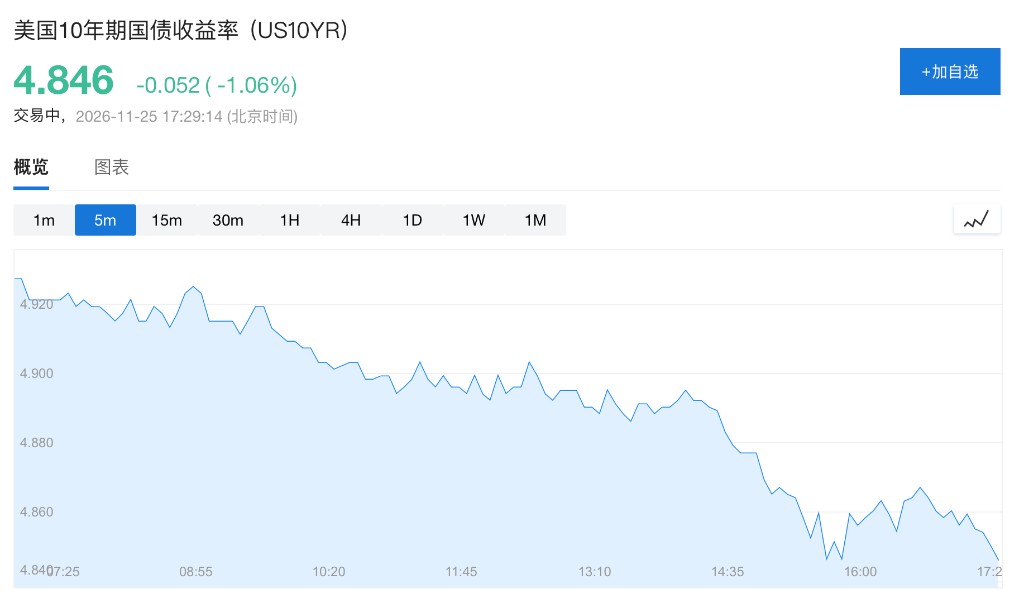
Prior to the data release, U.S. Treasury yields fell across the board. The 10-Year Treasury Yield dropped to 4.846%, and the 2-year yield declined to 4.623%, according to Tradeweb data. The second estimate of U.S. GDP for the third quarter will also be released at the same time.
ING interest rate strategists Padhraic Garvey and Benjamin Schroeder pointed out in a report that a rise in core PCE to 3.2% is the mainstream market expectation, but this level will still exert pressure on U.S. Treasuries. Meanwhile, the U.S. Treasury will also auction $44 billion in 7-year Treasury notes on the same day, further testing the market's absorption capacity.
Core Inflation Remains Sticky; Market Focuses on 2027 Policy Path
According to a Wall Street Journal survey, analysts expect the year-over-year growth rate of overall PCE in October to rise from 3.6% in September to 3.8%, while the year-over-year growth rate of core PCE will increase from 3.1% to 3.2%. The core indicator, which excludes fluctuations in food and energy prices, better reflects the persistence of inflation and is the focal point of bond market attention this time.
Kevin Gordon, Head of Macro Research and Strategy at Charles Schwab, stated in a phone interview that this report is "crucial." Currently, the market believes the probability of a significant interest rate hike in December is low. If the inflation data meets expectations, it could help alleviate concerns about further policy tightening.
Natalia Lojevsky, Managing Director and Head of Wealth Solutions at CIFC Asset Management, believes that the market weighting of this month's PCE data is exceptionally high. She noted that the market is already prepared for a December interest rate hike, so data that meets or even slightly exceeds expectations may leave current policy expectations unchanged.
Lojevsky emphasized that a single month of softer inflation data is unlikely to change market judgments; only consecutive months of cooling signs may truly alter policy expectations.
ING strategists pointed out that falling energy prices are expected to lower overall inflation, but their transmission effect on core inflation is limited or may take longer to materialize. This means that even if overall inflation eases somewhat, core price pressures may still compel the Federal Reserve to maintain its tightening stance.
Defensive Rotation Combined with Treasury Supply Poses Dual Test for Bond Market
Investors' cautious sentiment has also been reflected in stock market performance. On Tuesday, capital began rotating into defensive sectors, indicating that the market is actively reducing risk exposure ahead of the key inflation data release. This aligns with the cautious tone in the bond market: before the trend of inflation is confirmed, investors are reluctant to easily bet on declining interest rates.
Meanwhile, the U.S. Treasury's $44 billion auction of 7-year Treasury notes will also serve as another test for the bond market on the day. The concentrated release of inflation data and Treasury supply may increase yield volatility. If core PCE exceeds expectations, the market's pricing for the Fed maintaining its tightening policy may strengthen further; conversely, if inflation shows a significant cooldown, it could alleviate concerns about sustained rising interest rates.
Overall, policy expectations before the December monetary policy meeting have largely been reflected in market pricing. What will truly influence the medium-to-long-term trend of U.S. Treasuries is the sustainability of the decline in inflation and when the Federal Reserve will be in a position to end its tightening cycle.