
Bernstein: rough estimates suggest hyperscalars will roll out roughly $1.2 trillion of AI infrastructure by 2027. Achieving a 15% return on investment would require about $175 billion in net profits, meaning around $729 billion in spending at a 24% net margin. That is roughly three times Exponential View's $229 billion ARR projection from August.
$Alphabet(GOOGL.US) $Meta Platforms(META.US) $Microsoft(MSFT.US) $Oracle(ORCL.US) $Amazon(AMZN.US)
Equity research

E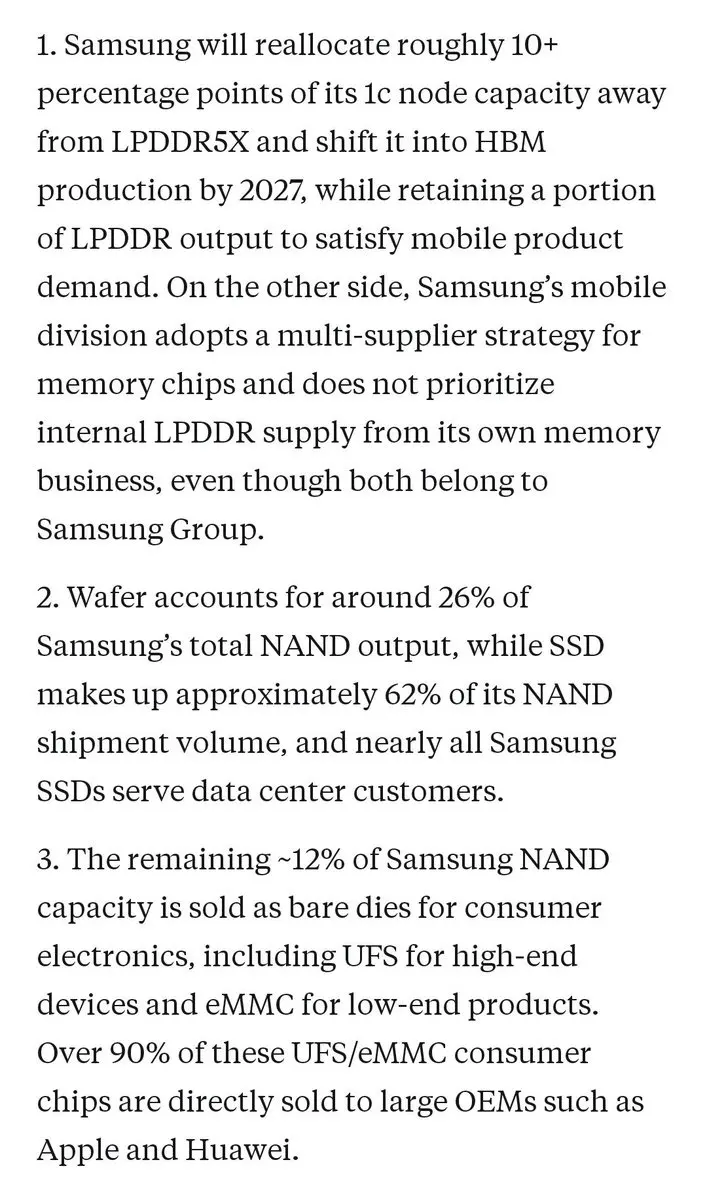
Expert Takeaways: Samsung
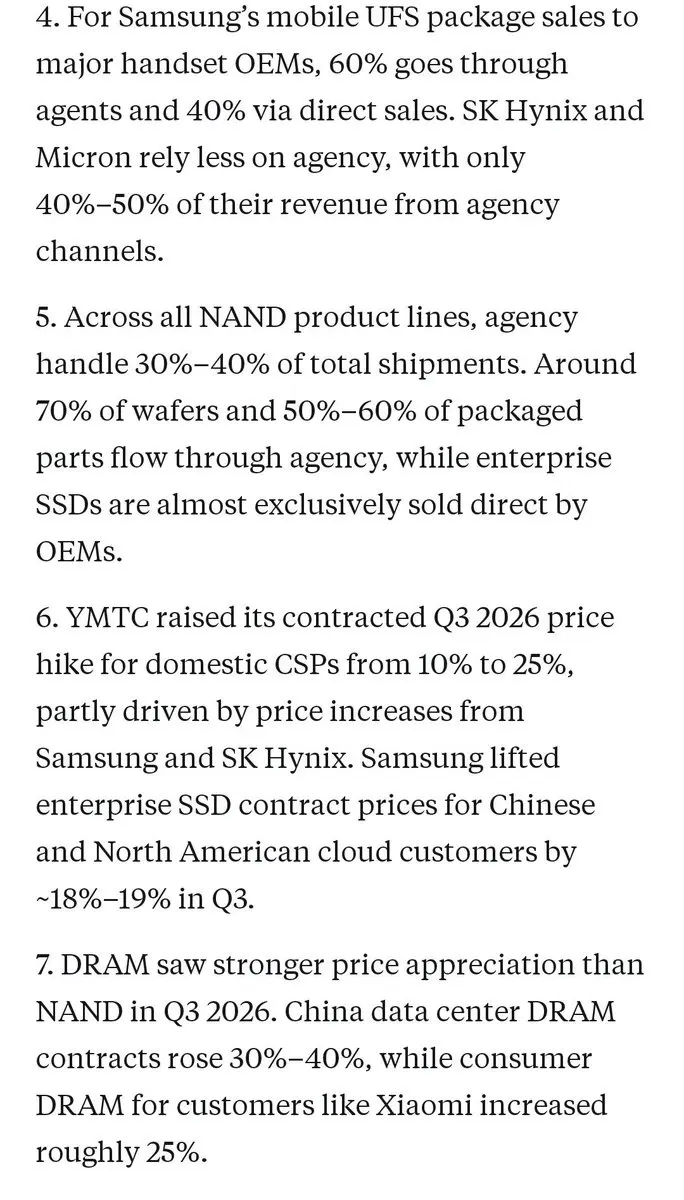
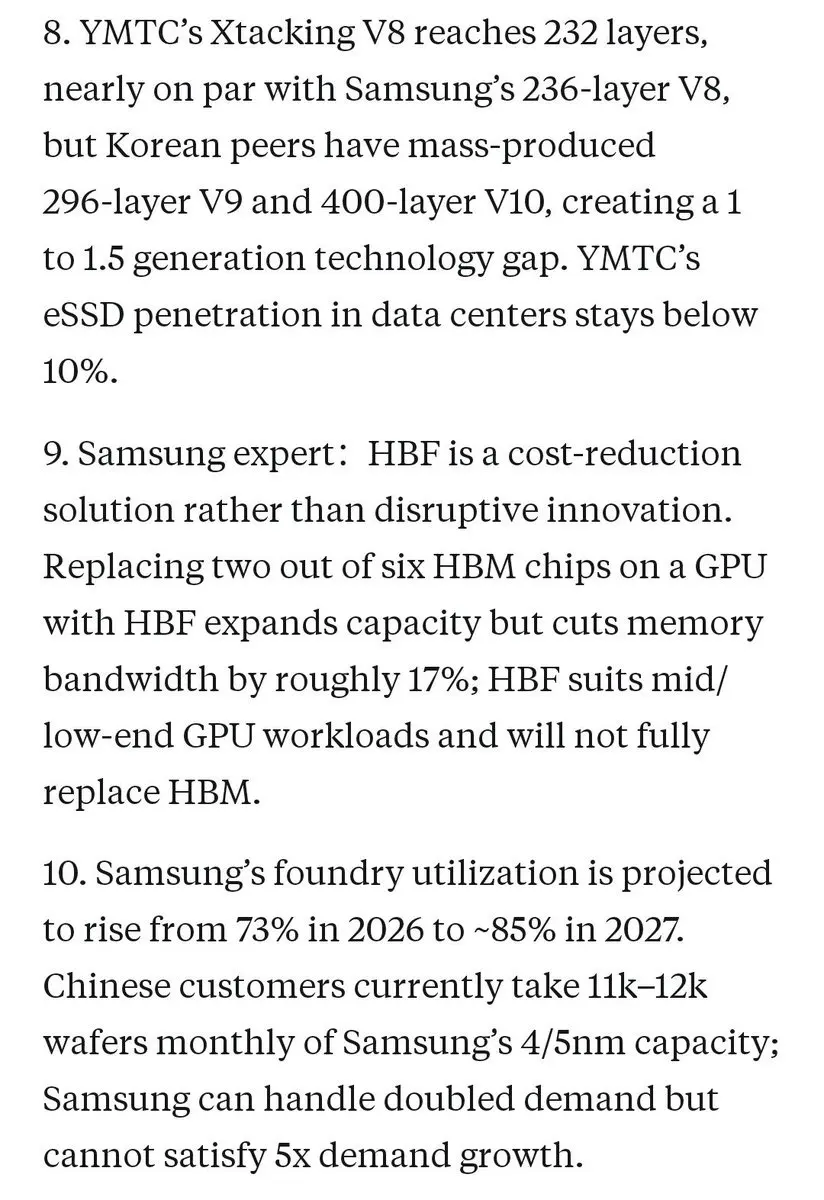
> Samsung's Production & Sourcing Shift: Samsung is reallocating 10%+ of its 1c node capacity from LPDDR5X to HBM by 2027, while its mobile division relies on a multi-supplier strategy rather than prioritizing internal memory supply.> NAND Product Breakdown & Sales Channels: SSDs account for ~62% of Samsung's NAND shipments (mostly for data centers), while agency channels handle 30%–40% of overall NAND shipments and 60% of Samsung's mobile UFS sales.> Q3 2026 Price Hikes: Price increases from Samsung (~18%–19% for enterprise SSDs) and SK Hynix helped push YMTC's Q3 2026 contract price hikes for domestic CSPs up to 25%. DRAM saw even steeper growth, with China data center contracts rising 30%–40%.> Tech Gap with YMTC: YMTC's Xtacking V8 (232 layers) trails Korean peers who mass-produce 296-layer (V9) and 400-layer (V10) chips, keeping YMTC's enterprise SSD data center market penetration under 10%.> HBF & Foundry Forecasts: HBF is viewed as a cost-reduction tool for mid/low-end GPUs—expanding capacity but reducing bandwidth by ~17%—while Samsung's foundry utilization is expected to grow from 73% in 2026 to ~85% in 2027.Date: 10/7/26$Micron Tech(MU.US) $DRAM $EWY
E![图片 1,共 1 张]()
Rothschild: Anthropic's contracted capacity by counterparty
$Amazon(AMZN.US) $Alphabet(GOOGL.US) $Microsoft(MSFT.US) $SpaceX(SPCX.US) $Coreweave(CRWV.US)
E![图片 1,共 2 张]()
![图片 2,共 2 张]()
SpaceX & xAI : 10GW–20GW AI Data Center Buildout, Terafab & Supply Chain Strategy
> 10GW compute target (with a 20GW long-term goal) up from ~1.3GW current capacity.> 60% internal (xAI, SpaceX, Tesla) and 40% external (Anthropic, Google) for the initial 10GW.> Plans include terrestrial sites, a late 2027 Star Mine space data center, and a 2028 lunar deployment.> Terafab launching to make proprietary ASICs solely for internal use to dodge geopolitical risks.> Memphis/South Haven sites mix 3.6–4GW grid, 4GW gas turbines, 2GW Tesla solar, and 2GW Megapack backup.> Facing tight supply constraints on PCBs, optical modules, transformers, and cooling hardware.$SpaceX(SPCX.US) $Intel(INTC.US) $Taiwan Semiconductor(TSM.US)
E![图片 1,共 1 张]()
Rosenblatt: Amazon AWS revenue to climb to $334 billion in 2028E, up from $177 billlion in 2026E.
"A $496B backlog and +$200B in Trainium commitments provide contracted revenue that imply strong Y/Y gains before any new or on-demand bookings realized." $Amazon(AMZN.US)E![图片 1,共 1 张]()
UBS: WFE spend is projected to go from $116.5B in 2025 to $274.5B in 2028E (2.4x), with memory leading at 2.7x, from $46.3B to $125.8B.
$Teradyne(TER.US) $KLA(KLAC.US) $Lam Research(LRCX.US) $Applied Materials(AMAT.US) $MKS(MKSI.US)
E![图片 1,共 3 张]()
![图片 2,共 3 张]()
![图片 3,共 3 张]()
Coherent Expert Interview: Takeaways
Pluggable Transceivers & ASP Trends2025 Performance: Shipped ~3.1 million 800G units (ASP $415) and 2.2 million 1.6T units (ASP $1,320).2026 Forecast: Expected to grow to 7.4 million 800G units (ASP dropping to $370) and 3.2 million 1.6T units (ASP dropping to $1,100).DSP Cost Pressure: A 12% DSP chip price hike starting September 2026 will impact costs beginning Q4 2026; Coherent plans to pass most cost increases downstream via quarterly contract adjustments.NPO & CPO RoadmapMass Ramp (2027): NPO business hits mass ramp in H2 2027, targeting 220k–230k (1.6T), 380k–400k (3.2T), and 70k–80k (6.4T) units. All current designs still require DSP chips.FAU Supply Chain: HD Optics is a key supplier holding a 45%–48% share for CPO DFAU and ~40% for NPO FAU, with TFC as the other major vendor.InP Capacity Expansion: Completed the first doubling of 6-inch InP capacity in H1 2026, with a second doubling planned for 2027 to support laser, EML, and NPO/CPO demand.Optical Circuit Switches (OCS)2026 Volume: Shipped 1,400 units of the 300x300 bidirectional port model, with Google driving ~1,300 units. The 512x512 large-port version is delayed to 2029.Future Forecast: Projected at 4,400 units for 2027 (Google ~4,000, NVIDIA ~300) and scaling to 10,500 units in 2028 (adding Meta adoption).Customer Concentration: NVIDIA and Google account for roughly 48% and 23% of Coherent’s optical module sales, respectively.Lasers & EML ChipsEML Shipments (2026): 100G EML reaches 17.8 million pieces (~$9 ASP, dropping to ~$8 for bulk orders); 200G EML hits 11.5 million pieces (~$17 ASP).CW Lasers (300mW): Grew from 1.1 million units (2025) to 3.2 million units (2026), with ASP decreasing from $38 to $34.Financials & Profitability TargetsIndustrial Revenue: Projected at $2.21bn (2025), $2.32bn (2026), $2.48bn (2027), and $2.7bn (2028). (2025 baseline: 34.2% gross margin, 13.1% net margin).Net Margin Targets: Company-wide net margin is targeted at 17.8% (2026), ~19% (2027), and a long-term goal of 22%–25% from 2028 to 2030.$Coherent Corp.(COHR.US)
E![图片 1,共 3 张]()
![图片 2,共 3 张]()
![图片 3,共 3 张]()
Expert takeaways on optics:
> 350–400mW high-power CW laser 2027 shipment target revised upward from 16 million to 25 million units. Unconstrained market demand stands at roughly 60 million units, yet capacity acts as the hard constraint.> OCS current shipments are dominated by Google and Oracle’s 300port demand.> OCS ASP declined with product volume ramp up: early samples were $14k–$15k, while volume pricing now lands at $10k–$11k.> Two CPO light source options are under evaluation for next-gen NVIDIA Feynman architecture: boosting laser power to ~800mW, or retaining 350–400mW power while adopting 16-wavelength DWDM.> Substrate suppliers for high-power lasers are primarily AXT and Sumitomo, with JX Metal of Japan as the secondary option. High-power lasers currently use 4-inch wafers; 6-inch wafer adoption is scheduled for 2028.$Coherent Corp.(COHR.US) $Lumentum(LITE.US) $NVIDIA(NVDA.US) $Alphabet(GOOGL.US) $AXT(AXTI.US)
E![图片 1,共 1 张]()
UBS: Nvidia's CPO suppliers
$NVIDIA(NVDA.US) $Taiwan Semiconductor(TSM.US) $Teradyne(TER.US) $Advanced Semiconductor Engineering(ASX.US)
E![图片 1,共 1 张]()
According to the IPO prospectus of Anthropic seen by Reuters.
> Anthropic reported a net loss of $42 billion in 2025, and plans to spend $518 billion on cloud, computing and infrastructure obligations in coming year. > Revenue grew 12-fold in 2025 to nearly $4.6 billion, even as the company lost more than $8 billion on an operating basis, excluding writedowns of various liabilities mostly tied to previous fundraising.> The AI lab spent $7.33 billion on compute and infrastructure last year, a threefold surge from 2024, accounting for more than half of its $12.65 billion in total operating expenses.> The near-$42 billion net loss included a roughly $34 billion accounting charge that reflected an increase in the estimated value of financing that could eventually turn into Anthropic shares, rather than money the company spent running its business.> Anthropic had cash, cash equivalents and short-term investments totaling $20.28 billion as of December 31, the prospectus shows.$Alphabet(GOOGL.US) $Amazon(AMZN.US) $Microsoft(MSFT.US) $Meta Platforms(META.US) $AMD(AMD.US) $NVIDIA(NVDA.US)E![图片 1,共 1 张]()
Evercore ISI: Marvell's 800G DSP share to remain high and perhaps increase 80+% as Broadcom prioritizes, although, 1.6T share expected to increase in 2027 vs 2026.
$Broadcom(AVGO.US) $Marvell Tech(MRVL.US)
E![图片 1,共 1 张]()
Barclays: total sales for the ethernet market is expected to increase from ~$20 billion in 2025 to $80 billion in 2031. AI scale-out remains the largest segment, while AI scale-up expands fastest, with a 413%/198% yoy unit growth in 2027 and 2028, respectively. AI-related demand is estimated to be 79% of units in 2031, compared to 62% in 2025.
$NVIDIA(NVDA.US) $Applied Optoelectronics(AAOI.US) $Lumentum(LITE.US) $Coherent Corp.(COHR.US) $Credo Tech(CRDO.US) $Macom Tech(MTSI.US)E![图片 1,共 1 张]()
Nice coverage by @FuturumEquities on Coherent from ECOC 2026.
> Anderson told the ECOC audience that PhotonLink adds roughly $30 billion of integrated optics opportunity to the company’s 2030 addressable market, raising the total from $60 billion for the existing portfolio to $90 billion.> The company disclosed 2 long-term agreements with leading hyperscale AI datacenter customers for its ultra-high-power laser platform, spanning both CPO and NPO, and put its content opportunity at up to $15,000 per 100 Tbps switch or compute chip on 200G optical lanes when it supplies the complete solution.> More than 300 million InP lasers shipped, more than 1 billion photodetectors, more than 650 million optical components, and more than 250 million lenses. Capacity is expanding to match, with GaAs lines supporting more than 1 billion VCSEL arrays per year. > InP capacity doubled last year, a quarter ahead of schedule, and a further doubling is planned through CY2027 on the industry’s first 6-inch InP production ramp.> Production timing frames the revenue story with scale-out CPO ramping in the December quarter, scale-up CPO and NPO following in 2H CY2027, and chip-to-chip landing in the 2029-2030 window.$Coherent Corp.(COHR.US)E
Jefferies: AI transceiver forecast now pushing to nearly 180 million units in CY27, including 90 million 800G and 80+ million 1.6T units. Growing to 245 million in CY28. Material production volume for Scale-Up CPO has likely pushed to CY29.
$Applied Optoelectronics(AAOI.US) $Lumentum(LITE.US) $Coherent Corp.(COHR.US) $Macom Tech(MTSI.US) $NVIDIA(NVDA.US) $Broadcom(AVGO.US) $Marvell Tech(MRVL.US)
E
After holding a conference with major memory makers, BofA remains confident in the memory super-cycle continuing through 2028-2030 with no downturn, as high ASPs, strong demand, and supply tightness continue.
$Micron Tech(MU.US) $DRAM $EWY $DISK $SK Hynix(SKHY.US) $Sandisk(SNDK.US)E![图片 1,共 1 张]()
ABF substrate S/D gap is expected to become progressively worse year over year, reaching a S/D gap of 46% in 2028. Up from just 1% in 2026.
Hello ABF substrate department? Yes, please send us more ABF we need it desperately!E![图片 1,共 1 张]()
Long-term contracts for 12-inch silicon wafers are expected to rise next year
Industry surveys estimate that the price of new long-term contracts for 12-inch epitaxial wafers will increase by 15% to 25%, while the price of polished wafers may increase by more than 40%, with some second-tier customers seeing increases of over 50%, and there is still room for further price increases in 2028.Currently, the spot price of 12-inch silicon wafers continues to rise. Analysts predict that the spot price may surpass existing long-term contract prices in the fourth quarter of this year, becoming an important support for the renegotiation of new long-term contracts in 2027.From the demand side, analysts believe that AI will continue to drive demand for advanced logic chips. Overall CoWoS capacity is projected to increase by 70.9% year-on-year in 2027, while shipments of GPU and AI ASIC chips are projected to increase by 44.9% year-on-year. Overall shipments of Intel, AMD, and NVIDIA CPUs are also projected to increase by 36% year-on-year, which will simultaneously boost 12-inch wafer starts and silicon interposer demand.Memory capacity expansion is another source of demand support. Analysts predict that DRAM bit supply will only increase by 22% year-on-year in 2027, which will still be insufficient to fully support the growth in demand.With both prices and shipments growing in tandem, GlobalWafers' operations are expected to expand significantly starting in 2027. Analysts predict that its ASP for 12-inch silicon wafers will increase from US$92 in 2026 to US$122 in 2027, an annual increase of approximately 32.6%, and further rise to US$166 in 2028, an annual increase of approximately 36.9%.Shipments of 12-inch silicon wafers are estimated to increase from 11,907 kwpq in 2026 to 16,174 kwpq in 2027 and 21,237 kwpq in 2028.$GlobalFoundries(GFS.US) $Micron Tech(MU.US) $Intel(INTC.US) $AMD(AMD.US) $NVIDIA(NVDA.US) $Taiwan Semiconductor(TSM.US) $Alphabet(GOOGL.US)E![图片 1,共 2 张]()
![图片 2,共 2 张]()
Rothschild & Co: Nebius and CoreWeave ecosystem
$Nebius(NBIS.US) $Coreweave(CRWV.US) $Microsoft(MSFT.US) $Amazon(AMZN.US) $NVIDIA(NVDA.US) $AMD(AMD.US) $Alphabet(GOOGL.US)E![图片 1,共 1 张]()
Samsung Securities: Key Terafab Beneficiaries
Terafab initially plans to leverage Intel's 14A process technology and supply chain, as a result, these global and domestic equipment vendors are positioned as key early beneficiaries.$ASML(ASML.US) $Applied Materials(AMAT.US) $Lam Research(LRCX.US) $KLA(KLAC.US) $Intel(INTC.US) $SpaceX(SPCX.US)E
BofA: expect U.S. top hyperscalers (Amazon, Microsoft, Oracle, Alphabet) to grow cloud revenue to $975 billion in 2028, up from $290 billion in 2025. Meanwhile, China's top hyperscalers (Alibaba, Tencent, ByteDance, Baidu) cloud revenue to increase to $94 billion, up from $28 billion.
$Alphabet(GOOGL.US) $Amazon(AMZN.US) $Microsoft(MSFT.US) $Oracle(ORCL.US)E![图片 1,共 1 张]()
General Manager of Microsoft Taiwan says the demand for AI computing power will continue to exceed supply for the next 2-3 years, as a result, the company is expanding the construction of data centers in Taiwan from 2 to 4.
$Microsoft(MSFT.US) $NVIDIA(NVDA.US) $AMD(AMD.US) $Alphabet(GOOGL.US) $Amazon(AMZN.US)E
BofA: We do not expect “de-spec” or lower memory content in new GPUs/ ASICs; instead, we assume a further increase, to 1,000GB per Rubin Ultra or 384GB for the new Rubin, vs 288GB currently.
$NVIDIA(NVDA.US) $AMD(AMD.US) $Alphabet(GOOGL.US) $Amazon(AMZN.US) $Microsoft(MSFT.US) $Meta Platforms(META.US)E![图片 1,共 1 张]()
DS Investment & Securities: SiC & GaN
Market Growth & Opportunities:> The adoption of 800V architectures creates new growth opportunities for 8inch foundries, challenging traditional Si power semiconductors.> SiC Power Market: Expected to grow at a CAGR of +20%, scaling from $3.4 billion (2024–2025) to $10.3 billion by 2030F.> GaN Power Market: Expected to experience even faster growth at a CAGR of +44%, rising from $0.6 billion to $3.0 billion by 2030F.Role Breakdown & Material Specialization:> SiC: Excels in high-voltage, high-power, and high-temperature environments, serving as a partial substitute for Si IGBT. Main applications include EV inverters/OBC, 800V EVs, AI datacenters (AI DC), and energy storage systems (ESS).> GaN: Excels in high-frequency, high-power-density, and high-efficiency power conversion, serving as a partial substitute for Si MOSFETs. Key application areas include chargers, adapters, power supply units (PSU), AI datacenters, robots, and solar power.Infrastructure & Trends:> Datacenter Penetration: The penetration rate of SiC/GaN within datacenter power systems is projected to increase from 17% in 2026F to over 30% by 2030F, driven heavily by new high-frequency, high-density conversion needs (such as 800V to 54V/12V transitions in AI datacenters).> Manufacturing Shifts: SiC is currently transitioning from 6-inch to 8-inch fabrication lines, while GaN relies heavily on 8-inch GaN-on-Si processes. Long-term transitions up to 12-inch wafers are also being evaluated.