
$Intel(INTC.US)
Intel’s 10% CPU hike feels like another inflationary hit for PC buyers. I expect volumes to suffer, but tight supply and AI demand give Intel room to push prices—for now.


$Intel(INTC.US)
Intel’s 10% CPU hike feels like another inflationary hit for PC buyers. I expect volumes to suffer, but tight supply and AI demand give Intel room to push prices—for now.
OpenAI's GPT-6 Astra and Nvidia's "AGI has arrived" moment are the most visible face of an AI compute boom so intense it's pushed global memory chip inventories down to just 10 days' worth. Separately...
$DBS(D05.SG)
DBS, OCBC or UOB: Which Bank Wins on S$10,000?
For a S$10,000 investment, DBS wins the dividend race, but it is not necessarily the cheapest.
Using FY2026 annualised payouts, S$10,000 generates roughly S$421 from DBS, S$386 from UOB and S$332 from OCBC. DBS therefore ranks first for income, although part of its payout includes a capital-return component that may not be permanent.
Force Ranking
1. DBS — BUY/HOLD
The clear quality leader. 1H26 net profit reached S$6.01bn, ROE was 17.5% and asset quality remained strong. The downside is valuation: around 19x earnings and 3x book, making DBS the most expensive.
2. UOB — BUY
The valuation winner at roughly 16x earnings and 1.4x book, with ~4% yield. However, weaker ROE and greater exposure to regional economies temper the upside.
3. OCBC — HOLD
Strongest 1H26 earnings growth, but its ~17x P/E and ~2x book valuation leave less margin of safety. Its lower ~3.3–3.5% yield also trails DBS and UOB.
Technically, all three remain strong after their 2026 rally, but valuations are stretched. Falling rates could further compress NIMs, while credit losses and slower regional growth remain key headwinds.
Verdict: DBS for quality and income; UOB for value; OCBC for growth. Overall: DBS > UOB > OCBC.
Not financial advice.

$DBS(D05.SG)
US August jobs surprised on the upside, putting rate hikes back in the spotlight. For Singapore’s three local banks, that could mean one thing: NIMs may stay healthier for longer.
US markets are closed today for Labor Day, so let's recap Friday's session: August non-farm payrolls blew past estimates, pushing September rate-hike odds to 60%. Tesla's Cybercab officially launched ...
$SATS(S58.SG)
SATS: Why the 15% Drop — and Is the Worst Over?
SATS (S58) did not disappoint on revenue; it disappointed on quality of growth. Q1 FY27 revenue rose 11.3% to S$1.68b, but EBITDA grew only 5.9%, squeezing margin to 17.3%. Profit rose just 6% to S$75.1m. The 18.9% decline in associates/JVs earnings added to the concern.
The bigger issue is cost inflation and execution. Middle East disruptions, flight cuts, labour/input costs and weaker JV volumes are turning strong cargo growth into weaker incremental profits. That explains the market’s reaction.
FY26 fundamentals remain solid: revenue S$6.35b (+9%), PATMI S$285.2m (+17%), EBITDA S$1.15b (+10.6%) and FCF S$215.8m. But leverage deserves watching: debt/EBITDA is ~3.3x and interest coverage ~4.5–5.2x — not dangerous, but hardly comfortable for a low-margin business.
At ~$4.04, valuation is around 21x earnings, while the 7-cent dividend yields only ~1.7%. Technically, the 15% breakdown is bearish.
View: HOLD. Existing shareholders need not panic, but chasing the rebound looks premature. The thesis remains intact if margins recover; below ~$4, the risk/reward becomes more interesting.
Not financial advice.
$NVIDIA(NVDA.US)
NVDA just dropped a $12.9B acquisition on Hugging Face—the “GitHub for AI.” It gives Nvidia a front-row seat to open-source AI. Brilliant strategic move… or an expensive bet?
Snowflake surged 16.55% on a blowout earnings beat, and Fed Governor Waller's dovish tilt sent September rate-hike odds tumbling. All three US indices closed up more than 1%. Tesla's Cybercab official...
$ST Engineering(S63.SG)
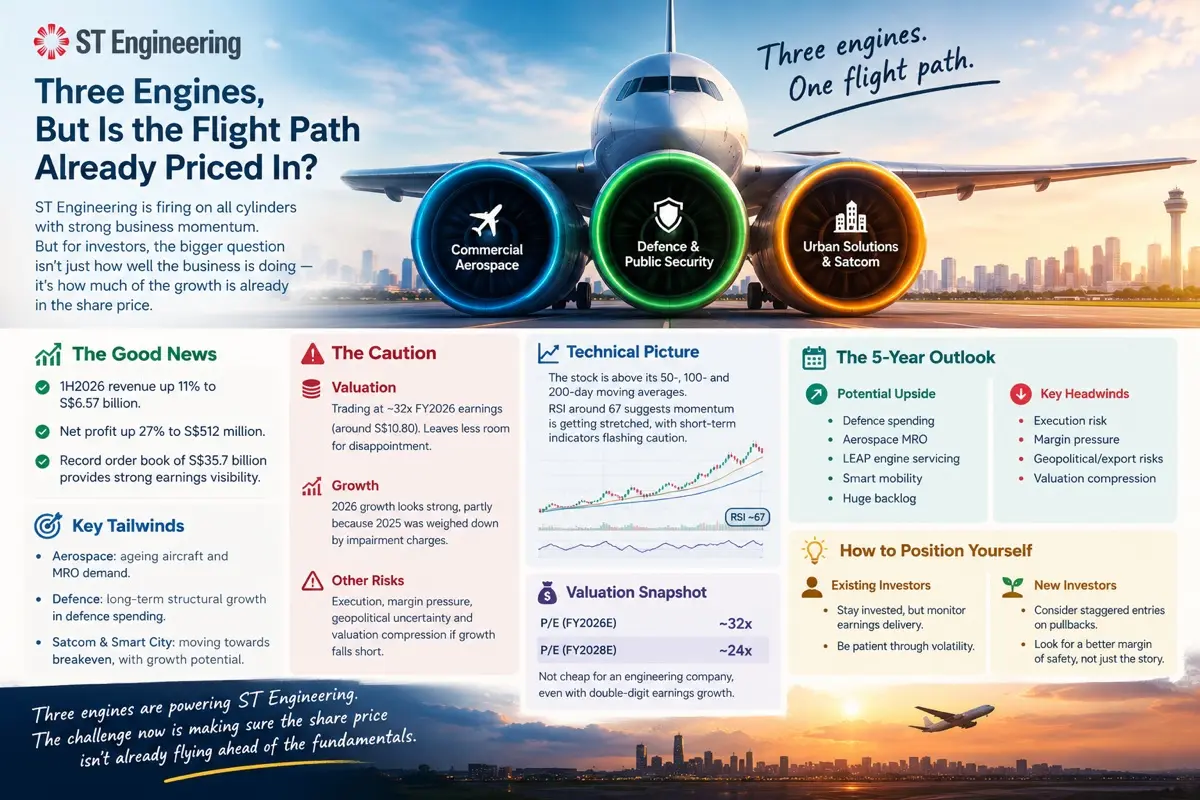
ST Engineering: Rail Wins Add Fuel to an Already Strong Engine
ST Engineering’s S$750 million Taoyuan Green Line contract is more than headline value: it reinforces the Urban Solutions turnaround and adds seven years of relatively visible revenue from Q4 2026. Together with the S$840 million Taoyuan Brown Line win, Taiwan is becoming a meaningful growth market. (The Straits Times)
Fundamentally, the story is strengthening. 1H26 revenue rose 11% to S$6.57 billion while net profit jumped 27% to S$512 million, with EBIT margins expanding. Its record S$35.7 billion order book provides strong visibility, including S$5.7 billion earmarked for delivery in 2H26. (ST Engineering)
At S$10.58, FY26 earnings imply roughly 30x P/E—no longer cheap, but justified if earnings compound. DBS forecasts S$1.08 billion FY26 net profit and values the stock at S$12.40; Phillip targets S$13.00. (DBS Singapore)
Technically, the pullback from S$10.96 offers a more attractive entry than chasing the recent rally. Dividend investors also have reason to stay interested: the FY26 policy adds one-third of incremental profit to the S$0.18 base, implying roughly S$0.25/share on current estimates. That points to ~2.4% yield with further growth potential. (ST Engineering)
View: BUY on weakness. The combination of defence, aerospace, smart-city contracts and dividend growth makes the road ahead increasingly compelling.
Not financial advice.
Oil won’t ease, geopolitics remain tense, and August ADP hiring disappointed. Warsh faces a tough call. My take: hold for now—don’t risk crushing a weakening labour market just to fight supply-driven inflation.
Dell surged 15.8% Wednesday as its AI-server refresh story kept building. Broadcom fell despite revenue growing 86% and AI chip sales more than tripling — its guidance simply wasn't enough. A weak ADP...
$Salesforce(CRM.US)
Salesforce: Turnaround, or the death of SaaS?
Salesforce’s 22.6% jump looks less like a dead-cat bounce and more like the market finally giving AI-enabled SaaS credit. Q2 FY27 revenue rose 11% to US$11.35bn, while cRPO grew 14% to US$33.5bn. FY26 itself delivered US$41.5bn revenue, +10%, with strong cash generation.
The ClaudeForce partnership is important: Salesforce is embedding Claude into workflows rather than fighting AI head-on. AI product ARR has reportedly reached nearly US$3.9bn.
Stance: This looks more like a SaaS reset than its death. Fundamentals are improving, but after the surge, valuation has quickly rerated. Technically, the breakout is powerful, but $252 is now a major reference point; chasing here carries risk.
For an option writer, I’d favour 30–45 DTE covered calls, around 10–15% OTM, targeting Delta ≤0.20. With CRM around $252, September $280–290 calls offer a better assignment buffer; premiums around $0.15–$0.50 are currently indicated, depending on strike/liquidity.
Bottom line: own the turnaround, but sell calls patiently rather than chase the rally.
Not financial advice.$Salesforce(CRM.US)
$CapLand IntCom T(C38U.SG)
Tuesday’s yield spike gave battered S-REITs another punch. Higher yields mean tougher refinancing and less appeal versus bonds. But there’s a silver lining: if yields stabilise, beaten-down REITs with solid balance sheets could rebound. The pain today may create opportunity tomorrow.
US Central Command struck Iranian Revolutionary Guard targets Tuesday; Iran retaliated against US bases in Jordan and Bahrain. Oil jumped over 5%. Dell raised its full-year revenue guide by $25 billio...
$SingPost(S08.SG)
SingPost: Parcel Growth Is the New Post
SingPost’s Q1 FY26/27 update shows encouraging operational progress, but the investment case remains one of execution rather than growth. The reported figures are validated: revenue fell 0.9% to S$93.4 million, while operating profit jumped 55.2% to S$4.1 million as operating expenses declined 2.4% to S$89.3 million. Operating margin consequently improved to 4.4%. (The Business Times)
The improvement is meaningful against FY2025/26, when revenue plunged 23.1% to S$376.1 million and operating profit fell 68.9% to S$11.8 million. Underlying net profit was only S$10.7 million, highlighting still-thin profitability. (SingPost)
Fundamentally, the structural decline in letters remains the problem: domestic letter volumes fell 13.5% in FY26. However, domestic eCommerce volumes rose 8.1%, while Q1 domestic parcels surged 36.5%. SingPost is clearly repositioning toward logistics, warehousing and value-added services, supported by S$30 million of investment in automated parcel sorting. (SingPost)
Technically, S08 at S$0.33 remains weak, sitting close to its S$0.31 52-week low and well below S$0.50. Valuation is not demanding at roughly S$780 million market capitalisation, but earnings quality remains the concern. (SingPost)
Position: HOLD. Parcel momentum and cost discipline are promising, but sustained earnings growth must first be proven. The transformation is interesting; the turnaround is not yet complete.
Not financial advice.
$Broadcom(AVGO.US)
Broadcom earnings are next. Can it top Nvidia’s blockbuster numbers? Maybe not in size, but its AI chips and networking business could surprise. I’ll be watching guidance closely—if AI demand keeps accelerating, AVGO could have another strong run ahead.
$Broadcom(AVGO.US) reports Q3 FY2026 after the US close on Wednesday 2 September — the numbers land around 04:00 SGT Thursday morning. ⏰Nvidia already beat the earnings estimates. Broadcom trades abou...
$Apple(AAPL.US)
Big shoes to fill. Tim Cook deserves credit for steering Apple through tariffs, China tensions and a messy global backdrop. Now John Ternus gets his shot as Apple’s third CEO. The real test starts now—can he keep Apple growing while bringing back that innovation edge? All eyes on the next few quarters.
Anthropic locked in a $35B cloud deal with Nvidia-backed Lambda on Sunday — its fourth mega compute deal this month. Rate-hike odds jumped again too, hitting 64-65% just one trading day after Friday's...
$NVIDIA(NVDA.US)
NVIDIA: AI Growth Still Dominates, but Expectations Are the Risk
NVIDIA remains the strongest AI-chip franchise, but the setup is becoming more balanced. Its latest reported Q1 FY2027 delivered $81.6bn revenue (+85% YoY), with Data Center up 92% to $75.2bn and a strong 74.9% gross margin. Q2 guidance of $91bn implies another 12% sequential jump. (NVIDIA Newsroom)
Fundamentally, FY2026 revenue reached $215.9bn (+65%), net income $120.1bn and EPS $4.90. The concern is margin compression: FY2026 gross margin fell to 71.1% from 75.0%, while operating expenses rose 41%. (NVIDIA Newsroom)
Technically, NVDA closed at $208.48 on August 24, down 2.9%, with RSI around 22—oversold but still bearish. (MarketWatch) Valuation around 24–25x forward earnings is actually more attractive than AMD and Broadcom, making NVDA the strongest risk/reward among major AI semiconductors. (Yahoo Finance)
Option strategy: Prefer covered calls 21–35 DTE, targeting $225–$230 strikes, ~0.20–0.30 delta. Avoid selling immediately before earnings because implied volatility is elevated. After earnings, premium collection becomes more attractive if NVDA holds above $200.
View: BUY/HOLD. Fundamentally #1; valuation increasingly reasonable, but earnings expectations leave little room for disappointment.
$AEM SGD(AWX.SG)
AEM: AI Growth Is Real, But the Price Has Run Ahead
The headline is validated. AEM’s 1H26 net profit surged 876% to S$30.8 million, while revenue rose 29.9% to S$247.2 million. Management raised FY2026 revenue guidance to S$630–680 million and introduced EPS guidance of S$0.245–0.275, supported by AI/HPC production ramps. (DBS Singapore)
Fundamentally, AEM is compelling: higher-margin Test Cell Solutions lifted 1H gross margin to 33.1%, while its balance sheet remained conservatively geared, with only 0.03x debt/equity and net cash. (DBS Singapore)
But valuation is the concern. At S$9.36, the stock trades around 34–38x FY2026 guided EPS and roughly 5.8x NAV, leaving limited margin for execution disappointment. Technically, momentum has cooled sharply: shares fell from S$11.54 after results and now sit below the 50-day moving average of S$9.91, although still above the 200-day average of S$9.16. (Investing.com)
View: HOLD, not BUY. Existing investors can retain exposure, but fresh money should wait for S$9.15–9.30 support. Those seeking better value could rotate partially into UMS Integration, where 1H26 earnings rose 66% and valuation remains more reasonable relative to growth. (DBS Singapore)
Not financial advice.
Warsh is playing it differently from Powell: fewer clues, no dots, no promises. The next rate move comes down to the data—and markets have to guess.
PCE at 3.7% beat expectations unexpectedly, pushing the probability of no rate hike in September from 35% to 66%. Since Walsh took office, forward guidance has been scrapped and the dot plot abolished...
Credit to all the NVDA option writers who had taken advantage of the heightened implied volatility.
No print in this market carries more than $NVIDIA(NVDA.US): a US$5.07 trillion company reporting into its longest losing streak since 2022, with the whole AI stack repriced behind it. In three days th...