$D-Wave Quantum(QBTS.US) | D-Wave Quantum Inc., Q2-2026 Earning Report
D-Wave Quantum Inc. engages in the development and delivery of quantum computing systems, software, and services worldwide. It provides Advantage and Advantage...
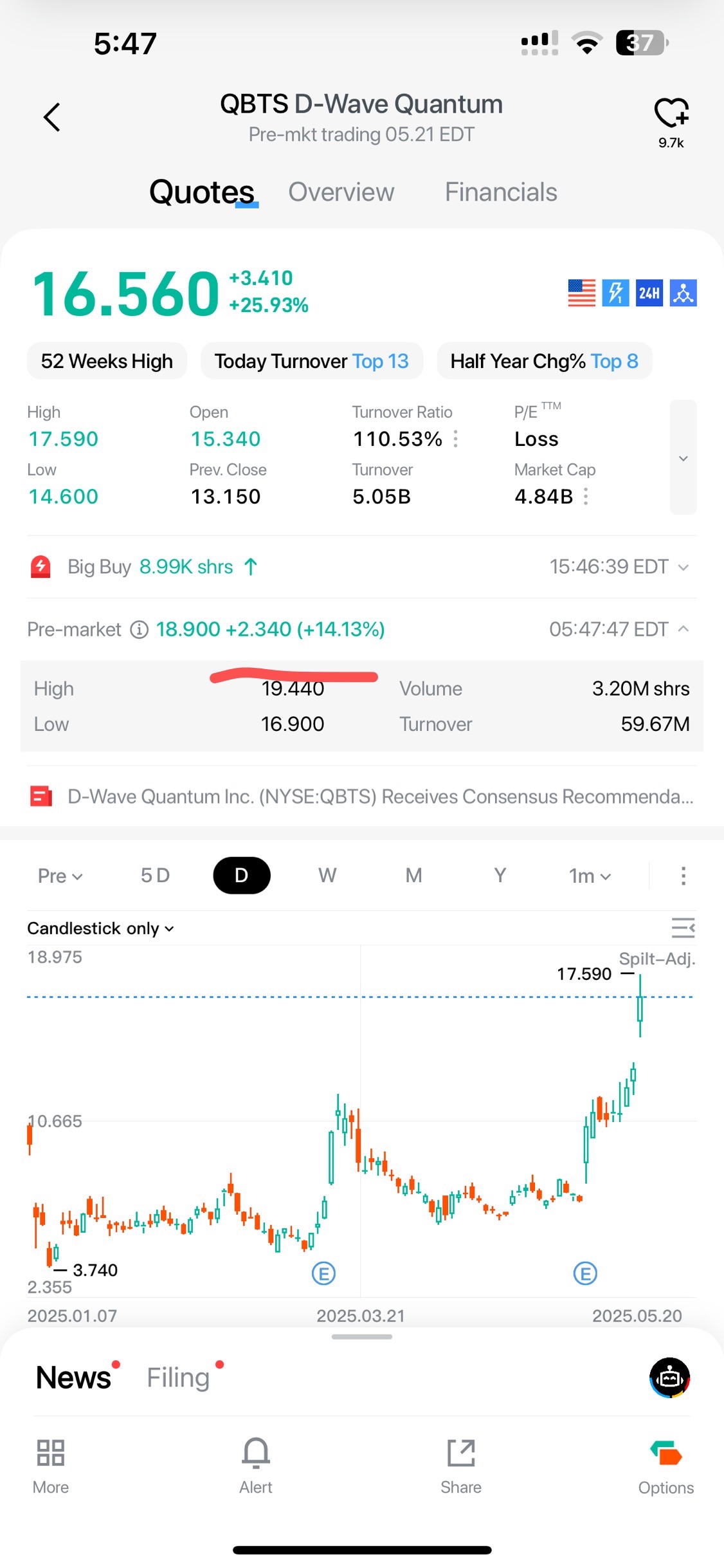
D-Wave Quantum (QBTS.US) traded up intraday, rising about 3.8% to $20.09 as of 9:34 AM ET, recovering from a pre-market low of $19.70. News of Kevan P. Krysler's appointment to the board and audit committee, along with an expanded quantum network optimization partnership with NTT DOCOMO, buoyed sentiment. Financially, Q2 2026 revenue was $3.076M, down 0.61% YoY, while net loss narrowed 71.3% to $48.028M, with EPS of -$0.1295 improving 76.6% YoY, though operating loss remained at $53.278M. The stock is 57.05% below its 52-week high of $46.75 and down 28.62% YTD, but has reclaimed the 20-day moving average of $19.38. However, post-market trading saw the price retreat to $20.842, indicating lingering resistance.
D-Wave Quantum (QBTS.US) surged in early regular trading, gaining over 5% intraday, driven by carryover from a nearly 2% pre-market rise and continued optimism around the AT&T deal's 240x order boost. Q2 earnings showed revenue slightly down 0.61% to $3.076M, but net loss narrowed 71.3% to $48.028M with EPS improving 76.51% YoY, indicating a gradually improving cost structure. However, the stock's current price of $20.378 remains 56.41% below its 52-week high of $46.75 and below the 60-day MA of $22.165, with a year-to-date loss of 27.56%.
D-Wave Quantum (QBTS) opened sharply lower in regular trading today, initially dropping to a session low of $18.01 — nearly 61.5% below its 52-week high of $46.75 — after its latest quarterly results missed analyst estimates; Q2 revenue of $3.076 million fell short of expectations, while net loss widened 238.6% YoY to $18.357 million. However, the company also disclosed a 1,120% surge in year-to-date bookings and unveiled a breakthrough gate-model hardware architecture the prior day, helping the stock recover from early lows to a session high of $19.46. The stock remains below its 60-day moving average of $22.20 and is down 31% year-to-date.
D-Wave Quantum (QBTS) rallied intraday on August 4, closing up 5.3% at $21.04, driven by a broad quantum computing sector rebound and the company's partnership with Nasdaq Verafin to develop quantum-hybrid tools for financial crime detection. The stock hit an intraday high of $21.33 and a low of $20.34, with volume of ~8.1 million shares, well above the prior session. Despite Q1 2026 results showing a widening loss (EPS of -$0.05) and an 81% YoY revenue drop to $2.86 million, the market focused on the strategic collaboration. The stock remains 55% below its 52-week high of $46.75 but has reclaimed its 20-day moving average ($18.35), paring its YTD decline to 25.2%. However, with a price-to-book ratio of 6.86x and no profitability in sight, valuation concerns persist.
D-Wave Quantum shares surged in regular trading, driven by renewed sector-wide sentiment and a strategic partnership announcement. The stock opened at $18.15 (after a pre-market low of $18.00) and rallied steadily to an intraday high of $19.75, representing a gain of over 9%, last trading at $19.66 as of 10:20 ET. The rally was supported by news of a collaboration with Nasdaq Verafin to develop quantum-hybrid tools for financial crime detection, alongside broad gains in peers like IONQ and RGTI. However, fundamentals remain challenged: Q1 revenue was only $2.86 million, down 80.95% YoY, and net loss widened to $18.36 million. The stock is still about 58% below its 52-week high of $46.75 and down approximately 30% year-to-date, though it has reclaimed its 20-day moving average ($18.34), indicating short-term momentum.
IONQ vs. RGTI vs. QUBT vs. QBTS: Which Quantum Stock Had the Best Q2 Earnings?
Quantum Stocks Sink Again: IONQ, QBTS, QUBT and RGTI Fall as Treasury Yields Rise
D-Wave Quantum vs. Microsoft: Which Is the Better Quantum Computing Stock to Own for the Next 5 Years?
D-Wave Quantum (NASDAQ:QBTS) Stock Price Down 6.4% - Should You Sell?
D-Wave and NTT DOCOMO expand quantum network optimization
D-Wave Quantum Adds Finance Veteran to Board as QBTS Scales and Faces Big Capital Decisions
📢 𝗝𝗨𝗦𝗧 𝗜𝗡: $D-Wave Quantum(QBTS.US) D-Wave Publishes Nature Research Advancing Fault-Tolerant Quantum Computing
👉 𝗞𝗲𝘆 𝗛𝗶𝗴𝗵𝗹𝗶𝗴𝗵𝘁𝘀:➤ 𝗗-𝗪𝗮𝘃𝗲 published peer-reviewed quantum research in 𝗡𝗮𝘁𝘂𝗿𝗲.➤ Research validates D-Wave's 𝗱𝘂𝗮𝗹-𝗿𝗮𝗶𝗹 architecture for scalable gate-model quantum computing.➤ New two-qubit entangling gate achieved approximately 𝟵𝟵.𝟵% fidelity.➤ Gate operations completed in approximately 𝟱𝟬𝟬 𝗻𝗮𝗻𝗼𝘀𝗲𝗰𝗼𝗻𝗱𝘀.➤ Architecture preserves hardware-level 𝗾𝘂𝗮𝗻𝘁𝘂𝗺 𝗲𝗿𝗿𝗼𝗿 detection during operations.➤ Simulations indicate up to 𝟭𝟬𝘅 logical error reduction per error-correction increment.➤ Technology could significantly reduce physical qubit requirements.➤ Roadmap targets a 𝟭𝟬𝟬-𝗹𝗼𝗴𝗶𝗰𝗮𝗹-𝗾𝘂𝗯𝗶𝘁 system by 𝟮𝟬𝟯𝟮.➤ D-Wave targets a 𝗟𝗮𝗺𝗯𝗱𝗮 of 𝟭𝟬 for scalable fault tolerance.👉 𝗪𝗵𝘆 𝗧𝗵𝗶𝘀 𝗠𝗮𝘁𝘁𝗲𝗿𝘀:➤ Addresses one of quantum computing's biggest barriers: scalable error correction.➤ Lower hardware overhead could reduce the cost of fault-tolerant quantum systems.➤ Supports D-Wave's strategy to commercialize gate-model quantum computing.➤ Peer-reviewed validation in 𝗡𝗮𝘁𝘂𝗿𝗲 strengthens the technology's scientific credibility.👉 𝗘𝘅𝗽𝗲𝗿𝘁 𝗦𝘁𝗮𝘁𝗲𝗺𝗲𝗻𝘁𝘀:𝗗𝗿. 𝗔𝗹𝗮𝗻 𝗕𝗮𝗿𝗮𝘁𝘇, CEO of D-Wave:“Gate-model quantum computing’s greatest remaining challenge is not simply building more qubits. It is building systems that can correct errors efficiently as they scale. Superconducting quantum computers are known for speed, but achieving the high fidelity needed for scalable, fault-tolerant systems has remained a challenge. This research demonstrates that our dual-rail architecture combines fast superconducting operations with high-fidelity performance while preserving native hardware-level error detection. We believe that this work confirms our path to commercial fault-tolerant quantum computing is practical and achievable.”𝗗𝗿. 𝗥𝗼𝗯𝗲𝗿𝘁 𝗦𝗰𝗵𝗼𝗲𝗹𝗸𝗼𝗽𝗳, Chief Scientist at D-Wave:“The entangling gate demonstrated through this research is already integrated into our gate-model systems, where it is delivering comparable performance. We believe these results provide strong evidence that the core architectural principles underpinning our gate-model development roadmap can deliver the speed, fidelity and error-correction efficiency required for practical, fault-tolerant quantum computing.”𝗗𝗿. 𝗧𝗿𝗲𝘃𝗼𝗿 𝗟𝗮𝗻𝘁𝗶𝗻𝗴, Chief Development Officer at D-Wave:“Building a fault-tolerant quantum computer requires systematically solving a series of difficult scientific and engineering challenges, with each success bringing us closer to a scalable system. This research demonstrates one of the foundational capabilities of our dual-rail architecture and brings us an important step closer to fault-tolerant gate-model quantum computing.”Wedbush analyst Matt Bryson assumes coverage on Quantum Stocks - $Rigetti Computing(RGTI.US) $D-Wave Quantum(QBTS.US) $IonQ(IONQ.US) $Infleqtion(INFQ.US) $Quantum Computing(QUBT.US)