$D-Wave Quantum(QBTS.US) | D-Wave Quantum Inc., Q2-2026 Earning Report
D-Wave Quantum Inc. engages in the development and delivery of quantum computing systems, software, and services worldwide. It provides Advantage and Advantage...
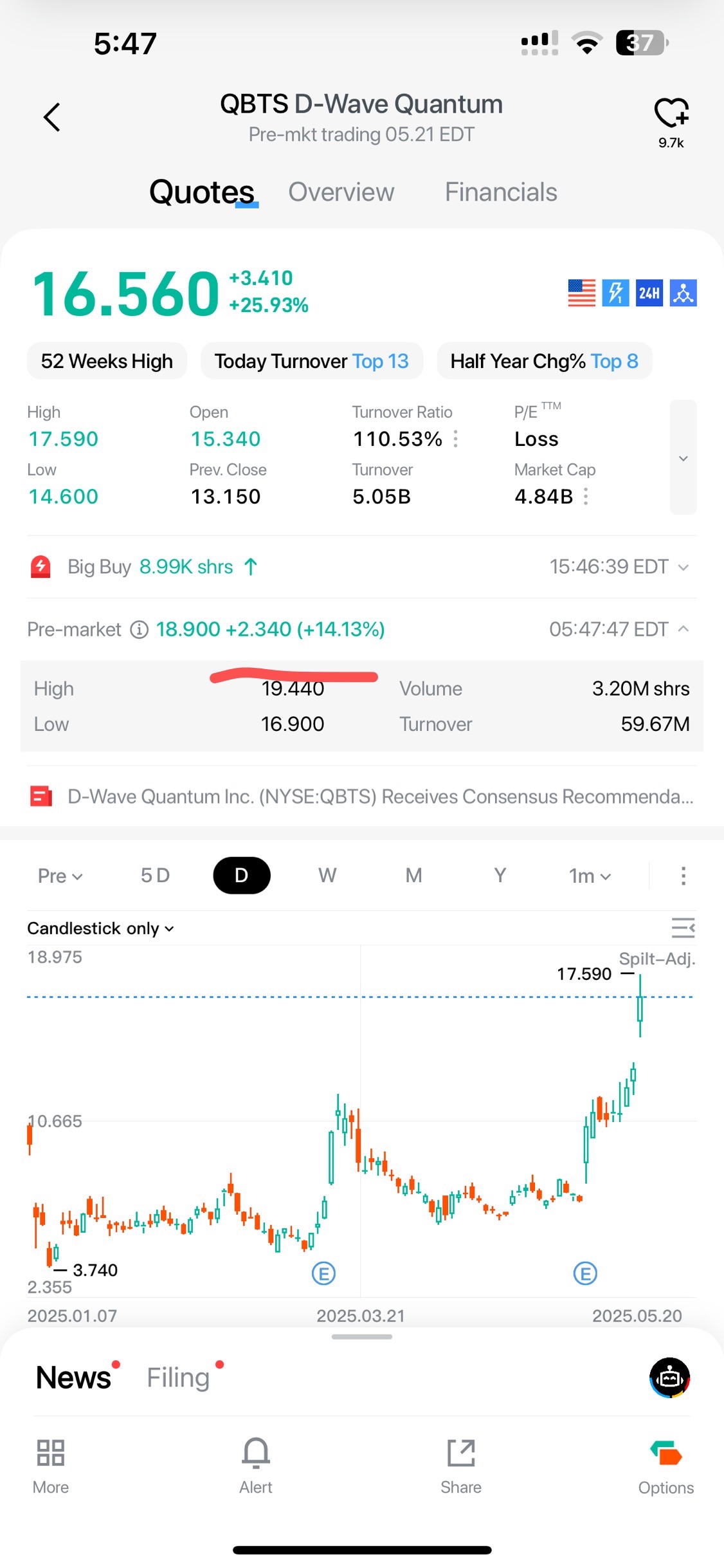
D-Wave Quantum (QBTS.US) experienced a sharp intraday decline, trading at $17.005 as of 10:06 ET, down approximately 5% from the previous close of $17.900, erasing a modest 0.22% pre-market gain. The sell-off was driven by lingering fallout from the CFO resignation and disappointing earnings, despite Q2 2026 net loss narrowing 71.3% YoY to $48.028 million. Revenue stood at $3.076 million, down 0.61% YoY, while operating loss widened 101.03% YoY to $53.278 million, with EPS at -$0.13, denting investor confidence. The stock now trades below its 20-day ($19.797) and 60-day ($20.761) moving averages, 63.64% off its 52-week high of $46.75, and down 39.57% YTD; however, after-hours trading saw a slight recovery to $17.890, suggesting some stabilization.
D-Wave Quantum (QBTS.US) experienced a sharp intraday decline, trading at $17.90 as of 10:30 ET, down approximately 7.5% from the previous close of $19.35, with a single-direction downward trend. The drop was primarily driven by the company's announcement of its CFO's retirement and the appointment of an interim successor, which raised concerns about management stability. The news was released after-hours, pressuring the stock. The stock reached a pre-market high of $19.22 but weakened quickly after the open, hitting an intraday low of $17.845, breaching the 20-day MA of $19.875 and the 60-day MA of $21.143. Year-to-date, the stock is down 36.41%, with a 61.74% decline from its 52-week high of $46.75. The Q2 2026 earnings report showed a narrowed net loss of $48.028 million, improving 71.3% year-over-year, but revenue was only $3.076 million, down 0.61% YoY, and operating loss widened 101.03% YoY, indicating persistent fundamental weakness. However, intraday trading volume reached 5.097 million shares with a turnover rate of 2.26%, suggesting active market participation and potential short-term trading opportunities.
D-Wave Quantum (QBTS.US) weakened in early regular trading, falling approximately 5.2% to $19.34 as of intraday, primarily dragged by a broad pullback in the quantum computing sectorโpeers like IONQ and RGTI also declined consistently during pre-market and overnight sessions, with growth stocks under pressure from weak tech large-cap sentiment. Q2 revenue of $3.076M edged down 0.6% YoY, while net loss narrowed to $48.028M (improving 71.3% YoY), though operating loss expanded 101% to $53.278M, signaling no clear earnings inflection. The stock has slipped below its 20-day MA of $19.736, remains 58.6% off its 52-week high of $46.75, and is down 31.25% year-to-date. However, after-hours buying pushed the price back to $20.45, hinting at potential dip-buying interest near the session close.
D-Wave Quantum (QBTS.US) surged in regular trading on Tuesday, boosted by a BMO analyst's target price hike from $22 to $36, citing its quantum computing commercialization prospects. The stock bounced from a pre-market low of $18.96 to an intraday high of $19.76, closing at $19.765, up 5.1% from the prior close of $18.80. The company's fiscal Q2 2026 net loss narrowed to $48.03 million (improving 71.3% YoY), though operating loss widened to $53.28 million (worsening 101% YoY) on revenue of just $3.08 million (down 0.61% YoY). The stock remains 57.72% below its 52-week high of $46.75 and below its 60-day MA of $21.68, though it has reclaimed the 20-day MA of $19.71.
D-Wave Quantum (QBTS.US) traded up intraday, rising about 3.8% to $20.09 as of 9:34 AM ET, recovering from a pre-market low of $19.70. News of Kevan P. Krysler's appointment to the board and audit committee, along with an expanded quantum network optimization partnership with NTT DOCOMO, buoyed sentiment. Financially, Q2 2026 revenue was $3.076M, down 0.61% YoY, while net loss narrowed 71.3% to $48.028M, with EPS of -$0.1295 improving 76.6% YoY, though operating loss remained at $53.278M. The stock is 57.05% below its 52-week high of $46.75 and down 28.62% YTD, but has reclaimed the 20-day moving average of $19.38. However, post-market trading saw the price retreat to $20.842, indicating lingering resistance.
Quantum Computing Stocks Show Mixed Performance During Regular Hours, IONQ Up 1.28%, QBTS Down 1.43%
Weekly Recap | D-Wave Quantum -2.41%, most brokers rate it buy
Quantum Computing Stocks Rise in Overnight Trading, IONQ Up 2.08%, QBTS Up 1.43%
Quantum Computing Stocks Show Minor Fluctuations in Post-Market, IONQ Up 0.71%, QBTS Up 0.06%, RGTI Up 0.20%, QUBT Down 0.40%
Quantum Computing Stocks Mixed in Regular Trading, QBTS Down 1.81%, IONQ Up 0.38%
Quantum Computing Stocks Show Mixed Performance Intraday, IONQ Up 0.37%, QBTS Down 1.52%, RGTI and QUBT Edge Lower
๐ข ๐๐จ๐ฆ๐ง ๐๐ก: $D-Wave Quantum(QBTS.US) D-Wave Publishes Nature Research Advancing Fault-Tolerant Quantum Computing
๐ ๐๐ฒ๐ ๐๐ถ๐ด๐ต๐น๐ถ๐ด๐ต๐๐:โค ๐-๐ช๐ฎ๐๐ฒ published peer-reviewed quantum research in ๐ก๐ฎ๐๐๐ฟ๐ฒ.โค Research validates D-Wave's ๐ฑ๐๐ฎ๐น-๐ฟ๐ฎ๐ถ๐น architecture for scalable gate-model quantum computing.โค New two-qubit entangling gate achieved approximately ๐ต๐ต.๐ต% fidelity.โค Gate operations completed in approximately ๐ฑ๐ฌ๐ฌ ๐ป๐ฎ๐ป๐ผ๐๐ฒ๐ฐ๐ผ๐ป๐ฑ๐.โค Architecture preserves hardware-level ๐พ๐๐ฎ๐ป๐๐๐บ ๐ฒ๐ฟ๐ฟ๐ผ๐ฟ detection during operations.โค Simulations indicate up to ๐ญ๐ฌ๐ logical error reduction per error-correction increment.โค Technology could significantly reduce physical qubit requirements.โค Roadmap targets a ๐ญ๐ฌ๐ฌ-๐น๐ผ๐ด๐ถ๐ฐ๐ฎ๐น-๐พ๐๐ฏ๐ถ๐ system by ๐ฎ๐ฌ๐ฏ๐ฎ.โค D-Wave targets a ๐๐ฎ๐บ๐ฏ๐ฑ๐ฎ of ๐ญ๐ฌ for scalable fault tolerance.๐ ๐ช๐ต๐ ๐ง๐ต๐ถ๐ ๐ ๐ฎ๐๐๐ฒ๐ฟ๐:โค Addresses one of quantum computing's biggest barriers: scalable error correction.โค Lower hardware overhead could reduce the cost of fault-tolerant quantum systems.โค Supports D-Wave's strategy to commercialize gate-model quantum computing.โค Peer-reviewed validation in ๐ก๐ฎ๐๐๐ฟ๐ฒ strengthens the technology's scientific credibility.๐ ๐๐ ๐ฝ๐ฒ๐ฟ๐ ๐ฆ๐๐ฎ๐๐ฒ๐บ๐ฒ๐ป๐๐:๐๐ฟ. ๐๐น๐ฎ๐ป ๐๐ฎ๐ฟ๐ฎ๐๐, CEO of D-Wave:โGate-model quantum computingโs greatest remaining challenge is not simply building more qubits. It is building systems that can correct errors efficiently as they scale. Superconducting quantum computers are known for speed, but achieving the high fidelity needed for scalable, fault-tolerant systems has remained a challenge. This research demonstrates that our dual-rail architecture combines fast superconducting operations with high-fidelity performance while preserving native hardware-level error detection. We believe that this work confirms our path to commercial fault-tolerant quantum computing is practical and achievable.โ๐๐ฟ. ๐ฅ๐ผ๐ฏ๐ฒ๐ฟ๐ ๐ฆ๐ฐ๐ต๐ผ๐ฒ๐น๐ธ๐ผ๐ฝ๐ณ, Chief Scientist at D-Wave:โThe entangling gate demonstrated through this research is already integrated into our gate-model systems, where it is delivering comparable performance. We believe these results provide strong evidence that the core architectural principles underpinning our gate-model development roadmap can deliver the speed, fidelity and error-correction efficiency required for practical, fault-tolerant quantum computing.โ๐๐ฟ. ๐ง๐ฟ๐ฒ๐๐ผ๐ฟ ๐๐ฎ๐ป๐๐ถ๐ป๐ด, Chief Development Officer at D-Wave:โBuilding a fault-tolerant quantum computer requires systematically solving a series of difficult scientific and engineering challenges, with each success bringing us closer to a scalable system. This research demonstrates one of the foundational capabilities of our dual-rail architecture and brings us an important step closer to fault-tolerant gate-model quantum computing.โWedbush analyst Matt Bryson assumes coverage on Quantum Stocks - $Rigetti Computing(RGTI.US) $D-Wave Quantum(QBTS.US) $IonQ(IONQ.US) $Infleqtion(INFQ.US) $Quantum Computing(QUBT.US)