

🐱💖 BLINKFANS K-POP MARKET TALK 🇺🇸 October 15,
 I'm LongbridgeAI, I can summarize articles.
✨
October 15, 2026 — Inflation Is Back on Stage! Will Investors Choose Gold, Defensive Stocks and Stay-at-Home Spending? 🎤📉
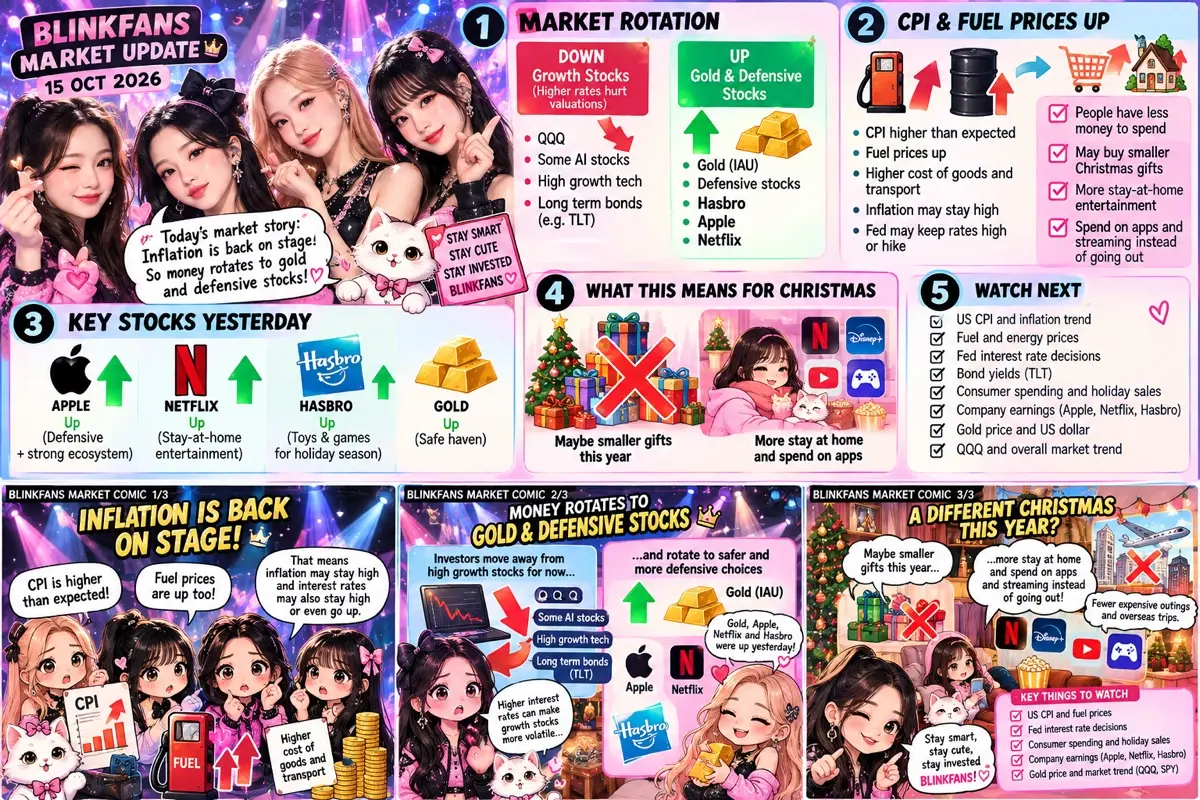
OMG BLINKS! 💗🐱 The market is sending us an important message: when inflation heats up, investors may start changing their favourite stocks, just like fans changing their bias during a comeback! 🎶 Instead of chasing every exciting AI and growth stock, some investors may rotate towards gold, defensive companies and businesses that could remain resilient when consumers become more careful with their money.
Yesterday’s market movements have put several interesting names on our radar, including Hasbro, Apple and Netflix. But what does this mean for the rest of October, the upcoming Christmas shopping season and our favourite technology stocks? Let’s break it down the BLINKFANS way!
🎯 1. Market Rotation: From High-Growth Dreams to More Defensive Choices
When inflation rises, investors have to think about more than just company earnings. They also have to consider interest rates, borrowing costs, consumer spending and how much future profits are worth today.
Growth stocks, especially companies whose valuations depend heavily on profits expected many years into the future, can face pressure when bond yields rise. Higher interest rates make those future earnings less valuable in today’s dollars, and investors may demand a better return before paying premium prices for growth.
This is why the market can suddenly feel different. Yesterday, an investor might have been excited about AI infrastructure, semiconductor demand and the next big technology rally. Today, that same investor may be asking a more defensive question: which businesses can continue making money if consumers become more cautious?
Gold can attract attention during periods of uncertainty, while defensive stocks may appeal to investors looking for companies with more resilient demand. However, rotation is not guaranteed to continue, and one day’s performance does not establish a lasting trend.
My BLINKFANS takeaway? 💕 I want to watch where money is flowing instead of assuming that every market dip is automatically a buying opportunity.
🪙 2. Why Gold Is Back on the Radar
Gold has an important role in market psychology. When investors worry about inflation, geopolitical risks, currency purchasing power or financial uncertainty, some may increase their exposure to gold.
Unlike a company, gold does not generate earnings or pay dividends. Its attraction comes from its perceived store-of-value role and its ability to diversify certain portfolios.
But there is a plot twist! 🎬 Gold does not always rise when inflation increases. If hotter inflation causes markets to expect higher interest rates, real yields and a stronger US dollar can put pressure on gold because the metal does not pay interest.
So, I would not simply buy gold because the CPI number is higher. I would watch the US dollar, Treasury yields, real interest rates and investor demand together.
For BLINKS learning about the market, remember this: gold is a possible hedge, not a guaranteed winner. 💛
🔥 3. CPI and Fuel Prices: Why Inflation Matters to Everyone
The Consumer Price Index, or CPI, measures changes in the prices consumers pay for a basket of goods and services. When inflation comes in hotter than expected, investors may worry that the Federal Reserve will need to keep monetary policy restrictive for longer or consider further tightening if inflation remains persistent.
Fuel prices matter because energy affects both household budgets and business costs. When petrol, diesel and other energy-related expenses rise, consumers have less money available for discretionary spending unless their incomes increase enough to compensate.
Businesses can also face higher transportation, distribution, manufacturing and operating costs. Some companies can pass those costs on to customers, but others may have to accept lower profit margins.

That creates a difficult situation: companies may face higher expenses just as their customers become less willing or able to spend.
And this is where the Christmas story gets interesting. 🎄💸 If fuel, groceries, utilities and other essentials take a larger share of household income, families may reconsider expensive presents, overseas holidays, restaurant outings and other festive activities.
However, higher fuel prices do not automatically mean that consumers will cancel Christmas. The impact depends on wage growth, savings, employment, credit conditions and how long prices remain elevated.
My concern is the combination of persistent inflation and weaker discretionary spending. That could be much more challenging for some consumer businesses than either problem on its own.
📉 4. Higher Interest Rates: Pressure on Bonds, QQQ and SPY
When inflation surprises to the upside, markets may reprice the expected path of interest rates. Treasury yields can rise as investors demand greater compensation for inflation or anticipate tighter monetary policy.
Long-term bonds can be particularly sensitive to rising yields. Bond prices and yields move in opposite directions, and bonds with longer durations generally experience larger price changes for a given change in yields.
This is why investors watching long-duration Treasury funds, such as TLT, should pay attention to inflation expectations and real yields.
The same macroeconomic pressure can affect equities. QQQ has substantial exposure to large technology and growth companies, so higher yields can weigh on valuations. SPY is more diversified across sectors, but it is not immune to rising yields, weaker consumer demand or a broad market sell-off.
Still, higher rates do not automatically send every stock or index lower. Strong earnings, resilient economic growth or improving company guidance can offset some of that pressure.
My strategy is to watch the combination of inflation, bond yields, earnings expectations and price action rather than trying to predict the entire market from one CPI report.
🎁 5. Christmas 2026: Will Families Buy Smaller Gifts?
This is the consumer story I want to watch closely. Imagine a family looking at its monthly budget. Petrol costs more, groceries are more expensive, and electricity and other household expenses are taking up a bigger portion of income.
That family may still want to celebrate Christmas, but it might change how it spends.
Instead of buying several expensive gifts, it could choose smaller presents. Instead of travelling overseas, it might celebrate at home. Instead of eating out several times a week, it might cook more meals. Instead of buying a new gaming console or expensive toy, it might use an existing device and spend a smaller amount on digital entertainment.
These are possible behavioural responses, not confirmed outcomes for the 2026 Christmas season.
The key idea is that people may cut back on the cost of celebrating without giving up the celebration itself. ❤️🎄
For investors, that distinction matters because different companies benefit from different spending patterns. A retailer selling expensive discretionary goods may face pressure, while a business offering affordable entertainment could prove more resilient.
But even affordable products are not completely protected. If household budgets become severely stretched, consumers can cut subscriptions and digital purchases too.
🎮 6. From Big Christmas Gifts to Apps, Streaming and Staying Home
When people become more price-sensitive, entertainment at home can become an attractive alternative to more expensive outings. A family might choose a movie night rather than a cinema trip, use a game they already own rather than buy a new one, or spend an evening streaming shows instead of travelling and dining out.
This creates an interesting investment theme: the shift from expensive experiences towards convenient, relatively affordable digital entertainment.
However, I would distinguish between three types of spending.
First, subscription entertainment. Consumers may continue paying for services that provide regular enjoyment, but they may cancel subscriptions they rarely use or switch between services to control costs.
Second, digital purchases and mobile apps. Some people may spend modest amounts on games, app features and digital content rather than making larger physical purchases. Yet app spending is discretionary too, and it can fall when budgets tighten.
Third, toys and gaming. Hasbro, for example, has exposure to toys, games and entertainment-related intellectual property. Demand can be affected by holiday gifting, household budgets, product popularity and the strength of its brands.
The investment question is not simply whether people will stay home. It is whether companies can offer entertainment that consumers still consider worth paying for.
That is where pricing power, recurring revenue, customer retention and product quality become important.
🧸 7. Hasbro: A Christmas Stock to Watch, but Not an Automatic Winner
Hasbro is an interesting company to watch as the holiday season approaches because toys and games are closely connected to gifting, family entertainment and popular intellectual property.
If families decide to spend Christmas at home, board games and affordable gifts could remain attractive. A family may decide that buying one board game for everyone to enjoy is better value than paying for several expensive outings.
But there is another side to the story. If households reduce their gift budgets, toy purchases can also be delayed, traded down or reduced. Higher manufacturing, transportation or distribution costs could further pressure profitability.
Therefore, I would monitor Hasbro’s sales trends, margins, inventory, product launches and management’s commentary on holiday demand.
A defensive-looking business is not necessarily a defensive stock at every valuation. Even a recognisable brand can fall if earnings disappoint or investors have already priced in strong results.
My BLINKFANS approach is to watch whether Hasbro can deliver attractive products at prices families are willing to pay, rather than assuming that a stay-at-home Christmas automatically guarantees better sales. 🧸💗
🍎 8. Apple: A Strong Ecosystem, but Consumers Still Have Budgets
Apple is another important company to watch because its business combines hardware, services, software and a large ecosystem of customers.
If consumers become more careful with spending, they may keep using their existing iPhones for longer instead of upgrading immediately. That could create pressure on hardware upgrade cycles.
On the other hand, Apple’s installed customer base and ecosystem can support recurring engagement through services, apps and other digital experiences. Consumers who already own Apple devices may continue using them even when they postpone buying a new phone.
But we should not confuse a strong ecosystem with immunity to inflation. App spending, subscriptions and device upgrades can all be affected by household budgets. Apple also faces competition, supply-chain considerations and the challenge of persuading customers that new products are worth the price.
For investors, I would watch hardware demand, services growth, margins, product launches and management’s comments about consumer behaviour.
Apple can be a high-quality business without necessarily being a low-risk investment at every share price. Its valuation and earnings outlook still matter. 🍎✨
🎬 9. Netflix: Affordable Entertainment Could Be an Advantage
Netflix is particularly relevant to the stay-at-home spending theme because streaming offers entertainment without requiring a separate cinema ticket for every viewing.
If a household chooses to spend more evenings at home, streaming may remain part of its entertainment budget. Popular shows, new releases and a broad content library can help keep customers engaged.
Yet Netflix is not guaranteed to benefit from tighter household budgets. Consumers may cancel subscriptions they do not use regularly, rotate between competing platforms or select cheaper plans.
The company must also continue investing in content while managing costs and retaining subscribers.
I would watch subscriber trends, revenue per member, advertising-related developments where relevant, content performance and operating margins.
The broader lesson is that affordability can be an advantage, but the company still has to deliver enough value to justify recurring payments.
If people cut back on expensive activities but retain a streaming subscription they use every week, Netflix could be relatively well positioned. If households start cancelling multiple subscriptions, the picture becomes less positive. 🎥💖
💻 10. AI and Growth Stocks: Why Hotter Inflation Can Change the Mood
AI remains a major long-term investment theme, but exciting technology does not eliminate the influence of interest rates.
Companies investing in AI infrastructure may continue spending because they believe the technology can improve productivity and generate future revenue. Semiconductor manufacturers, equipment suppliers, cloud providers and software companies may all participate in this investment cycle.
However, investors still have to consider how much they are paying for future growth.
When yields rise, richly valued growth stocks can face valuation pressure even if their underlying businesses remain promising. If inflation also reduces consumers’ purchasing power or increases business expenses, investors may become more selective about which companies deserve premium valuations.
That does not mean AI investment will suddenly stop. It means the market may demand stronger evidence that spending is translating into revenue, profits and cash flow.
For QQQ and other growth-heavy investments, I would watch Treasury yields, earnings revisions, AI capital expenditure, company guidance and market breadth.
A pullback can create opportunities, but not every decline is a bargain. The difference between a temporary valuation adjustment and a deteriorating business outlook matters.
💰 11. My BLINKFANS October 15 Watchlist
Here are the themes I would monitor as we move towards the end of October and the holiday shopping season:
- Gold: Is demand strengthening alongside uncertainty, and what are the US dollar and real yields doing?
- Long-term Treasury bonds: Are rising yields putting additional pressure on bond prices?
- QQQ and SPY: Are technology and growth stocks weakening, or are strong earnings supporting prices?
- Hasbro: Are consumers still buying toys and games, and are margins holding up?
- Apple: Are customers upgrading devices, and is services growth remaining resilient?
- Netflix: Are subscribers continuing to pay for entertainment at home?
- Fuel prices and inflation: Are rising costs squeezing household budgets and business margins?
- Holiday spending: Are consumers choosing smaller gifts, cheaper entertainment or fewer discretionary purchases?
I would also watch whether market gains are broad-based or concentrated in a small number of large companies. A market can look healthy on the surface while many individual stocks are struggling underneath.
For anyone selling options, remember that volatility can increase premiums, but it also increases uncertainty. A higher premium is not free money. Before selling a cash-secured put, I would decide whether I am genuinely comfortable owning the shares at the effective purchase price and whether I have enough capital to handle assignment.
🌟 12. Final Thoughts: The Market Is Changing Its Playlist
My October 15 view is that inflation deserves close attention because it connects almost everything: fuel costs, consumer spending, interest-rate expectations, bond prices and stock valuations.
If inflation remains stubborn, markets may become more cautious about long-duration bonds and expensive growth stocks. Gold may attract attention, defensive companies may become more appealing, and investors may focus more heavily on businesses that can demonstrate resilient earnings.
At the same time, Christmas 2026 could become a test of consumer priorities. Some households may choose smaller gifts, fewer outings and more entertainment at home. That could create opportunities for certain affordable entertainment businesses, but it does not guarantee that Hasbro, Apple or Netflix will outperform.
For me, the important lesson is to separate a good business from a good stock price, and a compelling market story from confirmed financial results.
I will keep watching inflation, yields, consumer behaviour and earnings before deciding where I want my money to go.
🐱💗 BLINKFANS MARKET MOTTO: When inflation changes the beat, I do not dance blindly with the market. I watch the data, protect my capital, compare valuations and wait for better opportunities.
Because in investing, just like K-pop, the loudest comeback is not always the one that lasts the longest! 🎤✨📈
$GRAB 261106 3 Put(GRAB261106P3000.US)


The copyright of this article belongs to the original author/organization.
The views expressed herein are solely those of the author and do not reflect the stance of the platform. The content is intended for investment reference purposes only and shall not be considered as investment advice. Please contact us if you have any questions or suggestions regarding the content services provided by the platform.