

🎤 Portfolio Management TalkPart 1 🐾 Understanding Concentration Risk: never all in a single stock
 I'm LongbridgeAI, I can summarize articles.
🎤 Portfolio Management Talk – Part 1
🐾 Understanding Concentration Risk: Why I Should Never Put More Than 20% of My Portfolio Into One Stock
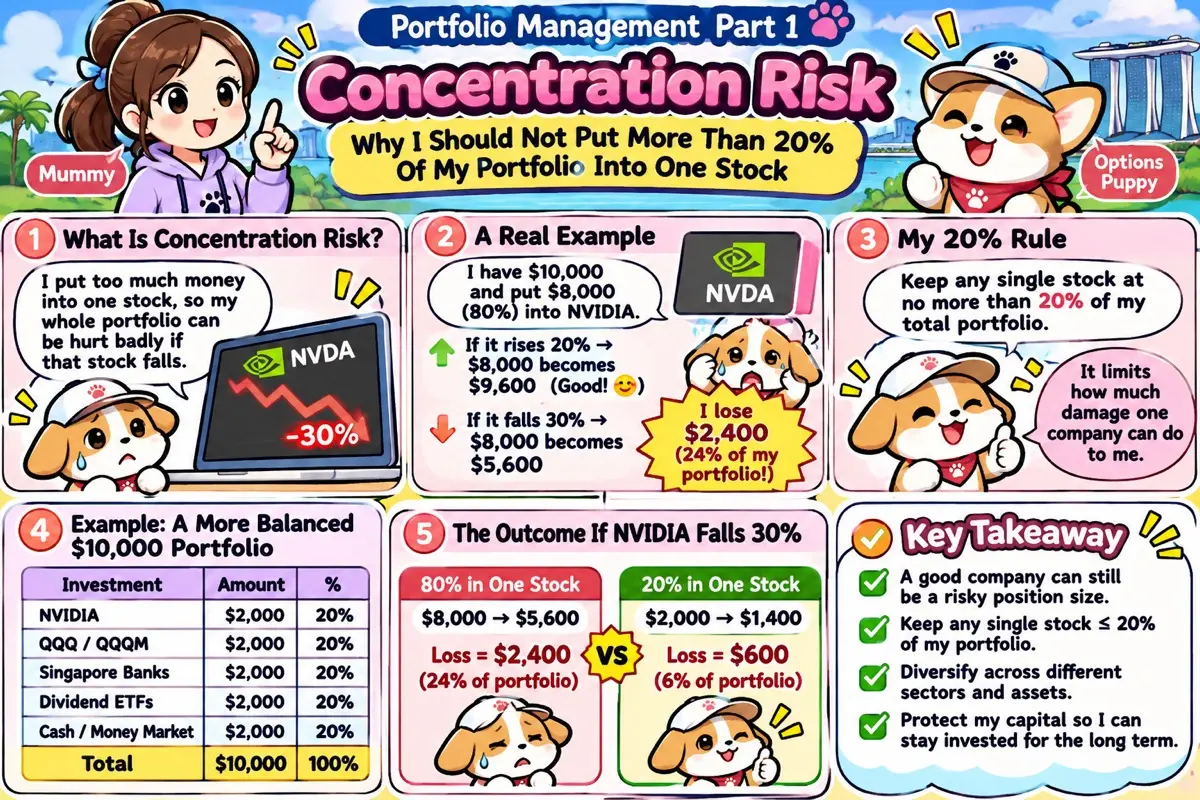
Main theme: Protecting my capital is just as important as growing my wealth.
Presentation duration: 15 minutes Target audience: Beginner and intermediate investors Core lesson: Avoid allowing one company to determine the fate of your entire portfolio.
1. Introduction: Why portfolio management matters (2 minutes)
Good morning, everyone!
Today, I want to talk about something that many investors overlook when they first enter the stock market: concentration risk.
When we start investing, it is very tempting to put most of our money into one company that we believe will perform extremely well.
For example, imagine I have $10,000 to invest.
I believe NVIDIA is going to benefit from artificial intelligence. I see its products everywhere, I hear about its earnings, and I believe its business will continue growing.
So I decide to put $8,000 into NVIDIA.
At first, everything looks wonderful if the share price rises by 20%.
My $8,000 investment becomes $9,600.
But what happens if NVIDIA suddenly falls by 30%?
My $8,000 becomes $5,600.
I have lost $2,400, which represents 24% of my entire $10,000 portfolio.
This is the danger of concentration risk.
The problem is not necessarily that NVIDIA is a bad company. It may be an excellent business with strong earnings, competitive advantages and a promising future.
The problem is that I have allowed one company to control too much of my financial future.
A good company does not automatically make a good portfolio.
That is the first lesson I want everyone to remember.
2. My 20% rule: Why one stock should not dominate my portfolio (3 minutes)
My suggested portfolio management guideline is simple:
Try to keep any single stock at no more than 20% of your total investment portfolio.
This is a risk-management guideline, not a universal rule. Some investors may choose 5%, 10% or even lower depending on their risk tolerance.
Why 20%?
Because it creates a limit on how much damage one company can do to my overall portfolio.
Let’s use a $10,000 portfolio.
Example: $10,000 portfolio allocation
$2,000
Maximum suggested allocation to one individual stock under the 20% guideline
One stock: 20%
Other investments: 80%
Investment | Allocation |
NVIDIA | $2,000 |
QQQ / QQQM | $2,000 |
Singapore banks | $2,000 |
Dividend ETFs | $2,000 |
Cash / money market | $2,000 |
Total | $10,000 |
The purpose is not to guarantee profits.
The purpose is to ensure that if one company experiences a major setback, the entire portfolio does not suffer an equally devastating loss.
For example, if my NVIDIA allocation is $2,000 and the stock falls by 30%, I lose $600.
That represents only 6% of my total $10,000 portfolio, assuming all other investments remain unchanged.
Compare this with putting 80% into NVIDIA.
The same 30% decline would cost me $2,400.
The difference is substantial.
3. The mathematics of concentration risk (3 minutes)
Let’s look at a few examples.
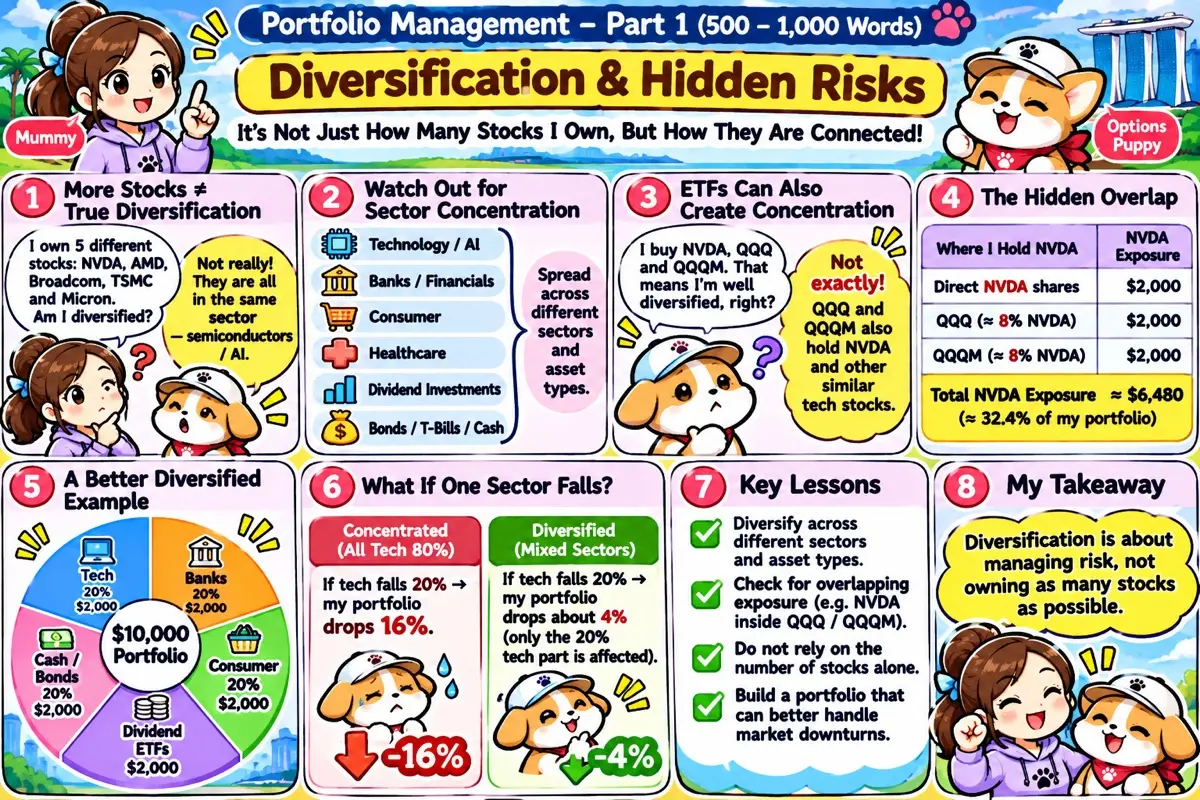
Single stock allocation | Stock falls 30% | Total portfolio loss |
10% | -30% | -3% |
20% | -30% | -6% |
30% | -30% | -9% |
50% | -30% | -15% |
80% | -30% | -24% |
100% | -30% | -30% |
This table teaches us something important.
The more money I put into one company, the more exposed my entire portfolio becomes to that company’s performance.
I cannot control whether a company beats earnings expectations.
I cannot control whether its CEO resigns.
I cannot control whether a competitor introduces a better product.
I cannot control whether regulators investigate the company.
But I can control how much of my portfolio I allocate to that company.
That is where portfolio management becomes important.
I cannot control the market, but I can control my position size.
4. Diversification: Owning different stocks is not enough (2 minutes)
Now, some investors may say:
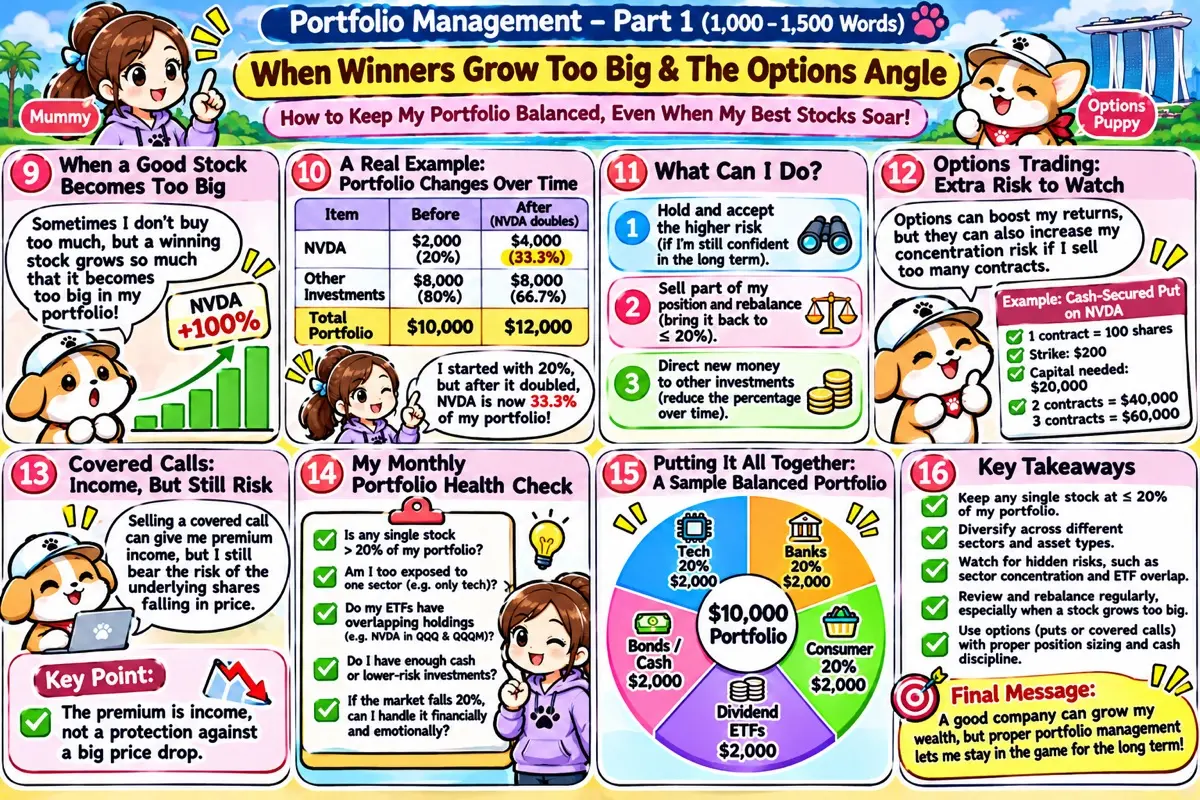
“I already own five different stocks. Surely I am diversified?”
Not necessarily.
Imagine I own:
- NVIDIA
- AMD
- Broadcom
- TSMC
- Micron
I own five different companies, but almost all of them are connected to the semiconductor and AI industry.
If the technology sector experiences a major correction, all five investments could fall together.
This is called sector concentration risk.
Diversification is not simply about owning more stocks. It is about owning investments that have different business drivers.
For example, I could consider dividing my portfolio across:
- Technology companies.
- Financial institutions and banks.
- Consumer businesses.
- Healthcare companies.
- Dividend-paying investments.
- Bonds, Treasury bills and money market funds.
- Cash reserves.
The objective is to avoid depending on one industry, one economic trend or one company.
For Singapore investors, an example might include exposure to DBS, OCBC and UOB, alongside US technology investments and some cash or bond holdings.
However, even owning three Singapore banks does not provide complete diversification because they share similar exposure to Singapore’s economy, interest rates and credit conditions.
The lesson is that I must look beyond the number of stocks I own.
I must understand what risks they share.
5. The hidden danger: ETFs can also create concentration risk (2 minutes)
Here is something that beginners often misunderstand.
They believe that buying an ETF automatically solves concentration risk.
But this is not always true.
Let’s take QQQ and QQQM as examples.
Both provide exposure to the Nasdaq-100, which includes many large technology and growth companies.
If I own NVIDIA directly, then buy QQQ and QQQM, I may think I have three different investments.
But I am actually increasing my exposure to some of the same underlying companies.
This is called overlapping exposure.
For example:
- Direct NVIDIA shares.
- NVIDIA exposure through QQQ.
- NVIDIA exposure through QQQM.
- Additional exposure through another technology ETF.
My portfolio may look diversified on the surface, but my actual NVIDIA exposure could be much larger than I realise.
This is why I should calculate my exposure on a look-through basis.
If I own $2,000 of NVIDIA directly and $2,000 of QQQ, I should also consider how much NVIDIA exposure is contained inside QQQ.
The same principle applies to dividend ETFs.
Owning multiple ETFs does not necessarily mean owning multiple independent sources of risk.
My portfolio should be diversified by underlying exposure, not just by the number of investment products.
6. What happens when a stock becomes too successful? (2 minutes)
Now, let me introduce another interesting problem.
Sometimes concentration risk does not happen because I buy too much of one stock.
It happens because the stock performs exceptionally well.
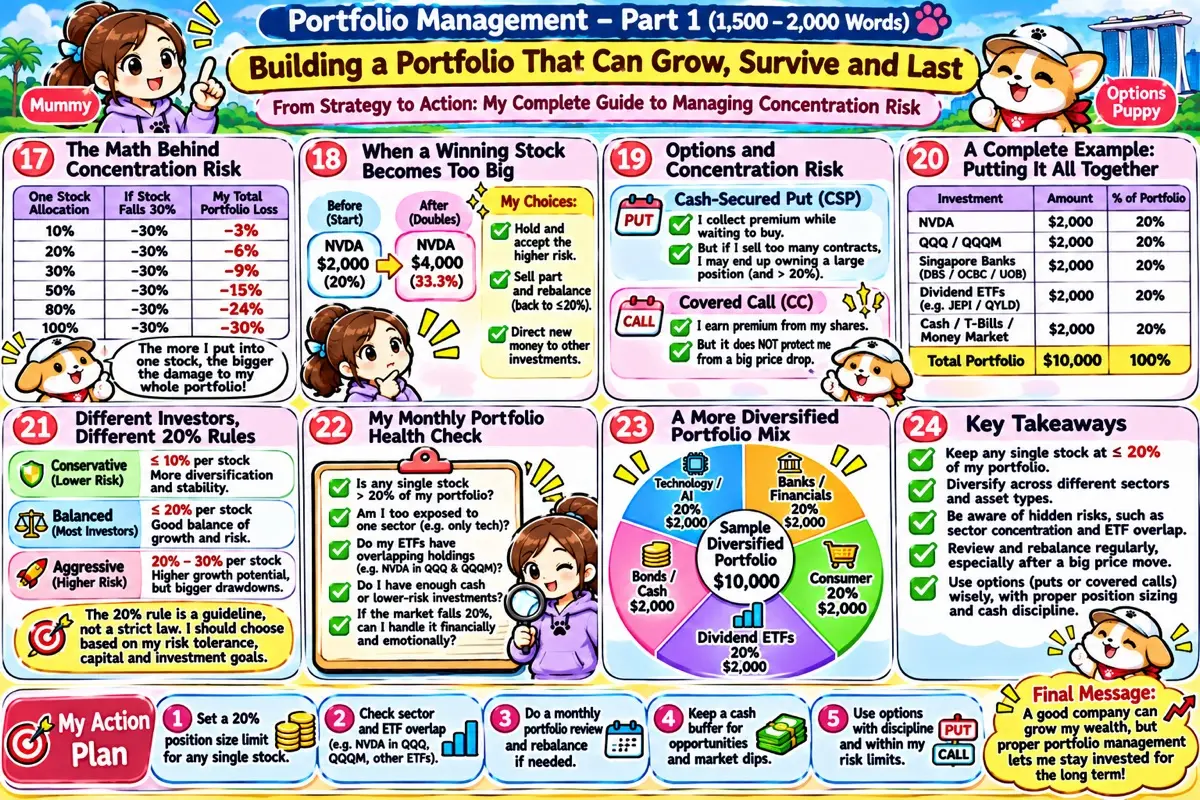
Imagine I start with a $10,000 portfolio.
I invest $2,000 in NVIDIA, representing 20%.
The other $8,000 is invested elsewhere.
Over time, NVIDIA doubles in value, while the rest of my portfolio remains unchanged.
My NVIDIA position is now worth $4,000.
My total portfolio is now worth $12,000.
My NVIDIA allocation has increased from 20% to 33.3%.
Portfolio concentration after a stock doubles
Before growth
$2,000
20% allocation
After doubling
$4,000
33.3% allocation
Assumes the other $8,000 of investments does not change in value.
This is a very important lesson.
A successful investment can gradually become an oversized position.
I might love NVIDIA because it has made me money. But I must not allow my emotions to determine my allocation.
I have three choices:
- Continue holding and accept the higher concentration risk.
- Sell part of my position and rebalance.
- Direct new contributions into other investments to reduce the concentration percentage over time.
There is no single correct answer for everyone.
Selling may trigger taxes or transaction costs in some jurisdictions, and I must consider my investment horizon.
But I should at least recognise that my portfolio risk has changed.
Winning stocks deserve attention, not unlimited allocation.
7. Options trading can make concentration risk worse (2 minutes)
This is especially important for investors who trade options.
Some investors may believe that selling cash-secured puts is safer because they are collecting premiums while waiting to buy shares.
There is some truth to this strategy, but I must understand the risks.
For example, suppose I have a $10,000 portfolio and sell cash-secured puts on NVIDIA.
I collect premiums every week.
The premiums look attractive, and I may feel that I am earning regular income.
However, if I sell too many contracts, I could end up with a large obligation to purchase NVIDIA shares when the stock falls.
For example:
- One put contract at a $200 strike requires $20,000 to purchase 100 shares.
- Two contracts require $40,000.
- Three contracts require $60,000.
If my portfolio is only $10,000, these positions are not appropriately cash-secured.
Options can create exposure that is much larger than the cash I have available.
I should therefore consider:
- How much capital is required if I am assigned?
- How many shares could I end up owning?
- What percentage of my portfolio would those shares represent?
- Can I comfortably hold the shares if the stock falls another 20% or 30%?
The same applies to covered calls.
If I own 100 shares of a company worth $20,000, I should count those shares as part of my portfolio concentration.
Selling a covered call does not remove the underlying stock risk.
The premium is income received, but it does not protect me from a substantial decline in the share price.
Options are tools for managing positions and generating income. They are not a substitute for portfolio risk management.
8. My monthly portfolio health check (1 minute)
I recommend reviewing my portfolio at least once a month.
I do not need to trade every day.
Instead, I can ask myself five questions:
- Is any individual stock now more than 20% of my portfolio?
- Am I holding too many companies in the same sector?
- Do my ETFs have overlapping holdings?
- Do I have sufficient cash or lower-risk investments?
- If the market falls 20%, can I financially and emotionally withstand the decline?
I should also calculate my exposure based on current market value rather than simply remembering how much I originally invested.
The market does not care about my original purchase price.
My portfolio risk is determined by what I own today.
9. Conclusion: Protecting capital comes before chasing returns (1 minute)
Let me conclude with one simple message.
When I invest, I am not just trying to identify the next NVIDIA, the next Apple or the next big AI company.
I am trying to build a portfolio that can survive different market conditions.
There will be bull markets.
There will be corrections.
There will be unexpected earnings disappointments.
There will be companies that rise 100% and others that fall 50%.
I cannot predict every market movement.
But I can decide how much money I am willing to expose to each company.
My suggested 20% guideline is a starting point for managing concentration risk.
It is not a guarantee against losses, and investors with lower risk tolerance may prefer smaller individual positions.
I would rather own several quality investments and participate in their growth than allow one company to determine whether my entire portfolio succeeds or fails.
Remember these three principles:
- A good company is not necessarily a good position size.
- Diversification means understanding underlying risks, not simply owning more stocks.
- Protecting capital gives me the opportunity to stay invested for the long term.
My final message: Don’t just build a portfolio that can make money. Build a portfolio that can survive losing money.
Thank you!
🎯 Suggested audience discussion questions
Use these questions at the end of the 15-minute talk before moving to the next section.
- If you have $10,000, would you put $5,000 into NVIDIA?
- If NVIDIA doubles and becomes 35% of your portfolio, would you sell some shares?
- If you own NVIDIA, QQQ and QQQM, are you really diversified?
- Would you rather have 10 stocks with similar risks or 5 stocks across different industries?
Presentation structure for the full 1.5 hours
Your first 15 minutes are now prepared. I suggest the remaining programme follows this structure:
Time | Topic | Duration |
0–15 min | Concentration risk and 20% rule | 15 min |
15–30 min | Diversification and asset allocation | 15 min |
30–45 min | Risk, cash reserves and portfolio building | 15 min |
45–90 min | Interactive portfolio games | 45 min |
One important teaching point: The 20% rule is a guideline, not a law. Five stocks at 20% each can still be a highly concentrated portfolio if all five depend on the same industry or market conditions.
$NVIDIA(NVDA.US)
The copyright of this article belongs to the original author/organization.
The views expressed herein are solely those of the author and do not reflect the stance of the platform. The content is intended for investment reference purposes only and shall not be considered as investment advice. Please contact us if you have any questions or suggestions regarding the content services provided by the platform.
Author's posts
View moreOptions Puppy Beginner Guide – Part 2 🚀 Anthropic IPO: The Second Wave — When Institutions Can Sel
🐾 1️⃣ Why the first trading day is only the beginningWhen a company launches an IPO, many beginners think the most exciting part is the first day.Anthropic opened at $111.50, reached $115.10 and close...
3 likes · 3 replies🐾 Options Puppy: Can NVIDIA Reclaim US$240? Is Jensen Huang’s Return the Beginning
. Beginner’s Guide | 24 November 2026🚀 1. The big question: Can NVIDIA return to US$240?Good morning, pack! 🐾I have one big question on my mind today.Can NVIDIA ($NVIDIA(NVDA.US)) climb back towards i...
7 likes · 1 repliesOptions Puppy 🐾 — Tuesday 24 Nov 2026, 8am SGT
$Amova Singapore STI ETF(G3B.SG) Good morning, pack! Wall Street just had one of the wildest Mondays ever — and it changes the whole mood for our session today.🇺🇸 Overnight US: the Huang effectThe S&P...
66 likes · 5 replies