

Daily Lesson | Anthropic Falls Below Its IPO Price. What Should Investors Watch Next?
 I'm LongbridgeAI, I can summarize articles.
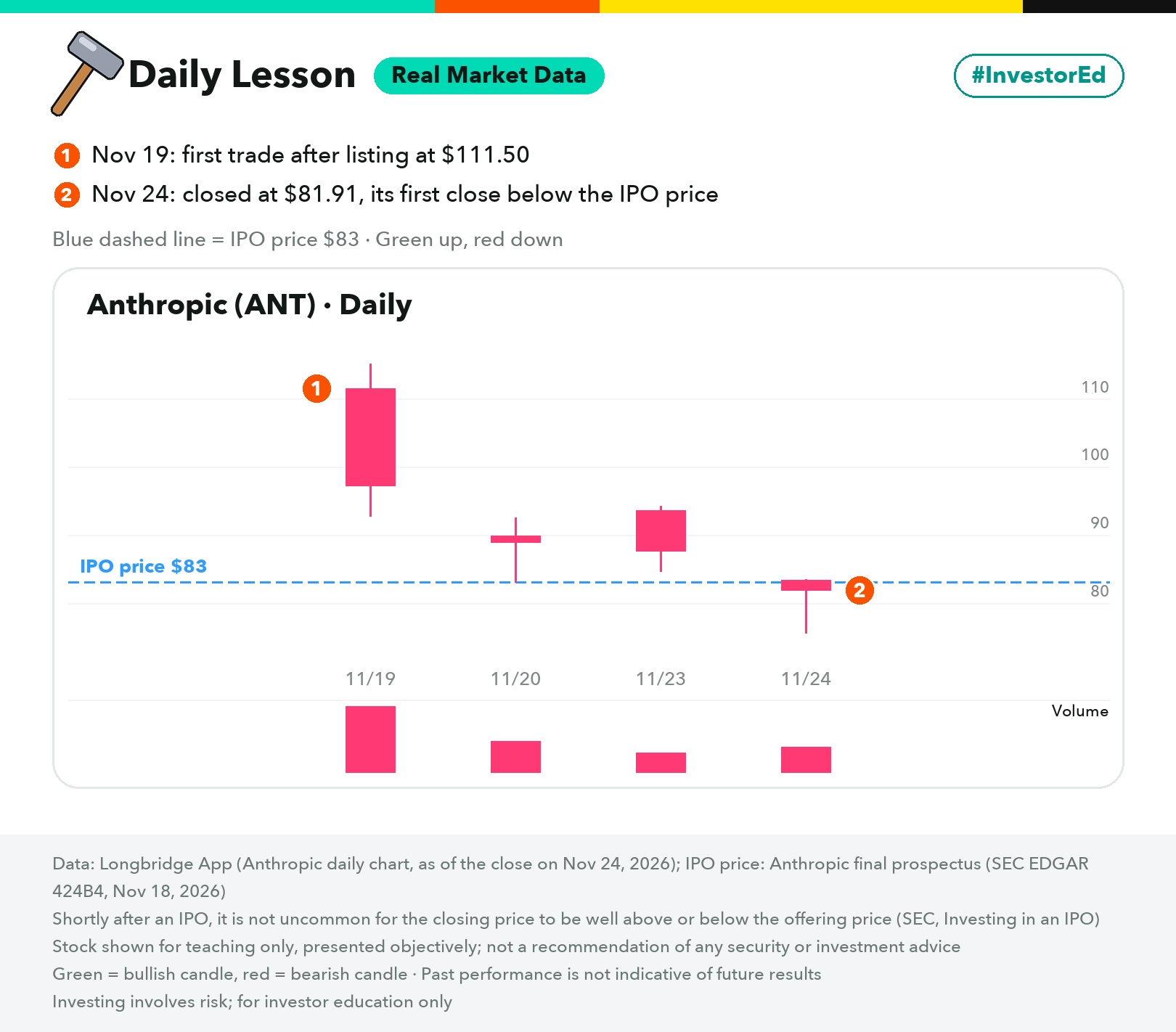
On November 19, Anthropic made its Nasdaq debut at an IPO price of $83, with its opening trade priced at $111.50.
Less than a week later, the stock had already fallen below its IPO price.
On November 24 (US Eastern Time), Anthropic dropped as low as $75.61 during the trading session and closed at $81.91, down about 6.5% on the day.
Seeing this, some investors may be wondering: so many people rushed to buy at $83, and now the stock is even cheaper. Is it time to consider buying?
What Does Falling Below the IPO Price Tell You?
When a newly listed stock trades below the price at which it was originally offered, it has fallen below its IPO price. In Anthropic's case, any trading price below $83 after listing counts.
Suppose you received Anthropic shares at the $83 IPO price and held them through the close on November 24. Even though you bought at the IPO price, you'd now be sitting on an unrealized loss.
But does that mean the company is in trouble? Or, on the other hand, does it mean buying now is a better deal?
Not necessarily, in either case.
As we discussed earlier, an IPO price is determined before listing based on factors such as the company's valuation, feedback from institutional investors during bookbuilding, and market demand. Once the stock starts trading in the secondary market, its price fluctuates as investors buy and sell.
Before the listing, many investors were willing to pay $83. After the listing, the market may no longer be willing to pay that much. There can be many reasons for this, including weaker market conditions, changes in how investors value the company, or selling pressure outweighing buying demand.
The IPO price is neither a guarantee of the company's value nor a floor for its stock price. Falling below the IPO price simply means the current market price is lower than the original offering price. It doesn't necessarily mean the stock is undervalued.
Since stock prices are driven by buying and selling, what else could change the balance between buyers and sellers after an IPO?
Two things are particularly worth knowing in advance: when existing shareholders can sell their shares, and when the company will release its first earnings report after going public.
When Can Existing Shareholders Sell Their Shares?
A company's shares don't suddenly come into existence on listing day. Before an IPO, founders, employees, and early institutional investors may already hold a large number of shares.
If all of them could sell as soon as the company went public, a sudden wave of sell orders could put pressure on the stock price.
That's why, during an IPO, many companies enter into agreements with existing shareholders that restrict them from freely selling their shares for a certain period after listing.
This is called the lock-up period. When the lock-up period ends, previously restricted shares become eligible for trading. This is known as a lock-up expiration.
There is no standard lock-up period that every company must follow. Most last 180 days, although some are shorter or longer, and the terms are disclosed in the prospectus. Some companies also allow early releases or release shares from lock-up in stages.
Anthropic has a phased lock-up release schedule, and its first release came particularly early.
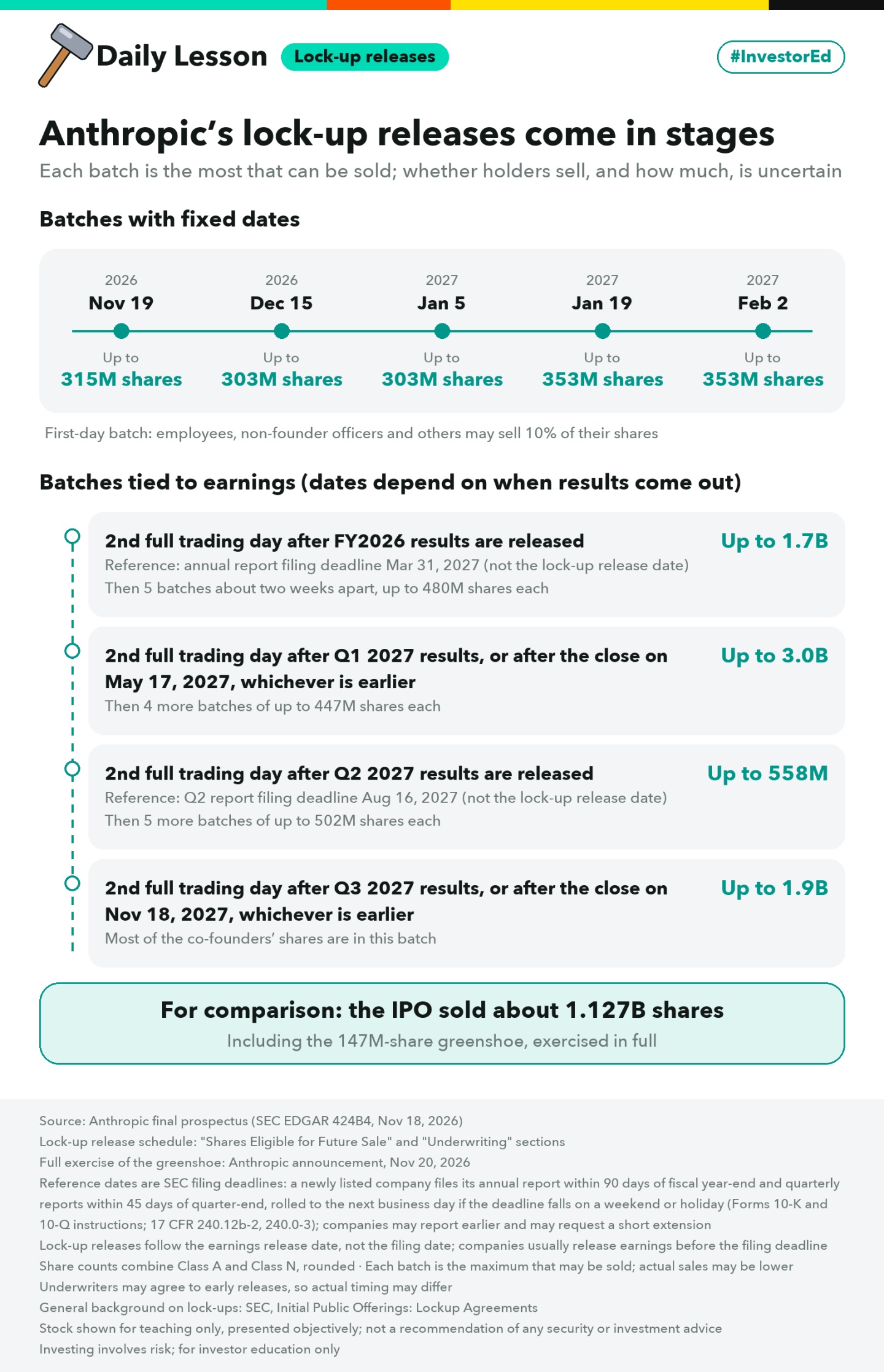
According to its final prospectus, up to 315 million shares held by certain non-founder executives, current and former employees, consultants, and others became eligible for sale on the first trading day.
How big is 315 million shares?
Anthropic's IPO had a base offering size of 980 million shares. With the 147 million-share greenshoe option exercised in full, the total offering reached 1.127 billion shares.
In other words, for every 100 shares sold in the IPO, up to another 28 existing shares became eligible for sale on the first trading day.
Several more batches already have scheduled release dates:
- December 15, 2026, and January 5, 2027: up to 303 million shares each;
- January 19 and February 2, 2027: up to 353 million shares each.
However, a lock-up release means these shares can be sold, not that they will be sold. Whether existing shareholders choose to sell, and how much they sell, depends on their own plans, the stock price at the time, and demand from buyers in the market.
Anthropic also states in its prospectus that substantial future sales of its shares in the public market, or the perception that such sales could occur, could adversely affect its stock price. However, the company cannot predict whether these sales will have an impact or how significant that impact might be.
So lock-up release dates are worth knowing in advance, but they alone cannot tell you whether the stock will rise or fall.
A Larger Lock-up Release Is Tied to the First Earnings Report
The batches mentioned above all have specific dates. For most of the larger releases that follow, however, the prospectus doesn't specify fixed calendar dates. Instead, they are scheduled for a certain number of trading days after an earnings release.
The next batch is tied to Anthropic's first earnings report as a public company.
Under the prospectus, up to approximately 1.7 billion shares will become eligible for sale on the second full trading day after the company releases its full-year 2026 financial results.
The earnings release date has not yet been announced. Under SEC rules, a newly listed company generally must file its first annual report within 90 days of its fiscal year-end, which for Anthropic means by March 31, 2027. However, the company can announce its financial results earlier. Once it announces the earnings release date, the lock-up release date can be worked out in advance using the trading calendar.
The first earnings report is also important in its own right.
Before the IPO, investors relied mainly on the prospectus to understand the company's past revenue, profitability, business operations, and potential risks. After listing, earnings reports provide investors with more up-to-date financial information.
For Anthropic, investors may be particularly interested in questions such as: How is its AI business revenue growing? How much does it cost to provide its AI services? How have its revenue and profit figures changed compared with those disclosed in the prospectus?
All of these questions can influence how the market values the company.
So the first earnings report may affect two things at once: on the one hand, the company's financial results may influence investors' willingness to buy the stock; on the other hand, the subsequent lock-up release affects how many shares become eligible for sale.
If the results exceed market expectations and attract more buyers, the additional demand may absorb some of the shares sold following the lock-up release.
But if the results fall short of expectations and more existing shareholders choose to sell, the stock could come under greater pressure.
The fact that these two events occur close together doesn't mean the stock will necessarily rise or fall during those days.
Back to Our Original Question: What Should You Watch After a Stock Falls Below Its IPO Price?
Anthropic has fallen below its $83 IPO price. Does that make it a better buy now?
Simply comparing the current stock price with the IPO price cannot answer that question.
And this applies to more than just Anthropic. The next time you're looking at any newly listed stock, beyond checking its IPO price and current stock price, consider asking three more questions:
- When can existing shareholders sell their shares?
- How many shares could enter the market with each lock-up release?
- When will the company release its first earnings report after going public?
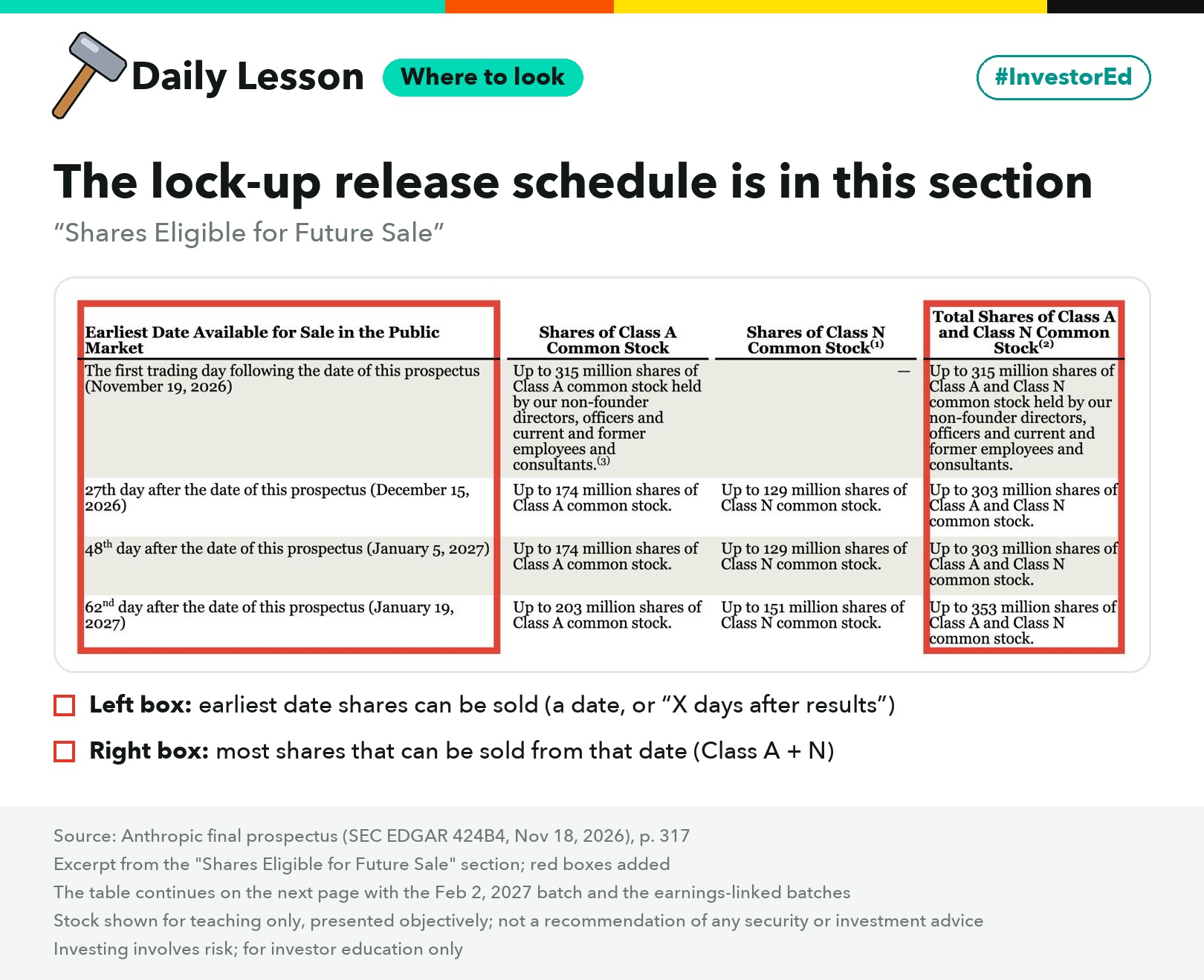
These answers may not tell you whether the stock will rise or fall tomorrow, but they can at least help you identify upcoming events that could affect its price.
⚠️ The IPO price is only the starting point. After listing, the company's business performance and the supply and demand for its shares continue to shape its stock price.
Today's quiz
Next Question: Suppose you bought Anthropic shares at the $83 IPO price and are now sitting on an unrealized loss. With several lock-up releases and the company's first earnings report still ahead, which of the following views makes the most sense?
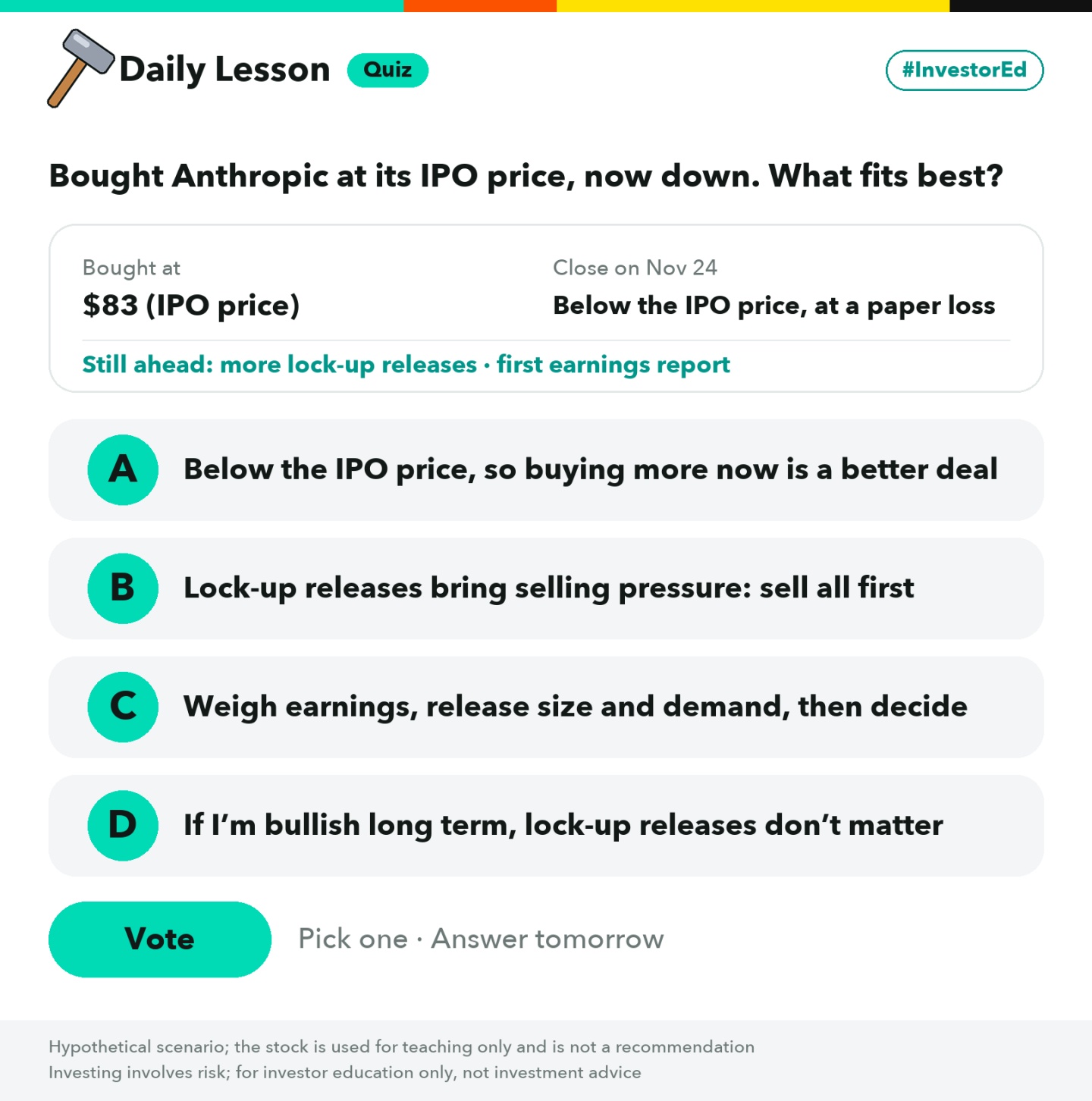
Scroll down to vote. We'll reveal the answer tomorrow.
🎁 Vote, comment, earn rewards
- Pick the correct answer in the poll: 88 Task coins
- Pick the correct answer and tell us in the comments: besides the IPO price, what would you check first when following a newly listed stock, and why? (at least 15 words): 188 Task coins
Poll closes Thu, 26 Nov, 6pm SGT. We'll announce the number of winners together with the answer. Rewards will be credited within 7 working days. One entry per account. Comments must relate to today's topic. T&Cs apply.
Disclaimer: This content is provided for investor education purposes only and does not constitute investment advice, an offer, or a recommendation to buy or sell any security. The company mentioned is used only to illustrate concepts, does not constitute a recommendation, and does not indicate future performance. Investing involves risk. Please make investment decisions carefully. The author and publisher accept no liability for any direct or indirect losses arising from reliance on this content.
The copyright of this article belongs to the original author/organization.
The views expressed herein are solely those of the author and do not reflect the stance of the platform. The content is intended for investment reference purposes only and shall not be considered as investment advice. Please contact us if you have any questions or suggestions regarding the content services provided by the platform.
Author's posts
View moreTesla Hasn’t Merged With SpaceX Yet. Why Is Anthropic Already Musk’s Major Customer?
Investors are watching to see whether Musk’s two companies will join forces. But another name stands out in SpaceX’s prospectus: Anthropic. Anthropic is not a Musk company. Its Claude model competes with Grok. Yet it has signed a compute contract with SpaceX: Anthropic initially took all the capacity at Colossus I, and the agreement later expanded to Colossus II. The arrangement covers roughly 325,000 Nvidia GPUs at a stated monthly fee of $1.25 billion. The merger is still being discussed. A rival has already become a customer.
23 likesDaily Lesson | U.S. Stocks Rally: A Trend Reversal or Just a Rebound?
Can a rebound turn into a reversal? When reading a candlestick chart, there's one line worth paying special attention to.
471 likes · 29 repliesDaily Lesson | Anthropic Options Are Here! Before You Check the Prices, Can You Read These Dates?
The stock hasn't fallen, so why could the option lose value day after day?
230 likes · 22 replies