

 Posts
Posts Likes Received
Intel: AI PC, is it the life-saving straw for the "toothpaste factory"?

As the manufacturer that launched the world's first commercial computer microprocessor, Intel's technological capabilities have long been at the forefront of the industry. It is precisely because of its long-standing technological leadership and monopolistic market position that Intel has had the opportunity to "squeeze toothpaste".
However, being stagnant for a long time will eventually be caught up by competitors. It is evident from the stock price that in the past decade, Intel's stock price has only increased by a little over 1x, while during the same period, NVIDIA's stock price has increased by 140x and AMD's stock price has increased by 40x. As a former giant, Intel's current market capitalization (198.4 billion) is even less than a fraction of NVIDIA's (14 trillion). What has happened in these ten years?
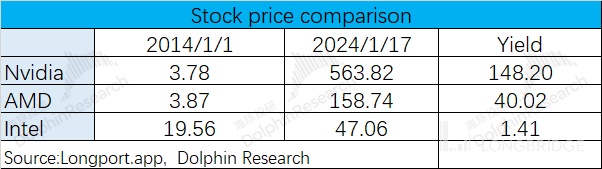
Dolphin Research has previously conducted company research on NVIDIA and AMD, and now, combined with the situation of Intel, we can have a more complete understanding of the rise and fall of each company.
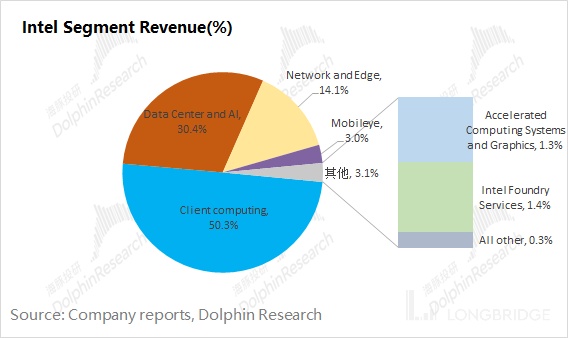
Although its influence has declined, Intel is still a major player in the CPU market. Whether in the PC market or the data center market, Intel's CPUs account for more than half of the market share. These two major businesses are also the company's largest sources of revenue, accounting for over 80%.
PC market: As a relatively mature market, the company's client computing business is mainly affected by the overall industry situation. The current demand in the PC market is still relatively weak, leading to a decline in the company's related business. In addition, it should not be ignored that the company's product performance and market share in the PC CPU market are facing competition from manufacturers such as AMD.
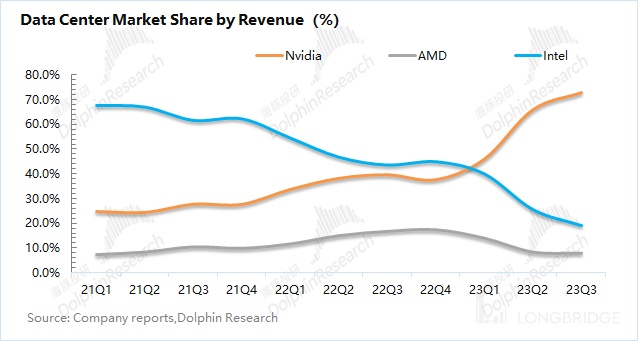
Data center market: Compared to the PC market, the data center market still has double-digit growth. The overall industry situation is better than the PC market, but Intel's growth in the data center and AI business has stagnated, mainly due to the weakening of the company's position in the market. The revenue from the data center business has decreased from 70% to 20% among the three manufacturers (Intel, NVIDIA, AMD).
Recent updates to AI PCs and the Windows operating system are expected to drive demand growth in the PC market once again. However, even with market growth, the decline in company competitiveness will suppress its growth potential. In the original traditional market, the main competition was between AMD and Apple, but now in the AI PC market, new players like Qualcomm are also trying to enter, which will bring greater challenges to the company. While innovation is expected to bring industry-wide growth to the PC market, the company's own product strength will be the key factor in winning this round of competition.
In this article, Dolphin Research mainly focuses on the company's core business and competitiveness, and the next part will mainly analyze the company's performance and valuation. Stay tuned for more updates from Dolphin Research.
Here is Dolphin Research's detailed analysis of Intel:
I. Intel: Hitting the "Ceiling"
In the past decade, while NVIDIA and AMD have grown their revenue several times over, Intel seems to have hit a growth "ceiling". From 2014 to 2022, Intel's revenue scale did not increase significantly.
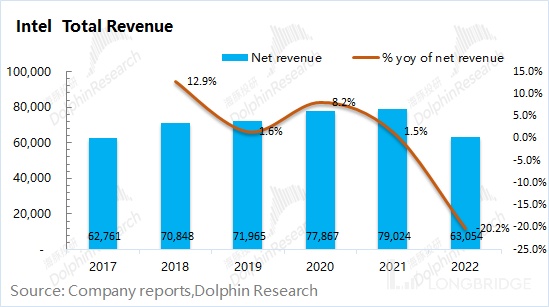
In the waves of technological advancements in the past, Intel has not been the market's "focus". What has limited Intel's growth? Let's start with the company's business:
According to the company's latest annual report, Intel's largest revenue comes from Client Computing and Data Center AI businesses, accounting for 80% of the revenue. Among them, Client Computing is still the largest source of revenue, accounting for 50%.
II. Client Computing: Showing signs of decline
Client Computing is the company's largest source of revenue, mainly consisting of desktop and laptop computers. The company's main product is CPUs for PCs, so the company is heavily influenced by the demand in the PC industry. In recent years, the company's revenue from Client Computing has declined significantly, mainly due to the global decline in PC demand.
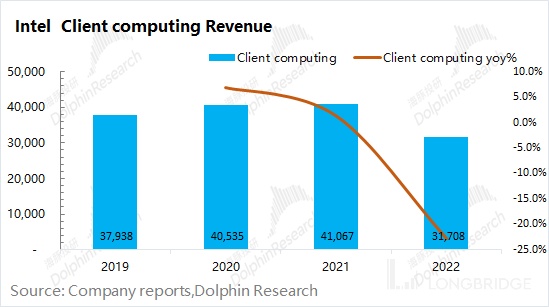
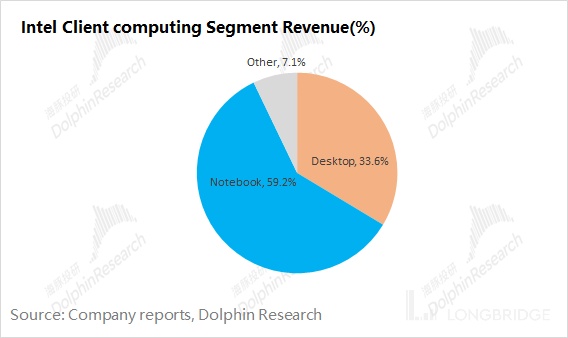
In the Client Computing business, laptops are currently the main source of revenue. The current market demand for PCs is mainly for laptops, while the more traditional desktop market is relatively smaller.
According to the data from the PC industry, the global PC industry has been experiencing continuous decline. After the boost from the home economy during the pandemic, there has been a significant decline in PC demand. Especially in the past two years, there has been a double-digit decline. The overall downward trend is similar to the company's client computing business.
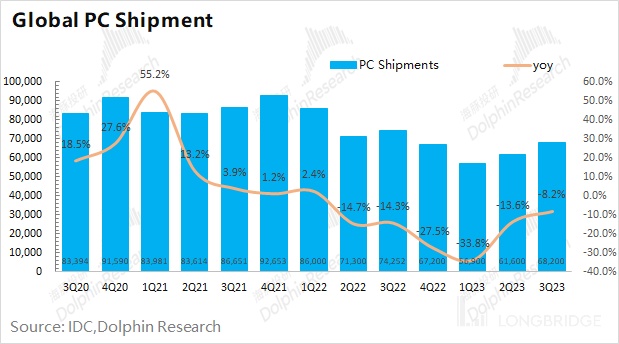
Although the downward trend is similar, the decline in the company's client computing business is significantly faster than the performance of the global PC market, mainly because Intel has lost some market share in the processor market.
According to the latest data from JRP, integrated graphics data to some extent reflects the current CPU market share. Although Intel still holds 80% of the processor market share, its share has declined. AMD has gained more market share in the CPU market. This has also led to Intel's revenue declining faster than the overall industry.
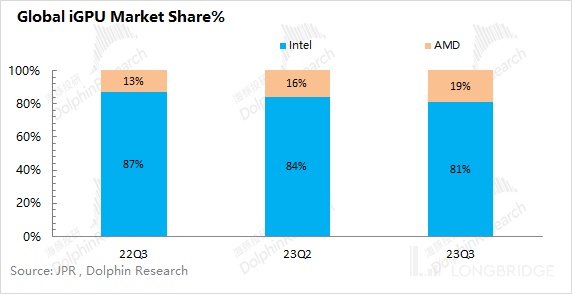
The decline in Intel's market share is not a coincidence, mainly because the company has been "squeezing toothpaste" in terms of innovation. Under the siege of AMD, NVIDIA, Apple, and others in recent years, Intel can no longer afford to "squeeze toothpaste" comfortably. After AMD joined forces with TSMC for production, its product competitiveness and market share gradually improved.
Although Intel's current CPU still leads in single-core performance, AMD has surpassed Intel in multi-core performance. It is no longer a situation where Intel is the only dominant player.
Currently, if you choose single-core tasks, Intel is still stronger, but if you need to handle multiple programs or software, AMD is already quite outstanding. It is because of this that AMD's market share in the processor market is showing an upward trend.

II.Data center&AI:
In contrast to the PC business, the data center business has shown significant growth in the past 10 years. Intel's data center business has grown from $15 billion 10 years ago to over $26 billion, mainly due to the downstream demand for data centers. However, in the past two years, the development of the data center business has also encountered bottlenecks, and its previously monopolistic position has been challenged.
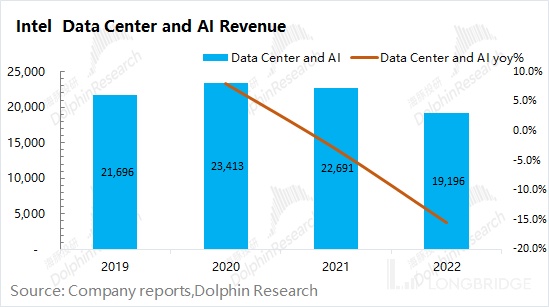
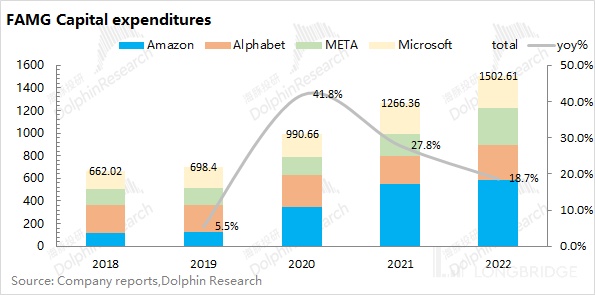
Due to the enormous investment required for the construction of data centers, the current main contributors are the American tech giants. Dolphin Research has compiled the capital expenditure of Amazon, Google, Meta, and Microsoft in recent years as a reference. It can be seen that global investment in data centers is still growing at a double-digit rate. However, Intel's growth in this business has stagnated, indicating that the company is facing increasing challenges.
In the data center CPU market, Intel took the lead. Since the introduction of the Xeon generation in 2015, the company has gone through several generations of updates from Sky Lake to Granite Rapids. However, due to the IDM model, the company has been unable to break through in the manufacturing process, directly limiting the improvement of product performance.

With its past competitive advantage, Intel used to occupy nearly 90% of the market share in the server CPU market before 2020. However, with the emergence of competitors such as AMD, Intel's market share in the server CPU market has declined to 70% in 2022. Intel has been unable to break through in manufacturing capabilities, while its competitors have gradually eaten away at the market share by leveraging the advantages of TSMC.
In addition, unlike traditional general-purpose servers, AI servers mainly rely on GPUs as the primary framework to enhance computing power through heterogeneous computing architectures. In the past, CPUs were the most important components in servers, but now they have gradually become supporting roles. Intel's advantage has weakened, while GPUs are the company's weakness. As a result, Intel's influence in the data center market is gradually diminishing.
Currently, the main players in the data center chip market are Intel, AMD, and NVIDIA. If we combine the disclosed data center revenue of the three companies, it is clear that Intel's revenue share in the market is decreasing and its influence is less than 20%. This indicates that NVIDIA has become the dominant player in the current data center market, and Intel's influence in the data center market has declined, just like in the PC market.
Although the company has other growing businesses besides PCs and data centers, the two aforementioned businesses account for 80% of the company's overall revenue. Therefore, the decline of these two businesses will directly impact the company's overall performance. Recent updates to AI PCs and the Windows operating system are expected to drive demand growth in the PC market once again. However, even with market growth, the decline in company competitiveness will suppress its growth potential. In the original traditional market, the main competition was between AMD and Apple. Now, in the AI PC market, new players like Qualcomm are also trying to enter, which will bring greater challenges to the company. While innovation is expected to bring industry-wide growth to the PC market, the company's own product strength will be the key factor in winning this round of competition.
Dolphin Research on Intel and Data Center Companies:
November 22, 2023: NVIDIA conference call - The First Wave of Artificial Intelligence (NVIDIA 3QFY24 Conference Call)
November 22, 2023: NVIDIA earnings report review - NVIDIA: The Firepower of Computing Power at Full Throttle? "False Fire" Looming
November 1, 2023: AMD earnings report review - Without NVIDIA's Explosive Power, AMD's Recovery is Too Slow
November 1, 2023: AMD conference call - AI PC, a New Wave of Productivity (AMD 3Q23 Conference Call)
Risk disclosure and statement for this article: Dolphin Research Disclaimer and General Disclosure
The copyright of this article belongs to the original author/organization.
The views expressed herein are solely those of the author and do not reflect the stance of the platform. The content is intended for investment reference purposes only and shall not be considered as investment advice. Please contact us if you have any questions or suggestions regarding the content services provided by the platform.
