

 Posts
Posts Likes Received
The core drivers of growth are the business model centered around training and continuous investment in product capabilities (Palantir 4Q23 earnings call)
Here is the summary of Palantir Tech's Q4 2023 earnings conference call. For an interpretation of the earnings report, please refer to "AI Drives Palantir's New Growth Cycle" here.
1. Review of Key Financial Information:
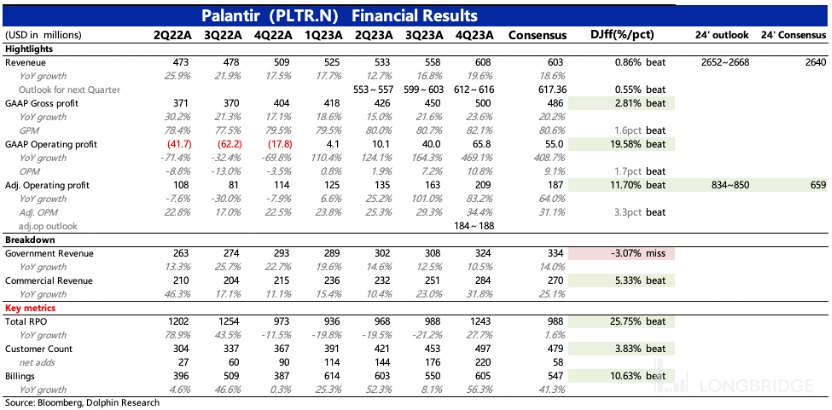
2. Details of the Earnings Conference Call:
2.1 Key Points from Management's Statements:
- AIP Products and Training: AIP focuses on tools rather than adjustments, emphasizing the transformation of business processes. The target for customer training was exceeded, and with the combination of LLMs and Foundry, the potential market size has expanded.
a) Customer Acquisition: Growth is driven by acquiring new customers and expanding existing ones. Training camps significantly shorten the sales cycle and accelerate the acquisition of new customers. In Q4, the acquisition rate of US commercial customers increased by 22% MoM.
b) Doubling the number of large transactions: This is achieved through customers participating in training camps and quickly signing enterprise contracts, driving pilot projects to conversion, and expanding existing accounts.
c) Strengthening long-term partnerships and exploring new markets: Renewed partnerships with giants such as Novartis and Swiss Reinsurance; deepening distribution channels and expanding into the Japanese market.
Product Strategy: The long-term core value is data integration, introducing new data into the context of operations to increase the complexity, subtle differences, and scope of decision-making, thereby creating value.
Government Business: Palantir actively participates in all crisis and conflict areas. On one hand, it focuses on deploying in the battlefield and large-scale plans related to JADC2, innovating participation models with governments and defense industrial bases through Mission Manager and the First Breakfast initiative. On the other hand, it has extended its partnership with the Army. The demand for government business is urgent, and it is expected that US government business will accelerate again in 2024.
International Government Business: More NHS trusts are starting to use Palantir's software to reduce care backlogs, including the Chelsea and Westminster NHS Foundation Trust.
At the same time, funding was obtained from Eastern European partner countries in Q4, and a strategic partnership with the Israeli Ministry of Defense was established to provide technology to help address the current situation in Israel, further expanding international government business.5) Business Expansion: Palantir is undergoing a commercialization transformation, similar to Amazon's expansion from e-commerce to AWS. Palantir is providing its proprietary technology to third parties for building and collaboration, supporting large-scale defense technology participants. The software solutions include Gotham, GAIA, and MetaConstellation.
- Financial Data:
a) Q4: Exceptional performance, with revenue, profit, and cash flow exceeding expectations. Revenue increased by 20% YoY, GAAP operating revenue increased by 65% QoQ to $66 million, reaching a historical high. Adjusted operating profit margin continued to climb to 34%, achieving a GAAP net profit of nearly $100 million. Adjusted free cash flow exceeded $300 million, accounting for 50%.
b) Breakdown by business segment: In Q4, the momentum in AIP is driving new customer conversions and existing customer expansion. The company signed $343 million in US commercial TCV, a 107% YoY increase based on the weighted average term in USD. US government revenue increased by 6% YoY and 3% QoQ, reaching $237 million. International commercial revenue increased by 11% YoY and 14% QoQ, reaching $154 million, mainly due to targeted growth opportunities in Asia, the Middle East, and other regions.
c) 2023: Expected to generate $120 million in GAAP operating revenue, a YoY increase of $281 million; achieve $210 million in GAAP net profit, a YoY increase of $584 million; and have adjusted free cash flow of over $730 million for the full year.
d) Outlook: For Q1 2024, revenue is expected to be between $612 million and $616 million, and adjusted operating revenue is expected to be between $196 million and $200 million. For the full year 2024, revenue is expected to be between $2.652 billion and $2.668 billion.
2.2 Q&A Analyst Questions and Answers
Q: Given the significant increase in demand for the Advanced Integration Platform (AIP), could the management team provide more details on the progress made in formulating the monetization strategy for the product?
A: With customer training bootcamps as a business model, the demand for AIP has surged, expanding our potential market continuously. In Q4 alone, the company completed 103 transactions worth over $1 million. In October, we set a goal of executing 500 training customers in the first stage of the sales process for AIP, and after nearly four months, we have already completed over 560 training customers, with this momentum still growing.
As a result, revenue in Q4 increased by 70% YoY, and the number of customer accounts increased by 55% YoY. Based on adjusted benchmarks, the total contract value (TCV) delivered increased by 107%. There are two main profit models behind this growth:On one hand, the training camp quickly converts potential customers into paying customers; on the other hand, it expands based on existing customers, accelerating the entire cooperation process with the launch of AIP.
Q: What kind of attention has the FedStart program recently received? What is the market's response, and will there be additional marketing promotion for these startups? Additionally, when do you expect Apollo to become a significant source of revenue for Palantir?
A: The FedStart program has been well received, with $100 billion flowing into the entire defense technology field. Typically, obtaining the relevant certification takes two years and $2 million, which few can afford. However, the FedStart program transforms the certification process into a six-week and cost-effective process, providing convenience for market access.
We initially focused on IL5 to help customers successfully enter the Department of Defense market. We plan to release IL6 FedStart at the end of the second quarter and FedRAMP High at the end of the third quarter or the beginning of the fourth quarter. We will also bring this technology to our allies and plan to collaborate with the UK later this year to launch FedStart on secret networks and advanced secret networks.
Apollo is emerging and performing well in practice. It not only manages our entire $2.2 billion in revenue but also brings significant value and benefits to our customers. A large part of this is because over the past two years, customers have been trying to solve these problems themselves and have gained a deep understanding of the value this technology can bring to them and how it can accelerate their processes, whether in government projects or in companies. Everyone is striving to explore how to efficiently deliver modern software into these environments.
In addition, Mission Manager has performed well. It combines Apollo, Rubix, and OSDK, with Rubix being zero-trust computing and network infrastructure. We provide these three as a comprehensive solution to the government, effectively and continuously meeting government needs by providing an infrastructure that allows them to build and manage large ecosystems of multiple vendors, promote continuous competition, and enable the government to have actual control over interfaces and avoid being locked in.
Therefore, you can consider FedStart as the first product we launched on the Mission Manager infrastructure. Currently, we have started other projects, including Army C2 work.
Before we launched FedStart, the market generally regarded Palantir as a competitor in the field of new defense technology. But in reality, we are not in competition with those companies. FedStart connects all these venture capitalists, their capital, and most of the companies they invest in with Palantir because we can enable enterprises to enter classified networks faster, allowing them to demonstrate results to investors more quickly.Many of the obstacles we faced are disappearing and have transformed into support for Palantir. These individuals are truly helping us establish a broader presence and influence in the industry. They are no longer solely focused on competing with us, but rather on how to achieve mutual success.
Q: Is the IT department still our biggest competitor among potential customers? Or has that changed?
A: We used to feel that way. However, the appeal of our training programs and AIP in the IT field has been tremendous. With features like Apollo, OSDK, and Marketplace, we have gained the support of IT, and the situation is completely different now. IT has become our biggest advocate. Perhaps the issue was never with IT itself, but rather with the complex ecosystem of the software development industry.
Products are designed for sales and can only temporarily solve problems without truly addressing them, and they may create dependencies that require strict adherence to architectural consistency.
Gen AI completely disrupts this, and the entire field and architecture are up for grabs. We are working closely with the IT department to build a framework that truly addresses all operational use cases for these customers. IT is continuously creating business value in the current commercial landscape.
Q: In previous discussions, it was mentioned that we are accelerating comprehensive growth and opportunities with the US government. However, this contradicts what we have heard from major contractors this quarter. They agree that the importance of software is increasing, but the Department of Defense still needs to learn and adapt to how to procure software, while software vendors also need to learn how to sell software to the Department of Defense. From your perspective, how much change is needed in the way the Department of Defense procures software? And what advantages does Palantir have in this long-term software sales environment?
A: We have been doing this for nearly 20 years, and the situation has significantly improved, although there is still room for progress. Unlike major contractors who previously focused on hardware and are now just starting to respond to software, we have always been focused on software. Software has a characteristic: its evolution is very fast. Its evolution is faster than the procurement process.
One unique advantage that Palantir has is our continuous investment, innovation, and management of software, regardless of the actual procurement situation of our clients. This means that we always have cutting-edge software that can continuously meet the actual needs of the Department of Defense. From a macro perspective, the current world situation imposes Pareto-optimal conditions, where the operational performance and reliability of software are crucial for personal safety, company success, and national security in critical environments such as the battlefield and defense.
The real value of Palantir lies in its reliable performance in critical environments, protecting lives. This goes beyond personal preferences or habits and becomes a key factor in the long-term success of companies.
Q: I think the achievements you have made this quarter are truly incredible. So, have you felt a significant increase in engagement from AIP customers? And has this increase been evident not only in the fourth quarter but also since the beginning of 2024?A: Yes. Although Palantir is still in the very early stages of promoting and expanding the AIP, we have seen an acceleration in customer engagement based on the results from the third quarter to the fourth quarter, as well as information from customer meetings. We are confident in this trend.
To meet the increasing demand for the AIP training camp, the company plans to take the following measures:
First, continue to hold AIP conferences and ensure their quality by limiting the number of participants.
Second, for potential customers interested in Palantir, the company is happy to invite them to directly experience the products and software, rather than just limiting discussions to abstract theories and business presentations.
Third, expand the company's scale according to demand, including transferring employees from Germany and France to the United States, and increasing recruitment efforts to attract more outstanding talents.
Risk disclosure and statement of this article: Dolphin Research Disclaimer and General Disclosure
