


 Posts
Posts Likes Received
Block: Optimistic about steady profit growth in 2024, with a 15% increase in gross profit.
Below is the summary of Block's fourth quarter earnings conference call in 2023. For the interpretation of the financial report, please refer to " Excited about US stocks, is Block's volatility reliable? 》
1. Review of Key Financial Information:
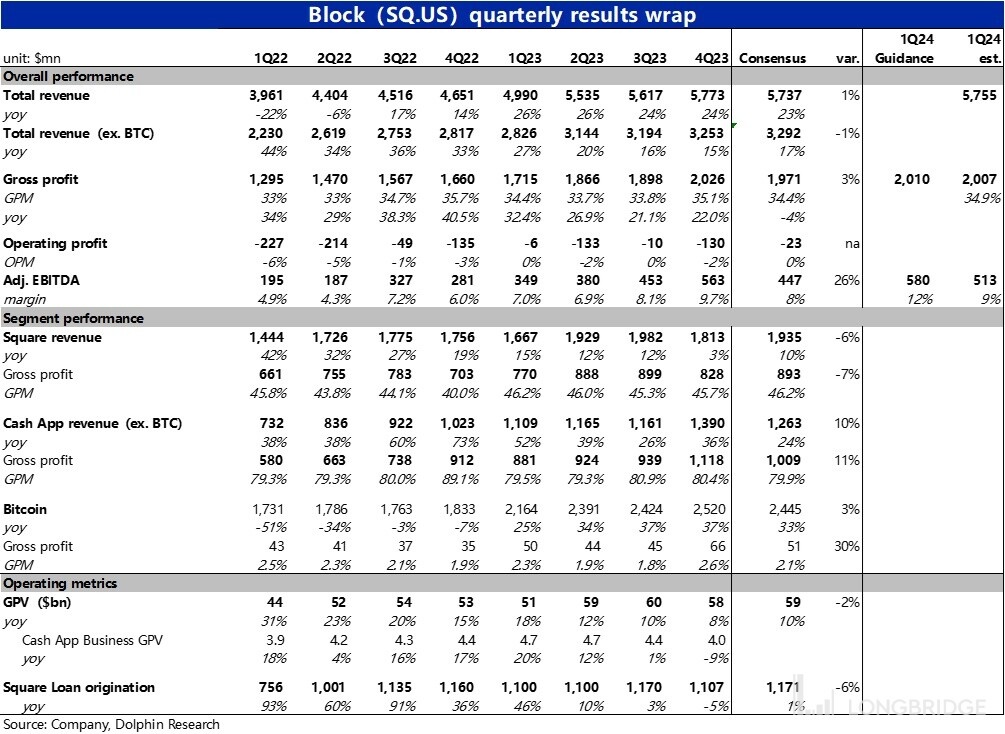
2. Detailed Contents of the Earnings Conference Call
2.1. Key Points from Executive Statements:
1. Full Year 2023: a) Overall performance in 2023: The company achieved a gross profit of $7.5 billion in 2023, a 25% year-on-year increase; b) Adjusted EBITDA was $1.79 billion, an 81% year-on-year increase, reaching a historical high; c) Adjusted free cash flow in 2023 was $515 million, a significant increase compared to the negative $346 million in the same period last year; d) In 2023, achieved the "Rule of 29," exceeding our expectations given in the third quarter by several percentage points. e) In 2023, Square and Cash App both achieved positive gross profit retention in each annual group, with strong performance in software and banking businesses offsetting soft transaction volumes throughout the year. f) The growth momentum of Cash App comes from the growth in funds inflow per active user driven by financial service products and pricing adjustments.
2. Fourth Quarter of 2023: a) On a GAAP basis, operating loss was $131 million, mainly due to $132 million in goodwill impairment, $70 million in CapEx spending (mainly related to recent organizational restructuring and lease impairment, restructuring costs), and $34 million in impact. b) Starting from the fourth quarter, the business model was restructured, integrating the Buy Now, Pay Later (BNPL) platform fully into Cash App.
3. Square: a) Compared to previous periods, GPV per seller is still affected by the reduction in discretionary spending by US consumers. Meanwhile, the contribution of new seller groups to gross profit remains low, consistent with the previous quarter. b) In card-not-present volume, online transaction volume showed strong growth, increasing by 11% year-on-year. However, this growth was partially offset by the decline in manually keyed entry (MKE volume), with MKE transaction volume accounting for 13% of Square GPV in the fourth quarter of 2023, down from over 16% two years ago. We expect headwinds from MKE transactions to persist for some time, but the impact should gradually diminish. c) Banking products and vertical point-of-sale solutions achieved strong growth, with gross profit growth of 18%, 28%, and 27% respectively.
4. Cash App:
a) As of December, Cash App's monthly active users reached 56 million, a 9% increase YoY. The average inflow per active user was $1,137, an 8% YoY increase. Cash App Card is expanding its reach and offering financial services to users within Cash App. By December, Cash App Card had 23 million monthly active users, accounting for over 40% of our total active users, a 20% increase compared to last year, growing at more than twice the pace of overall monthly active users.
b) Monetization rate: Reached 1.48%, up by 9 basis points YoY and 5 basis points QoQ. This improvement was driven by various factors, including pricing changes implemented during the quarter leading to increased gross profit from Bitcoin.
c) The BNPL platform contributed $242 million in gross profit to Cash App in the fourth quarter. The platform's GMV reached $8.6 billion, a 25% YoY increase, mainly driven by the strong performance of "Pay in four" and one-time payment services, allowing customers in the US, UK, and Australia to shop at merchants using the Afterpay app, without a direct relationship with these merchants, and pay using BNPL.
5. 2024 Full-Year Guidance:
a) Integrating commercial payment tools into our business is a key focus for us next year. b) Expected full-year gross profit for 2024 is at least $8.65 billion, or a minimum 15% YoY growth. c) Cash App's growth is expected to outpace Square, but the growth rate will slow down starting from 2023. Square's software, integrated payments, and banking businesses are expected to continue driving growth; d) Profit expectations and upgrades: The company has raised its full-year profit expectations, now expecting adjusted operating profit of at least $1.5 billion, compared to the previous preliminary estimate of $875 million. Adjusted EBITDA is at least $26.3 billion, compared to the previous expectation of $24 billion; e) Expense management: It is expected that stock-based compensation expenses as a percentage of gross profit will show leverage, improving compared to 2023.
6. 2024 First Quarter Guidance:
a) The company expects gross profit for the first quarter of 2024 to be between $20 billion and $20.2 billion, with a median growth rate of 17%. b) Compared to the fourth quarter, gross profit and Gross Payment Volume (GPV) for Square business are expected to slightly slow down, at 18% and 10% respectively. c) Weather conditions have had a cyclical impact on US Square GPV year-to-date, especially in January, leading to a 3 to 4 percentage point decline in growth rate.
We expect adj. operating income to be $225mn ~ $245mn,adj. EBITDA to be $570mn to $590mn.
2.1、Q&A
Q: What drives or accelerates the adoption of direct deposits? Within what timeframe would it be considered successful for 5% or 10% of Cash App users to adopt direct deposits?
A: The biggest driver for the adoption of direct deposits will be the ease of connecting and using banking features, with trust being a key factor as well. The company is aware that some services provided by traditional banks are currently lacking and plans to fill these gaps in an intuitive and well-designed manner. The company's current focus is on the banking business in the United States. They hope to see results faster than traditional methods, which also serve as the best foundation for the other two priorities (expanding into higher-end household markets and becoming a social bank). The company has already begun to see some early positive signs indicating their expansion into higher-end household markets. They plan to start from peer-to-peer, then expand to neighborhoods and local communities, with a greater focus on the business sector. The company prioritizes launching products that customers expect and then attracting more funds. Currently, about 2 million active users receive their salaries through Cash App, accounting for approximately 3% of its monthly active users. This is one of the key performance indicators being closely monitored, along with a broader focus on fund inflows and proactivity.
Q: With strict cost control in place, achieving at least a 15% increase in gross profit margin, what is the confidence in this growth? What signals or indicators is the company looking for when deciding whether to invest more actively in operating expenses (OpEx)?
A: The company has been pursuing key areas of operational cost leverage, including personnel, net constraints, general corporate expenses, and new technology applications. The personnel constraints the company faces are a key consideration in operating under a limit of 1,000 people, which is expected to continue for some time, providing a significant opportunity for the company to leverage operating costs from a non-GAAP and SEC perspective. Net constraints have led the company to prioritize and focus more strongly on areas that have the greatest impact on customers. The company has seen opportunities to improve efficiency in general corporate expenses, including third-party expenses, real estate, travel, data, cloud costs, professional fees, and more. The company is exploring how to leverage new technologies, such as artificial intelligence, to enhance its core competitiveness not only in product or service sales but also in improving efficiency within internal teams, especially in creativity and complex system integration, where AI is expected to enhance the company's core competitiveness. To address many inefficiencies between ecosystems, the company has invested a lot of effort in cleaning up and integrating operations, believing there is still room for further improvement.
Q: From which parts or user groups does Cash App's business growth mainly come from? How do partnerships affect Cash App's online business? Are there plans to further expand partnerships in the future?
Q: What measures are being taken to increase the penetration rate of Cash App? What is the investment situation in terms of compliance, including investments made to meet KYC requirements? What impact does this have on Cash App's P&L?
A: As of December last year, Cash App had 3 million monthly active payment transactions and an annualized total payment volume (GPV) of $25 billion, more than triple the growth reported since June last year. This growth has been driven by recent partnerships with DoorDash, Stripe, and other partners. The company has a series of large merchants as partners and is exploring further expansion of its coverage. Afterpay's enterprise sales team has played a key role in this process, leveraging existing relationships and the strengths of its sales organization to enable rapid expansion. Significant investments have been made in this area to ensure safety and trust, and this will continue to grow.
Q: Explain Cash App Card as a way to distribute BNPL (Buy Now, Pay Later). How much contribution does the company expect them to make to Cash App throughout the year?
A: The company recognizes that the main benefits of Afterpay should be focused on Cash App, with this integration focusing on discovering and promoting business activities, whether global e-commerce, online commerce, or more localized commerce. The company plans to integrate all financial tools created by Afterpay into Cash App and Cash App Card, meaning services like Buy Now Pay Later (BNPL) can be instantly enabled and exchanged on the Card, providing users with a more convenient payment experience. The guidance for new products to be released this year and next year is mainly based on current business trends and known cost leverage. The integration of Afterpay's tools and use cases in Cash App this year will be closer and more visible, meaning users will be able to use Afterpay's services more conveniently in Cash App. Greater benefits are expected later this year, but mainly in 2025 and beyond.
Q: Are there any different things to do in terms of banking licenses? If successful in banking efforts, what information needs to be shared? Can expansion still be achieved through acquisitions (such as acquiring Carter Bank) or is it necessary to directly obtain a license?
A: The company's current banking license (such as Square Financial Services Bank) does not require any special changes. Instead, this license can be used to expand potential use cases, especially beyond loans. The company aims to improve efficiency and speed through the bank itself, achieve tighter product integration, and provide a more coherent user experience. Despite having its own bank, the company does not limit the use of partner banks. The key to integrating all businesses is believed to be the product experience provided to people. Through new technologies, it is easier and more profitable to achieve this than traditional banks. The company will continue to focus on product development and sees no significant changes, driving this strategy through bank licenses, partner banks, and new technologies.
Q: The expected return period for investments in 2022 and 2023 is six to seven quarters. What about the investment return period in 2024 and 2025? How to plan and consider this year's marketing expenses?
A: The company is mainly ROI-oriented, observing the market performance within the Square ecosystem over a four-year period. As customers grow on the platform and add more products, the lifetime value of customers increases, ultimately determining the company's investment in market entry strategies. Over the past four years, the company has seen healthy ROI and will continue to focus on this in the future. The company's key focus in the future will be on sales and marketing. The company is undergoing a restructuring involving the actual functional organization of Square. This is to more closely integrate product and marketing, following the company's early-stage model. To ensure the smooth running of marketing activities, the company plans to more precisely target marketing activities to the target customer base and improve the entire process from contact to signing for customers. Additionally, the company aims to optimize the experience customers have when visiting the website or contacting the sales team.
Q: Cash App's monetization rate has increased by five basis points consecutively. What role do factors such as Bitcoin and pricing play in the growth of the monetization rate? How has Cash App's monetization rate changed this year?
A: The monetization rate in the fourth quarter increased by 9 basis points YoY and by 5 basis points MoM. The main reason for the MoM increase is Bitcoin-related factors, including product pricing and the appreciation of Bitcoin itself, which have contributed to the growth of the monetization rate. Looking ahead to 2024, the main drivers of growth will be the increase in active users and the inflow of funds per active user. From a longer-term perspective, there are opportunities to see growth in the monetization rate as the company deepens its presence in the financial services ecosystem and attaches more products to its customer base. However, due to some pricing changes expected in 2024, the monetization rate is not expected to change significantly as it did in 2023.
Q: Explain the revenue mechanism for direct deposit users and the savings products of Cash App? How will it evolve in the future?
A: As customers save more funds with the company, they are more likely to become the company's primary banking partners, allowing the company to offer more financial services, some of which will be profitable. The company has always considered its value from the perspective of the entire ecosystem, offering some free products (such as tax, investment, peer-to-peer products), while generating profits from products like debit cards. The company has introduced savings products, providing high returns (4.5%) for customers using direct deposit and lower returns (1.5%) for customers using the Cash App Card. This is intended to incentivize customers to channel more funds into Cash App, driving overall gross margin growth and increasing customer engagement with a wider range of Cash App products. At present, the savings balance is still in the early stage. As of the end of the fourth quarter, the total balance of Cash App savings accounts is $200 million, accounting for 60% of the total customer funds. The company will seek more opportunities to attract savings and fund inflows, ultimately driving customers to use a wider range of financial services products.
Q: The company's reliance on instant deposit financial services has significantly decreased, while the proportion of financial services in overall gross profit seems to be increasing. With the company executing its banking foundation strategy, what is the specific target for the proportion of financial services in Cash App gross profit? What could it reach by 2026? And the free cash flow in 2024?
A: Financial services accounted for 38% of Cash App gross profit in 2023, a significant increase compared to 29% two years ago, becoming a key growth factor within Cash App. Although Instant Deposit and other ecosystem parts are still growing, their growth rate is not as fast as financial services products. Therefore, the company will focus more on the development of financial services. While the calculation method of free cash flow differs from EBITDA, the direction of EBITDA growth can indicate the trend of free cash flow growth. The company expects free cash flow to increase over time.
Q: Compared to the U.S. market, international market growth still appears strong. How should we view the growth trajectories of the U.S. market and the international market, and predict the degree of their integration? When might the U.S. market reach the growth bottom? When can it recover growth? How does the company's focus on product impact the recovery of growth rates?
A: The company is focusing heavily on the growth of the food and beverage industry in the U.S. market and plans to accelerate growth through product and development improvements. The company believes there is a significant gap in product development and plans to address these gaps this year. For the U.S. market, the company plans to accelerate growth by improving product packaging, rethinking customer onboarding processes, and providing stronger marketing promotions. Currently, the company's penetration rate in the international market is less than 1%, but it sees long-term growth opportunities. In the fourth quarter, GMV in the international market grew by 26%, gross profit by about 28%, now accounting for 13% of Square's total gross profit. This indicates good growth momentum for the company in the international market. The company will continue to improve in the U.S. market and drive product speed, which will help capture the huge growth opportunities in the international market.
Q: What assumptions are currently being made about the growth of direct deposits? How is the mix ratio of direct deposits expected to change by 2024 and 2025? Are there specific conditions or factors that, if met, will promote this growth trend?
A: The company believes that product improvements and enhancements are key to driving development, especially in ensuring user experience and trust. The company hopes that users can trust its products and services, believing that this trust is built on the high practicality and wide connectivity of the products. The company plans to focus this year on ensuring that all features and services are satisfactory to users, similar to the comprehensive consideration when designing the Cash App card. The monthly active users of the Cash App Card are 23 million, growing at twice the rate of overall monthly active users, with over 40% of users utilizing it. The company achieved over $1 billion in gross profit in 2023, with a growth rate three times higher than instant deposits, where customers send funds through Cash App. Customers using the company's banking products have higher monthly activity on the Cash App Card, resulting in more than double the inflow of funds. Compared to peer-to-peer active users, direct deposit monthly active users bring in over seven times more funds. The company plans to leverage the success of the Cash App Card to introduce users to a more comprehensive suite of financial services and ultimately drive growth in direct deposits.
Risk Disclosure and Disclaimer for this Article: Dolphin Research Disclaimer and General Disclosure
