

 Posts
Posts Likes Received
Palantir: In the United States, we have no direct competitors (1Q24 earnings call minutes)
The following is a summary of Palantir's first quarter financial report conference call in 2024. For an interpretation of the financial report, please refer to " Palantir: Exceeded Expectations but Plunged? Market More Critical Under High Valuation 》
I. Review of Core Financial Information:
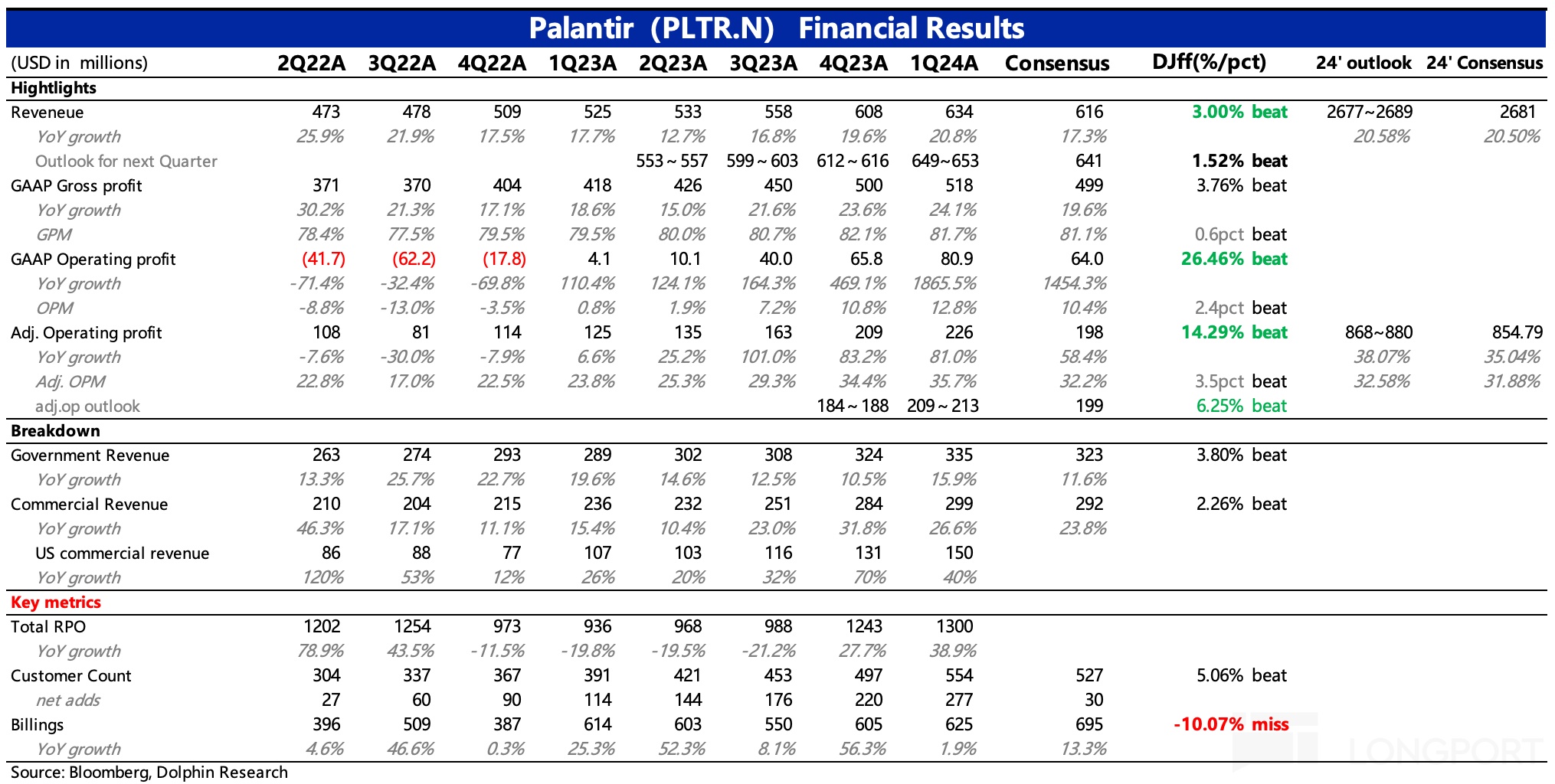
1. Slowdown in US Commercial Revenue Growth: Palantir's commercial revenue growth in the past year has accelerated, mainly driven by incremental AI products. Nearly half of the commercial revenue comes from the US region, where Palantir's advantages in scalability and profitability are higher. Therefore, the market is mainly concerned about the performance in the US region for the commercial sector.
However, after achieving a 70% high-speed growth well above expectations in 4Q23, the growth rate in the first quarter quickly dropped to 40%. Although there is an impact from a higher base, the trend of expansion is still slowing down on a quarter-on-quarter basis.
Commercial revenue in international regions accelerated compared to the previous quarter, reaching a growth rate of 15%. Ultimately, the overall commercial market revenue grew by 27% year-on-year, in line with market expectations.
2. Current Billings Below Expectations: Palantir mainly provides customized software services to clients, making the revenue more predictable in the short term. The company's guidance range is relatively narrow, implying a higher certainty of revenue. However, the market is more focused on indicators related to new contracts to reflect Palantir's true business growth, such as TCV (Total Contract Value), RPO (Remaining Performance Obligations), customer count, and Billings. The first three involve issues related to the cooperation period and may not be directly used to fit short-term revenue growth guidance, but Billings have a higher forward-looking nature for short-term growth.
In the first quarter, Palantir's billings only grew by 2% year-on-year, significantly below the market expectation of 13% year-on-year growth, which may have raised concerns in the market about the slowdown in short-term growth momentum.
3. Revenue Guidance Adjusted Upwards Due to AI, But Generally in Line with Expectations: Palantir's revenue guidance for Q2 is around $650 million, implying a growth expectation of 22%, slightly exceeding market expectations. The company also made certain adjustments to the full-year revenue guidance, but market expectations fall within the revised range.
Unlike the previous quarter's significantly exceeded short-term revenue guidance, this time the market expectations seem to be more fully priced in. Therefore, under high valuation, the Q1 financial performance may find it challenging to attract more funds.
4. Employee Incentive Control, Improved Profitability More Prominent: Although the revenue performance was "average," Palantir's profitability indicators further exceeded expectations. On one hand, costs seem to have not been burdened too much by incremental costs after the realization of AI products (gross margin only decreased by 0.5% quarter-on-quarter). On the other hand, there was some control over employee stock incentives in the first quarter, with SBC as a percentage of total revenue decreasing by 2%, ultimately leading to a 2% increase in operating profit margin quarter-on-quarterWith a year-on-year increase of 11 percentage points, significantly exceeding market expectations.
Due to the above reasons causing the expectation gap, the profit guidance for Q2 and the full year performance after the upward revision are naturally better than market expectations.
5. Maintaining robust medium to long-term forward-looking indicators: Apart from Billings, three forward-looking indicators including total contract value, remaining non-cancellable contract amount, and customer count have shown steady growth in the first quarter, with a further accelerating trend on a quarter-on-quarter basis.
Therefore, Dolphin believes that there is no need to be overly concerned about the short-term fluctuations in Billings, as historically the company's Billings have also experienced significant fluctuations during seasonal periods. Considering Palantir's customized services and the fact that the cooperation period with clients tends to be more medium to long-term, lasting at least over a year, short-term fluctuations, if not accompanied by a deterioration in medium to long-term indicators, do not actually require excessive worry.
At the same time, in actual news reports:
(1) The U.S. Army has signed multiple cooperation contracts with Palantir since the second half of last year, with the most recent being a two-year contract signed in March confirming Palantir as the supplier of the TITAN solution (next-generation deep sensing capability platform) worth $178 million.
(2) AIP's customer penetration is steadily progressing, with Palantir having tested software services for 915 corporate institutions by the end of the first quarter, nearly doubling from the disclosed number of 465 in the previous quarter. This customer penetration will further support long-term revenue growth, rather than immediately reflecting in short-term financial indicators.
6. Performance Indicators Overview
II. Detailed Content of the Financial Report Conference Call
2.1. Key Points in Management's Statements:
1) Business Highlights:
① High revenue growth: Revenue for this quarter reached $634 million, a 21% year-on-year increase, mainly driven by strong performance in AIP and the U.S. commercial market.
② AIP: AIP has high market acceptance, the strategy is not only successful but also accelerating, and AIP has become a part of the company's long-term business foundation.
③ U.S. Commercial Market: Despite seasonal factors, customer and revenue growth momentum is significant. Added 41 net new customers, soaring by 68% year-on-year, with a 22% increase quarter-on-quarter.
④ New customer acquisition: The company attracted participation from over 915 organizations through efficient training camps, quickly converting them into paying partners. New customers come from various industries, showcasing the broad applicability of AIP.
⑤ Existing customer expansion: Existing customers such as Lowe's, Cleveland Clinic, etc., have expanded their cooperation scope; deepened cooperation with key customers, expanding in scale⑥ Government Cooperation:
The revenue from the US government business continues to accelerate, including major contracts with the US Army, with Palantir becoming the main contractor for the Titan program;
The company is providing defense capabilities to the UK National Health Service (NHS) and global allies, advancing the delivery of key projects.
2) Future Outlook:
① Strategic Direction: Will continue to deepen the integration of software and hardware, promote the application of software on various platforms (including cockpits, vehicles, and ships); Accelerating the construction and development of more advanced technological solutions to support global critical missions in response to the needs of future wars and security.
② Financial Guidance:
| FY24Q2 Guidance | FY24 Full Year Guidance | |
| Revenue | $649 million ~ $653 million | $2.677 billion ~ $2.689 billion (with expected revenue from the US commercial sector exceeding $661 million) |
| Adjusted Operating Income | $209 million ~ $213 million | $868 million ~ $880 million |
| Free Cash Flow | / | $800 million ~ $1 billion |
| Capital Investment | Increasing investment in resources in the US, especially in AIP and specific defense opportunities, with expenses expected to increase starting from the second quarter. |
2.2, Q&A Analyst Q&A
Q: How is your AI strategy different from competitors?
A: Since the launch of AIP, we have anticipated the rapid proliferation of models, and the release of Llama-370B further confirms this. However, the real opportunity lies in the misuse of LLM by enterprises. We are the only company that has found a solution to help customers go beyond chat functionality, by leveraging our investment in ontology (Palantir Foundry Ontology) - transforming unstructured inputs into structured actions and outputs that drive economic value for enterprises.
We can add value to customers' messy data in just one day of training, focusing on helping builders within enterprises. I mentioned a hackathon at the Department of Defense, where a user built a logic function in Gaia Assist, reducing a continuous 6-hour localization process to 10 seconds using AIP.
In the commercial realm, we have released a wealth of tutorials, quick starts, and reference implementations to help every customer and user become builders, unlocking their potential on AIP. I believe we have no competitors (our talent background is superior, and newcomers would need a long time to build the technological foundation and products we already have), we are the only company with an ontology, which is crucial for AI to be effective, as ontology can operate in edge computing environments, providing users with more flexible ways of workingQ: I would like to understand the situation from the training camp to conversion. Can you provide a detailed introduction of typical customers? With more data obtained, what observations do you have on their conversion from training camp to signing deals?
A: We launched the training camp as a marketing method two quarters ago, and the results are obvious. In the training camp lasting from one to five days, we are able to accomplish work that previously took three months. Shortly after the training camp, customers signed seven-figure deals, allowing us to showcase their potential on the platform faster and engage in profit conversations.
In the U.S. business sector, our customer base has grown by 69%, completing 136 transactions in the first quarter of this year, a 94% increase from the same period last year. This demonstrates the effectiveness of the training camp. Although we are still in the early stages, we are working hard to figure out how to attract customers to purchase our products. We excel at educating customers, and some of them choose to make a purchase. As we make progress in this area, we expect the numbers to further increase.
Our training camp has set an industry standard, and even if customers do not choose to buy our products, they are made aware of possible solutions. This approach has been successful, with almost every country at some point purchasing our core product.
Q: In response to unprecedented demand, what are your upcoming plans? How is the recruitment plan, any partnerships, and what do you consider the most challenging?
A: In terms of products, I am most excited about the construction of AIP and the training camps we hold with customers after completing transactions. We are igniting the internal vitality of customers, unleashing their builders, and addressing use case issues. Therefore, even without the need for additional partners, we are leveraging reusable reference implementations, reference architectures, quick starts, and tutorials to drive customer development, covering various industries and functional areas, including the government itself.
In terms of partnerships, we have announced a partnership with Oracle. The hyperscale cloud service provider has realized the need for solutions beyond chat, and we are expanding our collaboration with partners to have them implement our products for our customers. We are in ongoing discussions with hyperscale cloud service providers and other partners, with the main idea being: we have an ideal product, you have ideal distribution channels, you can build on our product and then achieve higher profit margins in your distribution.
We have had such discussions with UHG in Japan, and we are also providing our core infrastructure to defense tech startups, allowing us to expand our core architecture and core software development to the defense sector, reducing competition with other competitors. Therefore, partnering with competitors can accelerate our revenue growth.
In the U.S. commercial market, we are enabling customers to complete tasks that previously required Palantir software engineers to do, in fact, we do not have enough Palantir staff to meet the demand. Therefore, we must encourage others to participate and provide a platform for them to join inWhat you see on AIP and Foundry is basically customers using our products on their own, which is why our revenue per person has increased by 26%, meaning we can earn more money without significantly increasing our workforce.
Q: Many people have noticed that Palantir is very outspoken when it comes to handling geopolitical issues. What kind of market feedback has this approach received?
A: Internally, we have disagreements, and some have even left because of this. Over the past 20 years, we have faced controversy when we refused to withdraw from collaborations with special forces, the U.S. Army, took on the Maven project, refused to stop working with the Department of Homeland Security, and discussed which countries to collaborate with. I believe the core risk that Palantir and the U.S. and the world face is the corrosion of backward thinking, which claims to be an awakening of progress but is actually a weak heresy that poses a real threat to our society.
Our success comes from complete alignment on software building and values, as well as full alignment with our customers. We believe that the Western way of life is superior, so we strive to provide the best products for American industry, government, and allies. Our product growth comes from full alignment and world-class products. We do not sell products by deceiving customers, but by adhering to values and the actual effects of our products. Whenever someone criticizes us negatively, our investors stand firmly by our side. Despite these challenges, we firmly believe that our efforts will succeed.
Risk Disclosure and Disclaimer for this article: Dolphin Research Disclaimer and General Disclosure
