

 Rate Of Return
How can swing traders avoid prematurely going against the trend in a strong market?

“ The way for swing traders to avoid premature counter-trend actions is to "let the sails run their course" within the same rhythm.”

Recently, I saw Liu Yansong, the author of the book "Rules and Human Nature," recalling an early investment experience in a video.
He mentioned that during a favorable period, he turned 760,000 into over 1.8 million in nine months, with his capital curve steadily rising.
After withdrawing 500,000, he kept thinking:
I’ve only been trading for a little over three years, yet I’ve achieved such impressive and stable returns. Most people with more experience rarely accomplish this. Am I overlooking some risks that haven’t surfaced yet? I remain vigilant every day, trying to identify potential risks I might not be aware of.
I believe it’s precisely this sense of crisis during good times that has made him a long-term investor with over 20 years of profitability.
Last year, after realizing I could profit by using a mean-reversion swing strategy to track tools like the Hang Seng Tech Index $HSTECH.HK$ and replicating it multiple times,
I also started wondering: Does this strategy have hidden risks I’m unaware of? How can I avoid or manage them?
Eventually, I realized this is a strategy that requires counter-trend actions when market sentiment reaches extremes. This means that during prolonged extreme trends, overbought conditions can become even more overbought, and oversold conditions can become even more oversold.
It’s easy to miss such strong trends, and worse, when judgment is still limited, one might prematurely act against the trend at the wrong time.
Although tight stop-losses are used, the cumulative cost of repeated mistakes can still be significant.
01—Premature Counter-Trend Actions in Strong Trends
Take the Hang Seng Index over the past two months, for example. The daily chart showed a strong trend with almost no meaningful pullbacks: overbought conditions leading to even more overbought conditions.
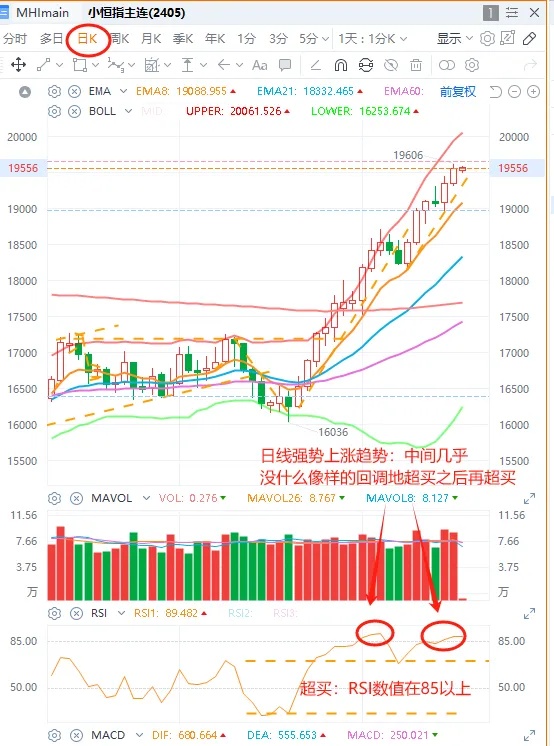
In such strong trends, many novice investors who missed the rally and are afraid to chase the uptrend
might impulsively assume the market has risen too much and act against the trend by shorting, only to miss out further and lose money.
How to avoid premature counter-trend actions in such strong trends?
Many would say to learn to identify the major trend and go with the flow. However, major trends are often serendipitous, and every counter-wave within them could potentially end the trend, making them hard to navigate.
From the insights of "Shanghai Twelve," a veteran swing trader with 20 years of experience,
I found an answer better suited to swing traders like myself:
A major trend is composed of many smaller trends with different structures. As a swing trader, the system’s goal is to "let the sails run their course" within the same rhythm.
02—"Let the Sails Run Their Course" in the Same Rhythm
Normally, a major trend starts with a slower rhythm, accelerates in the middle, and slows down again toward the end.
What "Shanghai Twelve" meant by "letting the sails run their course" in the same rhythm primarily refers to the fast-paced phase when the trend is clear.
Thus, the key to avoiding premature counter-trend actions in strong trends lies in mastering how to "let the sails run their course" during the fast-paced phase of a major trend.
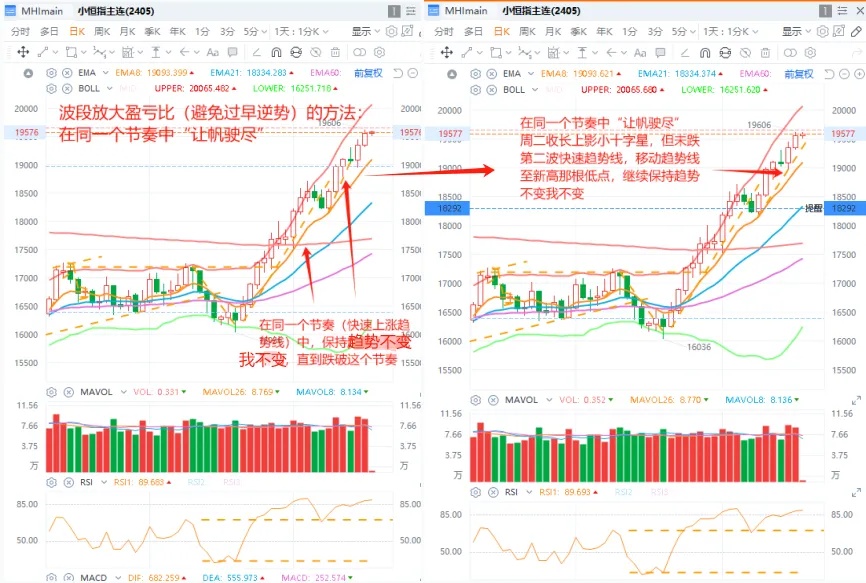
As shown in the left chart above, the specific approach is to maintain the trend until the rhythm (the rapid upward trendline) is broken.
In the left chart, after the first wave of the Hang Seng Index futures ended, the short-term break below the rapid trendline suggested the first rhythm might be exhausted, indicating a potential major pullback. One could reduce positions moderately and re-enter later if no major pullback occurs.
The second wave began a day later, lasting three days. By Tuesday, a small doji with a long upper shadow appeared, but the second rhythm (the yellow upward trendline in the chart) remained intact.
The right chart shows that by Thursday, a large bullish candle confirmed the continuation of the rhythm. The trendline could be adjusted to connect the lowest point of the new high candle, allowing one to continue "letting the sails run their course" in the same rhythm.
In summary, this approach isn’t overly difficult to judge and can be mastered with deliberate practice.
It captures the most lucrative phase of a major trend, maximizing the risk-reward ratio for swing trades while avoiding premature counter-trend actions.
As for judging whether to act counter-trend after a rhythm is broken, one must consider the conditions for trend reversal: breaking the trendline + breaking previous highs/lows.
The above is tailored for swing traders and may not suit everyone. Please refer to it rationally.
I hope my sharing helps you. See you in the next article.
Special Note: This article shares my trading system philosophy and investment logic, not any investment advice. If stocks are mentioned, they are not recommendations. The market is risky; invest cautiously and rationally!
The copyright of this article belongs to the original author/organization.
The views expressed herein are solely those of the author and do not reflect the stance of the platform. The content is intended for investment reference purposes only and shall not be considered as investment advice. Please contact us if you have any questions or suggestions regarding the content services provided by the platform.
