

 Rate Of Return
Analyzing the complexity of the overall trend from this week's Hong Kong stock market performance and how to respond

" Trend traders need more luck than swing traders."

Hong Kong stocks continued to decline this week, with market sentiment remaining sluggish. Today, the $Hang Seng Tech Index HSTECH.HK$ fell by as much as 3%, closing down 2.48%. The $Hang Seng Index HSI.HK$ and $Hang Seng China Enterprises Index HSCEI.HK$ dropped 1.38% and 1.44%, respectively, marking four consecutive days of losses. Major tech stocks were broadly lower.
Last year, when researching trading systems suitable for small capital growth, Financial Mom compared trend systems, swing systems, short-term systems, and intraday systems.
All these systems are good, and there are investors who have achieved stable profits using them.
However, Financial Mom ultimately chose the swing system over the trend system for two reasons:
First, swing trading is more suitable for her current stage;
Second, she wanted to minimize the role of luck in her trading.
As "Shanghai Twelve" said:
Trend traders need more luck than swing traders. Because the assets they trade must have strong trends and relatively smooth movements; otherwise, even if they correctly identify the trend, it's useless. Every reversal during trend development could end the trend, making trend trading so difficult. Even if you judge it as an uptrend and expect it to be significant, it doesn’t mean the pullbacks won’t be deep.
This can also be seen in the performance of Hong Kong stock indices this week.
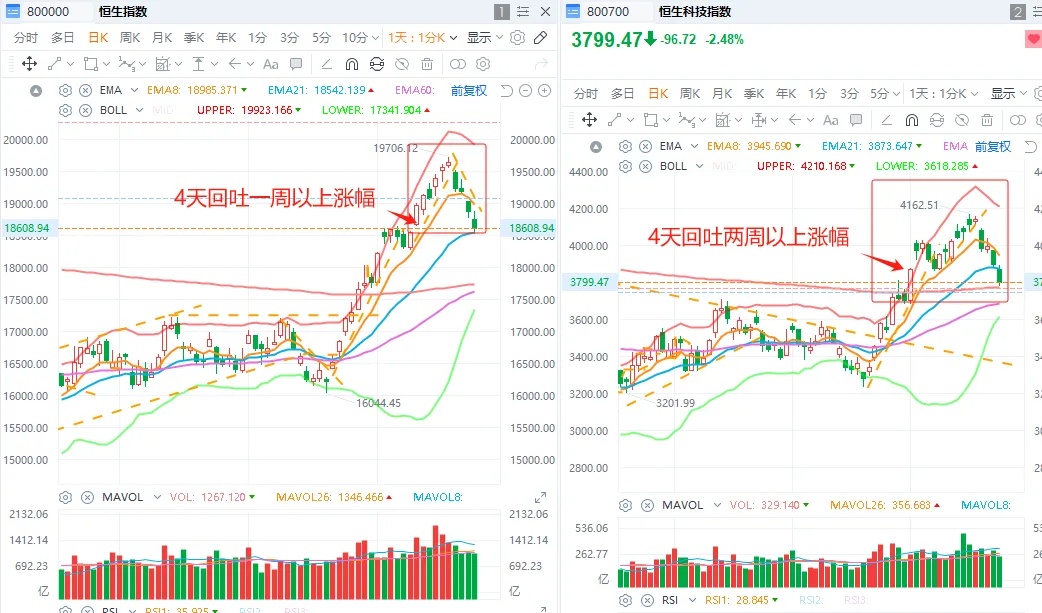
During deep pullbacks, the Hang Seng Index erased over a week’s gains in just four days, while the Hang Seng Tech Index wiped out more than two weeks’ gains in the same period.
How many trend traders can withstand such deep pullbacks?
Moreover, looking at moving averages, despite the significant pullback, the Hang Seng Index remains above the 21-day moving average (blue line in the chart), indicating the uptrend may not be over.
This shows that trends are more complex than most people think, with fluctuations and reversals making it harder to hold positions for a complete trend.
No wonder Shanghai Twelve said she once trained herself to hold positions for big trends but often ended up on a rollercoaster, turning profits into losses. Upon review, she realized:
It wasn’t that she couldn’t hold positions, but that trends are inherently complex.
She also realized that holding positions long-term depends on both the market and the system, not just the trader’s will.
Her solution to the challenge of holding long-term trend positions was: As long as you make money, it doesn’t matter whether you hold positions long or short. What matters is exiting when necessary and holding when appropriate.
Based on this, she designed a swing system better suited to her: enduring small pullbacks but not large ones, only following the trend within the same swing rhythm.
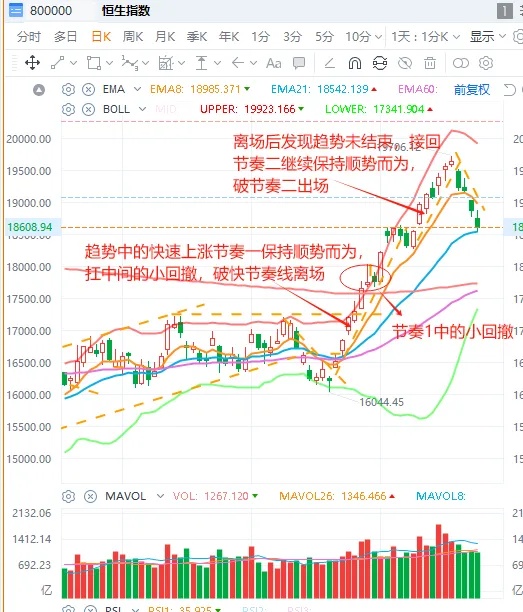
As shown above, her swing strategy only participates in the high-probability fast-upward phases of a trend.
If the market moves quickly after entry, she stays with the trend within the same swing, enduring minor pullbacks that don’t break the fast-upward rhythm line. She exits if the rhythm line is broken.
If the market only rises slightly or consolidates after entry, she sets a breakeven stop, either breaking even or catching a fast-upward trend later.
If the market falls after entry, she exits at the stop-loss.
Thus, following a single swing rhythm within a trend is easier than capturing the entire trend (it’s simpler to go with the flow within one swing than across the whole trend).
The trade-off is accepting the risk of missing out on further trend moves after exiting a swing, as well as breakeven results during minor gains or consolidation.
Both swing and trend systems must accept losses when the market reverses immediately after entry.
The above is just a limited personal perspective on these systems—it may not be accurate or suitable for everyone. Please consider it rationally.
I hope this content helps you. See you in the next article.
Disclaimer: This article shares Financial Mom’s trading system philosophy and investment logic, not investment advice. If stocks are mentioned, they are not recommendations. The market carries risks—invest wisely!
The copyright of this article belongs to the original author/organization.
The views expressed herein are solely those of the author and do not reflect the stance of the platform. The content is intended for investment reference purposes only and shall not be considered as investment advice. Please contact us if you have any questions or suggestions regarding the content services provided by the platform.
