

 Posts
Posts Likes Received
Palantir: Raises guidance, strongly proves the growth story of AI

$Palantir Tech(PLTR.US) released its Q2 2024 earnings after the U.S. market closed on August 6. Overall, the Q2 performance was solid. Although the Bloomberg consensus estimates couldn't fully reflect the market's relatively optimistic expectations (due to limited institutional coverage and data lag), Palantir didn't drop the ball on the most debated growth issue and even raised its full-year guidance. At the same time, the company is optimizing operational efficiency, leading to more noticeable improvements on the profitability side.
Key highlights:
1. Confidently raising guidance: The biggest positive from the Q2 report is the significant upward revision of the full-year guidance, with a more pronounced increase compared to Q1. This carries more weight than any growth narrative speculated by the market.
Management expects Palantir's full-year 2024 revenue to be between $2.742B and $2.750B, representing a median YoY growth of 23.4%, slightly above market expectations. Operating profit guidance was raised even more, thanks to improved operational efficiency, with an expected range of $966M to $974M for 2024.
2. Near-term reliance on government digital demand: In the short term, government demand contributes more to Palantir's revenue. Against the backdrop of escalating global tensions and the digitalization needs of defense systems, Palantir has secured multiple U.S. military contracts this year:
After signing a two-year, $178M contract with the Army in March (to build the TITAN deep sensing capability platform), the Defense Department signed another five-year, $480M contract in Q2 (to develop the Maven smart system integrating AI and computer vision).
With the U.S. government accounting for two-thirds of Palantir's government business, the accelerated growth in U.S. government revenue drove overall government revenue growth in Q2.
3. Long-term growth hinges on commercial AI demand: Relying solely on government revenue would make it hard to dispel market doubts about sustainable high growth. Due to its highly customized and expensive product offerings, the market has also questioned how Palantir can effectively scale its product and service revenue.
However, since the launch of its AIP platform amid the new wave of AI transformation, Palantir has accelerated customer conversion through Bootcamp. In less than a year, AI has quickly become a key driver of sustained high growth in commercial revenue. Therefore, the progress of AIP adoption and real-world implementation is the most closely watched operational metric beyond financial indicators.
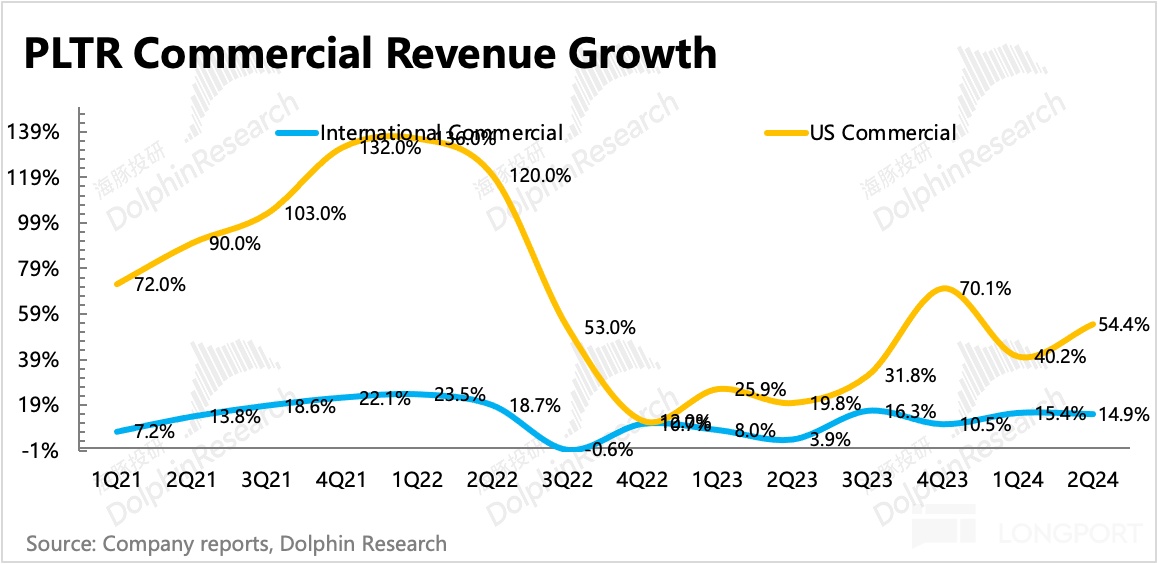
1) Q2 commercial revenue growth accelerated compared to Q1, with U.S. commercial revenue—the best proxy for AI-driven growth—rising 54%, exceeding the guided 45% growth.
2) In terms of AIP progress, Bootcamp added a net 110 customers sequentially, bringing the total to 1,025 enterprises, indicating steady expansion of its influence.
4. Forward-looking indicators remain solid: Since Palantir primarily provides customized software services, its revenue is relatively predictable in the short term, and the company's guidance range is narrow, implying high revenue certainty.
However, for this reason, the market pays closer attention to metrics related to new contracts, such as TCV (total contract value), RPO (remaining performance obligation), customer count, and billings (current-period invoiced revenue).
The first three metrics relate to partnership cycles and are more indicative of medium-to-long-term growth prospects: All contract-related metrics grew in Q2, with some accelerating sequentially.
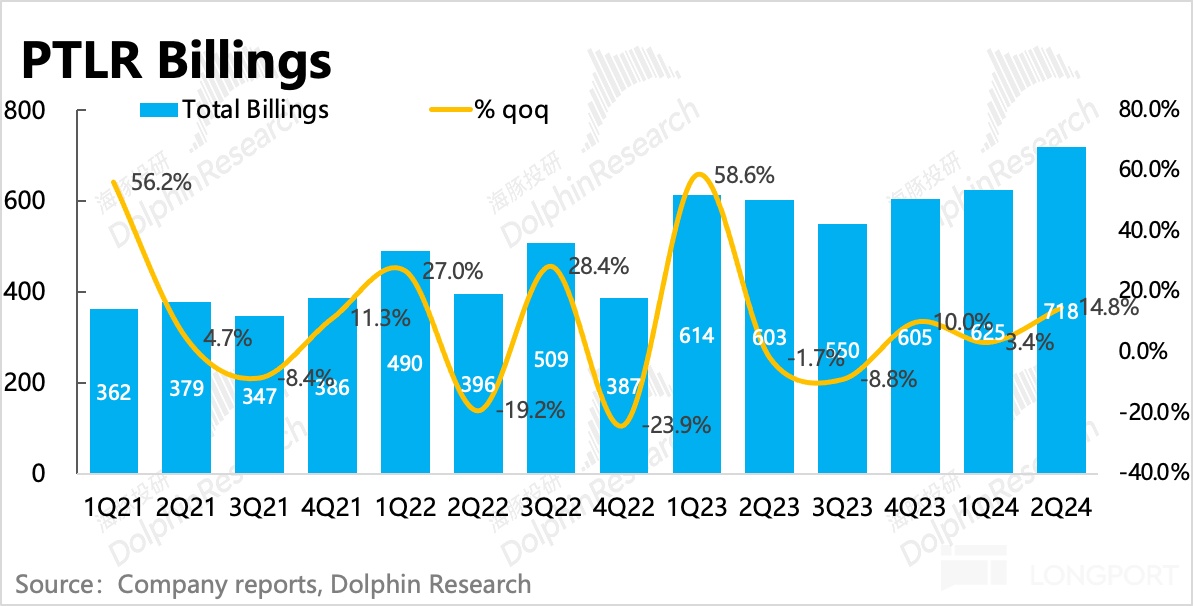
In the short term, the market focuses on the growth trend reflected in billings: Q2 billings grew 19% YoY, a significant improvement over Q1's 2% growth, alleviating last quarter's concerns about growth sustainability.
5. Profitability continues to improve, but expenses will accelerate in H2: Palantir is still in the early stages of turning profitable (with rapid profit growth), with operating profit surging YoY to $105M in Q2 (vs. just $10M last year), significantly exceeding market expectations. The profit improvement was driven primarily by revenue expansion, followed by reduced operating expenses. As a result, with higher revenue guidance, the company raised its 2024 profit guidance even more, outperforming market expectations.
6. Key performance metrics
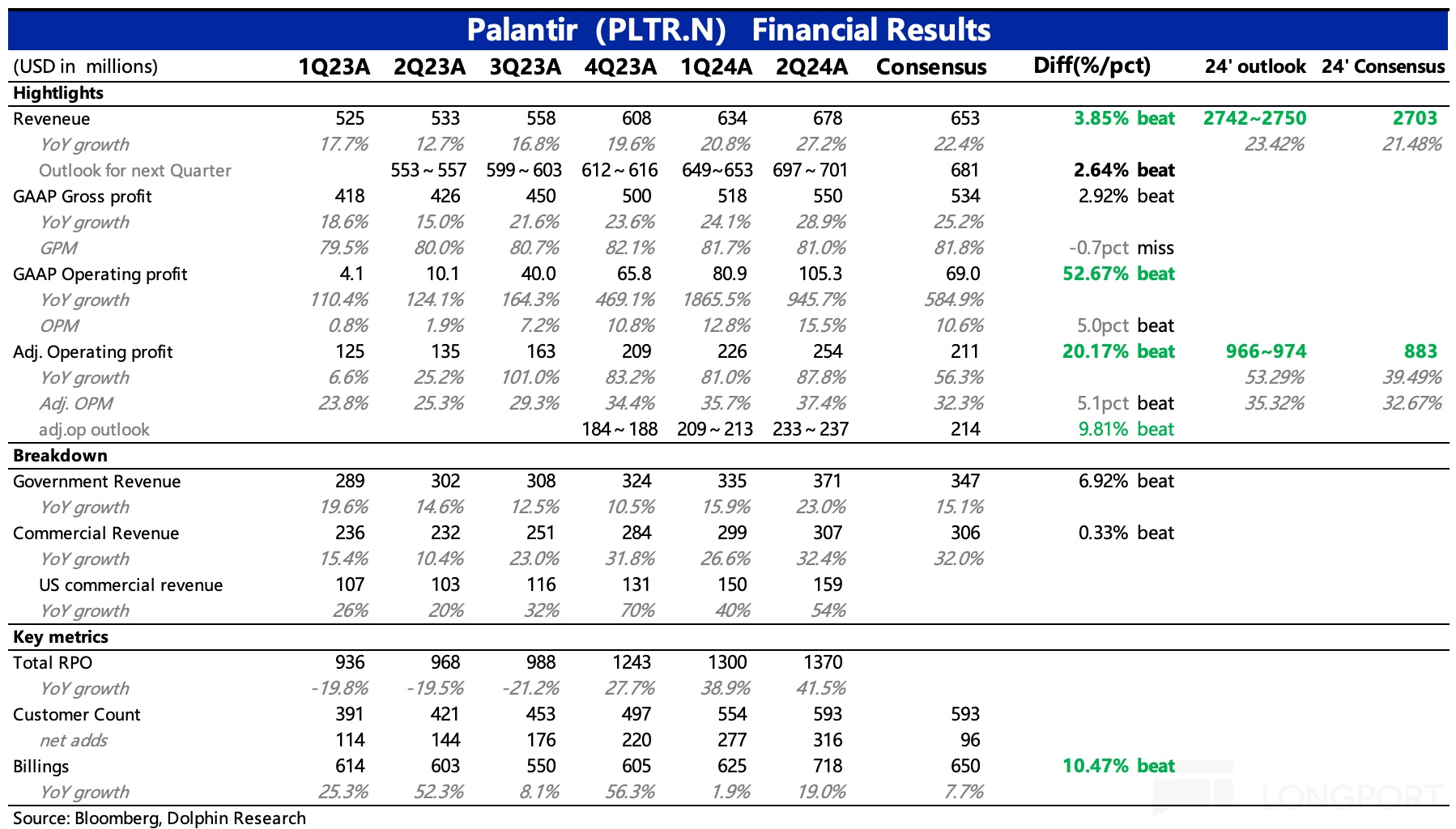
Dolphin Research's take
From a current and marginal performance perspective, Palantir delivered a solid Q2, at least not dropping the ball on the core growth issue.
In terms of marginal expectations, escalating global tensions could further aid Palantir in securing government contracts. However, will corporate spending on AI and other tech upgrades be affected by an economic slowdown? While Palantir may have an alpha logic of gaining market share through technological advantages, macro factors could still drag on growth. Some sporadic indicators (e.g., sequential decline in new U.S. commercial contract value) offer a glimpse into this risk, warranting attention.
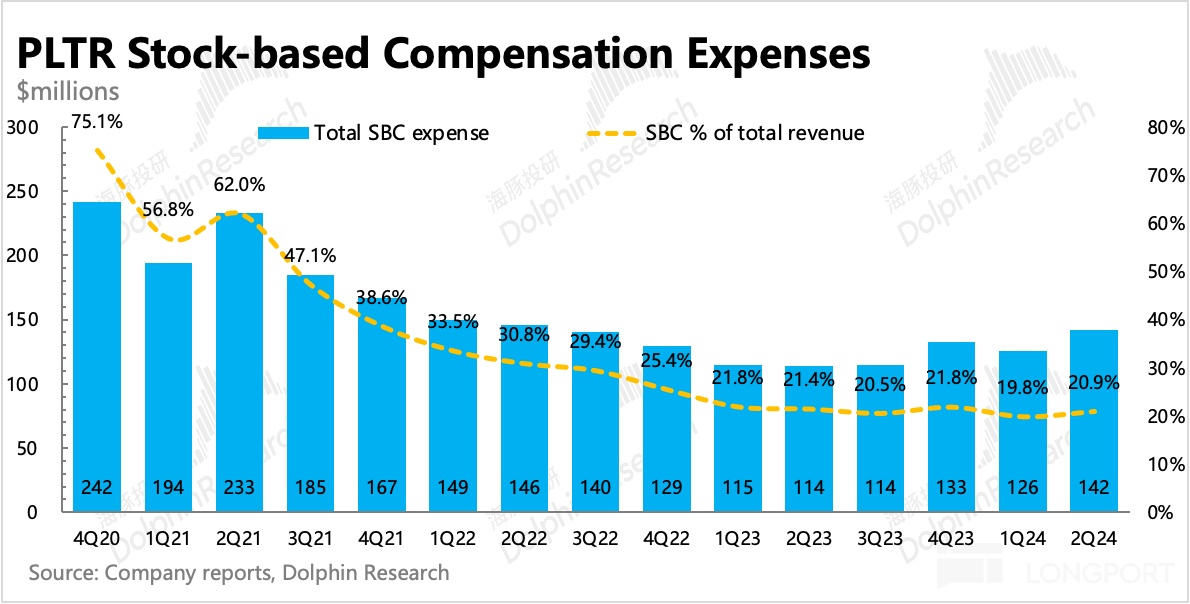
Valuation, however, is subjective. Dolphin Research believes Palantir's current valuation ($60B post-market) implies an 18x P/S for 2025, which remains relatively high compared to peers in the near term. Palantir's premium valuation stems from: 1) being in its first year of GAAP profitability, with revenue growth + rapidly declining SBC driving high GAAP profit growth at the inflection point; and 2) the long-term growth potential of AIP—both factors being priced into the stock.
Most Wall Street institutions don't assign Palantir a high valuation, mainly due to concerns about the scalability of its customized products. This "valuation bias" creates significant expectation gaps, leading to Palantir being both favored by a subset of institutions and facing substantial short interest, resulting in extreme volatility post-earnings.
In last quarter's earnings review, despite the stock plunging due to missed expectations, Dolphin Research noted that Palantir's medium-to-long-term forward-looking indicators weren't weak. Thus, overreacting to short-term quarterly fluctuations isn't advisable—logical marginal changes matter more. Beyond that, with forward-looking indicators intact, extreme volatility driven by short-term metrics could present risk-reward opportunities.
Detailed analysis below
I. Raising revenue guidance reflects growth confidence
Q2 total revenue reached $680M, up 27% YoY, beating market expectations (~$653M), with growth accelerating sequentially.
Since Palantir primarily provides customized software services, its revenue is relatively predictable in the short term, and the company's guidance range is narrow, implying high revenue certainty.
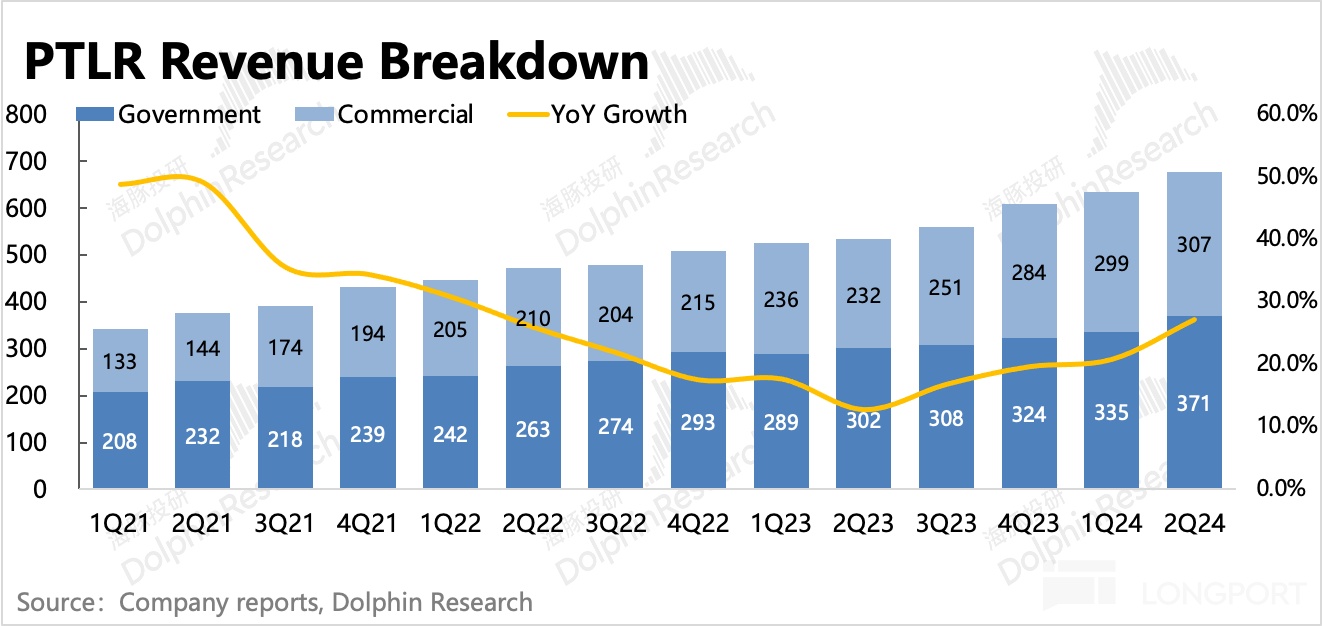
1. Segment breakdown
(1) Government revenue remains the largest contributor: Q2 government revenue grew 23% YoY, continuing to recover, driven primarily by U.S. government demand. Against the backdrop of escalating global tensions and defense system digitalization needs, Palantir secured multiple U.S. military contracts this year:
After signing a two-year, $178M contract with the Army in March (to build the TITAN deep sensing capability platform), the Defense Department signed another five-year, $480M contract in Q2 (to develop the Maven smart system integrating AI and computer vision).
Palantir holds a clear advantage in providing technology for U.S. government IT systems. With AI enhancements, government agencies have generated incremental demand. Official procurement data also shows Palantir's Q2 contract scale increased sequentially. Rising global tensions could further drive system upgrade and customization demand.
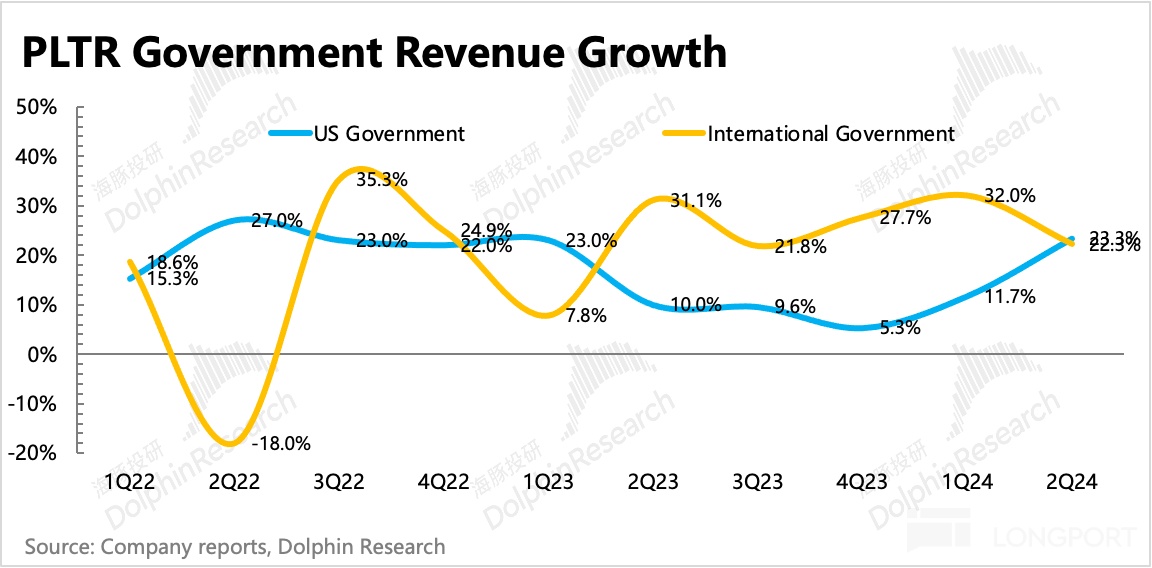
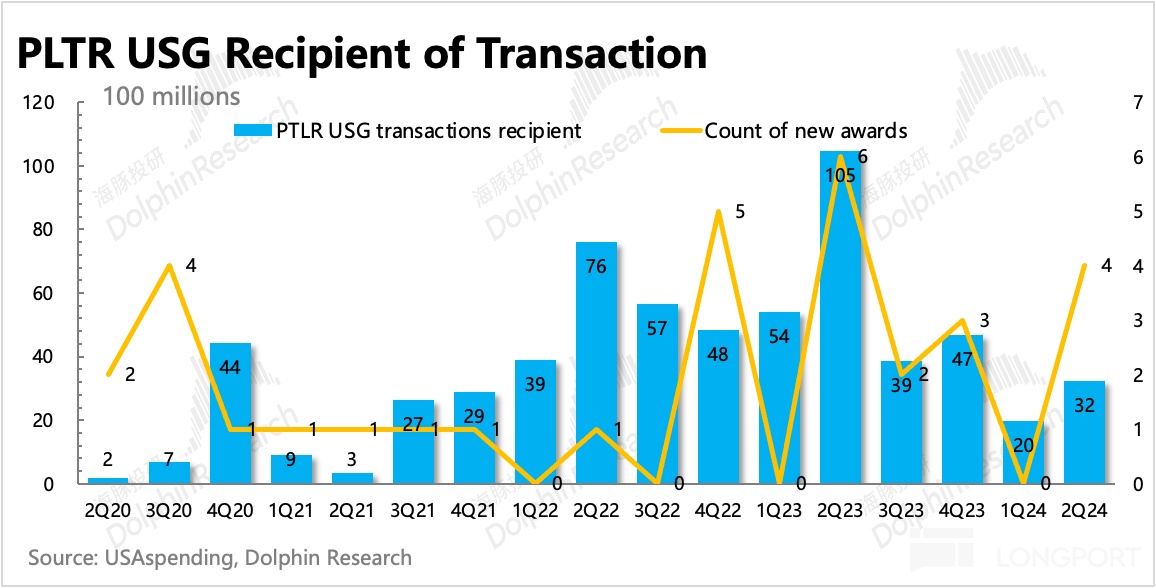
(2) But commercial revenue drives growth, catching up to government revenue: Q2 commercial revenue grew 32.4% YoY, also accelerating sequentially. The increase was mainly driven by AIP-driven customer demand, with Bootcamp participants reaching 1,025, up 110 from last quarter.
While Bootcamp shortens conversion time, increased customer penetration reflects medium-to-long-term growth momentum rather than immediate financial impact.
II. Contract metrics: Overall steady growth
For software companies, future growth is core to valuation. But quarterly recognized revenue is a lagging indicator, so we recommend focusing on new contract wins, reflected in RPO, TCV, billings, and customer growth.
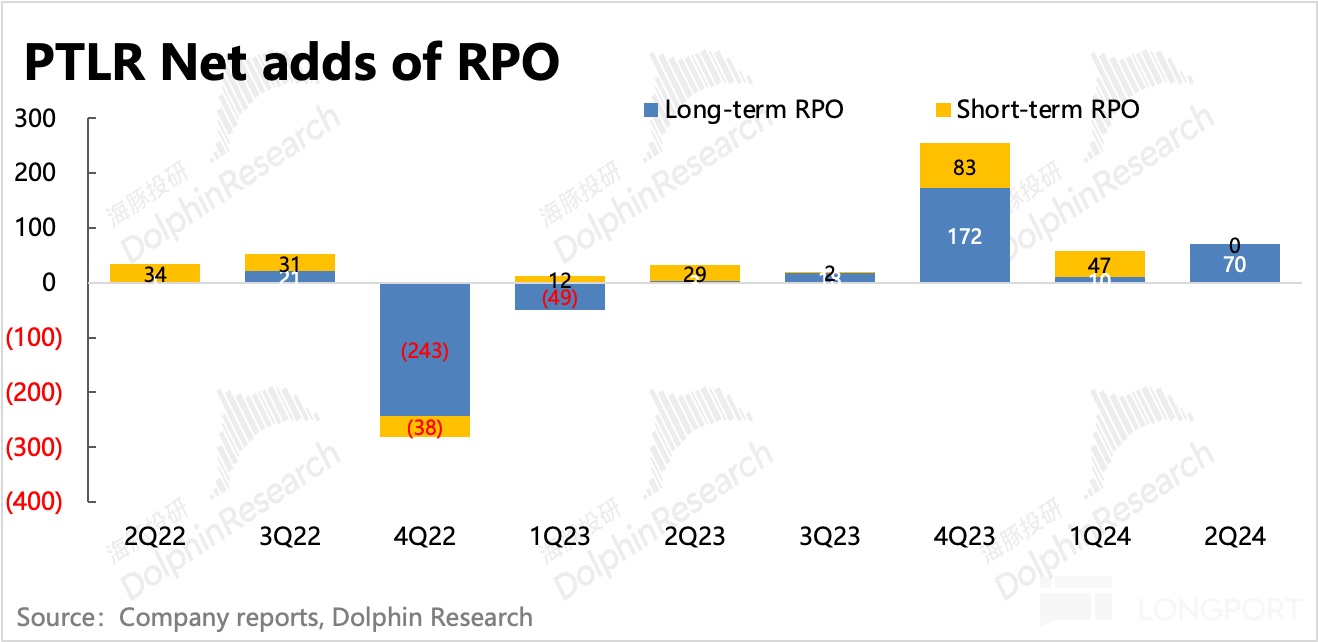
(1) Remaining performance obligation (RPO)
Q2 RPO stood at $1.37B, up $70M sequentially. Unlike Q1, Q2 saw more long-term contract additions, truly reflecting growth (short-term contract increases could stem from long-term contracts expiring and converting).
(2) Billings
Q2 billings were $718M, up 19% YoY, a clear rebound from Q1. Billings reflect short-term demand fluctuations, so Dolphin Research believes single-quarter volatility doesn't say much about product competitiveness. But given high valuations, the market scrutinizes this metric closely.
(3) Total contract value (TCV)
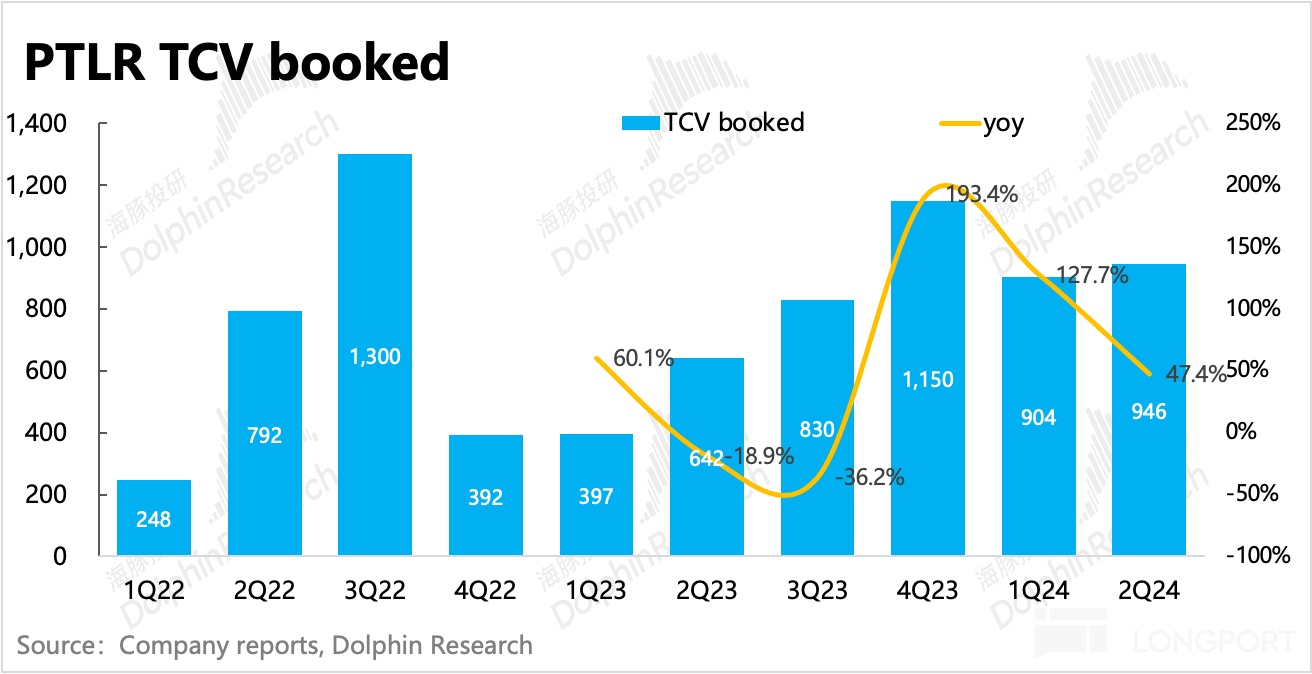
Q2 new TCV was $950M, up 45% YoY but slowing sequentially. U.S. commercial TCV was $262M, up 152% YoY, accelerating from Q1 but lower in absolute terms. Given macro concerns, potential slowdowns in corporate spending warrant attention.
(4) Customer growth
Customer count, another medium-to-long-term metric, added 39 net new customers in Q2, including 40 commercial clients.
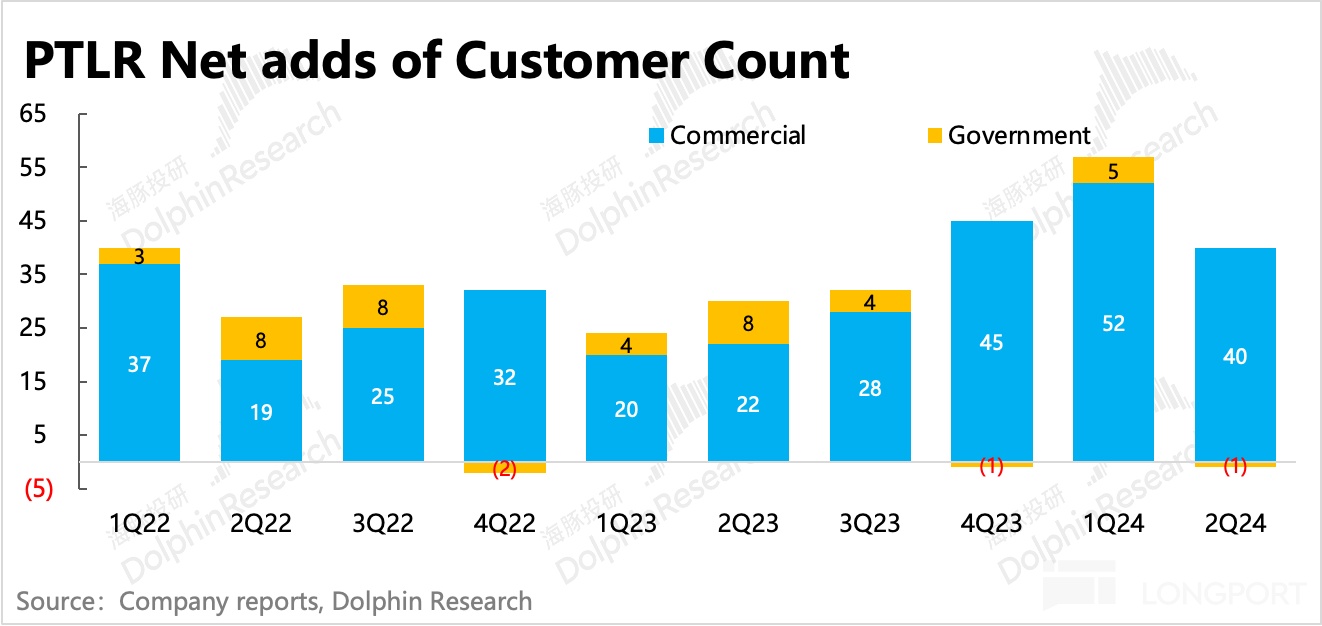
Combining <1-4>, Dolphin Research believes Palantir's forward-looking indicators reflect relatively steady short- and medium-term growth, with the only risk being a macro-driven slowdown in commercial contracts.
III. Profitability keeps improving, but H2 expenses will reaccelerate
Q2 operating profit surged YoY to $105M (vs. $10M last year), far exceeding expectations, driven by revenue growth and cost controls. With higher revenue guidance, profit guidance was raised even more.
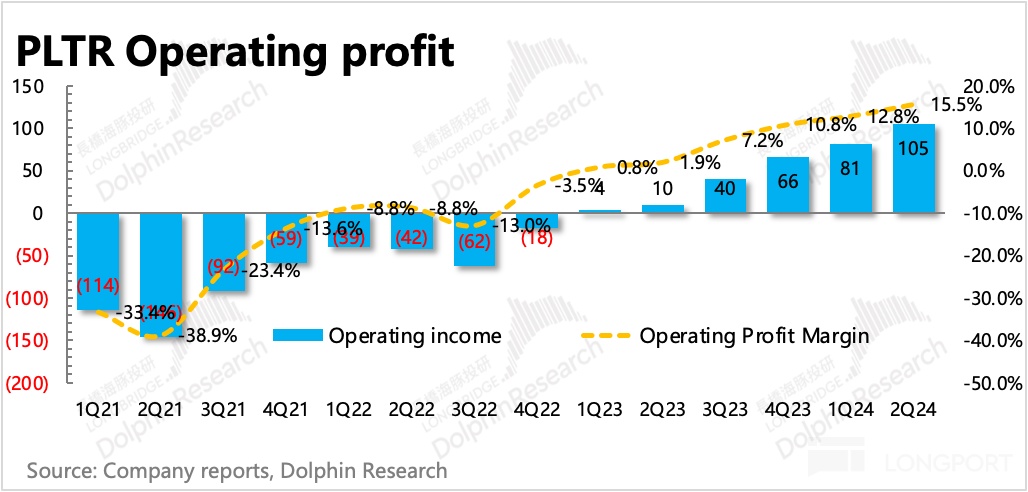
Cost optimization came from slower R&D and sales growth (excluding headcount). But headcount-related SBC rebounded, and management hinted at faster H2 spending while keeping expense growth below revenue growth to sustain margin expansion.
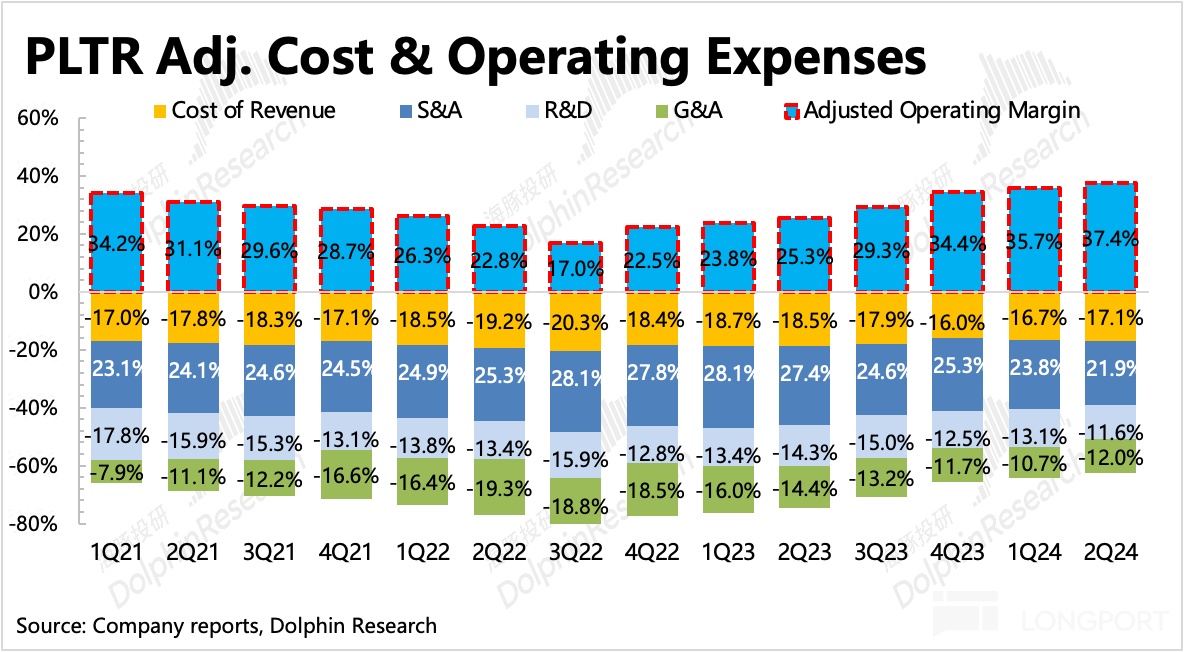
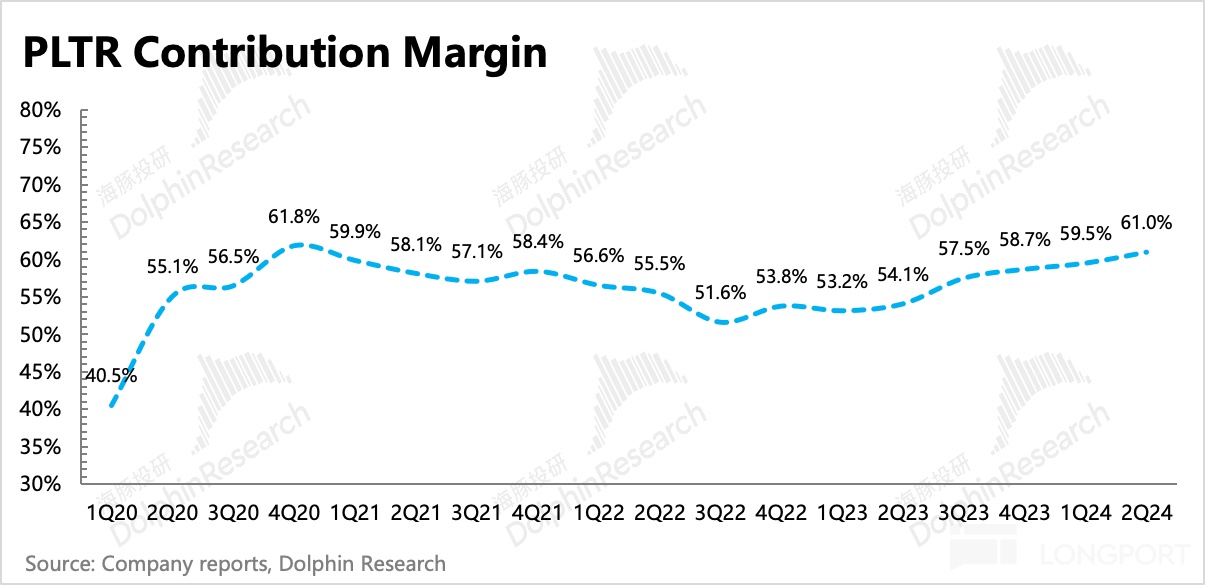
Finally, contribution margin (similar to gross margin minus sales expenses for consumer companies) rose to 61% in Q2, underscoring improving product competitiveness and monetization efficiency.
<End>
Dolphin Research's historical coverage of Palantir:
Earnings
May 7, 2024 call: Palantir: In the U.S., We Have No Direct Competitors (1Q24 Call)
May 7, 2024 review: Palantir: Why Did It Crash Despite Beating Expectations? High Valuation Makes the Market Picky
Feb 6, 2024 call: Growth Is Driven by Bootcamp-Led Commercialization and Continued Product Investment (Palantir 4Q23 Call)
Feb 6, 2024 review: AI Unlocks Palantir's New Growth Cycle
Nov 3, 2023 review: Palantir: Growth Rebounds Against the Trend—Thanks to AI Again?
Deep dives
Oct 13, 2023: Palantir: What Justifies Its Premium Valuation?
Sep 26, 2023: Palantir: The 'Mysterious' Military Weapon Activated by AI
Risk disclosures and disclaimers:Dolphin Research Disclaimer & General Disclosures
The copyright of this article belongs to the original author/organization.
The views expressed herein are solely those of the author and do not reflect the stance of the platform. The content is intended for investment reference purposes only and shall not be considered as investment advice. Please contact us if you have any questions or suggestions regarding the content services provided by the platform.
