

 Posts
Posts Likes Received
Airbnb: Is there a downgrade in travel consumption?
The following is a summary of Airbnb's second quarter 2024 earnings conference call. For an interpretation of the financial report, please refer to " Airbnb: A "loser" that can't even handle the Olympics? 》
I. Review of Core Financial Information:
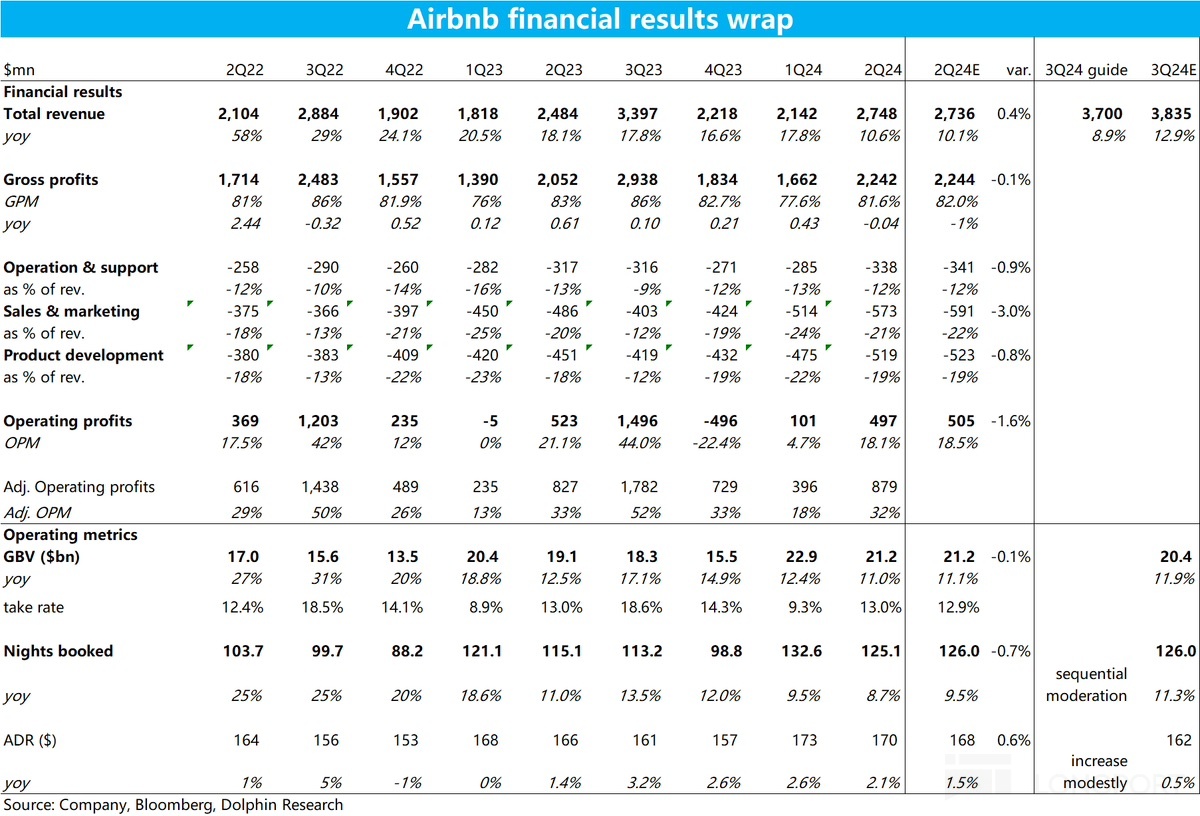
II. Detailed Content of the Earnings Conference Call
2.1. Key Points from Executive Remarks:
1) Strategic Focus:
① Making Hosting Mainstream:
- Increase awareness of the benefits of hosting and provide better tools for hosts.
- Over 8 million active listings, with year-over-year growth, covering all types of markets in all regions.
- Improve listing quality by removing over 200,000 listings that did not meet guest expectations.
② Enhancing Core Services:
- Introduced hundreds of new features and upgrades in the past two years to enhance Airbnb's reliability and user experience.
- Since the launch of "Guest Favorites," over 1.5 billion nights have been booked.
- Improvements in settings and logins, maps, cancellation policies, etc., have increased usability and booking conversion rates.
③ Beyond Core Business: Investing in underpenetrated markets, expanding night bookings significantly beyond core markets. Launched Airbnb Icons, expanding into new extraordinary experience categories, with nearly 40 million views since its launch in May.
2) Business Highlights:
① Mobile Growth:
- Mobile bookings increased by 19% year-over-year, accounting for 55% of total night bookings. The highest growth in first-time bookers on the platform is in the youngest age group.
- Airbnb performed well during special events (such as the Olympics, UEFA Euro), especially in cities hosting events like Paris and Germany. During the Paris Olympics, night bookings in the second quarter were double compared to the same period last year. During the UEFA Euro, night bookings in host cities grew by over 20% year-over-year.
② Supply Growth and Quality Improvement:
- Active listings grew by 37% year-over-year; active listings managed by Superhosts grew by 26% year-over-year.
- Introduced new features to help guests find high-quality listings, such as "Guest Favorites" and "Top Listing Highlights."
③ Q3 Outlook:
- Record-breaking summer travel season expected, with enthusiasm for the Olympics and UEFA Euro.
- Latin America and the Asia-Pacific region are growing rapidly and are the fastest-growing regions for the company.
- Observing global trends of shorter booking lead times and slowing demand in the United States, incorporating these trends into third-quarter forecasts.
2.2. Analyst Q&A
Q: Please further explain the extended fulfillment times in North America and how this impacts the strong performance during events like the Olympics and UEFA Euro?
A: From the beginning of this year to date, the trend of fulfillment time shows that the fulfillment time in Q1 and Q2 is consistent with last year, with no significant changes. However, as we entered July, we noticed a shortening of fulfillment time, especially with the rapid growth of short-term bookings made within a few days to weeks. At the same time, long-term bookings for holidays like Thanksgiving and Christmas did not show the same level of growth. This softness in long-term bookings is a major consideration for our outlook for the third quarter. In the past few years, as the market recovered post-pandemic, we have observed fluctuations in fulfillment time during certain periods and consumer hesitancy towards long-term travel bookings. We may currently be in such a situation. However, optimistically, consumers may simply not have made these long-term travel bookings yet. We are closely monitoring this trend as it directly impacts our Q3 forecast.
Q: With Airbnb introducing key improvements such as guest favorites and icons in the summer and winter releases, how will these new services shape the future of Airbnb?
A: In terms of expanding our core business, after 16 years of effort, we have built a business that is about to reach a booking value of $80 billion, mainly in short-term accommodations. Our product is singular but growing rapidly. Before the pandemic, we had already begun preparing for business expansion, but when the pandemic hit, we reduced resources, returned to basics, rebuilt the platform, and increased efficiency. Today, with the same number of employees as before the pandemic, our revenue has doubled, and our free cash flow profit margin has reached 41%, making us one of the most profitable companies.
Now, we are preparing for the next phase of Airbnb. We hope Airbnb can become one of the most important companies of our generation, and for this, we need to launch new products and services. In October this year, we will launch a significant new host service - Co-hosting Marketplace. This will match those who have houses but no time with those who have time but no houses, releasing more listings.
Next year, we will truly begin to expand Airbnb's core business by relaunching experience services. We have learned a lot from past experiences and will make experience services more affordable, unique, and in line with Airbnb's characteristics. We will use videos instead of photos, ensure bookable experience content, and effectively promote them.
Additionally, we are developing new customer services and host services and will introduce new products annually starting next year. Our goal is to surpass a single product line like Apple and Amazon and become a diversified company. The new Airbnb will not only be short-term rentals but will also include long-term accommodations, customer services, host services, and other new services and products.
Q: Regarding the short booking window you mentioned, have you observed any changes in pricing or property categories? Are there any significant patterns among specific groups or income levels?
A: So far this year, we have observed a slight increase in global ADR, especially more pronounced in North America. This is mainly due to a shift in product mix, where people tend to choose more expensive or larger properties. This can be explained by the fact that people are opting for more expensive accommodations, reflecting an increased demand from high-income groups. However, another interpretation is that the larger properties offered by Airbnb may be more cost-effective per guest, even more so than hotels Therefore, the growth of ADR partly reflects people's increasing focus on finding truly valuable choices on Airbnb.
Q: Regarding business expansion, are there any specific markets showing particularly strong growth trends?
A: We are seeking to accelerate growth with the goal of achieving healthy double-digit growth. Our strategy is divided into short-term, medium-term, and long-term. In the short term, we are optimizing core business, improving cost-effectiveness and accommodation quality, and increasing conversion rates. In the long term, we are launching new products and services. The medium-term strategy focuses on international markets, especially on 1 to 3 years of growth. Airbnb covers 220 countries and regions, but primarily penetrates only five main markets: the United States, the United Kingdom, France, Canada, and Australia. Our goal is to become the preferred platform for global travel.
We are focusing on several key expansion markets, such as Germany and Brazil, which are among the largest tourism markets globally. In Europe, Italy and Spain have lower penetration rates despite being major tourist destinations. In Latin America, Peru, Chile, Colombia, and Argentina present huge opportunity markets. Asian markets, especially China, Japan, South Korea, India, and Southeast Asia, are equally important. We have developed international market strategies, including product localization and marketing. For example, in Asia, we have redesigned products for different languages and user habits to improve conversion rates. Some markets like Switzerland, Belgium, and the Netherlands will see faster returns, while markets like Japan will require longer-term efforts.
We believe that by increasing the market penetration of these countries to the level of Canada or Australia, we can achieve billions of dollars in booking value growth. This is an area we have not paid enough attention to in the past few years, but now we are fully committed to it.
Q: Looking at the balance sheet, the funds held on behalf of customers have increased by 13% year-on-year, which seems to indicate an increase in bookings for this quarter. At the same time, you mentioned shortened booking times, which should also lead to an increase in bookings for this quarter. I would like to know if this is consistent with the guidance of slowing revenue growth that you mentioned?
A: The balance on the balance sheet can indeed reflect some backlog situations, but it should not be directly viewed as an accurate indicator of revenue to be recognized this quarter. There are two reasons: first, many bookings to be recognized this quarter have not actually been completed yet. Second, the items on the balance sheet reflect payment timing, including prepayments or full payments, so they cannot be directly correlated. These items only provide a snapshot of backlog orders at a specific point in time.
Q: Firstly, regarding the change in booking windows from the pre-pandemic normal to the current post-pandemic state, how does the current booking window differ from 2019? Secondly, behind this change, how much is driven by consumer desire to reduce expenses and be more selective, and how much is a reflection of global travel gradually returning to normal?
A: From the second quarter of 2019 to the same period in 2024, the platform's average booking lead time has not significantly changed. In the early stages of the pandemic, the booking lead time shortened significantly due to people's lack of confidence in booking far in advance. However, between 2022 and 2023, the desire for travel drove people to book far in advance to ensure they secure the best accommodations and prices By the second quarter of 2024, the booking mode has basically returned to normal.
Currently, instant bookings are very strong, with a growth rate far exceeding our average level of guidance. The demand for summer travel is high, but this strong demand is offset by bookings made a month or more in advance, accounting for about half of the total bookings. Slight softness has affected our backlog, as these bookings made well in advance are highly concentrated. In addition, occasional factors such as new COVID variants, macroeconomic news, or regional events may lead to changes in people's booking behavior, which is something we are currently closely monitoring.
Q: You mentioned that the growth rate of marketing expenses in the third quarter will exceed revenue. How do we balance the effectiveness of marketing with brand promotion? What have you learned from your marketing experience that makes you believe this will drive faster room growth?
A: Regarding our marketing expenses, let me first review the full-year guidance we provided in February. We plan to achieve an EBITDA profit margin of at least 35% for the full year, slightly lower than the nearly 37% in 2023. The reason we expect the profit margin to decrease is to retain flexibility for investment growth. In the first half of this year, the proportion of marketing to revenue is the same as last year, but we plan to increase investment from the third quarter onwards to drive growth. This is also the basis for the EBITDA guidance mentioned in our letter.
In particular, in terms of marketing, we will set some new marketing targets in the third quarter and launch our global strategy. You will see us trying to expand our successful experiences in Latin America, such as Brazil and Mexico, to other countries in the region, such as Peru, Colombia, Chile, and Argentina. We believe these new markets will contribute to our medium to long-term growth. Furthermore, in terms of performance marketing, we have achieved high efficiency based on the optimization of marketing strategies. We are confident in the returns from these optimization measures and will continue to increase investment in the third quarter.
Q: Regarding the strategy for general artificial intelligence, there is currently much discussion focused on using general artificial intelligence as a travel assistant. Have you considered leveraging your leading listings, possibly collaborating with hotels, combining advanced language model technology to create a unique hotel booking assistant?
A: I am incredibly excited about the development of AI, just like when we first discovered the Internet or when the iPhone was released, feeling like everything is about to change. Nevertheless, over the past 22 months, especially since the launch of ChatGPT, what we have learned is that the changes in applications take longer than people imagine. If I were to think about AI, I might divide it into three levels: chips, models, and applications. There has been a lot of innovation in chips and models, but look at your phone's home screen, which applications are fundamentally different because of generative AI? Especially in e-commerce or travel, there are hardly any.
The reason is that developing new AI applications takes time, and all our paradigms are from the pre-AI era. We need to develop truly model-based native AI applications, and no one has done that yet. We need a fundamentally different new interface like the multi-touch of the iPhone in 2008 This is also one of the directions we are working hard on. I believe that Airbnb will eventually be more than just a search box, but a travel advisor that learns and adapts to your needs through conversation, which will take years to develop.
This won't happen next year, and many of my tech friends also think it will take more time. But in terms of possibilities, a new interface paradigm will allow us to connect new businesses. For example, do we have the right to enter the hotel business? Today, we have the right because we have a lot of traffic. But with a breakthrough interface, we will have more rights because we can not only ask where you want to go, but also inspire your travel ideas and provide you with end-to-end travel services.
Just a reminder, we have a hotel booking business that we acquired before the pandemic, which is one of the most popular hotel booking apps in the world, and we are still investing in the hotel business. Therefore, as the new interface develops, we definitely have the opportunity to sell new products and services including hotels.
Q: The growth in the North American and European markets may be slightly slower than the company as a whole. Are there any signs indicating that cyclical or macroeconomic pressures, such as shorter travel times or lower consumption levels, could end? Will these factors accelerate growth at the end? What are your views on market share in these two key regions?
A: In the North American and EMEA markets, the current market performance is consistent with global trends, especially the trend of shorter booking lead times. The EMEA market has shown relatively stable performance this quarter, while the North American market has been influenced by several factors. Firstly, the long-term growth in overnight stays is slower than short-term accommodations, which has dragged down the average accommodation growth rate in North America. Secondly, our adjustments to long-term accommodation costs a year ago had some adverse effects on the platform, especially in the North American market. In addition, new regulations in California, including total price display and cancellation policies, have posed some headwinds to our business, and we are closely monitoring consumer behavior adjustments.
Nevertheless, we have not seen consumers leaning towards choosing cheaper accommodations. In fact, people are still booking our high-end and expensive listings. Additionally, the growth rate of short-term rentals is faster than long-term rentals, but this is not because people are choosing shorter travel times, but rather due to changes in market structure.
Regarding market share, we focus on the number of overnight stays in the entire hotel and other accommodation markets. In the second quarter, we continued to gain market share year-over-year, and this is also the case at the regional level. Our market share continues to grow globally, and we are satisfied with this.
Q: What problems are you currently working on solving regarding experiences? Despite sufficient property supply, please point out the main challenges faced by suppliers and customers.
A: We have five main improvement directions for experiences. Firstly, we aim to offer more affordable prices to attract young consumers. Secondly, we need to increase unique experiences to ensure they are one-of-a-kind on Airbnb. Thirdly, enhance the display of experiences through more engaging methods like videos. Fourthly, improve the search and discovery functions within the app to make experiences easier to find for users. Lastly, increase the market awareness of experience projects, as despite being launched for 8 years, many people are still unaware By integrating marketing strategies, we will effectively promote homes and experiences without the need for a significant increase in investment.
Q: The market shift towards non-urban areas in North America and EMEA was mentioned. Can you provide more information on this? Have you observed a decrease in demand or increased hotel competition in urban markets?
A: It is not a fundamental shift. We have observed slightly higher growth in non-urban markets compared to urban markets. This indicates that the products we offer in non-urban markets are unique, and even 4 years after COVID, there continues to be a significant share of market demand for this part of the business. Over the past 4 years, there has been a deeper understanding of the market diversity Airbnb can cover, especially in markets that traditional hotels cannot reach. We continue to see strong demand in these markets.
Q: How long will this investment cycle last? When can we expect to see significant returns?
A: We have not provided guidance for 2025 yet, but forecasts will be given in due course. From negative EBITDA before going public to a profit margin of nearly 37% now, we have significantly improved profitability. Our goal is to drive growth, which is why we set a lower profit margin target this year as we plan to increase investment by the end of the year.
Our medium-term growth will rely on international markets, while long-term growth will depend on expanding core products, all of which require ongoing investment to achieve. Despite this, our past expansions have not been capital-intensive, and we do not anticipate them fundamentally impacting profitability levels in the future. We will use existing profits for investment, but overall profitability is expected to remain stable.
Q: Excluding the impact of Easter, it seems that your revenue growth is slowing down quarter by quarter this year, especially in the third quarter. Based on what you currently observe, do you expect further slowdown by the year-end? Or do you see any signs in your current numbers that could lead to growth stabilization?
A: We do not make forecasts for the fourth quarter at the moment. Information on booking lead times shows that people have not stopped making long-term bookings, but may have delayed the booking time. Booking patterns have changed in recent years, with many people choosing to book later, which is one of the reasons we are cautiously optimistic about the fourth quarter. Additionally, considering the comparison base in the second half of last year, especially the weakness in September and October, with a recovery in November and December, these factors will also affect our year-end expectations.
Q: If market demand remains weak instead of recovering, how will you flexibly adjust investment strategies? How should we view the investment commitments to these anticipated new projects?
A: Our forecasts have already taken into account short-term, medium-term, and long-term growth factors. In the short term, improving conversion rates is key to growth, with every 1% increase in conversion rate bringing in approximately $100 million in revenue. We have many opportunities to increase conversion rates by improving user experience. In international markets, especially in major Asian markets like Japan, we will flexibly adjust strategies based on market feedback.
Our new services and products will not incur significant costs, mainly personnel expenses involving teams of several hundred people. Due to the network effects of the business, we will leverage existing traffic for cross-selling, and the cost of acquiring new supply is not high Therefore, these investments are very flexible and will not increase significantly. The biggest change may be the marketing strategy in the international market.
Q: How does the company strike a balance between introducing potentially standardized products with high conversion rates that are also sold on other platforms when adding city hotel supplies on the platform?
A: Customers choose Airbnb mainly for a unique experience, making Airbnb a well-known brand. However, the number of people choosing hotels far exceeds Airbnb. If we can attract some hotel guests, it will significantly increase our business scale. We plan to achieve this goal by improving housing reliability and adding hotel options on the platform. Our previous acquisition of Hotel Tonight shows our openness to adding hotels, and we believe that hotels can complement our services, especially during peak demand. Different travel scenarios may be more suitable for hotels or Airbnb, for example, solo business trips may be more suitable for hotels, while group travel or accommodations in non-urban areas may be more suitable for Airbnb. We have a large number of hotel resources and good cooperation with regulatory agencies, which will help us prepare for future large events such as the World Cup and the Olympics.
Since 2007, Airbnb has been providing accommodation for large events, including design conferences, the Democratic National Convention, and inaugurations. Our business was initially built around event accommodations because these events often exceed the capacity of hotels. People are willing to rent out properties for short periods during events to earn extra income. For example, in Paris, we started focusing on increasing housing supply a year ago and now have nearly 150,000 properties, accommodating 430,000 guests, equivalent to the capacity of 5 Olympic stadiums. This level of accommodation capacity cannot be achieved solely by traditional hotels without Airbnb.
We work closely with the Paris city government to ensure accommodation services during the Olympics. Now, we are expanding this strategy to 1,000 large events globally, such as the World Cup, Olympics, major concerts, and important conferences. We believe this is an effective strategy for recruiting housing resources because Airbnb provides cities with the ability to temporarily increase capacity, addressing the accommodation challenges brought by large events. We plan to continue and expand this strategy.
Q: What challenges are there in terms of room product adaptability or market awareness? You mentioned supply shortages earlier, are there any other factors that may affect its growth?
A: Although Airbnb's single room products are popular among young users, they account for a small proportion of the overall business, thus making a limited contribution to overall growth. Our goal is to provide a variety of accommodation options to meet various needs from individuals to large groups, from economy to luxury. The trust system is our core innovation, and we will continue to invest in it to enhance trust among users and drive acceptance of shared accommodations. Despite the lower starting point of Airbnb's room products, we still see long-term potential in them.
Q: Regarding the investments to drive growth in the second half of the year, can you explain the expected payback period for our investments? And how do we evaluate the impact of these investments on the company's growth rate within a certain period of time?
A: Our marketing ROI depends on the type of investment. The ROI of performance marketing is clear in the short term, evaluated on a weekly and monthly basis. The ROI of brand marketing, on the other hand, takes longer, typically requiring 6 months to a year, and continuous investment to maintain the effect. In addition, to drive growth, we will moderately increase investment in team building, expecting this to bring long-term high returns.
Q: Regarding ADR, despite the growing demand and trend towards high-end properties in North America, the growth of ADR in this region with the highest ADR has weakened. In a scenario where global travel demand may continue to decline, how do you view the sustainability of future ADR growth?
A: Global ADR is influenced by changes in regional composition. While ADR in North America is relatively high, global ADR may decrease as business expands to Latin America and the Asia-Pacific region. Nevertheless, the addition of room nights is beneficial to the business as their economic benefits remain strong. Overall, we are optimistic about the global performance of ADR as we can provide strong economic value across a wide price range.
End of content
Risk Disclosure and Disclaimer of this article: Dolphin Investment Research Disclaimer and General Disclosure
