

 Likes Received
The sun rises in the east and sets in the west, the dawn has come for Hong Kong stocks.


Introduction: "Policy-driven market" changes beliefs in 3 days. In this round of AH investment, fundamentals and specific purchases don't matter—"conviction + position size" determines portfolio performance.
1. Thoughts on AH Share Investment
①Market drivers: Each stock market has its characteristics; we can't label them as good or bad—only whether investors recognize them. In my view, the A-share market is "policy-driven," where policy influence significantly outweighs other markets.
②Fundamentals perspective: Domestically, we're at the tail end of passive destocking, while the U.S. is in early-stage active restocking (with low inventory levels across most industries), providing limited support for domestic exports. Historically, A-shares typically lead the inventory cycle by 3-6 months. Thanks to "policy combinations" and fiscal measures like real estate policies and consumption vouchers, domestic demand is expected to improve sequentially—meaning fundamentals are trending upward.
③Liquidity perspective: Today's turnover hit 2.6 trillion yuan. Short-term index performance relies on sentiment, but individual stock opportunities are undeniable—focus less on indices, more on quantitative stock selection.
④Technical perspective: The Shanghai Composite Index monthly MACD golden cross confirms a rebound trend. Coupled with improving fundamentals, the Shanghai Composite has escaped its investment slump. All sentiment indicators exceed thresholds (e.g., stocks hitting 20/60-day highs). After emotional surges, when markets rationalize, indices will pull back—but each dip should hold above prior lows.
2. So, what to invest in after the dip?
AH shares follow domestic fundamentals. Hong Kong stocks have liquidity and valuation advantages over A-shares—I prefer H-shares like Hang Seng Tech Index ETF 513180 (HK code 03088) + Hang Seng Internet ETF 513330 + Hang Seng Healthcare ETF 159892 (HK code 03069). For U.S. ETFs, iShares (BlackRock) is my go-to. Domestically, I favor ChinaAMC ETFs for their breadth, scale, liquidity, and research strength—key selection criteria.
1)Biotech investment logic: Hang Seng Healthcare ETF 159892 (HK code 03069)$CAM HSBIOTECH(03069.HK)
①Benefiting from "rate-cut trades": HK biotech is highly sensitive to Fed rates (approximated by 2Y Treasury yields—long-term inverse correlation). As cuts continue, the sector should rise.
②Investment enthusiasm: Biotech/tech M&A activity (monthly deals/amounts) inversely correlates with rates—cuts spur "big fish eating small fish," boosting competitiveness.
③Fundamentals: Overseas demand elasticity benefits HK biotech firms. With rate cuts underway, spring is coming for biotech.
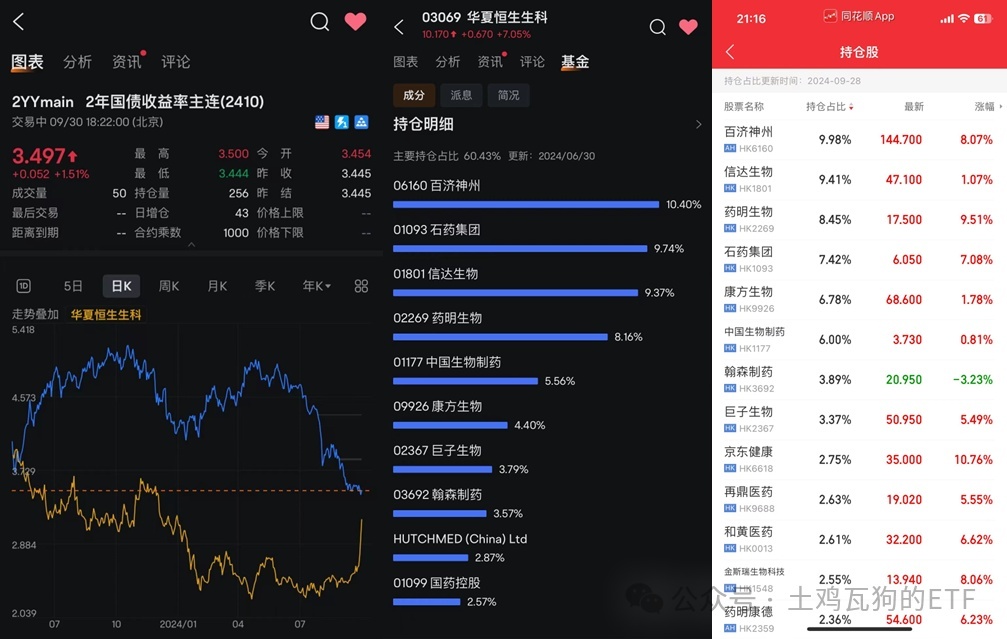
Data sources: Futu, THS, day trader's ETFs
2) Hang Seng Tech/Internet/China ADRs: Hang Seng Tech Index ETF 513180 (HK code 03088)+Hang Seng Internet ETF 513330$CAM HS TECH(03088.HK)
Most China ADRs follow domestic fundamentals—their customer base is local, just like A-shares.
Actually, Hang Seng Tech is equally Fed-rate-sensitive.
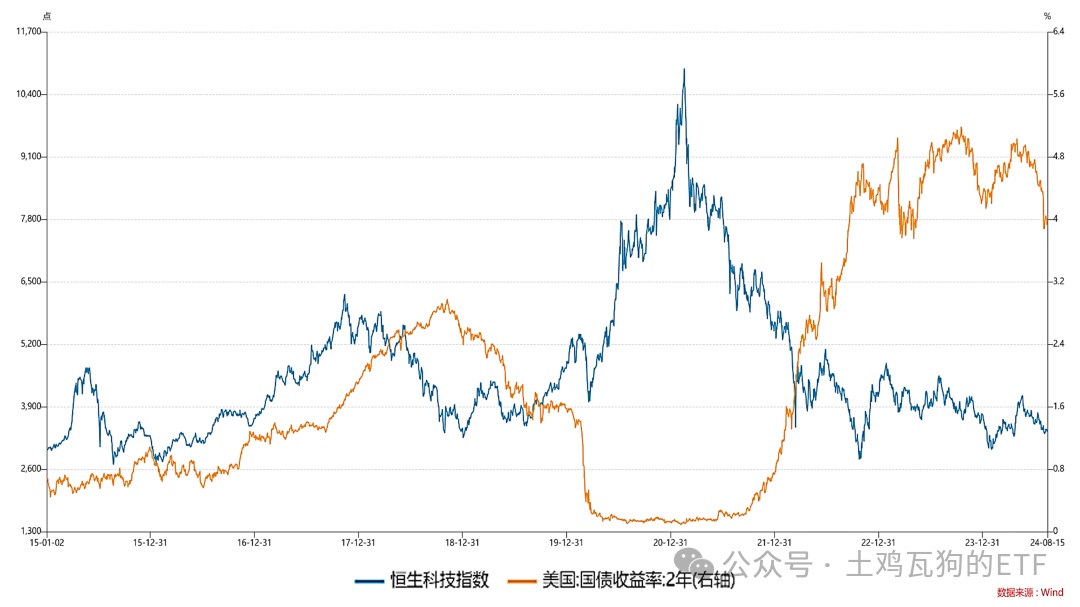
Data source: wind, day trader's ETFs
Theoretically, per Mundell's trilemma, Hong Kong pegged HKD to USD in 1983 (a linked exchange rate) to maintain its financial hub status—with free capital flow, HKMA must mirror Fed rates.
For heavyweights like Tencent and Alibaba, Q2 earnings weren't bad—valuation numerators are secure. With the PBOC's "policy combo" + upcoming fiscal measures improving domestic fundamentals, spring has arrived for China ADRs/H-shares.
The copyright of this article belongs to the original author/organization.
The views expressed herein are solely those of the author and do not reflect the stance of the platform. The content is intended for investment reference purposes only and shall not be considered as investment advice. Please contact us if you have any questions or suggestions regarding the content services provided by the platform.
