

 Rate Of Return
Two scenarios for trading with the trend by buying on pullbacks

" Once you can draw the trendline, it's time to go with the flow."
Today, the three major Hong Kong stock indices all rose, with the Hang Seng Index up 2.37%, the Hang Seng Tech Index HSTECH.HK up 3.07%, and the H-shares Index up 2.08%.
Recently, my second child, who is almost 100 days old, has become increasingly difficult to put to sleep. The previously effective methods suddenly stopped working for no apparent reason.
Only one specific way of holding and walking around can get them to sleep, but this is exhausting for mom, leaving me with very little personal time.
At this stage, family comes first, and taking care of the kids occupies almost all my time.
When it comes to investing and trading, I can only spare time to practice the first step: analysis—sorting out logical analytical thinking.
I organize clear response plans so that when I have time to trade in the future, I can apply them directly and practice execution and discipline.
01—Two Scenarios for Betting on the Trend After a Pullback Stabilizes
In the previous article, I wrote about how to respond to breakouts of trendlines at different rates—essentially, several scenarios for betting on trend reversals.
So, how do you go with the flow after a reversal? As shared before by Shanghai Twelve:
In a trending market, there are only two ways to enter a trade to go with the flow: chasing breakouts or waiting for pullbacks to stabilize/resistance bounces.
For traders who are afraid to chase highs, the only option is to participate in an uptrend by waiting for pullbacks to stabilize.
Today, let’s break down the two scenarios for betting on the trend after a pullback stabilizes:
1. Betting on a pullback stabilizing after a fresh reversal to confirm an uptrend.
To bet on the trend, you first need to identify it clearly. For a newly reversed trend, going with the flow means looking for opportunities to participate after breaking the trendline and surpassing the previous high (the criteria for a downtrend/consolidation reversing into an uptrend).
How to participate? After a high-volume breakout of the trendline and the previous high, patiently wait for a pullback to the previous high or even below it—but without making new lows—and enter when there are signs of stabilization and multi-timeframe confirmation to go long with the trend.
Strictly speaking, this scenario is about betting on the emergence of an uptrend after a reversal. Even though the trendline and previous high have been broken, there’s no higher low yet, so the trendline can’t be drawn. This means the market is still in consolidation, not yet an uptrend.
2. After drawing an uptrend line, start betting on trend continuation/acceleration.
This scenario occurs when the market follows the first case, with clear higher highs and higher lows, allowing an uptrend line to be drawn.
At this point, you can start betting on pullbacks to the uptrend line or even above it, looking for opportunities to go long with the trend.
A pullback to the uptrend line stabilizing is betting on trend continuation, while a pullback stabilizing above the trendline is betting on trend acceleration.
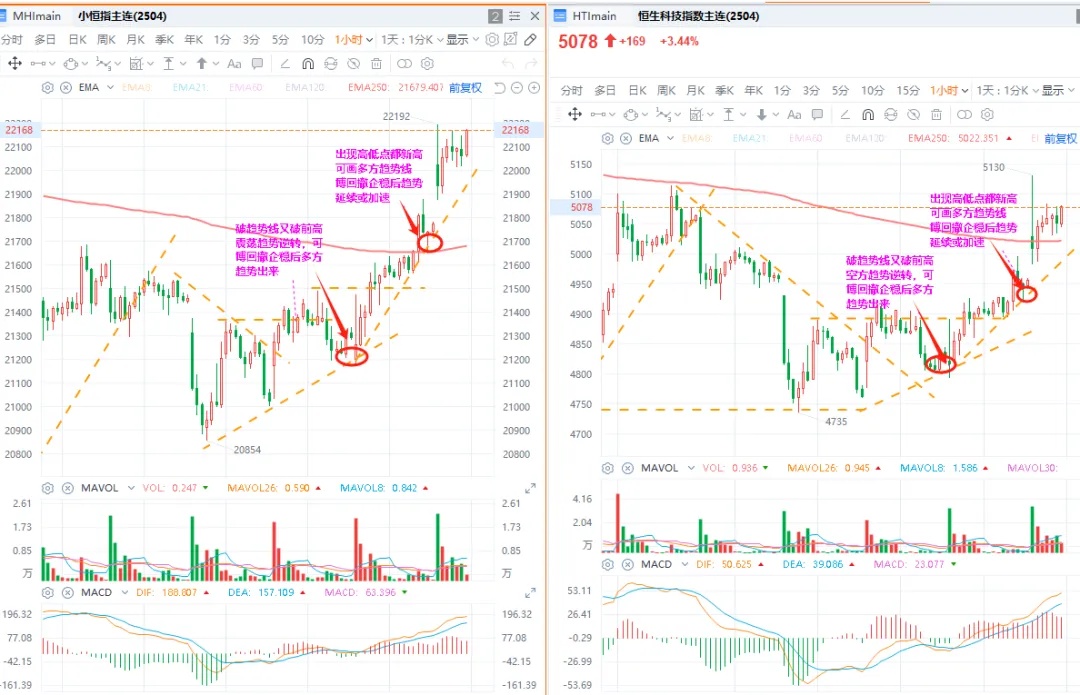
As shown in the screenshot, the Hang Seng Index and Hang Seng Tech Index recently presented entry opportunities matching these two scenarios on the 1-hour chart.
02—Weekly Market Review and Analysis
Next, let’s routinely analyze the three major indices I’m tracking: the FTSE China A50, the Hang Seng Index, and the Hang Seng Tech Index:
1. FTSE China A50 Index
Little has changed from last week, so the response remains the same. No need to repeat the analysis.
2. Hang Seng Index
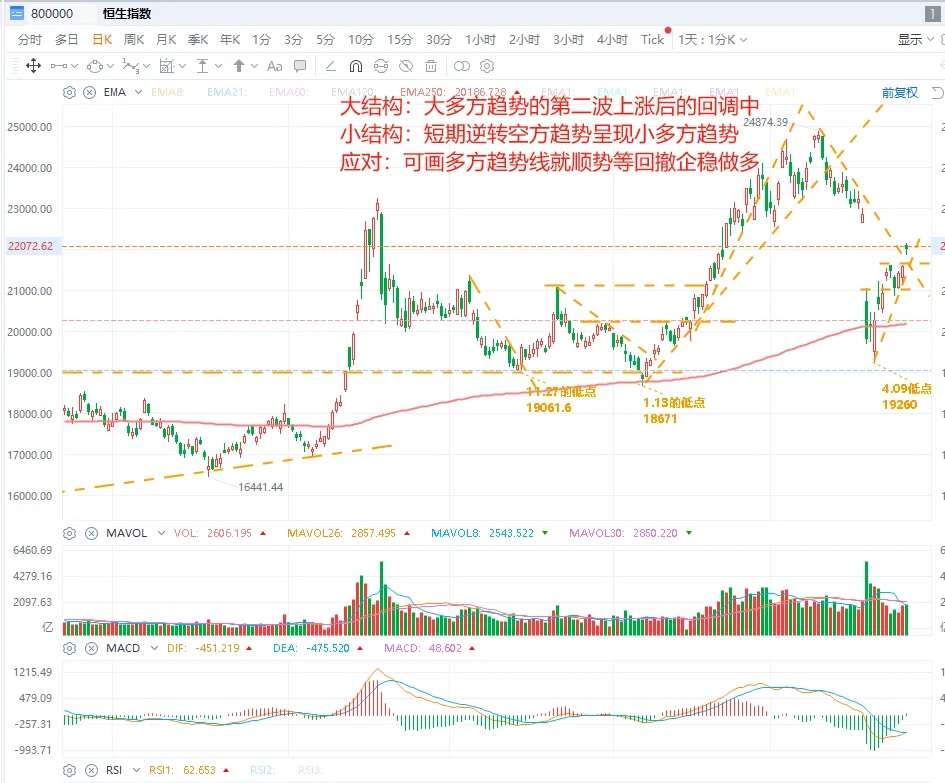
As seen in the screenshot, the Hang Seng Index’s broader structure remains in a pullback after the second wave of a major uptrend, as long as it doesn’t break below the January 13 low. On a smaller scale, if we treat the April 7 gap as the previous high, an uptrend line can already be drawn.
For swing traders, applying the trend-following plan above means: Once an uptrend line can be drawn, wait for pullbacks to stabilize and go long to bet on trend continuation/acceleration.
Also note that this is a case of just breaking a medium-speed downtrend line, so you can also bet on a second test of the previous low without making new lows, forming a bottoming pattern.
3. Hang Seng Tech Index
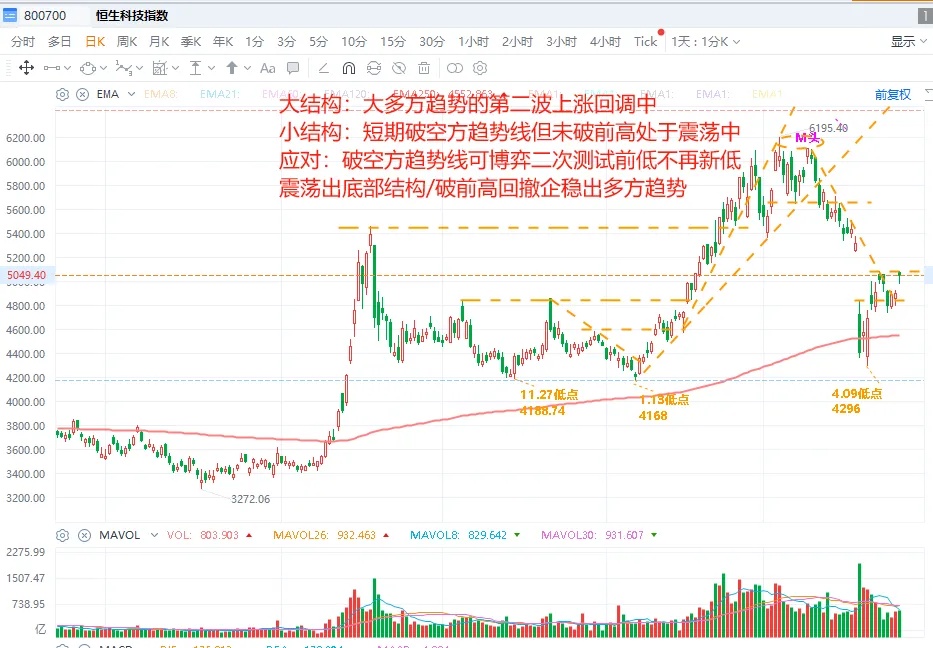
As seen in the screenshot, the Hang Seng Tech Index’s broader structure remains in a pullback after the second wave of a major uptrend, as long as it doesn’t break below the January 13 low. On a smaller scale, it’s currently in consolidation after breaking a downtrend line but not surpassing the previous high.
For daily swing traders, the response is: Since the downtrend line was just broken, you can bet on a second test of the previous low without making new lows, forming a bottoming pattern/breaking the previous high and then pulling back to stabilize, confirming an uptrend.
Not breaking the previous high shows weakness compared to the Hang Seng Index, so if going long, prioritize the Hang Seng Index, where a daily uptrend line can already be drawn.
Note: The above is purely my personal analysis as a swing trader. It may not be accurate or comprehensive, so please refer to it rationally.
I hope my sharing is helpful. See you in the next article.
Disclaimer: This article only shares my trading system philosophy and investment logic. It does not constitute any investment advice. If any stocks are mentioned, they are not recommendations. The stock market carries risks, so invest cautiously and refer rationally.
The copyright of this article belongs to the original author/organization.
The views expressed herein are solely those of the author and do not reflect the stance of the platform. The content is intended for investment reference purposes only and shall not be considered as investment advice. Please contact us if you have any questions or suggestions regarding the content services provided by the platform.
