

 Rate Of Return
Xiaomi's Q1 2025 Earnings Report Interpretation - The Strongest Quarterly Report in History, IOT Business Soars

Today, $XIAOMI-W(01810.HK) announced its Q1 2025 financial report. Since terms like "strongest in history" have already been used, this time we can only describe it as the "strongest of the strongest" quarterly report. Of course, Xiaomi is likely to continue breaking its own financial records in the future.
Regarding the financial report, due to the national subsidy in Q1 and the overwhelming orders for the SU7, the market had already fully anticipated that Xiaomi's financial data would be impressive. However, the results still exceeded expectations, with revenue surpassing market expectations by 2 billion and net profit exceeding expectations by 1.5 billion. From the financial data alone, this is truly explosive! This article was written on a plane today, so please forgive any oversights!
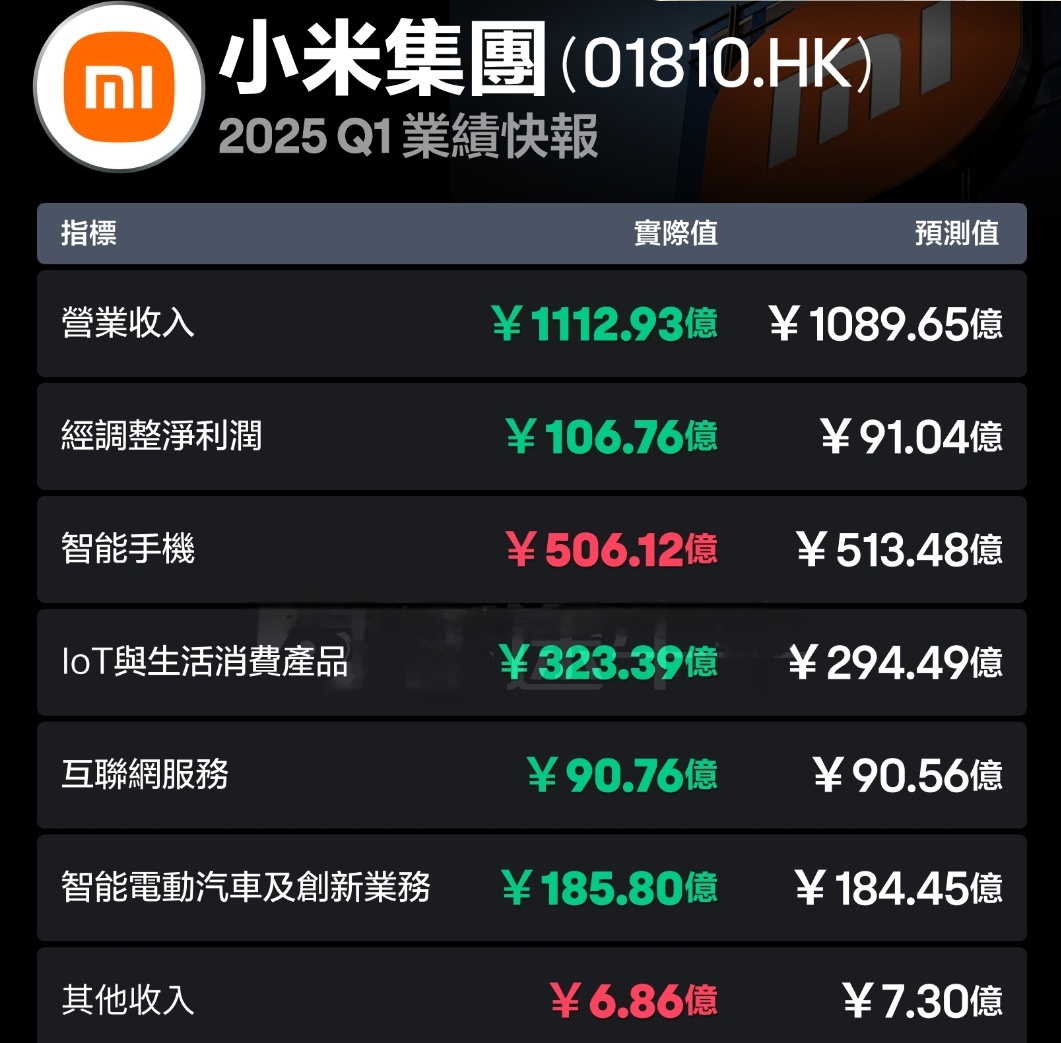
Xiaomi's financial report has been analyzed many times, and the core views remain unchanged: the certainty of the electric vehicle business is increasing, the smartphone business has made significant progress under the leadership of high-end models, and for the first time in recent years, it has topped the domestic sales charts in a single quarter. The IOT segment has grown far beyond expectations, with major appliances and tablets showing notable growth. There have been too many interpretations of Xiaomi's financial reports, and many views remain unchanged. Here are the key points:
1.Total revenue continued to break the 100-billion-yuan mark, with a growth rate of 47%. Traditional business grew by 22.1%, IOT by 58%, smartphones by 8.9%, and internet services by 12%. Objectively speaking, this growth rate is already the highest among Chinese tech giants. Previously, Pinduoduo's growth was explosive, but judging from its latest financial report, its growth rate is now far behind Xiaomi's. A company with quarterly revenue exceeding 100 billion yuan and a growth rate of over 40%—Xiaomi is likely the only one. That influencer who constantly criticizes Xiaomi probably doesn't understand math and is no longer in the same league as Xiaomi.
2. Adjusted net profit for the quarter grew by 10.68 billion yuan, with electric vehicles losing 500 million yuan, meaning traditional business net profit reached 11.18 billion yuan. Electric vehicles may turn a profit in Q2. Those who criticized Xiaomi for low profits can now be quiet. With quarterly net profit of 11.18 billion yuan from traditional business, annual net profit could reach nearly 40 billion yuan. At a P/E ratio of 25, the traditional business alone is worth 1 trillion yuan. Adding the promising electric vehicle business, is Xiaomi's market cap of 1.5 trillion yuan overvalued?
3. The gross margin for the electric vehicle business in Q1 was 23.2%, with quarterly revenue of 18.1 billion yuan. Losses in Q1 narrowed to 500 million yuan. With the delivery of the SU7 Ultra in Q2, the gross margin is likely to improve further, and profitability is within reach. This is a miracle among new energy vehicle startups. The 2025 delivery target has been raised to 350,000 units, compared to 136,000 last year. The average selling price (ASP) will also increase, and electric vehicles are expected to generate over 80 billion yuan in revenue this year, solidifying their position as the second growth curve.
4. The IOT business performed exceptionally well, with revenue growth exceeding 50% for consecutive quarters, especially in major appliances. Faced with Xiaomi's air conditioners, Trudy Dai has completely abandoned her image and is desperately criticizing Lei Jun.
5. The smartphone business grew relatively slowly at 8.9% this quarter, but driven by the SU7, Xiaomi has gradually gained a foothold in the domestic high-end market and topped the sales charts for the first time in years. So, Xiaomi's smartphone performance is also commendable!
6. Of course, we must mention the recent public opinion incident involving the Xiaomi SU7, which did have some impact on orders. However, I believe this is an inevitable part of a company's growth—success doesn't come easily. Especially in China's business environment, even Li Auto experienced at least two similar incidents before emerging stronger. In the short term, these events may have a significant impact on Xiaomi, but over 5 or 10 years, they will be mere ripples. To quote the core idea from "Antifragile": What doesn't kill me makes me stronger. As investors, we should focus more on business performance data and not be overly distracted by noise.
7. Xiaomi's stock price has now reached a new high of 50 HKD, with a market cap approaching 1.5 trillion yuan. Many question whether Xiaomi is worth this valuation, which is a normal reaction. In a previous article, I projected that based on 2025 performance, 57 HKD is indeed not cheap. But looking ahead to 2026, with 1 trillion yuan from traditional business and 500 billion yuan from electric vehicles, the valuation seems reasonable. For details, refer to my earlier article Is Xiaomi Worth 1 Trillion?—Xiaomi Valuation Analysis. Whether it's expensive depends on how far you look. Personally, I've held Xiaomi for nearly 5 years with a cost basis of 12.5 HKD. I sold 1/3 at my first target of 37.5 HKD and another 1/3 at around 52 HKD, leaving me with 1/3 remaining.
I. Overall Financial Data: Quarterly Revenue Exceeds 100 Billion Yuan
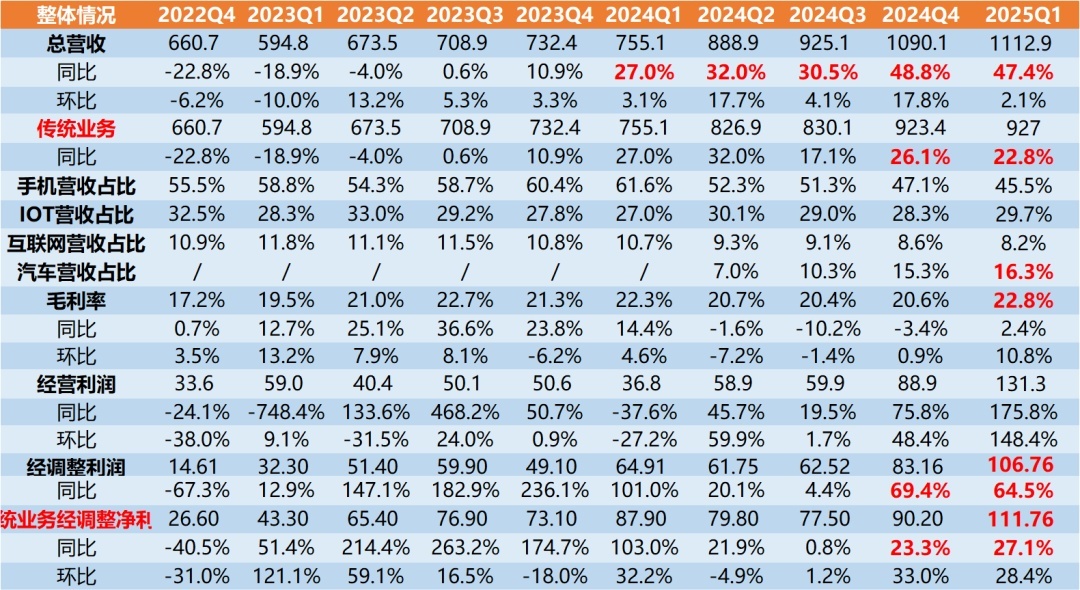
1.Revenue: Xiaomi's Q1 revenue reached 111.29 billion yuan, up 47.4% year-over-year, marking the fifth consecutive quarter with growth exceeding 27%. Traditional smartphone + AIOT + internet services grew by 22.8%, while the electric vehicle business contributed 18.1 billion yuan in revenue, becoming a stable second growth curve. Even excluding the electric vehicle business, this growth rate is among the highest for Chinese tech stocks.
Smartphone revenue was 50.61 billion yuan, up 8.9%, accounting for 45.5% of total revenue.
AIOT revenue was 32.34 billion yuan, up 58.9%, accounting for 29.7% of total revenue.
Internet services revenue was 9.08 billion yuan, up 12.8%, accounting for 8.2% of total revenue.
Electric vehicle revenue was 18.1 billion yuan, accounting for 16.3% of total revenue.
2.Adjusted Net Profit: Adjusted net profit was 10.68 billion yuan, with electric vehicles losing 500 million yuan, up 64.5% year-over-year.
3.Gross Margin: Xiaomi's overall gross margin in Q1 was 22.8%, up 0.5% year-over-year.
Key financial data are as follows:
II. Electric Vehicle Business: Gross Margin Reaches 23.2%
The electric vehicle business generated 18.1 billion yuan in revenue in Q1, with a gross margin of 23.2% and losses of only 500 million yuan. This performance is remarkable for a company that has been making cars for just over three years. It's a miracle among new energy vehicle startups. The 2025 delivery target is 350,000 units. In Q1, Xiaomi's average selling price (ASP) per vehicle was 238,569 yuan. The SU7 Ultra in Q2 and the YU7 in Q3 will further boost the ASP, making 80 billion yuan in annual revenue achievable.
The success of the SU7 exceeded 99% of people's expectations, including Lei Jun's own. The SU7 deserves at least 99 points. For a newcomer like Xiaomi, this achievement is nothing short of a miracle. The SU7 Ultra is priced at over 500,000 yuan, and Xiaomi's electric vehicle business may turn profitable in Q2. Of course, the recent public opinion incident has had some impact, but as mentioned earlier, this is part of the growth process. As investors, we should focus on business performance, such as SU7 sales and upcoming YU7 sales. If the 350,000-unit target is met, annual revenue will exceed 80 billion yuan. At this growth rate, Xiaomi could soon replicate its success in another sector!
III. Smartphone Business Performance: Ranked No. 1 in Domestic Market
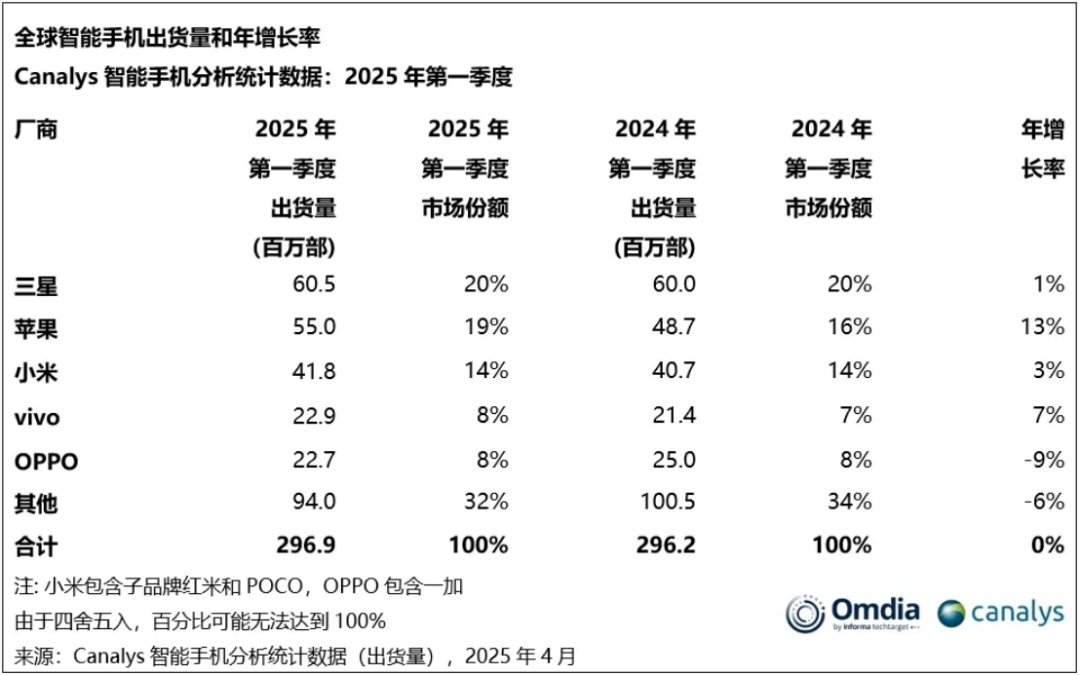
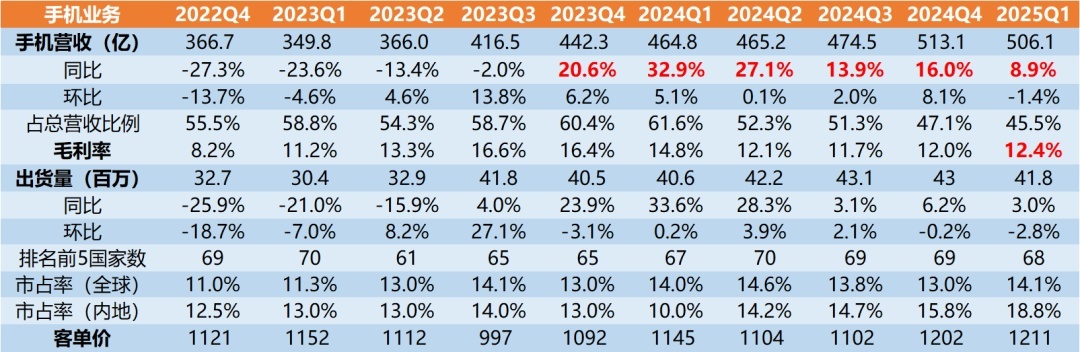
The smartphone business is relatively straightforward, as the industry has stabilized with no new entrants and few exits. Growth is limited. According to Canalys, Xiaomi ranked third globally in Q1. Smartphone revenue this quarter was 50.61 billion yuan, up 8.9%. The ASP was 1,211 yuan, thanks to the performance of high-end models.
Global smartphone market performance in Q1 is shown below:
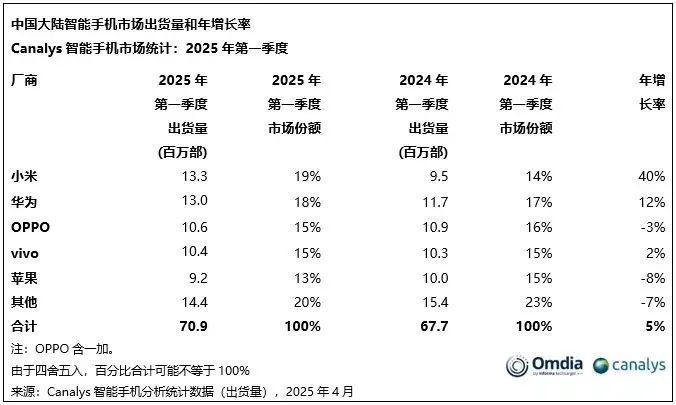
In the domestic market, Xiaomi performed exceptionally well in Q1, overtaking competitors to rank first with 40% growth. This is the first time in years that Xiaomi has topped the domestic sales charts! This success is attributed to the improving reputation of its flagship models, the boost from the SU7, and the national subsidy. Key data for Xiaomi's high-end smartphones:
1) In Q1 2025, high-end smartphones accounted for 25% of total domestic smartphone shipments, up 3.3 percentage points year-over-year.
2) In the 4,000–5,000 yuan price segment, Xiaomi ranked first with a 24.4% market share, up 4.6 percentage points year-over-year.
3) In the 4,000+ yuan price segment, Xiaomi's market share was 9.6%, up 2.9 percentage points year-over-year.
Domestic smartphone market performance in Q1 is shown below:
Xiaomi smartphone business data:
IV. IOT Business Performance: Surges 51.7%
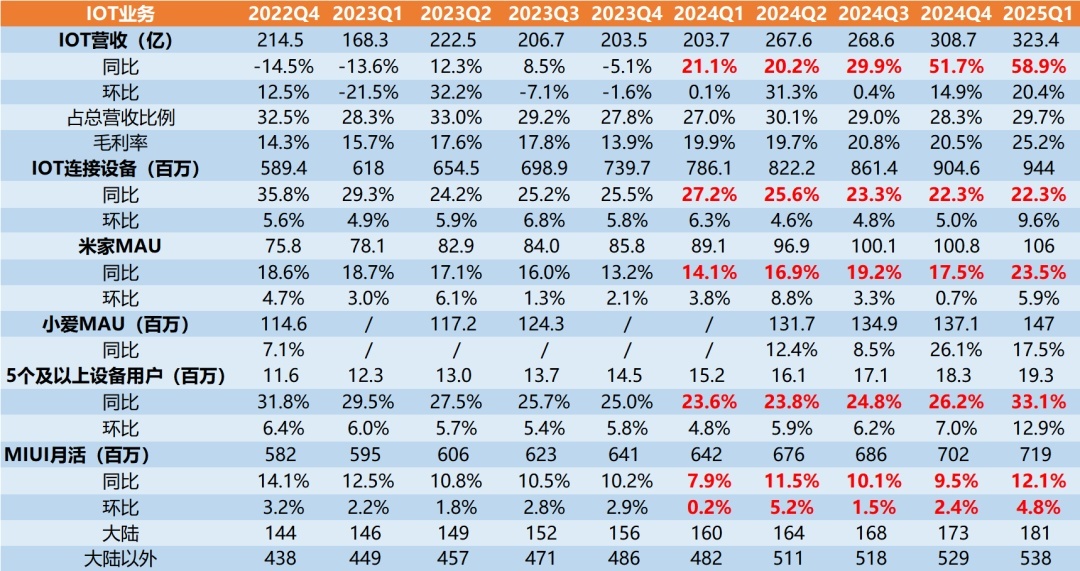
IOT revenue this quarter totaled 32.43 billion yuan, up 58.9% year-over-year, marking the fifth consecutive quarter with growth exceeding 20%. Revenue hit a record high, driven by the national subsidy, especially in major appliances. Smart major revenue grew by 113.8%, leaving Trudy Dai scrambling. Key data for smart major appliances in Q1:
1) Air conditioner shipments exceeded 1.1 million units, up over 65% year-over-year.
2) Refrigerator shipments exceeded 880,000 units, up over 65% year-over-year.
3) Washing machine shipments exceeded 740,000 units, up over 100% year-over-year.
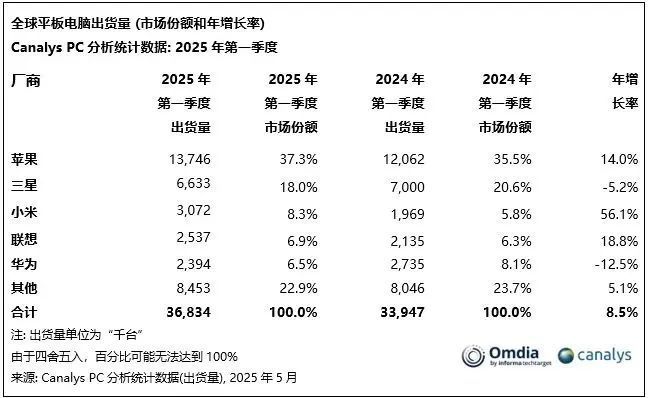
Tablets and wearables also performed well. See the data below:
AIOT business data:
V. Internet Business:
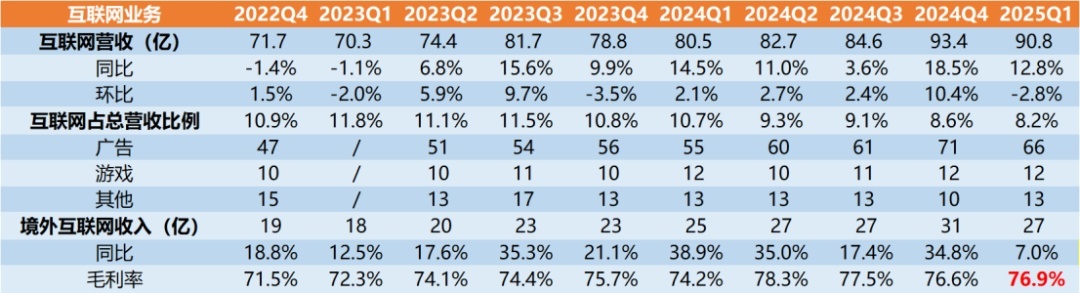
Internet services revenue in Q1 2025 was 9.08 billion yuan, up 12.8% year-over-year, with a gross margin of 76.9%. Growth slowed this quarter, as this segment depends on hardware sales. Although internet services account for a small portion of revenue, they are highly profitable and a major source of Xiaomi's earnings. As smartphone and electric vehicle sales grow, this segment has further potential!
Xiaomi internet business data:
Previous Xiaomi financial report analyses:
Xiaomi Q4 2024 Financial Report Analysis—The Strongest Ever, Traditional and New Businesses Soar
Is Xiaomi Worth 1 Trillion?—Xiaomi Valuation Analysis
Xiaomi Q2 2024 Financial Report Analysis—"The Most Outstanding Quarterly Report in History"
Xiaomi Q3 2023 Financial Report Analysis—Smartphones Recover, Electric Vehicles Arrive
Xiaomi Q2 2023 Financial Report Analysis—Net Profit Soars, but Hope Lies in Xiaomi Cars
Xiaomi Q1 2023 Financial Report Analysis—Results Exceed Market Expectations, but Challenges Remain
Xiaomi Q4 2022 Financial Report Analysis—Waiting for a Turnaround
Xiaomi Q3 2022 Financial Report Analysis—Expected Decline, Looking for a Rebound
The copyright of this article belongs to the original author/organization.
The views expressed herein are solely those of the author and do not reflect the stance of the platform. The content is intended for investment reference purposes only and shall not be considered as investment advice. Please contact us if you have any questions or suggestions regarding the content services provided by the platform.
